
IPO disclosure quality is the degree to which a registration statement and prospectus are specific, balanced, complete and verifiable, and the degree to which the narrative they establish can later be matched against delivery. It is assessed by reading the latest Form S-1 as a legal disclosure document rather than a marketing document, testing each section against defined criteria, and then tracking every quantified promise into the first periodic reports, earnings calls and proxy statements. The aspiration-to-execution gap that opens after listing is the most reliable evidence of how good the original disclosure was, and measuring it systematically, from public records alone, is the purpose of the Lacuna Index methodology.
TL;DR
- The operative document is the most recent amendment of the registration statement (typically Form S-1) on EDGAR, because the prospectus can be revised during registration.
- Quality is testable: risk factors should name one risk per heading, explain why it applies to the issuer and state its extent plainly; summaries should be balanced; MD&A should explain trends and changes in results.
- SEC review and effectiveness are not approval and do not guarantee complete or accurate disclosure, so the reader carries the verification burden.
- The strongest test is longitudinal: each IPO-era claim is traced into post-listing filings and scored for delivery.
- Sector-level benchmarks are free on Lacuna Index; company-level forensic analysis is a subscription product.
Table of Contents
- 1. What disclosure quality means in an IPO
- 2. Which U.S. documents to read
- 3. Testing risk factors
- 4. Testing MD&A and the summary
- 5. Comparing claims across documents
- 6. What disclosure quality can and cannot establish
- 7. From filing quality to delivery: the longitudinal test
- 8. Applying the method with Lacuna Index
- 9. Our perspective
- FAQ
- Sources
1. What disclosure quality means in an IPO
An IPO is the first occasion on which the market prices a company on the issuer's own account of itself. No trading history, no prior earnings-call record and no analyst consensus anchored to reported results exist to discipline that account. The prospectus therefore carries more informational weight than any later filing, and weaknesses in it are priced into the offering rather than corrected by it.
Four properties define quality in practice:
- Specificity. Statements tie to the issuer's own facts, customers, contracts, markets and figures, not to formulations that could appear in any prospectus.
- Balance. Positive and negative aspects receive comparable treatment in the summary and the narrative sections, so the document does not merely restate favorable material.
- Completeness. Trends, uncertainties, related-person transactions, dilution and use of proceeds are all addressed where an investor would look for them.
- Verifiability. Each material claim can be checked against financial statements and notes, exhibits, subsequent amendments or an independent source.
The SEC's own framing supports this approach. The Division of Corporation Finance has described its IPO filing review as focused on apparent conflicts with SEC rules or accounting standards and on disclosures that appear materially deficient in explanation or clarity. Disclosure quality is, in that sense, a question of explanation and clarity rather than of mere presence of required items.
2. Which U.S. documents to read
The SEC's Investor.gov bulletin on IPOs, updated on October 14, 2022, identifies Form S-1 as the typical IPO registration statement, with the prospectus describing the issuer, the terms of the offering and the information relevant to an investment decision. The same bulletin advises reading the latest version of the registration statement, since the prospectus may be revised during the registration process, and notes that filings can be retrieved from EDGAR.
A working read order for an analyst or journalist:
| Section | What to extract | Quality question |
|---|---|---|
| Prospectus summary | Headline claims, metrics, market size | Is the summary balanced, or does it only restate favorable material? |
| Risk factors | Named risks and their stated extent | Does each risk connect to this issuer's circumstances? |
| Use of proceeds | Allocation of offering proceeds | Is the allocation specific enough to be tested later? |
| Dilution | Effect on new purchasers | Is the arithmetic transparent? |
| MD&A | Trends, drivers, liquidity | Do explanations account for changes in results? |
| Business and management | Strategy, customers, compensation, related-person transactions | Are strategic claims quantified or only asserted? |
| Legal proceedings | Pending matters | Is exposure described plainly? |
| Financial statements and notes | Accounting policies, segment data, non-GAAP reconciliations | Do the notes corroborate the narrative? |
Each amendment (S-1/A) should be compared against its predecessor. Changes between amendments often show which statements the issuer had to clarify, qualify or remove after staff comments, and these are informative about the original draft's quality.
3. Testing risk factors
The SEC staff's observations on smaller-company IPO filings give an unusually clear standard. Each risk factor should identify one risk per heading, explain specifically why the risk applies to the company, and avoid generic formulations that do not help investors understand it. Disclosure of the extent of each risk should be plain and direct, and mitigating language is generally to be avoided.
These criteria convert into a repeatable screen:
- Heading test. Does the heading bundle several risks, or is it confined to one?
- Applicability test. Does the body text name the issuer's own contracts, products, jurisdictions or counterparties?
- Magnitude test. Is the extent stated, in dollars, percentages or customer concentration, rather than implied?
- Mitigation test. Does the paragraph soften the risk with reassurance in the same breath?
- Boilerplate test. Would the paragraph survive unchanged in an unrelated issuer's prospectus?
The same discipline applies to the way an issuer treats reputational exposure and its response. A reputation risk mitigation guide illustrates why a stated risk is most useful to investors when it is tied to the circumstances of the specific organization rather than expressed in general terms.
4. Testing MD&A and the summary
The staff observations also state what good management's discussion looks like: it addresses material trends and explains changes in results, not simply restating numbers visible in the financial statements. A useful MD&A reading procedure has three steps.
- Identify each reported change in revenue, margin, cash flow and liquidity between periods.
- Locate the stated cause and ask whether it is quantified. "Higher volume" differs from a decomposition of volume, price and mix.
- Check for omitted trends. If a customer cohort, a contract renewal or a cost input features in the business section but not in MD&A, the omission is a quality signal.
The prospectus summary receives the same scrutiny. The staff's position is that a summary should be balanced, covering positive and negative aspects rather than merely repeating material found elsewhere in a long document. A summary that lists strengths in the first pages and defers weaknesses to the risk section fails the balance criterion, even where every individual statement is accurate.
5. Comparing claims across documents
The central analytic move is cross-document reconciliation. A claim made in the S-1 should be traceable to at least one corroborating location: a financial statement note, an exhibit, a related-person disclosure, a later amendment. Equally, a claim in the roadshow narrative, a press release or an early earnings call should be matched to the registration statement. Divergences fall into three categories:
- Amplification: a qualified statement in the prospectus becomes unqualified in public communications.
- Omission: a metric highlighted publicly is absent from, or defined differently in, the filing.
- Drift: a quantified commitment is restated in softer terms in successive periodic reports.
The method for tracking these across filings is set out in the Lacuna Index guide to monitoring disclosure consistency across filings, and the logic of treating divergence as investable evidence is developed in the analysis of the public disclosure gap. Related-person transactions deserve separate treatment, since their description in an S-1 frequently determines how later governance questions are framed; the related party disclosure analysis sets out a forensic method for SEC filings. Where the issue is selective communication to particular audiences around the offering period, the Reg FD implications piece covers detection.
Evidence handling matters for journalists and advisors. Every finding should cite the specific filing, amendment and page, a practice described in the guide to citing public filings in research.
6. What disclosure quality can and cannot establish
A clean prospectus does not certify a company. The Investor.gov bulletin cautions that staff review and effectiveness do not amount to approval of an IPO, do not assess its investment merits and do not guarantee complete or accurate disclosure. Testimony from the Division of Corporation Finance before the House Financial Services Subcommittee in July 2023 adds that staff comments are specific to a company's facts and are not generally applicable rules, and that responsibility for filings rests with the company and others involved in preparing them.

The Securities Act itself sets a floor rather than a ceiling. Section 8(b), in the GovInfo compilation amended through July 18, 2025, permits the SEC to refuse effectiveness where a registration statement appears materially incomplete or inaccurate on its face. A document can clear that threshold and still be generic, unbalanced or difficult to test.
Three boundaries follow for any reader using disclosure quality as an input:
- It is evidence, not a verdict on legality. Weak disclosure is a signal for further review. Conclusions about violations belong to regulators, courts and counsel.
- It is not a valuation. A well-written prospectus can describe an overpriced business, and a thin one can describe a sound one.
- It is strongest in combination. Quality at filing, plus delivery afterward, plus governance indicators, gives a more reliable reading than any single measure. The governance red flags guide and the regulatory oversight gaps guide address the second and third layers.
Foreign private issuers follow a different disclosure regime from domestic filers, with certain exemptions from registration and reporting requirements. Readers assessing such an issuer should confirm which form and which exemptions apply on EDGAR before applying the domestic-filer criteria above.
7. From filing quality to delivery: the longitudinal test
The criteria above grade a document at a point in time. They cannot show whether the narrative was earned. That requires following the quantified promises forward: targets for margins, customer growth, capital allocation, governance commitments and use of proceeds, each matched to what subsequent filings, calls and proxy statements record.
A practical protocol for a research team:
- Extract every quantified or time-bound claim from the S-1 and the offering-period communications, with its location.
- Classify each as verifiable, partially verifiable or unfalsifiable. Unfalsifiable claims lower the quality score at the outset.
- Track each verifiable claim through the first four quarterly reports and the first proxy statement.
- Score delivery against the stated claim, recording the evidence for each score.
- Benchmark the result against the issuer's sector, so that an industry-wide pattern is not mistaken for company-specific behavior.
The litigation dimension is covered in the guidance on reducing litigation risk in disclosures, and the broader regulatory framing in the public company transparency assessment guide.
8. Applying the method with Lacuna Index
Lacuna Index applies this logic to public companies using public records only: earnings calls, SEC filings, press releases, proxy statements and public statements. The platform measures the gap between narrative claims and actual delivery, produces execution scores, and classifies companies into archetypes such as earned, borrowed or undervalued according to performance and valuation metrics. Scoring is audit-traceable, and governance logs are published for all scoring, so a reviewer can follow any score back to its evidence.
Sector benchmarks are free, and the methodology walkthrough shows how scores are constructed. For readers who need company-level forensic reports, Per-company analysis provides gated access, and the Cohort Pulse and Sector Sweep plans are described on the pricing page.
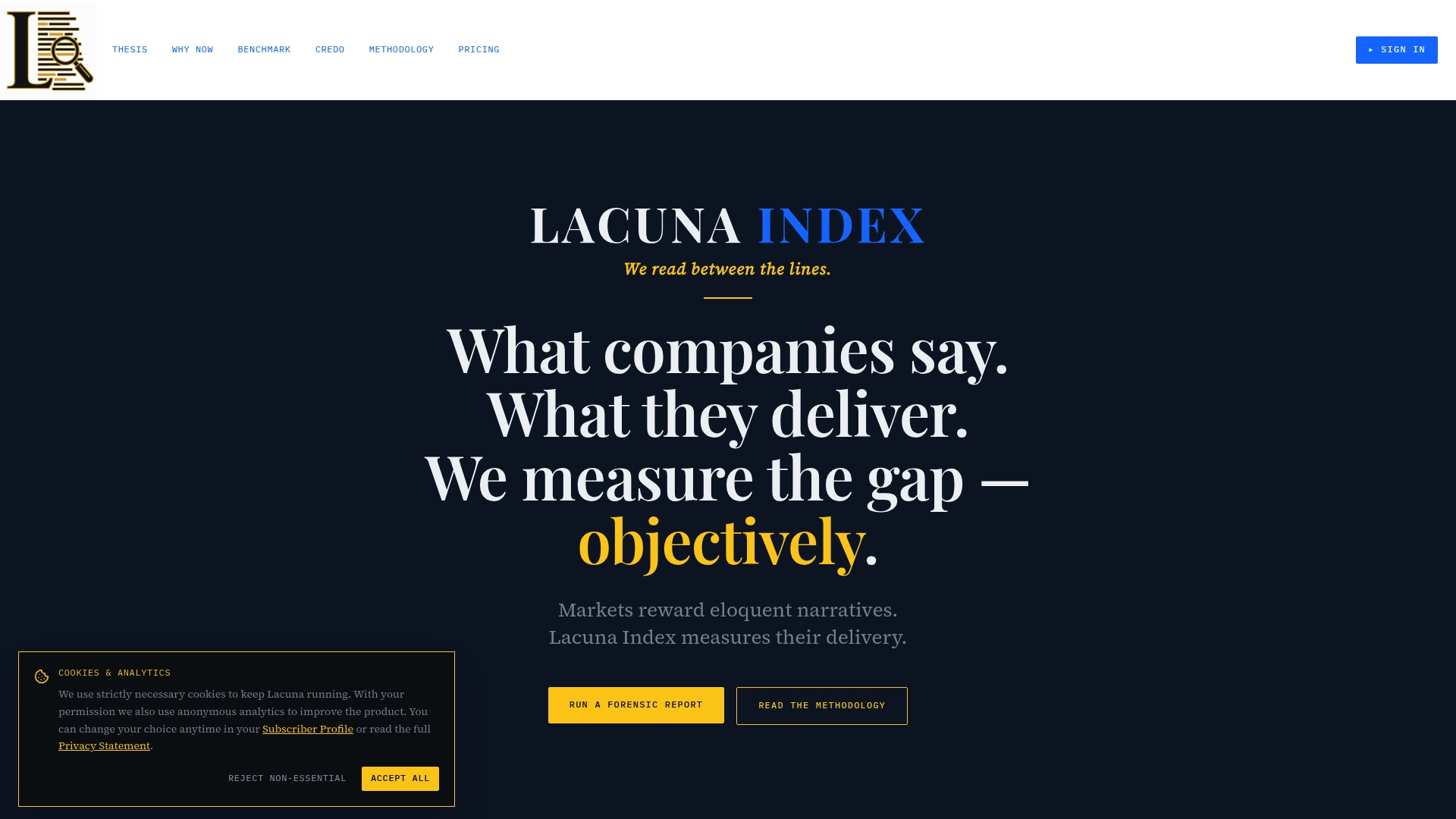
Sector benchmarks for Financials, Health Care, Industrials and Consumer Staples offer a starting reference for comparing a newly listed issuer's claims with its peers.
9. Our perspective
The IPO prospectus is the one document in a company's life in which the narrative is written under the heaviest legal discipline and the least market feedback. That combination is why we treat it as the baseline against which everything afterward is measured.
Our position is that disclosure quality cannot be judged from the page alone. A well-drafted risk factor and a balanced summary are necessary, but the decisive evidence is whether the company later delivers what it said. That is why the Lacuna methodology standardizes its process across all covered companies, relies only on public records and publishes governance logs for its scoring: comparability and auditability are what turn a reading of disclosure into a measurement.
The questions an issuer was never asked, and the claims engineered to be unfalsifiable, are as informative as the claims that were made. A systematic, evidence-citing approach exposes both, and it gives institutional investors, governance advocates, proxy advisors and journalists a shared factual basis for their conclusions.
Glen
FAQ
Which filing should be read first for an IPO?
The latest version of the registration statement, typically Form S-1, retrieved from EDGAR. The prospectus can be revised during registration, so earlier drafts may not reflect the final terms. Comparing amendments shows what changed after staff comments.
Does SEC review mean the disclosure is accurate?
No. According to the SEC's Investor.gov bulletin, review and effectiveness are not approval of the offering and do not guarantee complete or accurate disclosure. Responsibility for the content rests with the company and others involved in preparing the filing.
What are the clearest signs of weak risk factor disclosure?
Headings that combine several risks, paragraphs that could appear unchanged in another issuer's prospectus, and extent left unstated or softened with mitigating language. The SEC staff's observations call for one risk per heading, a specific explanation of why it applies and plain statement of its extent.
How can disclosure quality be turned into a comparable measure?
By extracting each quantified claim, classifying how testable it is, and scoring delivery against it in later filings, then benchmarking within the sector. Lacuna Index applies this process consistently across covered companies, with audit-traceable scores.
Sources
- SEC Investor.gov: Updated Investor Bulletin on Investing in an IPO (October 14, 2022)
- SEC Division of Corporation Finance: Staff Observations in the Review of Smaller Reporting Company IPO Registration Statements
- GovInfo: Securities Act of 1933, compilation amended through July 18, 2025
- Testimony on Oversight of the SEC's Division of Corporation Finance, House Financial Services Subcommittee, July 18, 2023