
Validating corporate claims in public disclosures is the process of confirming the accuracy of corporate statements by cross-referencing official SEC filings, registration records, and structured financial data. Institutional investors and governance analysts call this practice disclosure forensics. The core challenge is that corporate narratives are crafted to persuade, while the underlying financial notes, XBRL data, and registration documents tell a different story. SEC EDGAR, corporate registries, and historical datasets covering decades of filings give analysts the raw material to test every claim. Lacunaindex applies this methodology systematically, measuring the gap between what companies say and what the filings actually show.
What official public data sources should you use to validate corporate disclosures?
The most reliable sources for disclosure validation are SEC EDGAR filings, state corporate registries, and structured XBRL financial data. Each source serves a distinct verification function, and no single source is sufficient on its own.
SEC EDGAR filings form the backbone of any validation workflow:
- 10-K (annual report): Contains audited financial statements, risk factors, and management discussion. This is the primary document for testing margin, liquidity, and capital allocation claims.
- 10-Q (quarterly report): Provides unaudited interim financials. Useful for tracking intra-year deviations from annual guidance.
- 8-K (current report): Discloses material events such as executive changes, acquisitions, or earnings releases. Cross-referencing 8-K dates against price movements reveals whether disclosures were timely.
- DEF 14A (proxy statement): Contains executive compensation, board composition, and shareholder vote outcomes. Governance analysts use this to assess pay-for-performance alignment.
XBRL financial data is the structured layer beneath these filings. Automated EDGAR readers parse 10-K and 10-Q filings at scale, extracting tagged financial facts without manual transcription. That extraction speed matters because it allows analysts to compare hundreds of filings in the time it would take to read one.
Corporate registration records serve a separate but equally critical function. State secretaries of state, the Delaware Division of Corporations, and equivalent bodies in other jurisdictions maintain incorporation documents, bylaws, and entity status labels. These records confirm whether a company is legally authorized to operate and enter contracts.
| Source | Primary Use | Key Data Points |
|---|---|---|
| SEC EDGAR 10-K/10-Q | Financial claim validation | Revenue, margins, debt, cash flow |
| SEC EDGAR 8-K | Event timing verification | Material event dates, press release alignment |
| XBRL structured data | Automated metric extraction | Tagged financial facts, period comparisons |
| State corporate registries | Entity status confirmation | Active/dissolved status, authorized signatories |
| DEF 14A proxy statements | Governance claim validation | Board composition, executive pay ratios |
Shareholder registries and labor disclosures add a third layer. Form 4 filings record insider transactions in near real time. EEO-1 reports and sustainability disclosures, where filed, allow analysts to test workforce and environmental claims against stated commitments.
How to systematically verify corporate entity authenticity through public records
Entity verification is the foundation of any disclosure review. A company may file accurate financials while operating through an entity structure that obscures true ownership or limits legal authority.
The verification process follows a defined sequence:
- Confirm incorporation status. Pull the entity's registration from its claimed jurisdiction. Registry status labels such as "active," "delinquent," "struck off," and "dissolved" carry materially different legal implications. A delinquent entity may lack authority to bind counterparties.
- Obtain core formation documents. Articles of incorporation establish the entity's legal existence. Bylaws define governance authority. Board resolutions authorize specific transactions. All three must align with the claims being tested.
- Verify tax identification. The EIN (Employer Identification Number) should match across SEC filings, state registrations, and any contractual documents. Mismatches signal either clerical error or deliberate obfuscation.
- Map the ownership structure. Corporate identity verification requires mapping legal authority across multiple entities and jurisdictions. A parent company's financial claims may not apply to the subsidiary actually executing the contract.
- Confirm signatory authority. Board resolutions and officer certificates identify who is authorized to sign on the entity's behalf. Cross-reference these against SEC filings that list executive officers.
- Check for name conflicts. Multiple entities with similar names registered in different states create confusion. Always verify the full legal name, jurisdiction, and formation date together.
Pro Tip: Build an escalation trigger list before starting any entity review. Flag any discrepancy between the operating entity named in contracts and the registrant named in SEC filings. That gap is a common entry point for fraud.
The most frequent error in entity verification is treating a registry name check as sufficient. Verification must map authority to actual signers, ownership chains, and operating entities. A company can be "active" in a registry while the specific subsidiary executing a transaction is dissolved or unauthorized.

How to analyze financial claims using automated tools and filing metadata
Financial claim validation moves fastest when analysts use structured data rather than narrative text. The XBRL tagging system, mandated by the SEC for most public filers, converts financial statements into machine-readable facts. That structure enables automated comparison across periods and peers.
The core workflow for analyzing financial claims includes:
- Extract XBRL facts for target metrics. Revenue, gross margin, operating cash flow, and debt levels are all tagged. Pull the current period value and the prior three to five periods to establish a baseline.
- Run delta analysis. Effective validation tracks deltas between filings rather than reviewing entire reports. A 400 basis point margin expansion between two quarters warrants a line-by-line review of cost of goods sold and operating expense notes.
- Flag share authorization changes. Abnormal increases in authorized share counts or new share classes disclosed in 10-K amendments are high-risk signals. Automated EDGAR processing flags these dilution events without manual review.
- Benchmark against historical data. Analysts can validate stock claims against 64 years of historical data covering nearly 9,900 US-listed stocks. That depth allows peer benchmarking across full market cycles, not just recent quarters.
- Apply claim validation meta-tools. Structural fact-checking tools cross-check plain-English numeric claims against SEC XBRL data, outputting verdicts such as "confirmed" or "refuted." This reduces the risk of accepting a management claim that has no filing-level support.
Pro Tip: Pair every management claim about margins, liquidity, or capital allocation with a specific note reference from the filing. If the claim cannot be traced to a numbered note or XBRL tag, treat it as unverified until you find the supporting data.
Management disclosures should be treated as testable claims, not narratives. Each assertion about revenue growth, cost reduction, or market share requires a corresponding data point from the financial statements or footnotes. Analysts who skip this pairing step accept the narrative at face value, which is precisely the condition that allows mispriced securities to persist.
Common mistakes when assessing public disclosures and how to avoid them
Governance analysts encounter a consistent set of errors when they investigate corporate claims in public filings. Recognizing these patterns in advance reduces both false positives and missed signals.
- Misidentifying the operating entity. The SEC registrant and the entity executing a specific contract or transaction are often different legal persons. Always confirm which subsidiary or affiliate is the actual counterparty before drawing conclusions from consolidated financials.
- Misreading insider trading signals. Distinguishing discretionary insider trades from Form 10b5-1 plan trades is critical. A large insider sale executed under a pre-scheduled 10b5-1 plan carries different implications than a discretionary sale timed to a disclosure event. Automated filtering by trade type prevents this misinterpretation.
- Over-relying on narrative disclosures. Management discussion and analysis sections are written to present the company favorably. The governance red flags that matter most appear in footnotes, related-party transaction disclosures, and auditor attestation qualifications, not in the executive summary.
- Ignoring subsidiary and holding structures. A parent company may report strong consolidated cash flow while individual operating subsidiaries carry significant undisclosed liabilities. Mapping the full ownership chain is not optional for institutional-grade analysis.
- Accepting status labels without verification. An "active" registry label confirms only that the entity has not been formally dissolved. It does not confirm good standing, tax compliance, or authority to act in a specific transaction context.
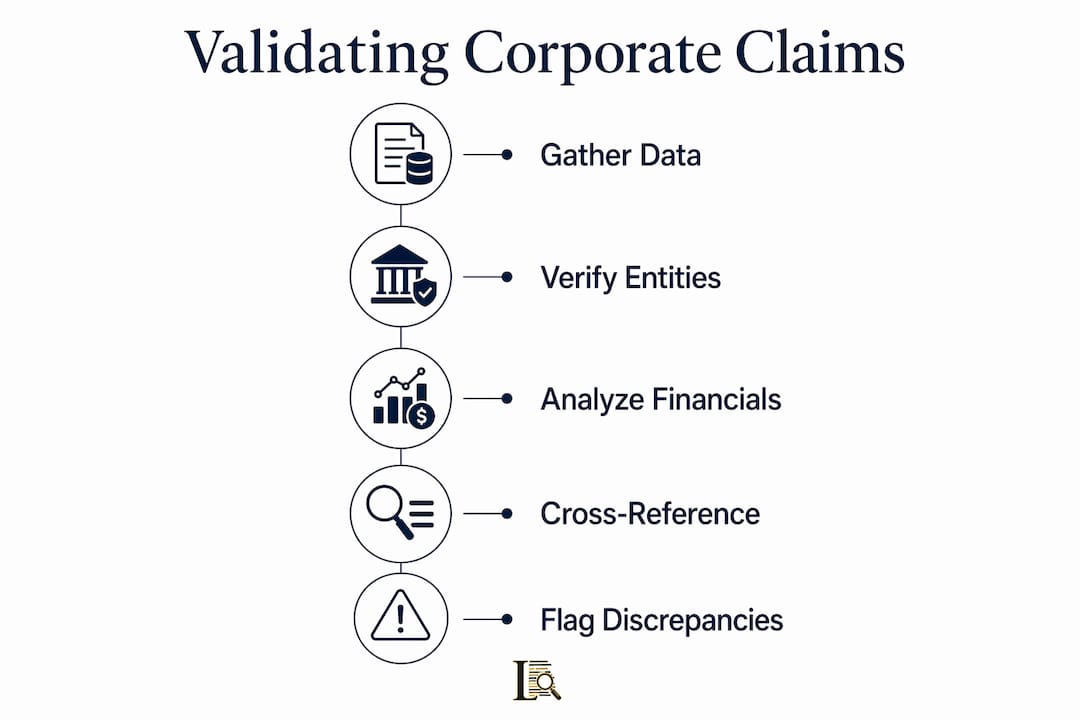
The annual report credibility framework most useful for avoiding these errors combines entity verification, XBRL data extraction, and delta analysis into a single repeatable workflow. Analysts who treat each step as independent rather than integrated miss the cross-referencing that catches the most material discrepancies.
Key Takeaways
Validating corporate claims in public disclosures requires integrating entity verification, structured XBRL data extraction, and delta analysis into a single repeatable workflow rather than treating each step in isolation.
| Point | Details |
|---|---|
| Use layered data sources | Combine SEC EDGAR filings, XBRL data, and state registries for complete validation coverage. |
| Verify entity authority, not just status | Confirm signatory authority and ownership chains, not only whether the entity is listed as active. |
| Apply delta analysis to filings | Compare current filings against prior periods to isolate material changes without reviewing entire reports. |
| Treat management claims as testable | Pair every narrative claim with a specific note reference or XBRL tag before accepting it as accurate. |
| Filter insider trades by type | Separate 10b5-1 plan trades from discretionary sales to interpret insider activity correctly. |
What I've learned from years of reading between the lines
The most persistent problem in disclosure validation is not a lack of data. It is the assumption that narrative and data tell the same story. They rarely do. Management teams are skilled at constructing disclosures that are technically accurate at the sentence level while being materially misleading at the document level. The gap between what is stated and what is delivered is where the real analytical work happens.
What I have found consistently is that analysts who build their workflow around delta analysis catch more anomalies in less time than those who read reports sequentially. A 10-K is a long document by design. The material changes are almost always concentrated in a handful of footnotes and XBRL-tagged line items. Focusing there first, then expanding outward, is the most efficient path to a defensible conclusion.
The other underappreciated skill is entity mapping. Most analysts stop at the SEC registrant. The registrant is often a holding company with no direct operations. The entity that actually employs people, holds assets, and executes contracts sits one or two levels below. Governance conclusions drawn from consolidated financials without that mapping are incomplete by definition.
Lacunaindex applies this layered methodology at scale, measuring the aspiration-to-execution gap across thousands of filings. The platform's execution scores and sector benchmarks give analysts a reference point that individual filing review cannot provide. That context is what separates a finding from a conclusion.
— Glen
Lacunaindex: forensic-grade disclosure analysis at institutional scale
Institutional investors who need to move beyond surface-level filing review can use Lacunaindex to quantify the gap between corporate narrative and actual delivery across thousands of public companies.
The platform mines earnings calls, SEC filings, press releases, and proxy statements to produce execution scores and sector benchmarks grounded entirely in public records. The Lacunaindex user guide explains how to read a forensic report and apply its findings to governance decisions. Analysts who want to contextualize a single company's disclosures against sector norms can use the sector benchmarks to identify where the aspiration-to-execution gap is widest. No insider access is required. Every finding traces back to a public filing.
FAQ
What is the best source to validate corporate claims in public disclosures?
SEC EDGAR is the primary source, providing 10-K, 10-Q, 8-K, and proxy filings with structured XBRL data for automated extraction. State corporate registries supplement EDGAR by confirming entity status and signatory authority.
How does XBRL data improve financial claim verification?
XBRL tags convert financial statement line items into machine-readable facts, enabling automated period-over-period comparison without manual transcription. This makes delta analysis across hundreds of filings practical at institutional scale.
What is the most common mistake when investigating corporate claims in public filings?
The most common error is accepting the SEC registrant's consolidated financials as representative of the operating entity. Analysts must map the full subsidiary structure to identify where assets, liabilities, and contractual authority actually reside.
How do you distinguish a material insider trade from a routine 10b5-1 plan sale?
Form 4 filings disclose whether a transaction was executed under a pre-scheduled 10b5-1 plan. Discretionary sales outside a plan, particularly those timed close to disclosure events, carry stronger signals and require separate analytical treatment.
How far back should historical data go when benchmarking corporate financial claims?
Benchmarking across full market cycles requires at least a decade of data. Databases covering nearly 9,900 US-listed stocks with records going back to 1962 allow analysts to test claims against long-term sector norms rather than recent conditions alone.