
Regulatory oversight gaps in public reporting are defined as structural failures within disclosure frameworks that allow incomplete, inconsistent, or misleading corporate information to reach investors and regulators without correction. These gaps sit at the intersection of deregulatory policy shifts, fragmented jurisdictional authority, and voluntary reporting shortfalls. The consequences are concrete: only 34% of US public company CFOs had fully operational data collection systems for Scope 1 and 2 emissions as of early 2026, despite 72% rating SEC climate disclosure as a top priority. That 38-point readiness gap is not an anomaly. It is a symptom of systemic disclosure architecture that has not kept pace with regulatory expectations or investor demand.
1. What are the most significant regulatory oversight gaps in public reporting?
The industry term for this category of failure is "disclosure opacity," a condition in which the form of reporting satisfies procedural requirements while the substance fails to convey material risk. Seven gap types recur across SEC filings, ESG disclosures, and cross-border reporting regimes.
Deregulatory-driven disclosure gaps
The SEC's current deregulatory agenda has widened the gap between what companies must disclose and what investors need to make informed decisions. Voluntary disclosures outside Form 10-Q lack structured procedural guidance, exposing firms to federal antifraud liability without the procedural protections of formal filings. The result is a disclosure environment where companies face higher litigation risk precisely because they chose to communicate more.

Climate data integration failures
Only 22% of large accelerated filers had fully integrated climate data controls into their Internal Controls over Financial Reporting (ICFR) by 2025. This means the majority of large public companies are reporting climate metrics through channels that have not been subjected to the same audit rigor as financial data. Investors relying on these figures for capital allocation decisions are working with unverified inputs.
Voluntary reporting shortfalls
Only 3% of entities subject to California's SB 261 voluntarily reported climate data as of june 2026. That figure represents 157 out of approximately 4,000 covered entities. Low voluntary adoption signals that compliance infrastructure has not been built, not that risk exposure is low.
Fragmented jurisdictional oversight
Regulatory fragmentation and overlapping jurisdictions produce incomplete regulatory coverage and internal control weaknesses. When multiple agencies share nominal authority over the same disclosure domain, accountability diffuses. No single regulator owns the gap, so no single regulator closes it.
Tiered supervision and hidden grace periods
Tiered regulatory frameworks create hidden grace periods that allow governance weaknesses to persist well before enforcement occurs. For growing companies moving between supervisory tiers, this runway can extend long enough for material risks to compound without triggering formal corrective action.
Cross-regime reconciliation failures
Public Country-by-Country Reporting requires rigorous reconciliation across multiple reporting regimes to avoid audit scrutiny and reputational damage. A company can produce individually accurate data sets across jurisdictions and still generate a materially misleading consolidated picture if reconciliation protocols are absent.
Boilerplate and non-material disclosures
Excessive prescriptive disclosure requirements drive boilerplate reporting, reduced comparability, and increased litigation exposure. When Regulation S-K comment letters push companies toward formulaic language, the resulting disclosures satisfy the letter of the requirement while stripping out the judgment-intensive content that makes disclosures useful.
Pro Tip: When reviewing a company's 10-K for disclosure quality, flag sections where language is identical across consecutive annual filings. Verbatim repetition in risk factor disclosures is a reliable indicator of boilerplate substitution for genuine risk assessment.
2. How do gaps in regulatory oversight affect corporate transparency and investor decision-making?
Disclosure gaps do not affect all investors equally. Institutional investors with dedicated governance teams can compensate through direct engagement, alternative data, and proprietary analysis. Retail investors and smaller asset managers absorb the information asymmetry without recourse. The market-level consequences are measurable.
- Reduced comparability. When companies apply different methodologies to the same disclosure category, cross-sectional analysis becomes unreliable. Analysts cannot build valid peer comparisons from data sets that do not share a common measurement basis.
- Litigation exposure from voluntary disclosures. The SEC's deregulatory agenda has created a structural paradox: relaxed mandatory requirements push companies toward voluntary disclosures, which carry higher antifraud liability because they lack the safe harbor protections of formal filings. Companies that communicate more face greater legal exposure than those that communicate less.
- Valuation distortion. When reporting rigor declines, analyst coverage quality follows. Earnings models built on incomplete or unverified ESG and operational data produce valuation estimates with wider error bands. That uncertainty is priced into discount rates, not always in the company's favor.
- Governance quality signals. The tension between principles-based and prescriptive disclosure requirements creates compliance strategies that optimize for form over substance. Companies that treat Regulation S-K as a checklist rather than a materiality framework signal governance cultures that prioritize procedural compliance over genuine transparency.
- Reputational risk from reconciliation failures. Cross-regime inconsistencies, particularly in public Country-by-Country Reporting, can surface during audit cycles and generate reputational damage even when individual data points are accurate. The damage comes from the appearance of inconsistency, not necessarily from underlying misconduct.
For compliance officers assessing qualitative risk signals in public disclosures, these five consequences represent the primary transmission channels through which reporting gaps convert into market integrity problems.
3. Which regulatory frameworks are most vulnerable to oversight gaps?
The table below maps the primary disclosure frameworks against their principal vulnerability types, common compliance failures, and enforcement risk profiles.
| Framework | Primary vulnerability | Common compliance failure | Enforcement risk |
|---|---|---|---|
| SEC financial disclosures (Form 10-K, 10-Q) | Boilerplate risk factor language | Verbatim repetition across filing years | Moderate; comment letter driven |
| SEC climate disclosure rules | ICFR integration gap | Climate data not subject to auditor attestation | High; only 22% of large filers compliant |
| Regulation S-K | Principles vs. prescriptive tension | Non-material disclosures crowding out material ones | Moderate; litigation exposure rising |
| Voluntary ESG reporting | No structured validation | Metrics selected for favorable presentation | Low regulatory; high reputational |
| Public Country-by-Country Reporting | Cross-regime reconciliation | Inconsistencies across jurisdictions | High; audit and reputational risk |
| Tiered bank supervision | Hidden grace periods | Governance weaknesses persist pre-enforcement | High for growing institutions |
The tiered supervision row deserves particular attention. Long supervisory runways in tiered bank regulation delay enforcement and compound governance risks, especially for institutions crossing asset thresholds. The gap between when a risk becomes observable and when it triggers formal corrective action is where the most significant damage accumulates.
Voluntary ESG reporting carries the lowest formal regulatory risk but the highest aspiration-to-execution gap. Companies publishing sustainability reports without third-party assurance are producing narratives that cannot be independently verified. For investors using those reports to assess long-term value drivers, the absence of auditor attestation is a material limitation.
4. What practical strategies can compliance officers use to address reporting gaps?
Closing gaps in reporting regulations requires a combination of process redesign, technology deployment, and governance culture change. The following approaches address the root causes identified above.
- Integrate climate and ESG data into ICFR. The 22% integration rate among large accelerated filers is the single most actionable gap in current practice. Compliance teams should map climate data collection points to existing internal control frameworks, assign control owners, and subject climate metrics to the same testing cadence as financial data.
- Adopt qualitative supervisory methods. The shift toward qualitative, judgment-intensive oversight is the direction both the Bank for International Settlements and the Government Accountability Office recommend for addressing root causes before they escalate. Quantitative triggers alone miss the early warning signals embedded in narrative disclosures.
- Build cross-regime reconciliation protocols. For companies subject to multiple reporting regimes, a reconciliation matrix that maps each data point across jurisdictions prevents the consistency failures that generate audit scrutiny. This is particularly relevant for multinationals subject to public Country-by-Country Reporting requirements.
- Establish early escalation procedures. Tiered supervision creates grace periods that compliance teams can exploit in reverse: by escalating internally before external regulators act, companies can remediate governance weaknesses during the window when enforcement is still discretionary.
- Use technology to detect disclosure inconsistencies. AI-driven analytics tools can flag language drift, metric inconsistencies, and boilerplate substitution across filing periods. Platforms that mine earnings calls, SEC filings, and press releases simultaneously can identify the aspiration-to-execution gap before it becomes a regulatory or litigation event.
For compliance officers building a 2026 finance compliance checklist, the ICFR integration gap and cross-regime reconciliation protocols represent the two highest-priority items given current enforcement trajectories.
Pro Tip: When evaluating your company's disclosure quality, run a side-by-side comparison of your risk factor language across the last three annual filings. If the language has not changed materially despite changes in the operating environment, that is a governance signal worth escalating to the audit committee.
For a structured approach to identifying high-risk narrative companies through qualitative oversight methods, the Lacunaindex oversight guide provides a replicable framework applicable across sectors.
Key takeaways
Regulatory oversight gaps in public reporting persist because disclosure frameworks reward procedural compliance over substantive transparency, and no single regulator owns the full gap zone across voluntary, mandatory, and cross-border reporting regimes.
| Point | Details |
|---|---|
| ICFR integration is the priority gap | Only 22% of large accelerated filers have integrated climate data into internal controls. |
| Voluntary disclosures carry litigation risk | Disclosures outside Form 10-Q lack safe harbor protections, increasing antifraud exposure. |
| Tiered supervision creates enforcement delays | Hidden grace periods allow governance weaknesses to compound before corrective action triggers. |
| Boilerplate reporting reduces investor utility | Prescriptive disclosure requirements drive formulaic language that satisfies form but not substance. |
| Cross-regime reconciliation is a distinct risk | Individually accurate data sets can produce misleading consolidated pictures without reconciliation protocols. |
The gap between disclosure form and disclosure substance
The most persistent problem in public reporting is not that companies lie. It is that they comply. Compliance with the letter of Regulation S-K, SEC climate rules, or voluntary ESG frameworks can produce a disclosure record that is technically accurate and substantively uninformative at the same time. I have reviewed hundreds of corporate filings where the risk factor section reads as a legal liability management exercise rather than a genuine communication of material risk. The language is precise, the format is correct, and the investor learns almost nothing.
The deregulatory shift underway at the SEC in 2026 makes this worse in a specific way. When mandatory requirements relax, companies face pressure to fill the information vacuum with voluntary disclosures. Those voluntary disclosures, as Harvard Law has documented, carry higher litigation risk than formal filings. So companies face a choice between saying less and facing reputational risk, or saying more and facing legal risk. Neither option serves the market well.
The practical answer is not more rules. It is better measurement. Regulators and investors alike need tools that can detect the gap between what a company claims and what its actual record shows, without relying on the company's own framing. The corporate credibility assessment framework developed for regulatory professionals addresses exactly this problem: it treats public disclosures as evidence to be tested, not narratives to be accepted. That methodological shift, from compliance verification to execution measurement, is where the field needs to move.
— Glen
How Lacunaindex measures what disclosures miss
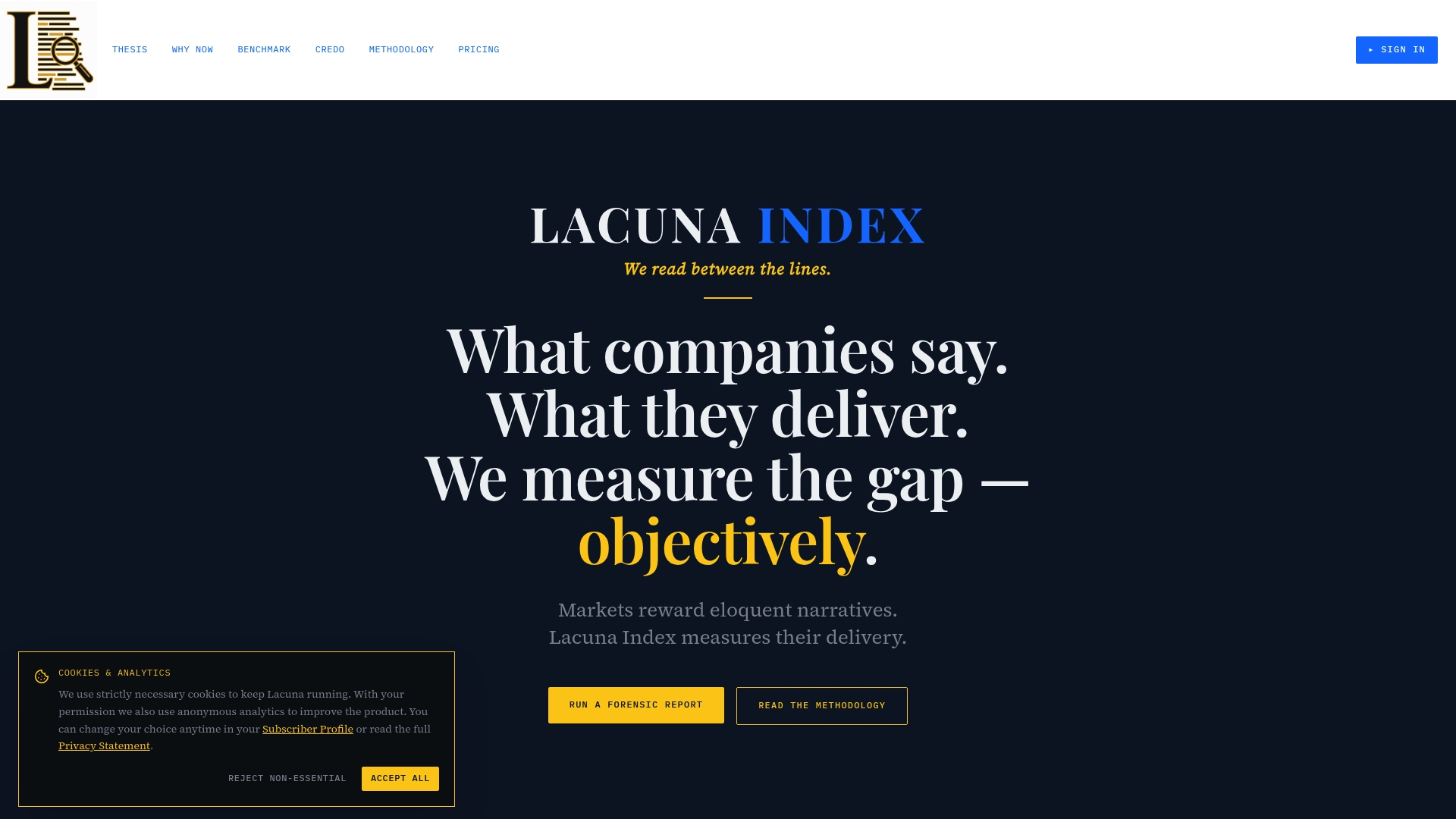
Lacunaindex is a forensic analytics platform built specifically for the problem this article describes. It mines SEC filings, earnings calls, press releases, and proxy statements to measure the gap between corporate narrative claims and actual delivery, using only public records. The platform produces execution scores, sector benchmarks, and disclosure opacity ratings that give institutional investors and governance professionals an objective basis for evaluating reporting quality. Where traditional compliance tools verify that disclosures were made, Lacunaindex measures whether the underlying claims hold up. Explore the Lacunaindex methodology and review the full user guide to understand how forensic disclosure analysis applies to your oversight or investment process.
FAQ
What are regulatory oversight gaps in public reporting?
Regulatory oversight gaps in public reporting are structural failures in disclosure frameworks that allow incomplete, inconsistent, or unverified corporate information to reach investors without correction. They arise from deregulatory shifts, fragmented jurisdictional authority, and the absence of auditor attestation for voluntary disclosures.
Why is climate data integration into ICFR a critical gap?
Only 22% of large accelerated filers had integrated climate data into their Internal Controls over Financial Reporting by 2025. This means the majority of large public companies report climate metrics without the audit rigor applied to financial data, reducing reliability for investors.
How does tiered regulatory supervision create hidden enforcement gaps?
Tiered supervision frameworks create extended supervisory runways that delay formal enforcement, allowing governance weaknesses to persist and compound before corrective action is triggered. This is particularly acute for institutions crossing asset thresholds between supervisory tiers.
What is the litigation risk of voluntary disclosures under the current SEC regime?
Voluntary disclosures made outside formal SEC filings lack the structured procedural guidance and safe harbor protections of Form 10-Q or 10-K submissions. This exposes companies to increased federal antifraud liability, meaning more communication can produce more legal risk.
How can compliance officers detect boilerplate reporting in their own filings?
Compliance officers should compare risk factor language across consecutive annual filings and flag sections where language is verbatim or near-verbatim despite changes in the operating environment. Identical language across filing years is a reliable indicator that disclosures are serving legal liability management rather than genuine investor communication.