
Monitoring disclosure consistency across filings is the process of systematically verifying that financial and narrative information remains aligned across multiple corporate disclosure documents, including 10-K and 10-Q filings, MD&A sections, and proxy statements. Inconsistencies between filings signal either evolving corporate risk or deliberate narrative management. Both outcomes carry material implications for investment decisions. Analysts who track disclosure accuracy across periods gain an informational edge that peers relying on single-period reviews routinely miss. This guide covers the regulatory prerequisites, step-by-step methodology, and common failure points that define effective disclosure compliance monitoring in 2026.
How to monitor disclosure consistency across filings: prerequisites
Effective filing consistency review begins with a clear regulatory baseline. As of june 2026, Regulation FD requires public companies to maintain a written policy reviewed within 12 months, with non-intentional selective disclosures triggering an 8-K filing within 24 hours. That requirement creates a direct audit trail analysts can use to verify whether a company's public disclosures align with what was communicated in investor meetings.
Before any monitoring program can function, analysts need access to the right filing types and data infrastructure. The critical documents to baseline are:
- 10-K annual reports: Full-year financial statements, Risk Factors, and MD&A narrative
- 10-Q quarterly reports: Period-over-period financial statement consistency and updated risk language
- 8-K current reports: Prompt disclosures of material events, including earnings releases and executive changes
- Proxy statements (DEF 14A): Compensation disclosures and governance language consistency
- MD&A sections: Management's explanation of financial results, where narrative drift is most detectable
Technology access is equally foundational. The SEC's EDGAR database provides free access to all public filings in HTML and XBRL formats. Sentence-level diff monitoring tools parse these documents to surface textual changes between filing periods. Automated diff tools allow professional investors to review changes within minutes of a new filing appearing on EDGAR, with particular focus on MD&A and Risk Factors sections.
| Filing Type | Primary Consistency Risk | Key Sections to Compare |
|---|---|---|
| 10-K vs. prior 10-K | Year-over-year risk factor changes | Risk Factors, MD&A, Notes |
| 10-Q vs. prior 10-Q | Quarterly narrative drift | MD&A, Liquidity, Commitments |
| 8-K vs. earnings call | Selective disclosure gaps | Press release vs. call transcript |
| Proxy vs. 10-K | Compensation narrative alignment | CD&A, Executive Summary |

Document management discipline underpins the entire process. Consistent file naming conventions using a structure like [ClientID]_[Year]_[DocType]_[Version] reduce version control errors and prevent analysts from comparing the wrong document pairs. Fragmented folder structures are among the most common sources of false discrepancy findings.
Step-by-step process to track disclosure accuracy in SEC filings
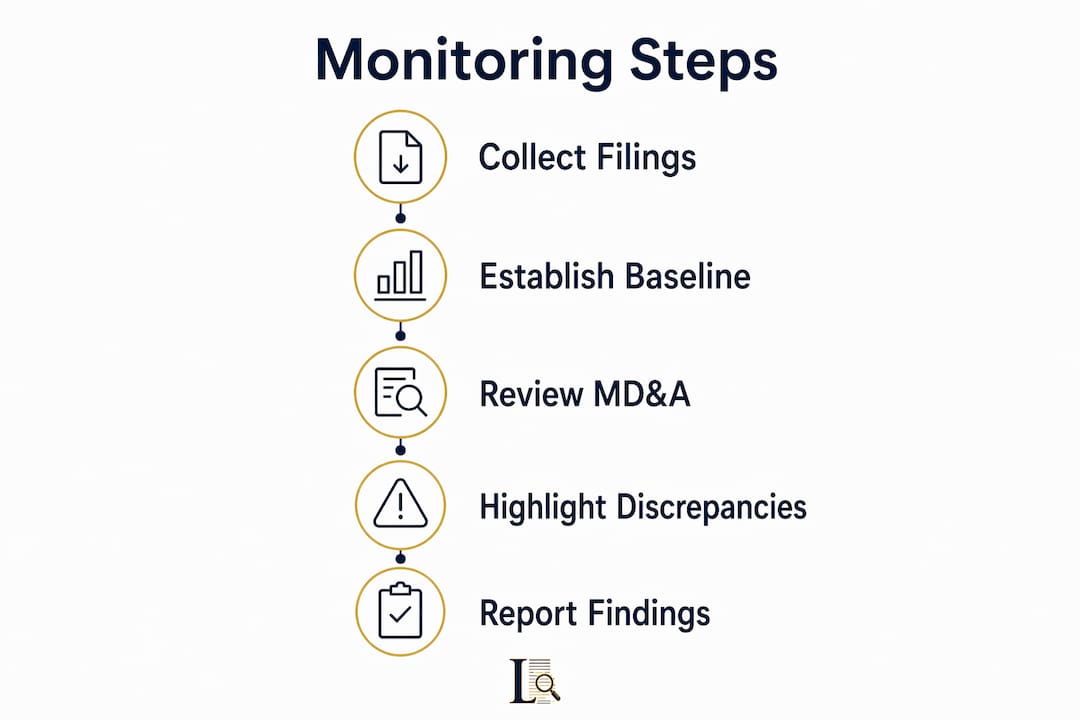
A repeatable monitoring process follows six distinct stages. Each stage builds on the prior one, and skipping any stage degrades the reliability of the output.
-
Establish baseline filings. Pull the most recent 10-K and 10-Q from EDGAR for each company under coverage. Save these in reader mode, which strips extraneous HTML and focuses the document on narrative content. Baselining in reader mode surfaces subtle risk factor changes that tools focused only on tables routinely miss.
-
Configure automated monitoring alerts. Set up sentence-level diff alerts for each filing type. Alerts should trigger on any new 10-K, 10-Q, or 8-K submission. Entry-level monitoring programs cover 15–30 companies and provide immediate notification of filing changes.
-
Run sentence-level diffs on priority sections. When a new filing arrives, compare MD&A, Risk Factors, and Liquidity sections against the prior period equivalent. A transformer-based deep learning model applied to this task achieves 94.3% accuracy in detecting disclosure discrepancies across 10-K and 10-Q filings while reducing manual review time by 67%. That accuracy level, validated on 2,847 SEC filings, sets the benchmark for what automated review can deliver.
-
Compare against peer benchmarks. Isolated changes within a single company's filings may reflect industry-wide shifts rather than company-specific risk. Peer benchmarking against resolved SEC comment letters helps analysts identify whether a disclosure gap is idiosyncratic or sector-wide, and reduces the risk of flagging normal language evolution as a material inconsistency.
-
Conduct manual review of flagged sections. Automated alerts identify candidates for review. Human judgment determines materiality. Analysts should read flagged passages in full context, not just the changed sentence, to assess whether the shift reflects new risk, corrected language, or deliberate narrative softening.
-
Document findings and escalate material discrepancies. Every flagged inconsistency requires a written record that includes the specific change, the filing period, the analyst's assessment of materiality, and the recommended action. This documentation trail is the evidence base for any regulatory response or investment decision.
Pro Tip: When reviewing MD&A sections, pay particular attention to changes in forward-looking language. Phrases like "we expect" shifting to "we believe" or "we anticipate" often signal management's reduced confidence in a prior commitment, even when the surrounding financial data appears stable.
Common challenges when evaluating filing consistency
Fragmented workflows produce the majority of false positives and missed discrepancies in disclosure monitoring programs. When analysts store filing versions across multiple folders without a consistent naming protocol, they frequently compare non-equivalent documents. Standardizing folder structures and adopting a uniform naming convention delivers the largest single improvement in monitoring reliability, ahead of any technology upgrade.
A second failure mode is treating software alerts as completed reviews. True disclosure monitoring requires documenting the control failure, identifying ownership, recording the compliance escalation path, and retaining evidence of remediation. An alert that is acknowledged but not acted upon creates a paper trail that regulators can use against the firm, not for it.
"Avoid confusing software alerts as completed reviews; actions must be verifiable with evidence." — Securities Mastery, Conflict Disclosure, Monitoring, and Evidence Guide
Handling ambiguous changes requires a defined decision framework. Not every textual difference is material. Analysts should classify changes into three categories: cosmetic edits (formatting, grammar corrections), language evolution (updated terminology reflecting industry shifts), and substantive changes (new risk disclosures, removed commitments, altered financial guidance). Only the third category requires escalation. The first two should be logged and closed.
Pre-filing peer benchmarking is the most underused tool for reducing regulatory risk. SEC comment letters are public records. Reviewing resolved comment exchanges in a company's sector reveals the disclosure depth the SEC expects. Analysts who conduct this review before a filing is submitted can flag gaps before they attract regulatory attention, rather than after.
- Classify every flagged change as cosmetic, language evolution, or substantive before escalating
- Retain all diff outputs, analyst notes, and escalation records in a centralized, version-controlled repository
- Run peer benchmarking against SEC comment letter archives at least once per annual filing cycle
- Assign clear ownership for each monitoring task so that no alert sits unresolved beyond a defined review window
How ongoing monitoring fits within compliance and governance
Monitoring and auditing serve different functions. Effective monitoring is frequent and proactive, designed to identify weaknesses before they become violations. Auditing is retrospective, examining what occurred after the fact. Disclosure compliance monitoring belongs in the monitoring function, not the audit function, and should run continuously rather than on an annual cycle.
Compliance officers play a central role in making monitoring programs work. Firms that involve compliance staff early in new business propositions, rather than consulting them after disclosure decisions are made, produce more consistent filings. The compliance officer's role in disclosure oversight includes reviewing draft filings against prior periods, flagging language that departs from established disclosure patterns, and maintaining the written Regulation FD policy required under current SEC rules.
Staff training is a structural requirement, not an optional enhancement. Analysts adopt consistency controls more readily when they understand why filing naming and storage conventions exist, not just what the conventions are. Training programs that explain the regulatory and investment consequences of inconsistent disclosures produce better compliance outcomes than those that focus only on procedural steps.
Pro Tip: Embed a quarterly disclosure consistency review into the existing earnings preparation calendar. Scheduling the review as a fixed step in the filing workflow, rather than a standalone project, ensures it receives consistent attention and does not compete with deadline pressure.
The monitoring insights generated through this process feed directly into corporate accountability analysis and investor communications. When analysts identify a pattern of softening language in Risk Factors across multiple quarters, that pattern informs both the investment thesis and the questions asked on earnings calls. Monitoring output is not just a compliance artifact. It is an investment signal.
Key Takeaways
Effective disclosure consistency monitoring requires disciplined workflows, automated sentence-level diff tools, and documented escalation processes applied continuously across 10-K, 10-Q, and 8-K filings.
| Point | Details |
|---|---|
| Baseline in reader mode | Strip HTML from filings to surface narrative changes that table-focused tools miss. |
| Classify before escalating | Sort flagged changes into cosmetic, language evolution, or substantive before acting. |
| Document every finding | Record the change, ownership, and remediation evidence for every flagged discrepancy. |
| Integrate compliance early | Involve compliance officers in draft filing review, not after disclosure decisions are made. |
| Use SEC comment letters | Benchmark peer disclosures against resolved comment exchanges to anticipate regulatory focus. |
Why most monitoring programs fail before they start
The most common failure in disclosure consistency programs is not technological. It is organizational. Firms invest in diff monitoring tools and then assign the output to analysts who lack the authority to escalate findings or the time to conduct manual review. The tool generates alerts. The alerts accumulate. Nothing changes.
The second failure is baselining only the financial tables. Quantitative data in 10-K and 10-Q filings is subject to auditor attestation and XBRL tagging, which creates its own consistency pressure. The narrative sections, MD&A, Risk Factors, and the liquidity discussion, carry no equivalent constraint. That is precisely where management has the most latitude to shift the story without triggering a restatement. Analysts who focus their monitoring on tables are watching the wrong part of the filing.
What I have found consistently useful is treating the aspiration-to-execution gap as a monitoring lens. When a company's MD&A language grows more optimistic while its execution metrics deteriorate, that divergence is a signal. Lacunaindex quantifies exactly this gap through its execution score methodology, which measures the distance between what management claims and what the public record confirms. That framing turns disclosure monitoring from a compliance exercise into an investment edge.
The firms that get this right treat monitoring as a continuous analytical function, not a pre-filing checklist. They assign ownership, set review windows, and feed findings back into their investment process. The firms that get it wrong treat it as a box to check before the 10-K goes out.
— Glen
Lacunaindex and the disclosure monitoring process
Lacunaindex applies forensic analytics to the exact problem this article addresses: the gap between what companies say and what the public record confirms.
The platform mines earnings calls, SEC filings, press releases, and proxy statements to produce execution scores and sector benchmarks that contextualize disclosure quality across peers. For analysts building a disclosure consistency program, the Lacunaindex user guide provides a structured starting point for reading forensic reports and interpreting filing-level discrepancies. Sector benchmarks available through Lacunaindex financials benchmarks allow analysts to calibrate their findings against industry norms, separating company-specific disclosure drift from sector-wide language evolution.
FAQ
What does it mean to monitor disclosure consistency across filings?
Disclosure consistency monitoring is the systematic comparison of financial and narrative information across multiple corporate filings, such as 10-K and 10-Q documents, to identify material changes or contradictions between periods. The process covers both quantitative data and narrative sections like MD&A and Risk Factors.
Which SEC filings require the most attention in a consistency review?
MD&A and Risk Factors sections in 10-K and 10-Q filings carry the highest monitoring priority because they contain management's narrative interpretation of results and are not subject to the same XBRL tagging constraints as financial tables. 8-K filings also require review to verify alignment with prior disclosures under Regulation FD.
How accurate are automated tools for detecting disclosure discrepancies?
A transformer-based deep learning model validated on 2,847 SEC filings detects discrepancies with 94.3% accuracy while reducing manual review time by 67%. Automated tools identify candidates for review; human judgment is still required to assess materiality.
What is the difference between disclosure monitoring and disclosure auditing?
Monitoring is proactive and continuous, designed to catch weaknesses before they become violations. Auditing is retrospective, examining what occurred after the fact. Effective compliance programs treat these as separate functions with different ownership and review cycles.
How can SEC comment letters improve a disclosure consistency program?
Resolved SEC comment letter exchanges are public records that reveal the disclosure depth regulators expect in specific sectors. Benchmarking draft filings against these exchanges before submission helps analysts identify gaps early and reduce the likelihood of follow-up regulatory inquiries.