What is the public disclosure gap and why does it matter to investors?
The public disclosure gap refers to the structural difference in information transparency between publicly traded firms and their private-market counterparts, a disparity that distorts capital allocation, misprices risk, and undermines the analytical frameworks institutional investors rely upon. In the context of investment analysis, this gap is not merely a regulatory inconvenience. It is a measurable source of informational asymmetry that shapes equity valuations, cost-of-capital estimates, and governance assessments across entire sectors.
Public companies operate under SEC Regulation S-K, periodic 10-K and 10-Q filings, and proxy statement requirements. Private firms face no comparable mandate. The result is a disclosure environment where two firms competing in the same industry may present radically different information surfaces to the market, with the private firm's opacity functioning as a competitive advantage that distorts the public firm's perceived risk profile.
Core facets of the disclosure gap include:
- Informational asymmetry: Private firms withhold operational, financial, and strategic data that public peers must disclose, skewing comparative analysis.
- Valuation distortion: Analysts pricing public equities cannot fully account for competitive dynamics when private peers remain opaque.
- Regulatory scope mismatch: SEC disclosure mandates apply to registered securities; private firms operating below registration thresholds face minimal transparency obligations.
- Aspiration-to-execution gap: Public firms' narrative disclosures often diverge from quantifiable performance outcomes, a divergence that forensic analysis can surface.
- ESG disclosure opacity: Private firms are largely exempt from emerging ESG reporting frameworks, creating additional blind spots for sustainability-focused allocators.
Lacunaindex addresses this gap by applying forensic analytics to publicly available records, including earnings call transcripts, SEC filings, press releases, and proxy statements, to quantify the distance between what management communicates and what the underlying data confirms.
How disclosure gaps affect investor sensitivities and market behavior
The market consequences of disclosure gaps are empirically documented and economically material. A 10% increase in private firm disclosure transparency produces a 4.3% reduction in global investor demand for public equity in the same sector, with an estimated impact of $358 million per investee country-industry. This negative pecuniary externality operates through a reallocation mechanism: as private firms become more transparent, institutional capital finds credible alternatives to public markets, compressing public firm valuations without any change in those firms' own fundamentals.
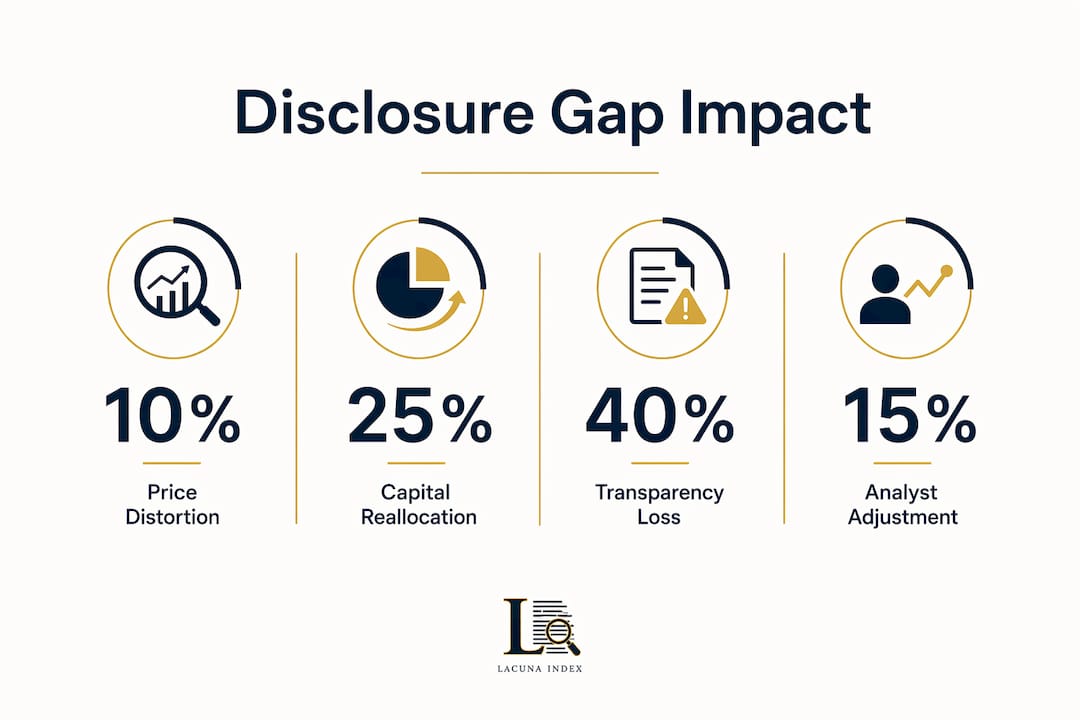
The social disclosure gap also correlates negatively with a firm's cost of equity capital. Investors tend to anchor on the most salient public information, which means discrepancies between internal performance and external narrative often go unpriced until a material event forces recognition. That lag creates both risk and opportunity for analysts equipped to detect it early.
| Impact Metric | Finding |
|---|---|
| Investor demand reduction associated with increased private transparency results in a measurable decline in public equity demand | |
| Estimated capital impact per country-industry is significant | |
| Cost of equity correlation with social disclosure gap | Negative (higher gap, higher cost of equity) |
| Disclosure tone manipulation risk | Elevated during early digital transformation stages |
Key finding: A 4.3% reduction in public equity demand per 10% increase in private firm transparency represents a systemic pricing externality that most equity models do not currently capture.
Analysts who treat public and private disclosure environments as independent make a category error. The two are structurally linked, and shifts in private-sector transparency propagate directly into public-market pricing dynamics.
Regulatory and governance challenges posed by disclosure gaps
The SEC has explicitly targeted the public-private disclosure gap as a priority concern, particularly as private markets have grown to rival public markets in capital volume. The regulatory challenge is structural: the SEC's authority derives from securities registration, which private firms can avoid by staying below investor-count thresholds or relying on exemptions under Regulation D.
Core regulatory and governance challenges include:
- Jurisdictional asymmetry: U.S. disclosure mandates apply to registered issuers; private firms operating under Regulation D or Rule 144A exemptions face minimal transparency obligations.
- ESG standardization failure: A survey of 30 Alberta oil and gas firms against 19 financial institutions' ESG standards found no consistent alignment, illustrating how fragmented reporting frameworks undermine cross-firm comparability.
- Governance blind spots: Boards of public firms competing against opaque private peers cannot accurately assess competitive positioning, weakening strategic oversight.
- Evolving climate disclosure rules: The SEC's proposed climate disclosure rules and the UK's mandatory climate disclosure legislation for large companies represent attempts to narrow the gap, but private firms remain largely outside their scope.
- Investor protection asymmetry: Retail investors in public markets bear disclosure-driven pricing distortions caused by private-sector opacity, with no direct regulatory remedy.
The regulatory oversight gap in public reporting continues to widen as private equity and venture-backed firms delay or avoid public listings, concentrating information advantages among a narrow class of institutional participants with direct access to private data rooms.
Methodological challenges in analyzing disclosure gaps
Measuring the disclosure gap with analytical rigor is harder than identifying it conceptually. Automated textual analysis methodologies for corporate disclosure tone vary considerably in accuracy, and no single standardized technique has achieved consensus across the research community. The Loughran-McDonald financial sentiment dictionary, the Harvard General Inquirer, and proprietary NLP models each produce divergent tone scores for identical disclosure texts, complicating cross-study comparisons.
Corporate digital transformation compounds the problem. Empirical evidence from Chinese A-share listed companies between 2012 and 2021 shows that digital adoption increases management's propensity for tone manipulation in disclosures, particularly during early transformation stages. As more firms adopt AI-assisted investor relations tools, the signal-to-noise ratio in disclosure analysis deteriorates.
Core methodological obstacles include:
- Data heterogeneity: Earnings call transcripts, 8-K filings, proxy statements, and sustainability reports follow different structural conventions, making unified analysis technically demanding.
- Tone interpretation variance: Disclosure tone studies show that investor awareness often aligns with formal risk disclosures, suggesting gaps arise more from interpretive divergence than raw information absence.
- Disclosure decoupling: Narrative claims in MD&A sections frequently diverge from quantitative performance data in the same filing, a pattern that requires longitudinal comparison to detect reliably.
- Machine learning limitations: Models trained on historical disclosure patterns may not generalize to novel manipulation techniques or sector-specific language conventions.
- Inter-rater reliability: Qualitative coding of disclosure content requires robust agreement metrics; without Cohen's Kappa or equivalent inter-rater statistics, findings lack replicability.
Pro Tip: Combining qualitative content coding with quantitative NLP outputs, and validating both against realized financial outcomes, produces materially more reliable disclosure risk assessments than either method alone. Kappa-validated coding frameworks applied to ESG disclosures represent current best practice in ESG risk analysis.
How forensic analytics can measure and benchmark disclosure gaps
Lacunaindex applies a systematic forensic process to quantify the aspiration-to-execution gap across public companies, using only publicly available records. The methodology cross-references management's narrative claims in earnings calls and press releases against audited financial outcomes, SEC filing data, and proxy statement commitments, producing an execution score that classifies each company into one of three archetypes.

| Archetype | Definition | Investment Implication |
|---|---|---|
| Earned | Narrative claims consistently supported by quantifiable outcomes | Valuation premium may be justified |
| Borrowed | Narrative claims exceed demonstrated delivery; gap is widening | Elevated rerating risk; monitor execution trajectory |
| Undervalued | Delivery consistently exceeds narrative claims | Potential mispricing; market may be discounting actual performance |
A representative case: a mid-cap technology firm classified as "borrowed" by Lacunaindex's execution scoring showed a pattern of accelerating revenue guidance language in earnings calls while organic revenue growth decelerated across six consecutive quarters. The divergence between disclosure tone and financial trajectory was detectable in public filings eighteen months before the stock's material rerating. Machine learning models incorporating financial, regulatory, and public pressure indicators achieve 74.9% accuracy in detecting manipulative disclosures, validating the forensic approach.
Practical strategies for incorporating forensic analytics into investment and regulatory workflows:
- Map execution scores across a sector to identify systematic disclosure manipulation patterns, not just individual outliers.
- Track disclosure trajectory changes over time; shifts in tone often precede financial deterioration by multiple reporting periods.
- Use sector benchmarks from Lacunaindex's Pressure Pool Index to contextualize individual company execution scores against peer-group norms.
- Cross-reference proxy statement commitments against subsequent capital allocation decisions to detect governance-level disclosure decoupling.
Pro Tip: Longitudinal analysis across at least eight quarters of disclosure data produces materially more reliable detection of thematic inconsistencies than single-period snapshot reviews. Snapshot analysis captures tone; trajectory analysis captures intent.
How public disclosure practices have evolved historically
The modern disclosure regime traces to the Securities Act of 1933 and the Securities Exchange Act of 1934, both enacted in direct response to the informational failures that contributed to the 1929 market collapse. For the first four decades of the SEC's existence, disclosure obligations centered on financial statement accuracy and material event reporting, with limited attention to forward-looking statements or qualitative narrative.
The Private Securities Litigation Reform Act of 1995 introduced safe harbor provisions for forward-looking statements, which inadvertently expanded the space for aspirational narrative in corporate disclosures. Management's Discussion and Analysis sections grew longer and more qualitative through the 1990s and 2000s, increasing the surface area for aspiration-to-execution divergence. Sarbanes-Oxley (2002) tightened financial controls but did not address narrative tone manipulation. The post-2015 period saw ESG disclosure emerge as a new frontier, with voluntary frameworks from the GRI, SASB, and TCFD creating a fragmented landscape that regulators are still working to consolidate.
How disclosure standards compare across major jurisdictions
The United States, European Union, and United Kingdom have taken materially different approaches to closing the public-private disclosure gap. The SEC's framework remains registration-triggered, meaning private firms below statutory thresholds face minimal obligations. The EU's Corporate Sustainability Reporting Directive (CSRD) extends mandatory ESG disclosure to large private companies above defined employee and revenue thresholds, a structural difference that narrows the private-public gap more aggressively than current U.S. rules. The UK has moved toward mandatory climate disclosures for its largest companies, applying TCFD-aligned requirements across both listed and large private entities.
These jurisdictional differences create cross-border analytical complications. A U.S. institutional investor comparing a domestic public firm against a European private-market peer may find the European entity subject to more rigorous ESG disclosure obligations than its American public counterpart. The absence of a globally harmonized disclosure standard means that corporate disclosure integrity assessments must account for the regulatory context in which each disclosure was produced.
How technology and data analytics are reshaping disclosure gap detection
Natural language processing, machine learning, and large-scale data aggregation have transformed the practical capacity for systematic disclosure gap detection. Where analysts once reviewed filings manually, current platforms can process thousands of earnings call transcripts, 10-K filings, and proxy statements simultaneously, flagging tone shifts, narrative inconsistencies, and disclosure decoupling at scale.
Random Forest classifiers and gradient boosting models trained on labeled disclosure datasets now achieve accuracy rates that exceed traditional rule-based detection systems, illustrating significant improvements in detection capabilities. Transformer-based language models fine-tuned on financial text, including FinBERT and domain-adapted variants of BERT, have further improved the granularity of tone analysis by capturing context-dependent sentiment that dictionary-based methods miss entirely. The practical implication for analysts is that technology does not eliminate the need for forensic judgment. It accelerates the identification of candidates for deeper review, concentrating human analytical effort where the probability of material disclosure divergence is highest.
Key Takeaways
The public disclosure gap creates measurable distortions in equity pricing and capital allocation that forensic analytics can systematically detect and benchmark.
| Point | Details |
|---|---|
| Disclosure gap drives capital reallocation | Increased private firm transparency corresponds with a 4.3% reduction in public equity demand in affected sectors. |
| Narrative-execution divergence is detectable | Forensic analysis of public filings can identify aspiration-to-execution gaps before they trigger market reratings. |
| Regulatory frameworks remain fragmented | The SEC, EU CSRD, and UK TCFD rules create jurisdictional inconsistencies that complicate cross-border disclosure analysis. |
| Technology improves detection accuracy | Machine learning models reach 74.9% accuracy in identifying manipulative disclosures, outperforming rule-based methods. |
| Longitudinal analysis outperforms snapshots | Tracking disclosure trajectory across multiple reporting periods is more reliable than single-period tone assessment. |
Lacunaindex's forensic benchmarking tools apply this methodology at scale, classifying public companies by execution archetype and surfacing the disclosure gaps that conventional financial models overlook. Analysts and regulators seeking a systematic, evidence-based framework for assessing corporate narrative against actual delivery will find the platform's sector benchmarks and execution scores a direct application of the principles covered here.