
Public company transparency regulatory assessment is the structured evaluation of how accurately and completely a public company discloses its financials, governance practices, and material risks to satisfy regulatory requirements and build investor trust. This process goes well beyond checking SEC filing boxes. Financial transparency is defined as proactive, accurate, and consistent communication that builds stakeholder confidence rather than merely fulfilling legal minimums. For investors, analysts, and policy-makers, understanding the gap between what companies are required to disclose and what they actually communicate is the foundation of sound governance analysis. Frameworks from the SEC, the OECD Principles of Corporate Governance, and the Corporate Transparency Act each define different layers of this obligation. Lacunaindex was built precisely to measure that gap at scale.
What are the key regulatory frameworks governing public company transparency?
Three primary frameworks define public company disclosure requirements in the United States and internationally: SEC disclosure rules, the Corporate Transparency Act, and the OECD Principles of Corporate Governance.
SEC rules require public companies to file annual 10-K reports, quarterly 10-Q reports, and current event 8-K filings. These rules set the floor for transparency in financial reporting, covering material risks, executive compensation, and auditor attestation. The Corporate Transparency Act, effective in 2024, extended beneficial ownership disclosure requirements to a broader set of entities, targeting opacity in corporate structures. The OECD Principles of Corporate Governance provide a diagnostic framework used by investors and policy-makers to evaluate accountability, board independence, and long-term capital stewardship across jurisdictions.

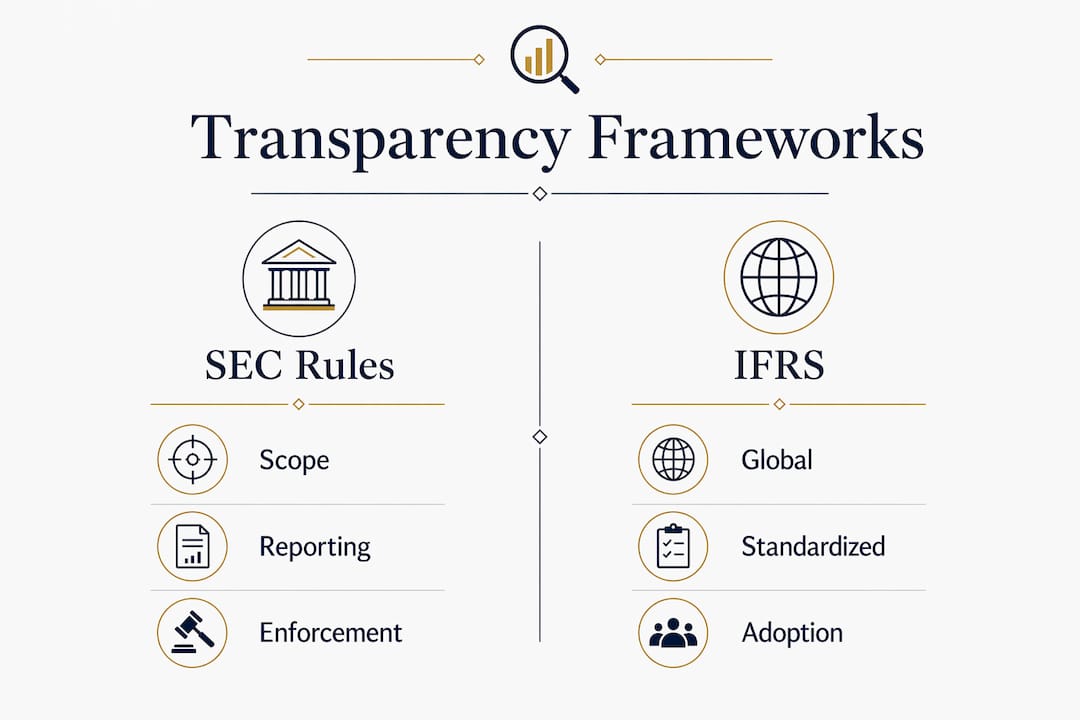
IFRS adoption adds another layer internationally. IFRS standardization improves financial reporting transparency, but its effectiveness depends on market maturity and enforcement strength. Standardization alone does not guarantee meaningful disclosure. A company in a jurisdiction with weak enforcement can technically adopt IFRS while still obscuring material risks through selective presentation.
The table below compares the three primary frameworks by scope, key transparency requirements, and enforcement mechanism.
| Framework | Scope | Key Transparency Requirements | Enforcement |
|---|---|---|---|
| SEC Disclosure Rules | U.S. public companies | 10-K, 10-Q, 8-K filings; material risk disclosure | SEC enforcement actions, delisting |
| Corporate Transparency Act | U.S. entities broadly | Beneficial ownership reporting | FinCEN penalties |
| OECD Principles | Global, voluntary | Board accountability, shareholder rights, risk disclosure | Peer review, investor pressure |
| IFRS Standards | 140+ jurisdictions | Standardized financial statement presentation | National regulators |
Key exemptions matter. Emerging growth companies under the JOBS Act receive reduced disclosure obligations for up to five years after their IPO. Smaller reporting companies face lower thresholds for executive compensation disclosure. These carve-outs create material gaps in the public record that analysts must account for when conducting a regulatory compliance review.
How do transparency assessments differentiate compliance from true transparency?
Compliance and transparency are not the same thing. A company can file every required document on time and still communicate almost nothing of substance about its actual financial condition or governance risks.
True corporate transparency is a strategic capability. It requires companies to provide context for their numbers, explain the assumptions behind forward-looking statements, and update stakeholders when material conditions change. A company that discloses a revenue miss in a 10-Q without explaining the operational cause has technically complied. It has not been transparent.
Analysts conducting a shareholder rights assessment should look for the following characteristics in genuinely transparent companies:
- Timely and voluntary updates when material conditions change, not just at mandatory filing intervals.
- Contextual risk disclosure that explains the probability and potential magnitude of identified risks, not boilerplate language.
- Consistent narrative alignment between earnings call statements and SEC filings, with no material divergence.
- Auditor attestation quality, including the nature of any critical audit matters flagged in the 10-K.
- Accessible governance documentation, including board committee charters, related party transaction policies, and executive compensation rationale.
Enhanced transparency can paradoxically increase 10-K report complexity by adding granular operational data. That complexity aids sophisticated institutional investors while potentially obscuring key signals for less experienced analysts. The implication is direct: disclosure volume is not a proxy for disclosure quality.
"The gap between what a company files and what it actually communicates is where mispricing lives." This is the core premise behind forensic disclosure analysis.
Pro Tip: When reviewing SEC filings, compare the risk factors section across three consecutive annual reports. If the language is nearly identical year over year, treat that as a signal of disclosure opacity rather than stable risk. Genuine transparency updates risk language as conditions evolve.
What recent regulatory reforms are shaping transparency requirements in 2026?
The SEC's 2026 regulatory agenda represents a significant directional shift. The agency proposed raising the large accelerated filer threshold from $700 million to $2 billion in public float, which would reclassify a substantial number of companies into lower-obligation reporting categories. That reclassification reduces the minimum transparency floor for those companies.
The SEC's 2026 capital formation agenda also prioritizes reducing issuer costs over environmental disclosure mandates, including a proposal for optional semiannual reporting in place of quarterly filings for certain companies. The intent is to lower administrative burden. The consequence is less frequent public disclosure for a segment of the market.
These deregulatory moves create a specific challenge for governance analysis:
- Companies that drop from large accelerated filer to accelerated filer status lose the requirement for an independent auditor's attestation on internal controls under Sarbanes-Oxley Section 404(b).
- Optional semiannual reporting reduces the frequency of material event disclosure, widening the gap between actual performance and public record.
- Reduced climate disclosure requirements remove a category of forward-looking risk data that institutional investors had begun incorporating into valuation models.
Proposed SEC reforms reduce compliance costs but create governance gaps where companies must voluntarily maintain high transparency to satisfy institutional investors. That voluntary layer is precisely where the aspiration-to-execution gap becomes measurable. Analysts tracking accountability benchmarks in 2026 need to account for this structural shift.
Internationally, the picture moves in the opposite direction. By 2025, 83% of jurisdictions require shareholder abstention from voting on related party transactions, up from 30% in 2014. That shift reflects a global consensus that shareholder rights protections require structural enforcement, not voluntary adoption.
How can investors, analysts, and policy-makers assess company compliance and transparency?
Assessing corporate transparency requires a structured diagnostic process, not a checklist of filed documents. The OECD and G20 Principles of Corporate Governance provide the most widely used diagnostic framework, covering board accountability, disclosure quality, shareholder rights, and audit independence.
Effective assessment combines four evaluation dimensions:
- Disclosure quality review: Examine whether filings provide forward-looking context, quantify material risks, and align with earnings call narratives. Divergence between verbal guidance and written filings is a primary indicator of disclosure opacity.
- Governance structure analysis: Evaluate board independence ratios, committee composition, and the existence of related party transaction policies. Independent audit committees with financial expertise correlate with higher disclosure integrity.
- Shareholder rights mapping: Confirm whether the company's governance documents protect minority shareholders, restrict dual-class share structures, and provide meaningful proxy access. The shareholder engagement checklist developed from OECD frameworks offers a practical starting point.
- Audit integrity assessment: Review critical audit matters in the most recent 10-K, auditor tenure, and any restatement history. Auditor changes within 12 months of a material event warrant additional scrutiny.
Institutional investors increasingly supplement mandatory filings with alternative data sources and direct engagement to address gaps created by deregulation. That practice is no longer optional for serious governance analysis. It is the standard operating procedure for any investor who needs to understand actual corporate performance versus communicated promises.
Pro Tip: Flag companies that have recently changed filer status under the 2026 SEC proposals. A company moving from large accelerated filer to accelerated filer loses Section 404(b) auditor attestation. That single change removes one of the most reliable independent checks on internal control quality. Adjust your risk weighting accordingly.
Policy-makers can promote transparency by tying capital market access incentives to voluntary disclosure standards that exceed minimum filing requirements. Jurisdictions that pair IFRS adoption with strong enforcement mechanisms consistently produce higher-quality disclosures than those relying on standardization alone.
Key Takeaways
A public company transparency regulatory assessment measures the gap between minimum disclosure compliance and the quality of communication that actually informs investor and governance decisions.
| Point | Details |
|---|---|
| Compliance is not transparency | Filing on time satisfies regulators but does not guarantee meaningful disclosure of risks or governance practices. |
| 2026 SEC reforms reduce the floor | Raising the large accelerated filer threshold to $2 billion removes Section 404(b) requirements for reclassified companies. |
| OECD frameworks are diagnostic tools | The OECD Principles of Corporate Governance provide a structured lens for assessing board accountability and shareholder rights. |
| Disclosure volume signals nothing | Higher 10-K complexity can reflect genuine transparency or deliberate obfuscation. Analytical depth determines which. |
| Deregulation shifts burden to investors | As mandatory disclosure requirements ease, institutional investors must rely more on alternative data and direct engagement. |
The gap between filing and communicating is widening
The regulatory reforms of 2026 are not a minor recalibration. They represent a structural shift in the relationship between public companies and their disclosure obligations. I have spent years analyzing corporate filings across sectors, and the pattern is consistent: when the regulatory floor drops, the distance between what companies are required to say and what investors need to know expands.
The deregulatory direction the SEC is taking has a defensible rationale. Reducing compliance costs for mid-sized issuers does lower barriers to capital formation. The problem is that cost reduction and accountability are not always compatible objectives. When a company loses its Section 404(b) auditor attestation requirement because its public float fell below a revised threshold, the market loses an independent check that has historically caught material control weaknesses before they became restatements.
What concerns me most is the voluntary transparency gap. Institutional investors with direct access to management can fill that gap through engagement. Retail investors and smaller governance advocates cannot. That asymmetry is not new, but the 2026 reforms make it wider. Policy-makers who care about market integrity need to design incentive structures that reward voluntary disclosure quality, not just penalize non-compliance.
The most effective response for analysts is to treat regulatory filings as a starting point, not a conclusion. The transparency premium in equity valuation is real and measurable. Companies that communicate proactively, update risk disclosures as conditions change, and maintain consistent narrative alignment between filings and earnings calls trade at a premium over time. That premium is the market's way of pricing the credibility gap.
— Glen
How Lacunaindex measures what filings do not say
Regulatory filings establish what companies are required to disclose. Lacunaindex measures what they actually communicate relative to what they have claimed.
The platform mines earnings calls, SEC filings, press releases, and proxy statements to quantify the aspiration-to-execution gap for each company it covers. Execution scores and sector benchmarks allow investors and analysts to compare disclosure quality across peers without relying on management-curated narratives. The Lacuna report guide walks through exactly how to interpret each component of a forensic disclosure assessment, from credibility scoring to archetype classification. For analysts building a systematic approach to corporate transparency evaluation, the sector financial benchmarks provide the reference data needed to contextualize individual company scores against industry norms. The platform operates entirely on public records, which means every finding is reproducible and auditable.
FAQ
What is a public company transparency regulatory assessment?
A public company transparency regulatory assessment is the structured evaluation of how accurately and completely a public company discloses financials, governance practices, and material risks. It measures both regulatory compliance and the quality of voluntary communication beyond minimum filing requirements.
How does SEC deregulation in 2026 affect transparency?
The SEC's 2026 proposals raise the large accelerated filer threshold from $700 million to $2 billion, which removes Section 404(b) auditor attestation requirements for reclassified companies. That change reduces the minimum independent oversight of internal controls for a segment of the public market.
What is the difference between financial disclosure and financial transparency?
Financial disclosure is the act of filing required documents with regulators. Financial transparency is proactive, accurate, and consistent communication of financial health and risks that goes beyond legal minimums to build genuine stakeholder trust.
How do OECD principles support shareholder rights assessment?
The OECD Principles of Corporate Governance provide a diagnostic framework covering board accountability, related party transaction controls, and shareholder voting rights. By 2025, 83% of jurisdictions required shareholder abstention on related party transaction votes, up from 30% in 2014, reflecting the principles' growing influence.
What tools do institutional investors use to assess company compliance?
Institutional investors use OECD and G20 governance frameworks as diagnostic tools, supplement mandatory filings with alternative data sources, and conduct direct management engagement to identify risks not captured in regulatory disclosures.