
Governance red flags in public disclosures are specific indicators in company filings and reports that signal weaknesses or risks in corporate governance, internal controls, or disclosure practices. These signals appear across Form 10-K annual reports, proxy statements, SEC registration statements, and earnings call transcripts. Regulations like SOX Section 404 and SEC Regulation S-K Item 404 create the disclosure framework within which these warning signs become visible. Investors and analysts who learn to read these signals systematically gain a material advantage in risk assessment before financial distress surfaces.
What are common governance red flags in financial statement and internal control disclosures?
The most consequential warning signs in governance begin with internal control failures reported under SOX Section 404. A material weakness means there is a reasonable possibility that a material misstatement will not be prevented or detected on a timely basis. That threshold matters because it defines risk exposure before an actual error occurs, not after.
Analysts should distinguish between two severity levels in these disclosures:
- Material weaknesses require public disclosure in annual reports and trigger auditor attestation requirements. They represent the highest level of control failure.
- Significant deficiencies are less severe and reported only to the audit committee, not publicly. Their absence from public filings does not mean they do not exist.
- Ineffective disclosure controls signal that management cannot certify the reliability of its own reporting. This certification failure, required under SOX Sections 302 and 906, is itself a red flag.
- Delayed remediation is a distinct signal. Late remediation or the absence of reliable remediation evidence classifies as a governance red flag independent of whether a financial misstatement has yet occurred.
- Repeated material weaknesses across consecutive annual filings indicate a systemic control environment failure, not an isolated incident.
The market consequences of these disclosures are direct. Companies that disclose ineffective internal controls face increased risk premiums, higher cost of capital, and reduced stock prices as investors reprice governance uncertainty. The SEC has also used control failure disclosures as the basis for enforcement actions, particularly when management certifications appear inconsistent with auditor findings.
Pro Tip: When screening Form 10-K filings, search for the phrase "material weakness" in the internal controls section and then cross-reference the remediation timeline disclosed in the prior year filing. A gap between promised and actual remediation dates is a high-signal governance indicator.

How to identify governance red flags related to related-party transactions in public disclosures
Related-party transactions are defined under SEC Regulation S-K Item 404 as transactions exceeding $120,000 that involve directors, officers, director nominees, shareholders holding more than 5% of outstanding shares, or their immediate family members. Disclosure is mandatory in proxy statements and registration statements. The presence of a disclosure is not itself a red flag. The structure, terms, and pattern of the transaction determine the risk level.
The following table distinguishes normal from suspicious related-party transaction characteristics:
| Characteristic | Normal transaction | Suspicious transaction |
|---|---|---|
| Transaction terms | At or below market rate, documented comparables | Above-market pricing, no comparables cited |
| Approval process | Independent board committee review, documented vote | No documented approval, or approval by interested parties |
| Disclosure quality | Specific amounts, counterparty identity, purpose | Vague descriptions, amounts rounded or omitted |
| Frequency | Isolated or clearly defined duration | Recurring annually with no stated business rationale |
| Structure | Simple, direct, traceable | Multi-layered, routed through subsidiaries or affiliates |
| Fairness assessment | Third-party fairness opinion or market comparison | No fairness assessment disclosed |
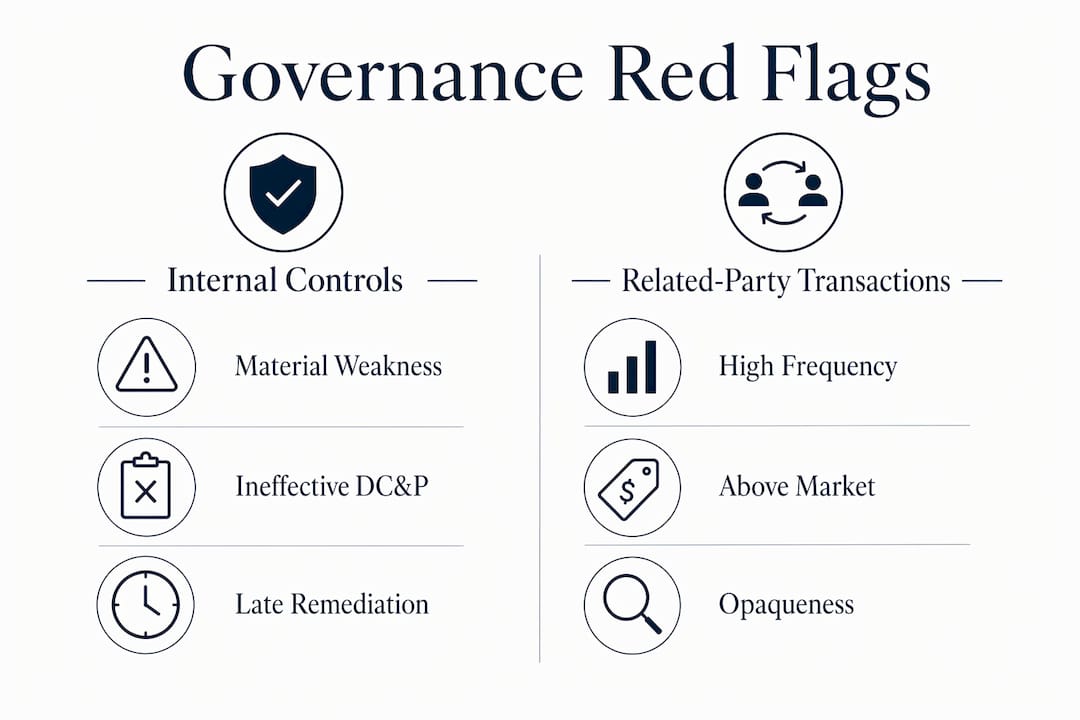
High frequency and above-market terms in related-party transactions indicate governance risk beyond the mere fact of disclosure. Volume and recurrence reveal whether a company is systematically transferring value to insiders rather than conducting isolated, arms-length arrangements.
Analysts should also apply time-series analysis. Tracking renewals and restructurings over multiple proxy statements distinguishes normal governance from a pattern of value extraction. A transaction that appears modest in isolation may represent a material governance problem when viewed across three to five annual filings.
Pro Tip: Never treat related-party disclosure as a binary yes/no check. Compare the disclosed terms against industry benchmarks for similar services or asset transfers. A lease to a CEO-affiliated entity at twice the market rate is a red flag regardless of whether the dollar amount clears the $120,000 threshold.
Why are disclosure controls and procedures critical red flags beyond financial reporting?
Disclosure controls and procedures (DC&P) are the broader governance system that ensures all material information reaches investors in a timely and accurate manner. DC&P extends beyond internal controls over financial reporting (ICFR). It covers non-financial disclosures including regulatory investigations, litigation, environmental liabilities, and executive misconduct. Failure to escalate material events like ongoing regulatory investigations can cause DC&P to be classified as ineffective even when financial controls pass audit.
This distinction matters for analysts. A company can report effective ICFR and simultaneously disclose ineffective DC&P. The two systems are related but not identical. ICFR effectiveness alone is insufficient for a complete governance assessment. Investors who stop at financial control conclusions miss the broader disclosure risk picture.
The consequences of DC&P failure are concrete. Disclosure failures cause restatements, SEC enforcement actions, investor uncertainty, and increased cost of capital. Management time consumed by remediation also diverts resources from operations, creating a secondary performance drag that compounds the governance risk.
Practical screening indicators for DC&P failures include:
- Management disclosures of "ineffective disclosure controls" in the Item 9A section of Form 10-K
- Gaps between the date a material event occurred and the date it was disclosed in an 8-K filing
- Vague or incomplete descriptions of escalation procedures in governance documentation
- Absence of named disclosure committee members or unclear ownership of the disclosure process
- Inconsistencies between what management states in earnings calls and what appears in formal SEC filings
Each of these signals points to a governance infrastructure that cannot reliably surface material information. The annual report credibility of a company depends directly on the integrity of its DC&P framework.
What patterns and disclosure quality issues in public filings signal governance risks?
Disclosure pattern analysis is one of the most underutilized tools in governance screening. A single vague disclosure may reflect drafting style. A recurring pattern of vague, delayed, or inconsistent disclosures across multiple filings reflects a systemic governance problem. Strong disclosure governance requires named owners, clear escalation triggers, and documented evidence standards. Weak governance shows up as vague board minutes, missing approval records, or policies that have not been updated in years.
Analysts should apply the following screening steps when evaluating disclosure quality across public filings:
- Compare disclosure dates to event dates. Material events disclosed weeks or months after they occurred indicate a broken escalation process, not just a drafting delay.
- Check for consistency across filing types. Statements made in earnings call transcripts should align with disclosures in Form 10-K and proxy statements. Divergence between these documents is a high-signal red flag.
- Examine board meeting minutes references. Proxy statements that reference board approvals without specifying vote counts, dissenting opinions, or deliberation records suggest incomplete governance documentation.
- Screen for selective policy enforcement. Consistent policy enforcement in related-party and governance matters strongly mitigates risk. Selective enforcement, where policies apply to some executives but not others, undermines governance credibility.
- Track disclosure language changes year over year. Sudden shifts in how a company describes its risk factors, control environment, or related-party relationships often precede formal restatements or enforcement actions.
The regulatory oversight gaps that create the most investment risk are rarely found in a single document. They emerge from triangulating disclosures across time and filing type. Analysts who build this cross-filing comparison into their standard workflow identify governance deterioration earlier than those who review filings in isolation.
Pro Tip: Use the SEC's EDGAR full-text search to pull every 8-K filed by a company in a given year. Sort by filing date and compare the event dates stated in each filing. A cluster of late filings in a single quarter is a reliable early signal of DC&P failure.
Key Takeaways
Governance red flags in public disclosures are identifiable through systematic analysis of internal control reports, related-party transaction terms, DC&P certifications, and cross-filing disclosure patterns.
| Point | Details |
|---|---|
| Material weakness threshold | Risk exists at "reasonable possibility" of misstatement, before any actual financial error appears. |
| Related-party transaction analysis | Compare terms, frequency, and structure across multiple proxy filings, not just the current year. |
| DC&P vs. ICFR distinction | Effective financial controls do not guarantee effective disclosure controls for non-financial material events. |
| Disclosure pattern screening | Cross-reference earnings call statements with Form 10-K and 8-K filings to detect inconsistencies. |
| Remediation timeline gaps | Late or undocumented remediation of control failures is itself a governance red flag, independent of errors. |
The red flags analysts consistently underweight
The governance signals that cause the most investment damage are rarely the ones that generate headlines at the time of disclosure. After 15 years of reading public filings forensically, the pattern is consistent: analysts flag material weaknesses when they appear, then move on once management issues a remediation plan. The remediation plan itself almost never gets scrutinized.
Late remediation is where the real risk lives. A company that discloses a material weakness in year one and provides a vague remediation timeline, then discloses the same weakness in year two with a revised timeline, has told you something definitive about its governance culture. That pattern is more informative than the original weakness disclosure. Most screening frameworks do not capture it because they evaluate filings in isolation rather than as a time series.
The same logic applies to DC&P failures. Investors who focus exclusively on ICFR miss the disclosure control layer entirely. A company can have clean financial controls and still be systematically late in disclosing regulatory investigations, executive departures, or litigation developments. The SEC's enforcement record in recent years reflects exactly this gap. The public company accountability question is not just whether the numbers are right. It is whether the governance machinery surfaces material information when it matters.
The practical implication for analysts is to build time-series comparison into every governance review. A single filing tells you the current state. Three to five years of filings tell you the trajectory. Governance risk compounds when it is not addressed. The trajectory is the signal.
— Glen
Lacunaindex and governance disclosure screening
Lacunaindex applies forensic analysis to public company disclosures, measuring the gap between what companies communicate and what their filings actually demonstrate. The platform mines SEC filings, proxy statements, earnings call transcripts, and press releases to produce execution scores and disclosure quality assessments without relying on insider access.
For investors and analysts building a systematic approach to governance risk, the Lacunaindex user guide explains how to interpret forensic reports and apply execution scores to specific governance screening questions. The sector benchmarks provide valuation context for assessing how a company's disclosure quality compares to its peer group. Both resources are built for professionals who need evidence-based governance assessment, not narrative summaries.
FAQ
What is a material weakness under SOX Section 404?
A material weakness is a deficiency in internal controls where there is a reasonable possibility that a material misstatement will not be prevented or detected on a timely basis. It must be disclosed publicly in the company's annual report.
What is the disclosure threshold for related-party transactions under SEC rules?
SEC Regulation S-K Item 404 requires disclosure of related-person transactions exceeding $120,000 involving directors, officers, nominees, or shareholders holding more than 5% of outstanding shares. Disclosure appears in proxy statements and registration statements.
How do disclosure controls and procedures differ from internal controls over financial reporting?
DC&P covers all material disclosures including non-financial events, while ICFR addresses only financial statement accuracy. A company can have effective ICFR and still disclose ineffective disclosure controls if it fails to escalate material non-financial events on time.
What makes a related-party transaction a governance red flag?
High frequency, above-market terms, opaque structures, and missing fairness assessments convert a disclosed transaction into a governance risk signal. Analysts should apply time-series analysis across multiple proxy filings to detect value-transfer patterns that appear modest in any single year.
How can analysts detect disclosure pattern red flags across public filings?
Compare event dates to disclosure dates in 8-K filings, cross-reference earnings call statements with Form 10-K language, and track year-over-year changes in risk factor descriptions. Weak disclosure governance consistently shows up as vague board minutes, missing approvals, and stale escalation policies.