
Public records due diligence on a U.S. public company is the systematic comparison of what the company says (earnings calls, press releases, investor presentations) with what its filed and otherwise public documents show it did. The method is repeatable only when every claim is logged, matched to a document, and scored by the same rules. Lacuna Index applies that discipline to public companies using public records alone, and it publishes sector benchmarks that show where narrative and delivery diverge.
TL;DR
- Public-company due diligence is a multi-source exercise: company and industry profile, financial statements, annual reports, SEC filings, legal proceedings, risk factors and proxy disclosures, not a single database check (AALL, 2024).
- Public companies are comparatively easy to research because regulation puts much of the information into SEC filings and investor-relations pages (Library of Congress).
- The central discipline is separating narrative documents (press releases, calls) from attested or legally filed ones (10-K, proxy), and testing the former against the latter.
- Record availability and definitions vary by state, and databases have coverage limits, so each record needs independent verification and a documented trail.
- Sector benchmarks on Lacuna Index are free; company-level forensic reports require a subscription.
Table of Contents
- 1. What the term means in practice
- 2. The source map: which record answers which question
- 3. A pre-research checklist
- 4. Running the comparison
- 5. Verification, conflicts and gaps
- 6. Access rules that change what a researcher can obtain
- 7. Documenting the work so it survives challenge
- 8. From a manual method to a standing process
- Where Lacuna Index fits
- Perspective
- FAQ
- Sources
1. What the term means in practice
The phrase covers two different activities. The first, familiar from transactions and background screening, checks an entity or person against court, licensing and regulatory records. The second, which this article addresses, is directed at a listed company's own communications: whether the stated strategy, targets, controls and commitments are matched by delivery that the public record can confirm.
The second activity is the one that serves institutional investors, governance advocates, financial journalists, regulators, proxy advisors and research analysts. It depends on a feature of the U.S. disclosure system: public companies are comparatively easier to research than private ones because regulatory requirements make much information available through SEC filings and company investor-relations pages, as the Library of Congress company research guide explains. The difficulty is therefore rarely access. It is structure: deciding which document is authoritative for which claim, and recording the comparison so that another analyst can repeat it.
2. The source map: which record answers which question
A workable source map pairs each category of claim with the document that carries the most legal weight. The table below is a working framework drawn from the cited guides and from standard filing types.
| Question | Primary public record | What it can establish | Typical limit |
|---|---|---|---|
| What does the business actually do, and where? | Form 10-K | Operations, competitive and regulatory conditions, facilities, workforce, legal proceedings, environmental matters, subsidiaries (Good Jobs First guide) | Annual cadence; written by the issuer |
| Who governs, and how are they paid? | Proxy statement (DEF 14A) | Officers, directors, biographies, senior-executive compensation (Library of Congress) | Usually limited to senior leadership |
| What did management promise publicly? | Press releases, earnings call transcripts | Official position and historical promises | Substantial hype is common (Good Jobs First guide) |
| What was the formal risk posture? | 10-K risk factors, legal proceedings | Disclosed exposures and litigation | Boilerplate risk language |
| How does the story present to shareholders? | Shareholder annual report | Narrative framing | Distinct from the government-filed 10-K (AALL, 2024) |
Two points follow from the table. First, the shareholder annual report and the 10-K are separate documents, and the AALL handout recommends examining both as independent sources. Differences in emphasis between them are themselves evidence. Second, the EDGAR database holds filings from 1994 onward, with some from 1993, and earlier filings may require paper copies or subscription archives, according to the Library of Congress. Multi-year delivery tests that reach back before 1994 need to plan for that boundary.
3. A pre-research checklist
A checklist is useful before any document is read, because it fixes scope and prevents the analysis from following whichever filing is most readable. The AALL 2024 due-diligence handout names the components: a company profile, an industry profile, financial statements, annual reports, SEC filings, legal proceedings, risk factors and proxy disclosures. Adapted for a claims-versus-delivery review, the checklist runs as follows.
- Define the question and the period. Specify the claims under test (for example, margin targets, remediation commitments, capital-return pledges) and the fiscal years covered.
- Build the company and industry profile. Record the legal entity, subsidiaries, segments and the peer set against which results will be read.
- Collect the narrative corpus. Earnings call transcripts, press releases, investor presentations and public statements for the full period, each with a date and a location.
- Collect the filed corpus. 10-K and 10-Q filings, current reports on Form 8-K, financial statements and the proxy statement for each year.
- Pull the legal and risk layer. Legal proceedings and risk factors, plus any disclosed regulatory matters.
- Set evidence rules in advance. Decide which document types count as confirmation, which count only as claims, and how conflicts will be resolved.
- Open a log. Every claim and every piece of evidence receives an identifier, a date, a source location and a note on how it was obtained.
The sixth step is the one most often skipped, and it is the one that determines whether the finished work is defensible. A rule written after the evidence has been read tends to fit the conclusion.
4. Running the comparison
Extract claims as testable statements
A claim is testable when it names a metric, a direction and a horizon. "Operational excellence" is not testable; "mid-teens segment margin by fiscal year-end" is. Extraction should preserve the speaker, the venue and the date, since the same sentence carries different weight in a prepared remark than in an answer to an analyst. Press releases serve as primary sources for a company's official position and its historical promises, though the Good Jobs First guide cautions that they can contain substantial hype, so they are treated as claims and never as confirmation.
Match each claim to an authoritative record
Each extracted claim is matched to the filing that would show the outcome: segment results in the 10-K for a margin target, the legal proceedings section for a remediation pledge, the proxy statement for a pay-for-performance assertion. A detailed procedure for this step appears in the guide on cross-referencing public filings, and the approach to formal claim testing is set out in validating corporate claims in public disclosures.

Read the governance layer
The proxy statement is the principal public source for directors and executive pay. Because the Library of Congress notes that coverage is usually limited to senior leadership, conclusions about management quality below that level should not be drawn from it. The forensic proxy statement red flags guide lists the patterns worth auditing, such as incentive metrics that diverge from the metrics management emphasizes on calls.
Watch the event layer
Current reports on Form 8-K record events between periodic filings, and their timing relative to public statements is informative. The five-step method in 8-K filing analysis covers this, and the material on Reg FD implications addresses how selective disclosure shows up in the record.
Score consistently
A finding is only comparable across issuers if the same scoring rules are applied to each. Where an analyst scores one company by judgment and the next by a different standard, the output cannot support a ranking. Alongside the filings, an analyst may also compare management statements against independent financial disclosures and operational data; assessing company statements alongside independent financial disclosures is one place to see how document-reading and validation work is applied to business records.
5. Verification, conflicts and gaps
Public records are not necessarily online, easy to obtain or free, and their availability and even their definition vary by state and country, according to the Harvard Library business records guide. The same guide advises checking a database's coverage and independently verifying information before relying on it. Four rules follow.
Corroborate across at least two independent record types. A figure in a press release that also appears in audited financial statements is corroborated; a figure that appears only in the press release is a claim.
Treat conflicts as findings. When the 10-K, the shareholder annual report and an earnings call describe the same matter differently, the divergence is logged with both sources. It is not resolved by choosing the more flattering version.
Record absence precisely. A missing disclosure supports a statement about the record ("no disclosure located in the filings reviewed, searched on these terms and dates"), not about the underlying facts. The search terms and the date of the search belong in the log.
Separate allegations from findings. Litigation and regulatory proceedings listed in a filing show that a matter exists and how the company characterizes it. They do not show an outcome until a resolution is recorded.
The limits on seniority matter here too: information is most commonly available for top executives and directors, while finding information about people lower in the hierarchy is harder, as the Library of Congress officers guide observes. Conclusions should be scoped to the level the record can support.

6. Access rules that change what a researcher can obtain
The documents above are federal securities filings and are available to anyone. Records held by states and local agencies are a different matter, because public-records statutes differ by jurisdiction, and recent amendments have changed timing and eligibility. The Wyoming Legislative Service Office's May 2026 multistate comparison reports two examples:
- Idaho's 2025 law distinguishes residents from nonresidents. As of July 1, 2025, residents receive an initial response within three working days and nonresidents within 21 calendar days.
- Texas House Bill 4219 took effect September 1, 2025, and sets a 10-business-day response period in specified cases where no responsive information exists or information must be withheld.
For a diligence timetable, the practical consequence is that state-held records (permits, inspection files, procurement documents) cannot be scheduled with the same certainty as an EDGAR download. The statute of the relevant state and the requester's residency should be checked first, and counsel should be consulted where a request is contested.
7. Documenting the work so it survives challenge
Journalists, proxy advisors and regulators all need to be able to show where a statement came from. Each log entry should hold the filing type, accession or URL, date filed, page or section, the exact language relied on, and the date the document was retrieved. The SEC citation guide sets out a format for this, and the piece on turning EDGAR filings into auditable evidence shows how the log supports an investigation. For orientation on the wider source landscape, corporate accountability and public records and alternative data sources for equity research are the relevant companions.
8. From a manual method to a standing process
The manual method above is sound, but its cost scales with each company, each year and each claim. The constraint is consistency: standardized rules applied to every issuer are what make results comparable across a sector.
Lacuna Index is built around that requirement. The platform measures the gap between corporate narrative claims and actual delivery using public records only, with no insider access and no proprietary data, and its scoring carries governance logs so that each result can be traced to its evidence. Companies are classified into archetypes (earned, borrowed or undervalued) according to performance and valuation metrics. Sector benchmarks are free to read, for example Health Care, Industrials, Consumer Staples and Financials, while the methodology walkthrough documents the scoring process.
Where Lacuna Index fits
For teams that need per-company forensic reports with execution and narrative scores, Lacuna Index offers per-company analysis and subscription plans named Cohort Pulse and Sector Sweep, described on the pricing page. No prices are published there.
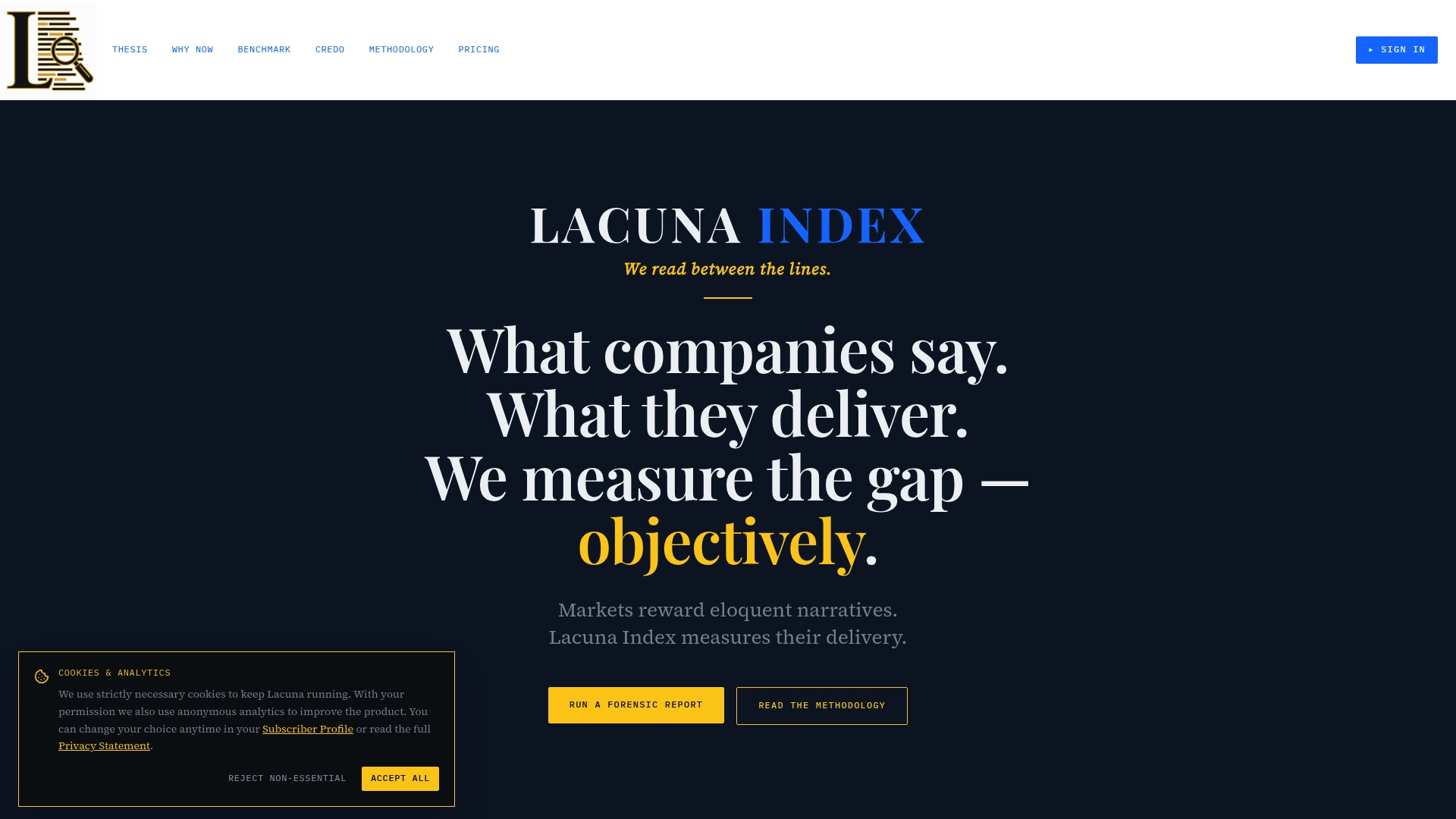
The subscription gives institutions, proxy advisors, governance professionals and financial journalists access to company-level reports, while sector benchmarks remain open to all readers. The full offering is described on the Lacuna Index site.
Perspective
Diligence on public companies is usually framed as an access problem. In our experience of building the method, the harder problem is consistency. Every issuer publishes a large corpus, and an analyst can assemble a persuasive case for or against nearly any of them by choosing which documents to weight.
The Lacuna approach removes that discretion in advance. We read only public records, we apply one methodology to every covered company, and we publish governance logs for the scoring, so that the gap between what a company said and what it delivered can be audited by someone who disagrees with us. That is why we regard cross-issuer comparability as the central property of the work, and why sector benchmarks are open while the per-company reports sit behind a subscription.
A checklist gets a researcher to the evidence. A standardized, logged process is what turns the evidence into a result that a committee, an editor or a regulator can rely on.
Glen
FAQ
Do all states have public records laws?
The Harvard Library guide notes that the availability and definition of public records vary by state and country. Each state's statute governs its own records, so response times, eligibility and fees differ. The Wyoming Legislative Service Office's 2026 comparison shows how recent amendments in Idaho and Texas changed timing rules.
What should the checklist cover before research starts?
The AALL handout lists a company profile, an industry profile, financial statements, annual reports, SEC filings, legal proceedings, risk factors and proxy disclosures. A claims-based review adds a defined period, a list of testable claims, evidence rules fixed in advance and a source log.
How far back do EDGAR filings go?
Per the Library of Congress guide, EDGAR holds filings from 1994 onward, with some from 1993. Earlier filings may require paper copies or subscription archives, so studies reaching before that date should plan for different sources.
How should conflicting or missing records be treated?
A conflict between two filings or between a filing and a call transcript is logged as a finding with both sources cited. A missing disclosure is recorded as an absence in the documents searched, with the search terms and date, and no conclusion is drawn about facts the record does not show.
Sources
- 2024 National Legal Research Teach-In Kit: due diligence handout (AALL)
- U.S. Public Companies, Doing Company Research (Library of Congress)
- Officers & Directors, Doing Company Research (Library of Congress)
- Dirt Diggers Digest Guide to Strategic Corporate Research (Good Jobs First)
- Business Records, Factual Research and Public Records (Harvard Library)
- Public Records Act Multistate Comparison, May 2026 (Wyoming Legislative Service Office)