
Corporate accountability is defined as the obligation of organizations to act ethically, transparently, and in accordance with legal standards, verified through legally mandated public records. The Securities Exchange Act, the FinCEN Beneficial Ownership Information rule under the Corporate Transparency Act, and SEC EDGAR form the foundational regulatory framework for corporate accountability public records explained in practice. Compliance officers and investors who understand how these records function gain a structural advantage in detecting misrepresentation, evaluating governance quality, and making defensible decisions. This article maps the full public records ecosystem, from document types to investigation workflows to regulatory nuances, so practitioners can apply it directly.
What types of public records are essential for corporate accountability?
Public records for corporate oversight fall into six distinct categories, each serving a different accountability function. No single source provides a complete picture. Effective due diligence requires all of them.
- Secretary of State business registries. These state-level databases confirm legal formation, registered agent identity, officer and director names, and current standing. A company that has lapsed its registration or changed officers without disclosure is a red flag before any financial review begins.
- SEC EDGAR filings. SEC EDGAR is the primary repository for public company filings, providing zero-cost access with latency of hours. Material misrepresentations in these filings constitute federal securities violations under SEC Rule 10b-5. Annual 10-K reports, quarterly 10-Q filings, and proxy statements (DEF 14A) are the three documents that reveal the most about governance quality and executive accountability.
- Beneficial Ownership Information (BOI) reports. The FinCEN Corporate Transparency Act rule requires most U.S. entities to file BOI reports identifying beneficial owners with at least 25% equity or substantial control. These reports are not yet publicly searchable but are accessible to law enforcement and, in limited circumstances, financial institutions.
- Court records. Civil dockets, bankruptcy filings, and criminal records expose litigation history, judgment liens, and regulatory enforcement actions. Litigation searches are the fastest-growing public record category in due diligence, with 65% of state courts offering free name-based search capabilities. That growth reflects how frequently litigation history predicts future compliance failures.
- License and regulatory compliance records. State agencies publish license status, disciplinary actions, and permit histories for regulated industries. A company operating under a suspended professional license while claiming regulatory compliance presents a direct contradiction.
- Sanctions and exclusion lists. OFAC's Specially Designated Nationals list and SAM.gov's exclusion database are mandatory screening points. Transacting with a sanctioned entity creates federal liability regardless of whether the compliance officer knew the entity's status.
Pro Tip: Cross-reference Secretary of State records with OFAC and SAM.gov before reviewing any financial filings. Structural disqualifiers found early eliminate wasted analysis time downstream.
How do compliance officers and investors use public records in their investigation process?
The public records corporate investigation process follows a structured sequence. Skipping steps or relying on a single source produces incomplete risk assessments. The workflow below reflects standard practice for high-stakes due diligence.
- Confirm legal existence and standing. Query the Secretary of State registry in the entity's state of formation and any state where it claims to operate. Verify that the entity is active, in good standing, and that the registered agent is current.
- Screen for sanctions and exclusions. Run the entity name, all known officer names, and any affiliated entities against OFAC, SAM.gov, and applicable state debarment lists. This step takes minutes and eliminates the most severe regulatory exposure.
- Pull SEC EDGAR filings. For public companies, review the most recent 10-K for auditor attestation language, going-concern qualifications, and management discussion disclosures. Compare stated performance metrics against prior-year guidance to identify the aspiration-to-execution gap.
- Search litigation records. Query federal PACER and available state court dockets for civil suits, regulatory enforcement actions, and bankruptcy proceedings. Comprehensive litigation reviews identify potential liabilities before high-stakes transactions close.
- Verify beneficial ownership. Cross-check disclosed ownership structures against Secretary of State filings, UCC lien records, and any available BOI data. Federal ownership trails are shrinking, requiring investigators to reconstruct beneficial ownership from structured sources due to siloed databases. That fragmentation is not accidental; it is the primary reason layered verification is necessary.
- Review complaint and regulatory databases. Check the Better Business Bureau complaint patterns, state attorney general enforcement records, and industry-specific regulatory databases for patterns of consumer or counterparty harm.
A baseline legitimacy verification using public records typically takes under 30 minutes and reveals key red flags. That efficiency means there is no justification for skipping the process on any transaction above a defined materiality threshold.
Pro Tip: Run steps 1 and 2 simultaneously. Legal standing and sanctions screening are independent checks that do not require each other's results, so parallel execution cuts total verification time significantly.

What regulatory nuances affect how public records are used for accountability?
The term "public accountability" carries a precise regulatory meaning that practitioners must distinguish from its general usage. Public accountability is a regulatory classification determining whether entities apply full IFRS standards or the IFRS for SMEs standard, based on two IASB criteria: whether the entity has issued debt or equity instruments in a public market (Criterion A), or whether it holds assets in a fiduciary capacity for a broad group of outsiders (Criterion B). That classification dictates disclosure depth, not just reporting format.
Several additional regulatory constraints shape how records can be accessed and used:
- Corporate Transparency Act scope and limits. BOI reports cover most U.S. entities formed after january 1, 2024, with 23 exemption categories including large operating companies and SEC-registered issuers. The exemptions mean that many entities compliance officers encounter will not have filed BOI reports, requiring reconstruction from alternative sources.
- Delaware Section 220 shareholder inspection rights. Section 220 demands are increasingly used as strategic tools for corporate concessions, with courts applying stricter confidentiality and scope limitations. A shareholder must state a proper purpose with reasonable particularity to survive judicial scrutiny.
- Confidentiality and scope limitations. Corporations can reject Section 220 demands that fail procedural requirements or lack a proper purpose. Companies can require confidentiality agreements and restrict the use of produced documents. This means that even legally obtained records carry conditions on their downstream use.
- Jurisdictional fragmentation. Court records, license databases, and regulatory enforcement files are maintained at the state and county level with no unified federal index. A company operating in 12 states generates compliance records across 12 separate systems.
Shrinking federal ownership transparency compels reliance on primary-source data aggregators to reconstruct corporate control. The Government Accountability Office has flagged this gap as a systemic challenge for investigators and regulators alike.
| Regulatory framework | Scope | Key limitation |
|---|---|---|
| FinCEN BOI rule (CTA) | Most U.S. entities formed or registered to do business | 23 exemption categories; not publicly searchable |
| SEC Rule 10b-5 | Public company filings on EDGAR | Applies only to registered issuers |
| Delaware Section 220 | Delaware-incorporated entities | Proper purpose and particularity required |
| IASB public accountability criteria | Entities with public market instruments or fiduciary assets | Classification affects reporting standard, not disclosure access |
| OFAC / SAM.gov | All U.S. persons and entities in regulated transactions | Screening is mandatory; no knowledge defense |
How does effective use of public records improve governance and investor confidence?
Transparent public records deter fraud and mismanagement by raising the cost of concealment. When officers know that SEC filings, court records, and beneficial ownership data are accessible to investors, regulators, and counterparties, the friction of maintaining a false narrative increases. That deterrent effect is structural, not incidental.
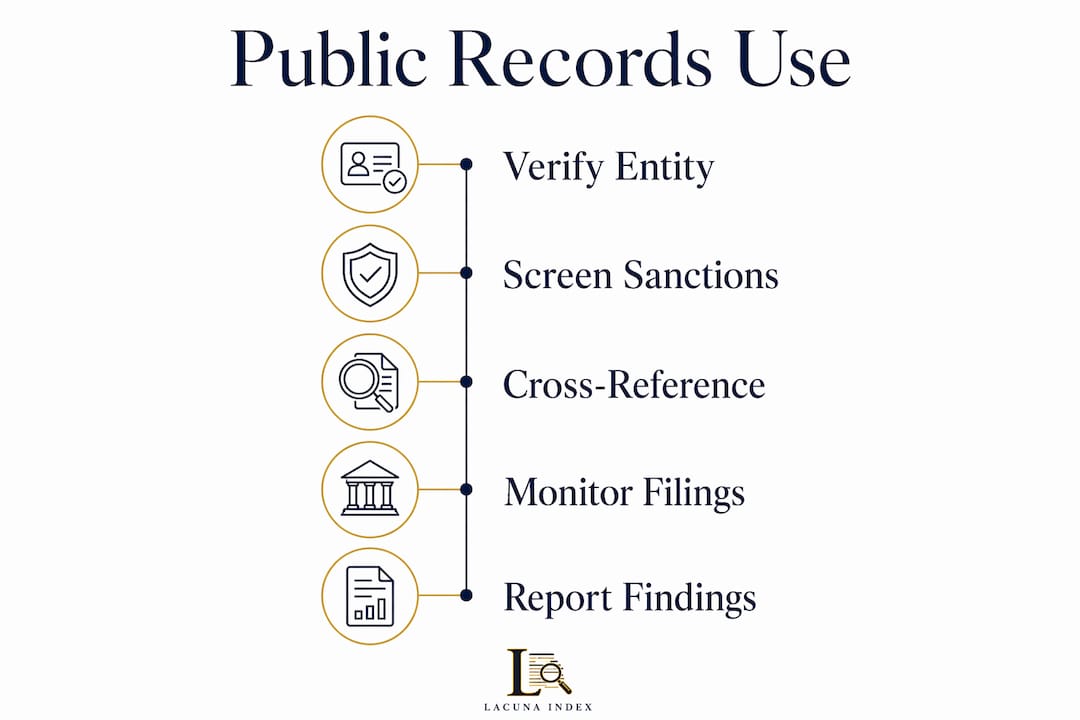
Joining federal workplace enforcement data, SEC financials, and other public agency datasets at the establishment level reveals operational risk patterns invisible in siloed analyses. A company with clean 10-K disclosures but a pattern of OSHA violations and wage-theft judgments across its operating subsidiaries presents a risk profile that no single-source review would capture. That composite view is where accountability in business becomes analytically meaningful.
Boardroom accountability improves when companies maintain documentation hygiene proactively. Boards that maintain accurate minute books, current officer records, and complete subsidiary registrations face lower exposure when Section 220 demands arrive. The preparation cost is low; the litigation cost of being unprepared is not.
Pro Tip: Build a composite public record profile for any company you monitor on a recurring basis. Set calendar alerts for annual 10-K filing deadlines and Secretary of State renewal dates. Gaps in those filings are often the first observable signal of internal distress.
Investor confidence follows directly from disclosure quality. A company that files timely, internally consistent disclosures across SEC EDGAR, state registries, and regulatory databases signals operational control. Lacunaindex quantifies this signal by measuring the gap between corporate narrative claims and actual delivery across earnings calls, proxy statements, and press releases, classifying companies as earned, borrowed, or undervalued based on execution scores derived entirely from public company accountability benchmarks. That classification gives compliance officers and investors a structured basis for comparing governance quality across sectors.
Integrating public record research into ongoing compliance monitoring programs converts a one-time due diligence exercise into a continuous risk signal. Regulatory oversight gaps in public reporting are well-documented, and companies that rely on periodic reviews rather than continuous monitoring miss the window between a red flag's first appearance and its escalation into a material event.
Key Takeaways
Corporate accountability requires layered public record verification across SEC EDGAR, state registries, court dockets, and sanctions databases to produce a defensible and complete risk assessment.
| Point | Details |
|---|---|
| Public records span six categories | Secretary of State, SEC EDGAR, BOI reports, court records, license databases, and sanctions lists each serve a distinct accountability function. |
| Baseline checks take under 30 minutes | A structured legitimacy verification using public registries and complaint databases reveals key red flags before deeper analysis begins. |
| Regulatory classification matters | IASB public accountability criteria determine whether an entity applies full IFRS or SME standards, affecting disclosure depth and investor expectations. |
| Fragmentation is the core challenge | Jurisdictional silos across state and federal systems require aggregated, multi-source workflows to reconstruct a complete corporate control picture. |
| Composite data reveals hidden risk | Linking SEC financials with workplace enforcement and regulatory records at the establishment level exposes patterns that single-source reviews miss entirely. |
What I've learned from watching compliance officers rely on the wrong records
The most consistent mistake I observe in corporate accountability workflows is treating SEC EDGAR as the primary source and everything else as supplementary. That hierarchy is inverted. EDGAR filings are the most polished layer of a company's public record. They are drafted by counsel, reviewed by auditors, and filed under penalty of federal law. They represent what a company wants the public to know, organized in the format regulators require.
The revealing records are the ones companies do not control: state court civil dockets, OSHA enforcement logs, state attorney general actions, and UCC lien filings. These records reflect what actually happened, not what was disclosed. A company can craft a narrative of operational excellence in its 10-K while simultaneously accumulating wage-theft judgments in three states. The 10-K will not mention those judgments unless they cross a materiality threshold. The court dockets will show them regardless.
The evolving regulatory environment is making this layered approach more necessary, not less. The Corporate Transparency Act's BOI rule adds a new data point, but its exemptions and access restrictions mean it supplements rather than replaces existing workflows. Delaware's tightening of Section 220 scope and confidentiality requirements signals that companies are becoming more defensive about record access, which itself is a governance signal worth tracking.
The practical advice is straightforward: build your investigation workflow around the records companies do not draft, and use the records they do draft to test consistency. Contradictions between the two layers are where accountability failures become visible.
— Glen
Lacunaindex: forensic analytics built on public records
Lacunaindex applies the multi-source public record methodology described throughout this article at scale, across sectors, and with a consistent scoring framework.
The platform mines earnings calls, SEC filings, proxy statements, and press releases to measure the gap between what companies claim and what they deliver. Every company receives an execution score and an archetype classification, earned, borrowed, or undervalued, based entirely on publicly available disclosures. Compliance officers use sector benchmark reports to compare governance quality across peer groups without relying on company-provided summaries. Investors use the same data to identify mispricing driven by disclosure opacity rather than operational reality. The user guide walks through how to read a Lacuna report and apply its findings to compliance monitoring or investment evaluation workflows.
FAQ
What is corporate accountability in the context of public records?
Corporate accountability is the obligation of organizations to act ethically and transparently, verified through legally mandated public disclosures including SEC filings, state registries, court records, and beneficial ownership reports.
How do I access public records for corporate oversight?
SEC EDGAR provides free access to all public company filings. State Secretary of State databases, federal court PACER, OFAC, and SAM.gov are all publicly accessible with no cost for basic searches.
What is the IASB definition of public accountability?
The IASB defines public accountability as a regulatory classification applied to entities that have issued instruments in a public market or hold assets in a fiduciary capacity for a broad group of outsiders. This classification determines whether full IFRS or the IFRS for SMEs standard applies.
What are Delaware Section 220 shareholder inspection rights?
Section 220 gives Delaware shareholders the right to inspect corporate books and records for a proper purpose stated with reasonable particularity. Courts have tightened scope and confidentiality requirements, making procedural precision critical for both requestors and companies responding to demands.
Why is beneficial ownership data difficult to verify?
Federal ownership transparency has declined, and BOI reports under the Corporate Transparency Act are not publicly searchable. Investigators must reconstruct ownership structures from Secretary of State filings, UCC records, and structured data aggregators to establish a complete control picture.