
An SEC Form 8-K is the current report that public companies file to disclose material events, and most items must reach the SEC within four business days of the triggering event. It functions as the closest thing markets have to a near real-time public feed of corporate developments. For analysts and governance stakeholders, systematic 8-K filing analysis is the fastest route to material information that has not yet been fully priced.
TL;DR:
- Most material event filings must be submitted within four business days after the triggering event, excluding weekends and holidays.
- High-impact items like auditor changes, cybersecurity incidents, and officer departures often signal imminent legal or governance risks and should be closely monitored.
- Reading exhibits and cross-referencing with previous filings quickly reveals critical details such as agreements, financial adjustments, or non-reliance notices that are buried in the narrative.
- Institutional investors tend to react to 8-K disclosures before the filing becomes public, while retail investors usually respond on the filing day, affecting market timing interpretations.
- Comparing 8-K disclosures with prior 10-K and 10-Q filings enhances understanding of true performance versus narrative claims and detects inconsistencies warranting deeper review.
Table of Contents
- 8-K basics: legal role, filing deadline, and where to find filings
- High-impact 8-K items investors should monitor
- How to read an 8-K quickly: a repeatable 5-step workflow
- Exhibits and the difference between "filed" and "furnished"
- How markets respond to 8-Ks: institutional vs retail attention and timing
- Checklist and red flags: when to escalate for forensic review
- Examples of significant historical 8-K filings and their market impact
- Comparison of 8-K filings with other SEC filings like 10-K and 10-Q for context
- Using 8-K monitoring in a forensic evidence framework
- How Lacuna Index supports 8-K filing analysis
- Sources
- FAQ
8-K basics: legal role, filing deadline, and where to find filings
Form 8-K exists under the framework of the Securities Exchange Act of 1934, and the SEC's 2004 rulemaking established the current structure: most triggering events require disclosure within four business days, a substantial acceleration from the prior standard. The deadline runs from the date the event occurs, not the date a company decides to announce it, and weekends and federal holidays do not count toward the four-day window.
Locating filings requires familiarity with EDGAR, the SEC's public filing system, and its supporting index infrastructure. A few practical entry points make the search efficient:
- EDGAR full-text search lets an analyst search by company, form type, or specific phrases such as "Item 4.02."
- Quarterly form.idx files, published in EDGAR's full-index directories, list every filing by form type, company name, CIK, and file path.
- Accession numbers, the unique identifiers assigned to each filing, let researchers track amendments (8-K/A) back to their original disclosure.
Together, these tools turn what looks like a scattered disclosure regime into a searchable, auditable record.
High-impact 8-K items investors should monitor
Form 8-K's item taxonomy spans several numbered sections, but a handful of items carry disproportionate weight for price discovery and governance risk:
- Item 1.01 (material agreements): the header rarely tells the story; the exhibits do, so read counterparties, payment terms, and termination triggers directly.
- Item 2.02 (results of operations): the earnings 8-K pattern, where guidance language and any divergence from prior commentary deserve closer scrutiny than the headline numbers.
- Item 4.01 and Item 4.02 (auditor changes and non-reliance): among the highest-signal integrity alerts in the entire taxonomy, since a non-reliance filing means a company has told investors its own prior financials cannot be trusted.
- Item 5.02 (officer departures) and Item 3.01 (delisting or transfer of listing): governance events that often precede broader disclosures.
- Item 1.05 (material cybersecurity incidents): a mandatory item since December 2023 requiring registrants to describe the nature, scope, timing, and impact of an incident, with narrow provisions for delay in extraordinary circumstances.
Item 4.02 filings are comparatively rare, which is precisely what makes them high-precision indicators. A pattern of practitioner use treats them as early markers that often precede restatements, enforcement inquiries, or executive turnover.
How to read an 8-K quickly: a repeatable 5-step workflow
A fast, disciplined read separates noise from signal within minutes rather than hours.
- Confirm the event date against the filing date and identify the item header, since the gap between when something happened and when it was disclosed is itself informative.
- Open every exhibit, including agreements, financial statements, investor decks, and auditor letters, and scan for dollar figures, indemnities, and carveouts rather than relying on the cover narrative.
- Note whether content is "filed" or "furnished," since that single word changes the legal exposure attached to the disclosure.
- Cross-check recent filings, including the most recent 10-Q, 10-K, and any 8-K/A amendments, along with related ticker news, to see whether the current filing is consistent with prior statements.
- Escalate when red flags appear, such as a non-reliance notice, an auditor reportable event, or an immediate, unexplained officer departure.
Pro Tip: Read the exhibit list before the item narrative. Companies often bury the most consequential term, an indemnity cap or a change-of-control clause, three pages into an attached agreement.
This workflow scales from a single filing to a daily monitoring routine, and analysts who build selective disclosure pattern detection into their process tend to catch inconsistencies that a headline-only read misses.
Exhibits and the difference between "filed" and "furnished"
The substantive evidence in most 8-Ks lives in the exhibits, not the item narrative. Agreements disclose actual payment terms and termination triggers; auditor letters disclose the specific reportable events behind a 4.02; investor decks disclose the assumptions behind guidance language that the cover page only summarizes.
The "filed" versus "furnished" distinction matters legally as well as analytically. Content that is "filed" generally carries Section 18 exposure under the Exchange Act, meaning it can support certain private claims if it proves materially misleading. Content that is "furnished," a status common for Regulation FD-related exhibits and some earnings materials, generally does not carry that same exposure. Checking exhibit labeling and any attached XBRL data before treating a number as authoritative is a basic but frequently skipped step, one that cross-filing consistency checks are built to catch.
How markets respond to 8-Ks: institutional vs retail attention and timing
Reaction timing is not uniform across investor types, and that asymmetry shapes how an immediate price move should be read.
Institutional attention and price discovery often precede the actual EDGAR filing, according to research on who pays attention to Form 8-K, while retail attention tends to peak on the filing day itself, after media coverage circulates. That gap implies that a price move visible at the moment of filing may already reflect information that sophisticated participants acted on earlier, while the retail-driven leg of the move is more likely to revert.
Separately, research matching 8-K filings to Wall Street Journal coverage finds that media adds incremental analysis beyond the raw filing, and the sentiment in that added coverage predicts both short-term and longer-term returns. Combining item type with market timing sharpens interpretation: a 4.02 non-reliance filing tends to draw sustained scrutiny over subsequent sessions, while a routine 2.02 earnings release often produces a same-day move that partially fades once the initial reaction settles.
Checklist and red flags: when to escalate for forensic review
A simple triage framework separates routine filings from those that warrant a deeper look:
- Flag Item 4.02 filings immediately, along with any auditor reportable event or an officer departure with no stated reason and no transition period.
- Treat vague Item 8.01 language involving a regulatory counterparty as a signal to pull the underlying correspondence or related litigation filings, since 8.01 is the catch-all category and companies sometimes use it to soften disclosure of a material issue.
- Cross-check metrics against prior filings, since inconsistent figures across an 8-K, a 10-Q, and an investor deck often precede a restatement rather than announce one outright.
- Watch for related-party agreements buried inside exhibits, particularly when the counterparty's relationship to the company is not disclosed in the item narrative itself.
- Escalate to a deeper forensic review when two or more of these signals appear in the same filing or across a short window of filings from the same issuer.
The partial restatement problem illustrates why this cross-checking step matters: relying on the latest filing alone, without reconciling it against what was previously disclosed, can corrupt financial comparisons built on top of it.
Examples of significant historical 8-K filings and their market impact
The 8-K's role as a market-moving document is best understood through the categories of events it has historically carried rather than any single anecdote. Earnings-related 8-Ks under Item 2.02 have long been the most frequent trigger for same-day trading volume spikes, since they carry the quarterly results and guidance language that analysts and algorithms parse within seconds of filing.
Auditor-related disclosures under Item 4.01 and Item 4.02 have historically produced some of the sharpest reactions in the taxonomy, precisely because they are rare and because a non-reliance notice tells the market that previously filed financial statements can no longer be trusted. Item 5.02 officer departure filings, particularly unscheduled CEO or CFO exits disclosed with minimal explanation, have repeatedly triggered governance scrutiny beyond the immediate price reaction, prompting analysts to review succession planning and internal controls language in subsequent proxy statements.
Item 1.05 cybersecurity disclosures represent the newest category with meaningful market impact, since the rule took effect only in December 2023 and requires registrants to describe the nature, scope, timing, and impact of a material incident. Because the item is new, the market's calibration of how to price these disclosures is still forming, which makes early comparisons across issuers especially valuable for analysts building a baseline. Across all these categories, the common thread is that the item type itself is a reasonable proxy for how much scrutiny a filing deserves before the market has finished digesting it.

Comparison of 8-K filings with other SEC filings like 10-K and 10-Q for context
Form 8-K, Form 10-K, and Form 10-Q serve different disclosure functions, and conflating them leads to analytical errors. The 10-K is the comprehensive annual report, covering audited financial statements, risk factors, and management's discussion and analysis in full detail. The 10-Q is its quarterly counterpart, offering unaudited financial statements and updates on a lighter cadence. Both are scheduled filings, known in advance, and structured around a fixed reporting calendar.
The 8-K is event-driven rather than calendar-driven. It exists to close the information gap between scheduled reports, disclosing a material event as soon as it occurs rather than waiting for the next quarterly or annual filing. This distinction has a direct analytical consequence: a 10-K or 10-Q gives a comprehensive backward-looking picture, while an 8-K gives a narrow, immediate, forward-looking signal about a single event.
The practical implication for analysis is sequencing. A rigorous read of any 8-K should include a check against the company's most recent 10-Q or 10-K, since apparent contradictions, a material agreement disclosed in an 8-K that conflicts with risk factor language in the last 10-K, for instance, are often the most valuable signal in the entire filing. The 8-K rarely stands alone as a complete picture; its value comes from how it updates the baseline established in the periodic reports.

Using 8-K monitoring in a forensic evidence framework
Item-level monitoring is one input among many when assessing whether a company's disclosures match its actual performance. Lacuna Index evaluates that gap using only public records, including 8-Ks, earnings calls, and proxy statements, feeding item-level signals into execution scores and sector benchmarks rather than treating any single filing as conclusive.
— Glen
How Lacuna Index supports 8-K filing analysis
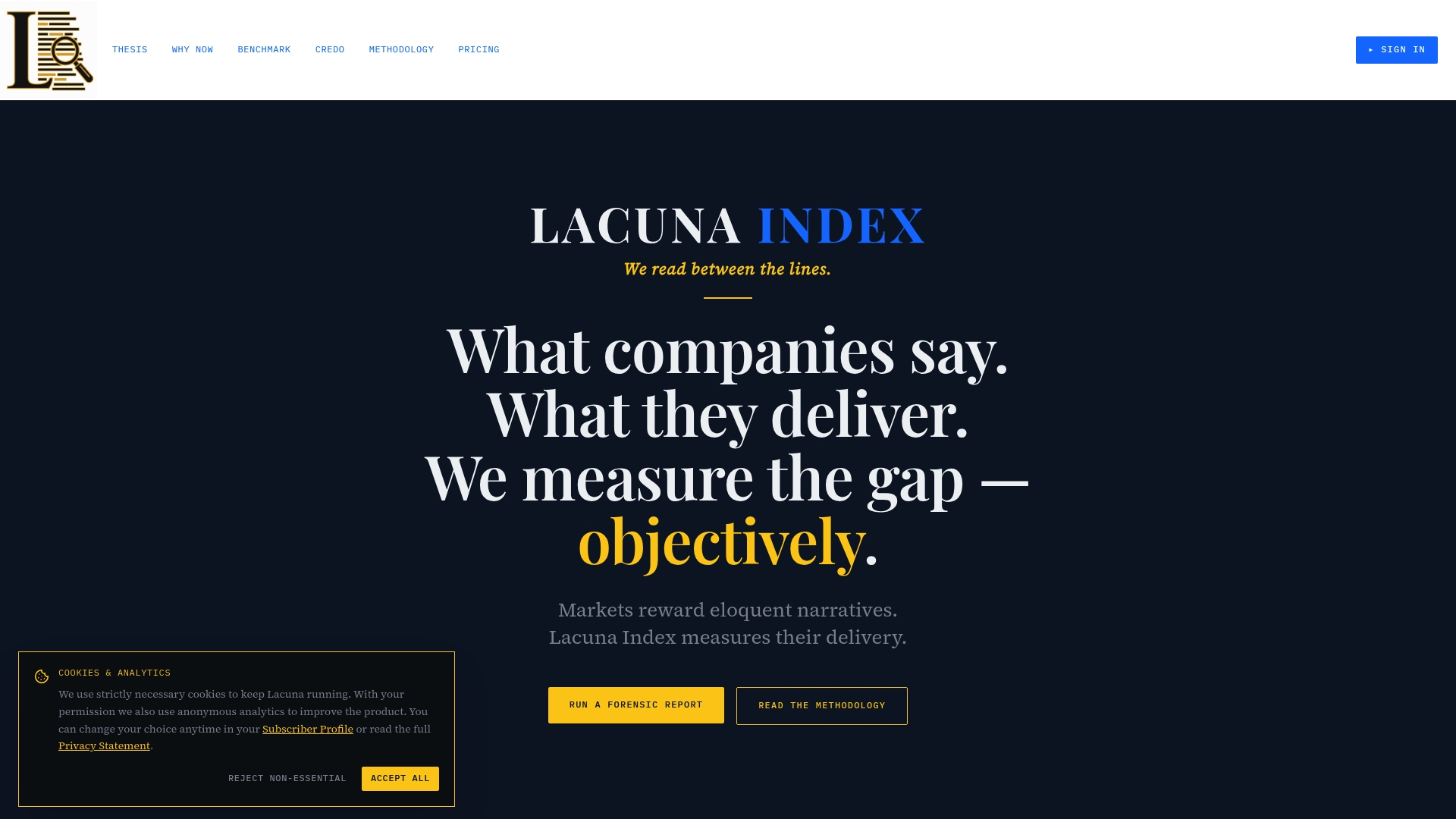
Reading item headers and exhibits manually catches obvious red flags, but reconciling a single 8-K against a company's full disclosure history, prior guidance, proxy language, and earnings call commentary, is a different scale of task. A forensic methodology can be applied to that reconciliation, scoring public companies on the gap between narrative claims and actual delivery using only publicly available records.
For readers who want to go beyond individual filing checks:
- Per-company analysis provides forensic reports scoring execution against narrative claims, drawing on 8-K disclosures and related filings.
- Sector Sweep and Cohort Pulse plans offer benchmarked comparisons across peer companies for institutional subscribers, detailed on the pricing page.
- Governance advocates and financial journalists researching a specific issuer can start with free sector benchmarks before considering a subscription.
Analysts and governance professionals who want to see the scoring approach before subscribing can review the methodology walkthrough or check pricing directly.
Sources
Single-filing review and portfolio-wide monitoring call for different tools, though both start from the same canonical source.
- Additional Form 8-K disclosure requirements; acceleration of filing date (SEC, 2004)
- Who Pays Attention to SEC Form 8-K? (Ben-Rephael et al.)
- Decomposing news and disclosures: WSJ coverage and 8‑K filings (FoFI 2026 paper)
Automated monitoring reduces manual scanning, but false positives are common when keyword filters lack context. Grounding filters in XBRL-tagged data rather than raw text search alone helps cut down on noise.
FAQ
What is the deadline for filing an 8-K after a material event?
Most triggering events require an 8-K filing within four business days of the event, a deadline set by the SEC's 2004 rulemaking. Weekends and federal holidays do not count toward that window, so the actual calendar gap can run longer.
What is the difference between an 8-K and a 10-K?
A 10-K is a comprehensive annual report filed on a fixed schedule, covering audited financials and a full year of business and risk disclosure. An 8-K is event-driven, filed only when a material event occurs, and serves as an update between scheduled periodic reports rather than a replacement for them.
Why does Item 4.02 matter so much to analysts?
Item 4.02 covers non-reliance notices, where a company states that previously issued financial statements should no longer be trusted. These filings are comparatively rare, which is part of why practitioners treat them as high-precision early warnings that often precede restatements or leadership changes.
Does the market react immediately to every 8-K?
Reaction speed varies by item type and investor group. Research on attention patterns around Form 8-K shows institutional attention and price discovery often occur before the filing itself, while retail attention tends to peak on the filing day, which means an immediate price move can partly reflect information already priced by sophisticated participants.
How can I monitor 8-K filings for a specific item type at scale?
The SEC's EDGAR system publishes quarterly full-index and form.idx files that list every filing by form type, allowing scripted or API-based filtering for specific items such as "Item 4.02" or "Item 1.05." Grounding these filters in structured data such as XBRL tags reduces false positives compared to raw keyword search alone.