
Corporate responsibility claims verification is the systematic process of independently validating a company's sustainability, ethical, and governance assertions against auditable evidence. Governance professionals, institutional investors, and financial journalists face mounting pressure to distinguish genuine accountability from engineered narrative. Regulatory regimes like the EU Empowering Consumers for the Green Transition Directive and intensified SEC enforcement have raised the cost of unsubstantiated claims significantly. The standard industry term for this discipline is ESG assurance, though "claims verification" better captures the forensic, evidence-first orientation that regulators and sophisticated investors now require. This guide covers the methods, failure modes, and internal frameworks that make verification defensible.
What methods are used for corporate responsibility claims verification?
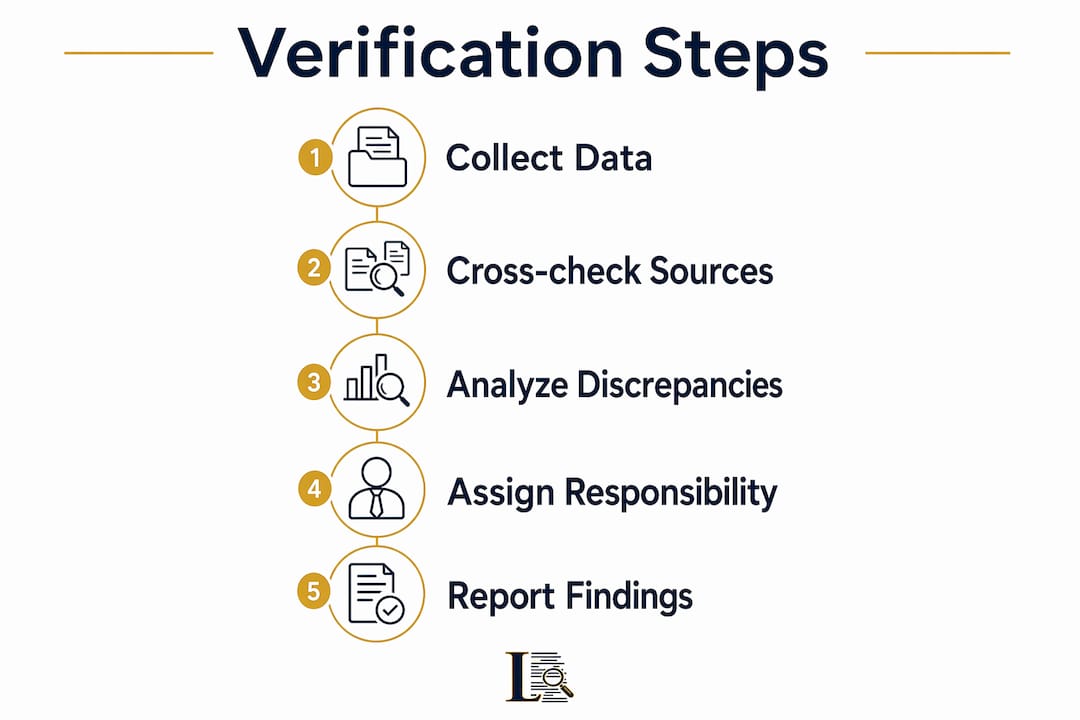
Structured verification follows a defined sequence rather than an ad hoc review. An 8-step process covering entity status confirmation, ownership mapping, risk screening, claim sampling, and audit trail maintenance produces more reliable results than reviewing every claim in equal depth. Sampling the two or three most material claims yields higher reliability than attempting exhaustive coverage, because material claims carry the greatest reputational and legal exposure.
The following steps form the core of a defensible verification sequence:
- Entity status confirmation. Verify legal registration, good standing, and authorized signatories against official registry records.
- Ownership mapping. Trace beneficial ownership structures to identify undisclosed related parties or conflicts of interest.
- Risk screening. Cross-reference the entity and its principals against sanctions lists, adverse media, and regulatory enforcement databases.
- Material claim sampling. Select the two or three claims with the highest financial or reputational materiality and test each against primary source documents.
- Document forensics. Apply metadata scrutiny, font and pixel anomaly detection, and revision history extraction to detect fabricated or altered documents. Cross-document corroboration uncovers fraud patterns that single-document reviews miss entirely.
- ESG indicator validation. Apply Agreed-Upon Procedures under ISRS 4400 (2026) for flexible, cost-efficient validation of specific ESG indicators without requiring a full assurance engagement.
- Automated deterministic checks. Deploy automated systems that perform over 300 deterministic checks per claim, maintaining structured audit logs with 95th percentile success rates.
- Audit trail maintenance. Document every verification step, the version of criteria in force at the claim date, and the evidence reviewed.
Pro Tip: When verifying Scope 3 emissions claims, always request primary supplier data rather than accepting aggregated estimates. Aggregated figures are the single most common point of failure in supply chain sustainability assessments.
Cross-document corroboration is the technique that separates surface-level compliance review from genuine forensic analysis. Comparing articles of incorporation against financial statements, proxy disclosures, and earnings call transcripts reveals inconsistencies that no single document review would surface. Lacunaindex applies this cross-document methodology systematically across SEC filings, press releases, and proxy statements to quantify the gap between corporate narrative and actual delivery.

Why do corporate responsibility claims often fail verification?
The root cause of verification failure is structural, not intentional. Disclosure systems are built for self-reporting, not for external scrutiny. That design gap means the evidence required to substantiate a claim often does not exist in a form that an independent verifier can access or test.
The consequences are measurable. A survey of corporate executives found that 59% admitted their companies had overstated sustainability efforts. The same survey found that 75% believed most of their peers would be found to engage in greenwashing if audited thoroughly. These figures indicate that overstatement is not an outlier behavior. It is a systemic condition produced by the architecture of corporate disclosure.
Several structural factors compound the problem:
- Organizational silos. Finance, procurement, IT, and sustainability teams operate under separate data governance regimes. Breaking down these silos and mandating data integrity across departments is the critical prerequisite for any verification program.
- Scope 3 data gaps. Primary data traceability across complex supply chains remains the weakest link in environmental claims validation. Most companies rely on spend-based estimates rather than supplier-reported primary data.
- Compliance as checkbox. Teams treat regulatory filings as a reporting exercise rather than an opportunity to build a defensible audit trail linking decisions to verified data.
- Regulatory escalation. The EU Empowering Consumers for the Green Transition Directive, effective in 2026, bans generic unsupported claims and prohibits offset-based carbon neutrality assertions outright. Substantiation now requires verified primary data traceable across Scope 1, 2, and 3 emissions.
"Verification often fails because systems are not designed for external scrutiny but internal reporting. Breaking down silos and mandating data integrity across departments is the critical intervention that separates defensible claims from regulatory liability."
The EU directive's prohibition on offset-based neutrality claims is particularly significant. Many companies built their net-zero narratives on carbon offset purchases rather than verified emissions reductions. Those narratives now carry direct legal exposure in EU markets and face increasing scrutiny from US regulators applying similar logic.
How to build an internal framework for claim verification
A verification framework is not a one-time audit. It is a continuous operating process. The starting point is a complete inventory of every live corporate responsibility claim appearing in public communications, including earnings calls, press releases, sustainability reports, and proxy statements. Validating corporate claims in public disclosures requires mapping each claim to the internal data source that is supposed to support it.
The framework requires cross-functional ownership. Sustainability, legal, finance, IT, and procurement must each hold defined responsibilities within the verification process. No single function can close the evidentiary gaps alone.
Practical components of a defensible internal framework include:
- Claim inventory. Catalog every public assertion by category: environmental, social, governance, and financial. Assign a data owner to each.
- Data source mapping. Identify the primary data source for each claim and assess whether it is internally generated, third-party reported, or estimated.
- Supplier contract clauses. Embed contractual requirements for verifiable primary data from upstream suppliers. Without contractual obligation, Scope 3 data will remain unverifiable.
- Continuous monitoring. Monitor disclosure consistency across filings over time rather than conducting point-in-time reviews. Consistency drift is an early indicator of data governance failure.
- Court-ready evidence standards. Cryptographic timestamps capture not only data points but also the version of criteria in force at the claim date. Without this, audits or litigation can dismiss historical verification as unreliable.
Pro Tip: Assign a single executive sponsor to the verification framework. Without executive mandate, cross-functional data sharing stalls at the first departmental boundary. Governance programs without executive accountability consistently underperform on audit readiness.
The court-ready evidence standard deserves particular emphasis. Regulators and plaintiffs' attorneys increasingly demand that companies demonstrate not just what they claimed, but what evidence existed at the time of the claim and which version of the relevant standard applied. Cryptographic timestamping of claim documentation satisfies this requirement in a way that retroactive record assembly cannot.
What are the red flags in corporate transparency disclosures?
Verification escalation decisions depend on recognizing specific anomaly patterns rather than general impressions of credibility. Consistency and discrepancies in ownership, signatories, or addresses are stronger risk signals than the mere existence of a registered legal entity. The table below maps common red flags to their verification implications.
| Red flag | Verification implication |
|---|---|
| Sudden registered address change without disclosed rationale | Possible restructuring to obscure liability or regulatory history |
| Unexplained director or signatory turnover | Governance instability; prior signatories may have withdrawn due to compliance concerns |
| Mismatch between registry data and submitted documents | Possible document alteration; triggers full forensic document review |
| Offset-based neutrality claims without primary emissions data | Non-compliant under EU ECGT 2026; high regulatory exposure |
| Scope 3 figures based solely on spend estimates | Unverifiable under primary data traceability standards; material misstatement risk |
| Inconsistent entity descriptions across filings | Cross-document corroboration failure; indicates siloed disclosure drafting |
Governance red flags in public disclosures require a structured escalation protocol. When two or more flags appear in the same filing cycle, the appropriate response is a full forensic review rather than targeted clarification. Data visualization tools that map entity relationships, ownership changes, and signatory histories over time make pattern detection faster and more reliable than manual review. Lacunaindex applies this pattern detection methodology across public records to produce execution scores that quantify the aspiration-to-execution gap for each covered company.
Monitoring these signals continuously rather than at annual reporting intervals is the standard that regulators and institutional investors now expect. A single-point-in-time check of legal entity existence tells you almost nothing about governance quality. Longitudinal consistency analysis tells you a great deal.
Key Takeaways
Effective corporate responsibility claims verification requires continuous, cross-functional monitoring of primary data sources, not periodic self-reported disclosures.
| Point | Details |
|---|---|
| Sample material claims first | Focus verification effort on the two or three claims with the highest financial or reputational exposure. |
| Apply ISRS 4400 procedures | Use Agreed-Upon Procedures for ESG indicators to achieve cost-efficient, flexible validation without full assurance. |
| Break down organizational silos | Finance, legal, IT, and sustainability must share data governance responsibility for verification to hold. |
| Embed supplier data obligations | Contractual clauses requiring primary data from upstream suppliers are the only reliable path to Scope 3 verification. |
| Use cryptographic timestamps | Court-ready evidence requires capturing the criteria version in force at the claim date, not just the data point itself. |
The verification gap no one wants to close
The uncomfortable reality I have observed across governance reviews is that most organizations know their verification processes are inadequate. The 59% of executives who admitted to overstating sustainability efforts did not do so because they lacked awareness. They did so because the internal incentive structure rewards disclosure volume over disclosure accuracy. Sustainability reports grow longer each year. The evidentiary trail supporting them does not grow proportionally.
The shift that matters is treating verification as a risk management function rather than a communications function. When the legal and finance teams own the evidentiary standards and the sustainability team owns the narrative, the gap between the two widens predictably. Executive mandate is the only mechanism that closes it. Without a C-suite sponsor who holds both functions accountable to the same evidence standard, the framework described in this article remains aspirational.
Regulatory pressure in 2026 is accelerating this reckoning. The EU ECGT Directive and intensifying SEC scrutiny of ESG disclosures are forcing companies to build the audit infrastructure they should have built years ago. The organizations that treat this moment as a governance opportunity rather than a compliance burden will be better positioned when the next wave of enforcement arrives. Verification is not a cost center. It is the mechanism by which corporate credibility is either earned or exposed.
— Glen
How Lacunaindex measures the gap between claims and delivery
Governance professionals and institutional investors need more than a checklist. They need a systematic, repeatable method for measuring whether a company's public claims align with its actual performance record.
Lacunaindex applies forensic analytics to public records including SEC filings, earnings calls, proxy statements, and press releases to quantify the aspiration-to-execution gap for covered companies. The platform classifies companies into accountability archetypes: earned, borrowed, or undervalued, based on the consistency between narrative and delivery. The sector benchmarks page provides peer-referenced execution scores that allow investors and governance analysts to assess relative disclosure integrity without requiring insider access. For a broader view of the platform's methodology and coverage, the Lacunaindex home page is the starting point.
FAQ
What is corporate responsibility claims verification?
Corporate responsibility claims verification is the independent validation of a company's sustainability, ethical, and governance assertions against auditable primary evidence. The standard industry term for this process is ESG assurance, and it encompasses document forensics, registry checks, and cross-document corroboration.
What does ISRS 4400 mean for ESG verification?
ISRS 4400 governs Agreed-Upon Procedures engagements, which allow auditors to test specific ESG indicators without issuing a full assurance opinion. The 2026 update makes this approach particularly relevant for cost-efficient, targeted sustainability claims assessment.
What are the most common red flags in corporate disclosures?
Unexplained director turnover, mismatches between registry data and submitted documents, and offset-based neutrality claims without primary emissions data are the highest-risk indicators. Two or more flags appearing in the same filing cycle warrant a full forensic review.
How does the EU ECGT Directive affect sustainability claims?
The EU Empowering Consumers for the Green Transition Directive, effective in 2026, bans generic unsupported environmental claims and prohibits offset-based carbon neutrality assertions. Substantiation requires verified primary data traceable across Scope 1, 2, and 3 emissions.
Why do most corporate responsibility claims fail independent verification?
Disclosure systems are designed for self-reporting rather than external scrutiny, and organizational silos prevent finance, IT, legal, and sustainability teams from sharing the primary data needed to build a defensible audit trail. Without cross-functional data governance and executive mandate, verification gaps persist regardless of reporting volume.