
In forensic equity research, "alternative data sources" means systematic mining of public company disclosures to quantify the gap between what management communicates and what the operational record confirms. The three highest-priority starting points are SEC EDGAR filings (10-K, 10-Q, 8-K), earnings call transcripts and investor presentations, and public sustainability filings including CDP submissions, GRI reports, and TCFD disclosures. Lacunaindex operationalizes all three through audit-traceable workflows that assign execution scores and narrative scores to each company under review.
- SEC EDGAR — the primary evidentiary layer; mandatory, timestamped, and legally attested
- Earnings call transcripts — the narrative layer; reveals management tone, Q&A evasion, and forward-guidance drift
- CDP/GRI/TCFD sustainability filings — the voluntary disclosure layer; highest talk-vs-walk divergence risk
Table of Contents
- What are the best alternative data sources for equity research?
- How to convert public records into reproducible forensic signals
- Which indicators most reliably signal misrepresentation?
- How to triangulate and validate signals across public records
- How Lacunaindex applies talk-vs-walk analysis in practice
- How to use forensic signals in investment and governance workflows
- What state corporate filings and ownership records reveal
- Ethical and legal considerations when using public-record data
- Data quality issues in public-record disclosures and how to mitigate them
- Key Takeaways
- The gap between what disclosures say and what they prove
- Lacunaindex: forensic public-record analysis without the build cost
- Useful sources
What are the best alternative data sources for equity research?
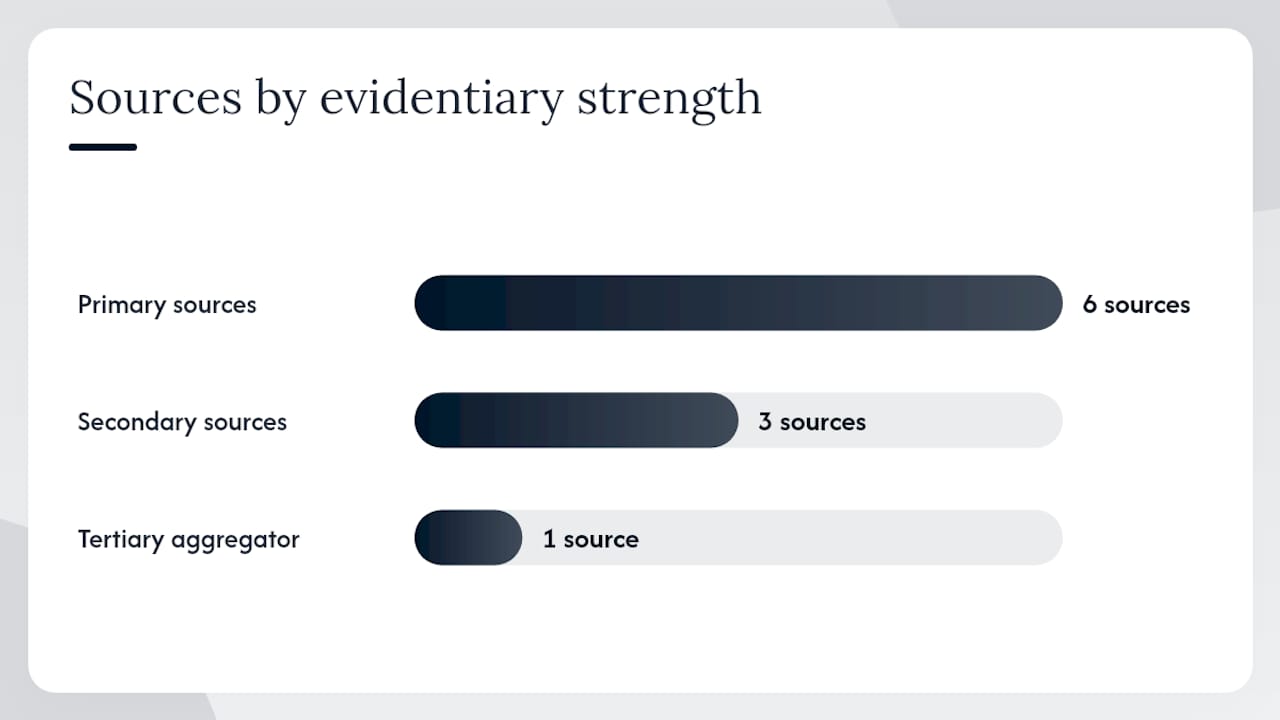
The table below maps each public record source to its signal type, timeliness, access cost, evidentiary strength, and processing complexity.
| Source | Signal Type | Timeliness | Access Cost | Reliability | Processing Complexity |
|---|---|---|---|---|---|
| SEC EDGAR (10-K/10-Q/8-K) | Operational + narrative | Periodic/real-time (8-K) | Free | Primary; legally attested | Structured + NLP |
| Proxy statements (DEF 14A) | Governance/narrative | Annual | Free | Primary | Semi-structured NLP |
| Earnings call transcripts | Narrative | Quarterly | Low–moderate | Secondary | Unstructured NLP |
| Investor presentations | Narrative | Periodic | Free | Secondary | Unstructured NLP |
| CDP/GRI/TCFD reports | Narrative + operational | Annual | Free | Secondary | Unstructured NLP |
| SEC AAERs / enforcement | Hard evidence | Event-driven | Free | Primary | Structured |
| PACER court records | Hard evidence | Event-driven | Low per-page fee | Primary | Semi-structured |
| USPTO patent filings | Operational (R&D) | Periodic | Free | Primary | Structured |
| Refinitiv / LSEG KPI feeds | Operational | Periodic | Licensed | Tertiary aggregator | Structured |
| State corporate filings | Ownership/governance | Periodic | Low | Primary | Structured |
SEC EDGAR remains the anchor. The 10-K's MD&A section, revenue recognition footnotes, and contingency disclosures carry auditor attestation and legal liability, making them the strongest evidentiary foundation for any forensic workflow. Proxy statements (DEF 14A) expose executive compensation structures, related-party transactions, and board independence metrics that rarely surface in earnings narratives. PACER court records and SEC Accounting and Auditing Enforcement Releases (AAERs) function as hard corroborating evidence when narrative signals suggest misrepresentation. Textual risk disclosures in annual reports meaningfully improve fraud detection accuracy when evaluated against SEC guidance, outperforming traditional MD&A analysis alone. USPTO patent filings provide a verifiable R&D signal: a company claiming technology leadership whose patent activity has stalled presents a measurable aspiration-to-execution gap. Refinitiv/LSEG operational KPI feeds serve as a tertiary cross-check rather than a primary source, given their aggregator-layer distance from the original filing.
How to convert public records into reproducible forensic signals
The core pipeline runs in four stages: ingest raw documents from EDGAR and transcript archives, extract structured KPIs and textual features, standardize variables against peer and temporal baselines, then validate through statistical corroboration before any signal enters a research output.
Parsing and KPI extraction. EDGAR's XBRL-tagged filings allow direct numeric extraction for revenue, operating cash flow, and segment data. Non-XBRL sections (MD&A, risk factors, footnotes) require OCR cleaning and rule-based parsers to isolate numeric reconciliations and qualitative disclosures. An agentic earnings analysis pipeline can automate KPI extraction, management tone scoring, and negative-trigger detection across quarterly filings.
Textual analysis methods. The validated approach for talk-vs-walk construction uses keyword-rate variables expressed per 10,000 words, then regresses those rates against objective operational metrics. A UCL study built keyword-rate variables from 725 sustainability reports and regressed them on firm emissions changes to test correspondence — a direct methodological model. BERT-based linguistic models applied to 10-K/MD&A sections identify fraud signals through positive-word bias, language inconsistency, and readability metrics. Retrieval-augmented generation (RAG) pipelines with domain-specific fine-tuning improve reliability for earnings call summarization and contradiction detection across long document sets.
Statistical validation. Robust standard errors correct for heteroskedasticity in cross-sectional disclosure regressions. Influence screening using Cook's distance removes outlier observations that could distort signal calibration. Out-of-sample backtests confirm that a signal constructed on historical filings retains predictive power on held-out periods.
Pro Tip: Tag every raw document at ingestion with a SHA-256 hash, the retrieval timestamp, and the source URL. Store these provenance records in a separate audit log so any downstream signal can be traced back to its exact source document without reconstruction.
Which indicators most reliably signal misrepresentation?
Operational authenticity measures predict market outcomes more reliably than communication quality alone, which means analysts should weight operational divergence signals above narrative polish when prioritizing review targets.
The highest-priority red flags, ranked by evidentiary weight:
- Q&A evasion scoring — analysts' direct questions deflected with forward-looking generalities; measurable as a ratio of direct answers to total questions in transcript Q&A sections
Pro Tip: Build an 8-quarter disclosure baseline for each company under coverage using its own historical filing patterns. Deceptive firms characteristically under-explain operational drivers while amplifying performance language — a departure from a company's own baseline is often more diagnostic than a peer comparison.
How to triangulate and validate signals across public records
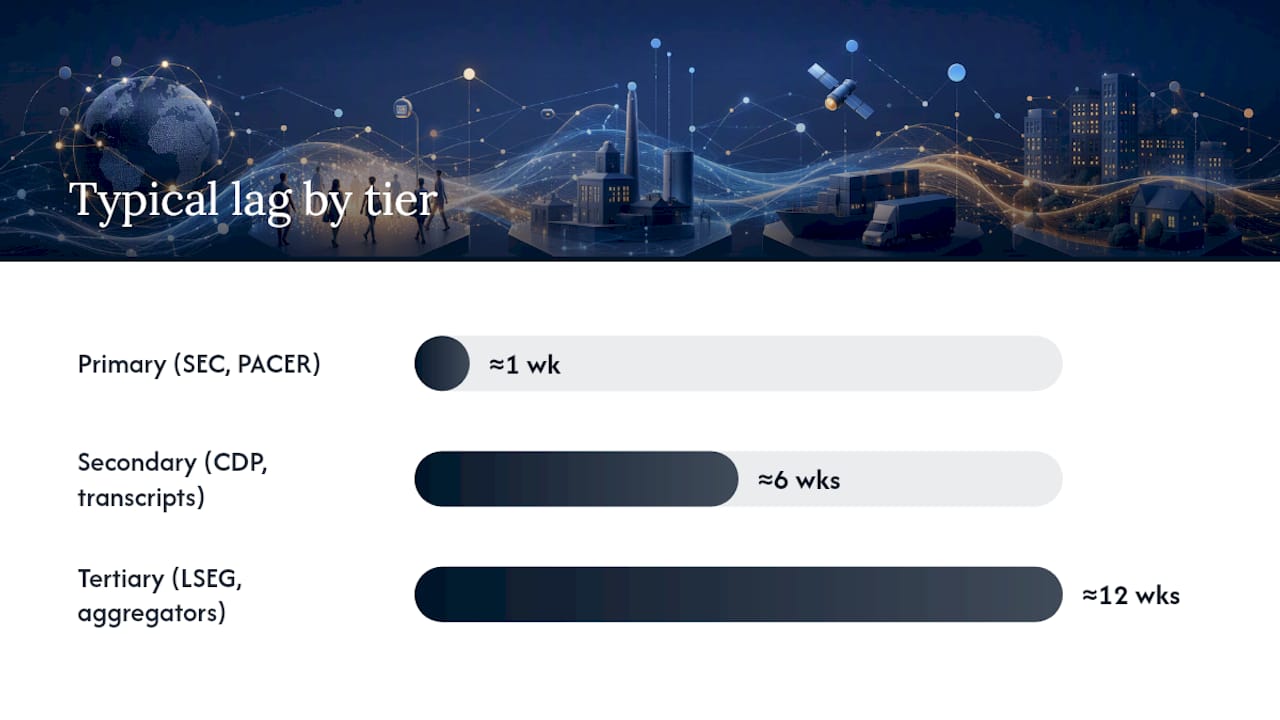
The evidence hierarchy runs: primary (official SEC filings and operational metrics) → secondary (corporate narratives, sustainability reports, investor presentations) → tertiary (vendor summaries, aggregated ESG scores, archived trackers). Robust forensic studies triangulate variables across primary company filings, established databases such as CDP and Refinitiv/LSEG, and tertiary proxies, with a documented priority table to reduce measurement error.
| Tier | Sources | Reliability | Typical Lag | Use Case |
|---|---|---|---|---|
| Primary | SEC EDGAR, PACER, USPTO, AAERs | Highest; legally attested | Days to weeks | Fraud confirmation, KPI extraction |
| Secondary | Earnings transcripts, CDP, GRI, TCFD | Moderate; voluntary | Weeks to months | Narrative scoring, talk-vs-walk |
| Tertiary | Refinitiv/LSEG, ESG aggregators | Lower; aggregator-derived | Months | Cross-check, benchmarking |
The audit trail an analyst must maintain:
- Time-stamped raw source document with retrieval URL and hash
- Extraction log recording parsing rules, software version, and any manual corrections
- Code and data hashes for all transformation scripts
- Model version and parameter record for any NLP or ML component
- Reviewer sign-off with date and scope of human review
Replicate every material signal across at least two independent source families before escalating to an investment or governance committee. A narrative-performance gap confirmed in the 10-K MD&A and independently corroborated by CDP emissions data carries substantially higher evidentiary weight than a signal present in only one source.
How Lacunaindex applies talk-vs-walk analysis in practice
A representative Lacunaindex review begins with source capture across SEC EDGAR filings, earnings call transcripts, and CDP/GRI sustainability submissions for a single company. Keyword-rate metrics quantify the density of climate-action, growth, and operational-improvement language in each disclosure. Those rates are then regressed against verified operational metrics — emissions trends from CDP, revenue and margin trajectories from EDGAR, and capital expenditure patterns from 10-K footnotes — using the triangulation hierarchy described above. Where Refinitiv/LSEG operational KPIs are available, they serve as a tertiary cross-check on the primary filing data.
Multimodal narrative-versus-performance gap scores materially predict abnormal returns, litigation risk, and reputational shifts, validating the market relevance of this approach across large firm samples. When the gap between a company's Narrative Ambition Score and its Performance Index exceeds sector-benchmark thresholds, Lacunaindex classifies the firm into a high-gap archetype — "borrowed" credibility — and flags it for governance escalation.
The output delivered to an investment or governance committee includes: an execution score, a narrative score, the measured gap with sector-relative context, the specific filing passages and operational data points that drove the classification, and a provenance log linking every element to its source document.
- Source capture with timestamped retrieval and document hashes
- Keyword-rate construction and temporal baselining against the company's own 8-quarter history
- Emissions and operational metric regression with influence screening
- Refinitiv/LSEG tertiary cross-check
- Scorecard output with full audit trail
Pro Tip: When packaging findings for proxy advisors or a board escalation, lead with the primary-source evidence (EDGAR filing passages, CDP data) and present the narrative score as context rather than conclusion. Governance committees respond to verifiable facts; the gap score frames the significance, but the filing excerpt is the evidence.
How to use forensic signals in investment and governance workflows
Three immediate applications: idea triage and screening, ongoing monitoring with alert rules, and escalation for engagement or proxy voting.
Idea triage. Assign a disclosure gap threshold for shortlist inclusion. Companies whose narrative-performance gap exceeds the sector 75th percentile enter a review queue; those below the 25th percentile may be deprioritized for misrepresentation risk. The public disclosure gap framework provides a structured approach to weighting these scores alongside valuation and cash-flow metrics.
Ongoing monitoring. Schedule quarterly re-runs triggered by 10-Q and 8-K filings. Alert rules fire when: a non-GAAP adjustment exceeds a defined threshold relative to GAAP earnings, a new related-party transaction appears in a proxy amendment, or an emissions intensity metric moves contrary to the prior year's stated trajectory.
Escalation flow:
- Signal detected in primary filing or transcript
- Analyst review confirms signal against secondary sources
- Corroboration across two independent source families
- Engagement brief prepared with primary-source citations
- Governance escalation or proxy voting recommendation issued
Integration with traditional metrics: weight disclosure gap scores as a qualitative overlay on DCF and EV/EBITDA screens rather than as a standalone filter. A company with a compressed valuation multiple and a low narrative-performance gap may represent an undervalued archetype; the same multiple paired with a high gap warrants deeper forensic review before position sizing.
What state corporate filings and ownership records reveal
State corporate filings, UCC financing statements, and beneficial ownership records held at the state level provide a layer of governance intelligence that federal filings do not always surface. Secretary of State databases across all 50 states record incorporation documents, registered agent changes, officer and director histories, and dissolution filings. Sudden registered agent changes, officer substitutions shortly before material transactions, or multi-state shell structures visible in UCC filings can indicate ownership opacity that warrants further investigation. The Financial Crimes Enforcement Network's (FinCEN) Beneficial Ownership Information registry, established under the Corporate Transparency Act, adds a federal layer for entities meeting the reporting threshold. Cross-referencing state filings against DEF 14A related-party disclosures and EDGAR ownership schedules (13D/13G) produces a more complete ownership map than any single source alone.
Ethical and legal considerations when using public-record data
Mining public records for forensic equity research is legally distinct from trading on material non-public information. All sources described in this guide are publicly available and legally accessible. Several constraints still apply.
The Computer Fraud and Abuse Act (CFAA) and terms-of-service agreements govern automated scraping of third-party platforms; EDGAR's full-text search API and PACER's documented access protocols are the appropriate ingestion channels. Republishing verbatim filing excerpts in research reports is generally permissible under fair use for commentary and analysis, but legal counsel should confirm scope for each publication format. Findings derived from forensic analysis of public records do not constitute investment advice and should be framed as research inputs subject to independent verification. When escalating findings to governance bodies or proxy advisors, analysts must distinguish between documented evidence from primary sources and inferences drawn from pattern analysis. This article provides general informational guidance; readers should confirm current regulatory requirements with qualified legal and compliance professionals.
Data quality issues in public-record disclosures and how to mitigate them
Public records carry structural quality risks that differ from those in commercial data products. XBRL tagging errors in EDGAR filings are documented and can cause numeric extraction errors; cross-validating extracted figures against the human-readable HTML filing reduces this risk. CDP submissions are self-reported and unaudited for most companies; treating them as secondary rather than primary evidence, and triangulating against third-party emissions verifiers where available, preserves evidentiary integrity. Large-scale ESG corpus analysis using topic modeling across 1,477 reports demonstrates that systematic language normalization is necessary before cross-company comparison, because reporting frameworks (GRI, SASB, TCFD) produce structurally different document formats. Transcript quality varies by vendor; always verify speaker attribution and confirm that the transcript version used matches the company's archived webcast. Temporal coverage gaps, particularly for companies that changed fiscal year ends or underwent mergers, require explicit handling in baseline construction to avoid spurious trend signals.
Key Takeaways
Forensic mining of public company disclosures — not satellite or transactional feeds — is the most defensible form of alternative data for institutional equity research, because every signal traces directly to a legally attested or publicly filed source.
| Point | Details |
|---|---|
| Scope definition | "Alternative data" here means public-record forensic mining: SEC EDGAR, PACER, USPTO, CDP, and transcripts. |
| Top starting sources | Begin with SEC EDGAR 10-K/10-Q/8-K, earnings call transcripts, and CDP/GRI sustainability filings. |
| Talk-vs-walk principle | Keyword-rate variables regressed against operational metrics expose the aspiration-to-execution gap. |
| Triangulation hierarchy | Primary filings outrank secondary narratives; replicate every signal across two independent source families before escalation. |
| Lacunaindex application | Lacunaindex delivers audit-traceable execution and narrative scores using this public-record methodology; sector benchmarks are free, company reports require a subscription. |
The gap between what disclosures say and what they prove
The most common mistake in forensic disclosure analysis is treating a well-written sustainability report or a confident earnings call as evidence of delivery. It is not. Corporate communication has become sophisticated enough that linguistic polish and operational underperformance can coexist for several reporting cycles before the gap becomes visible in financial metrics. The discipline this guide describes — anchoring every claim to a primary filing, constructing keyword-rate variables against objective operational data, and maintaining a full provenance log — exists precisely because narrative quality and operational authenticity are measurable separately, and markets tend to price them as if they were the same thing.
The practical lesson: start with the 10-K, not the press release. The MD&A section, the revenue recognition footnote, and the contingency disclosure carry legal weight that no investor presentation does. Build the narrative score second, from transcripts and sustainability reports, and treat it as a hypothesis to test against the filing record rather than a finding in its own right. Provenance discipline is not bureaucratic overhead; it is what separates a defensible research output from an opinion.
Lacunaindex: forensic public-record analysis without the build cost
Institutional teams that want audit-traceable talk-vs-walk analysis without constructing the pipeline from scratch have a direct route through Lacunaindex. The platform applies the methodology described throughout this guide — EDGAR ingestion, keyword-rate construction, emissions regression, and Refinitiv/LSEG cross-check — to produce execution scores, narrative scores, and sector-relative gap classifications for individual companies.
Key features relevant to this audience:
- Sector benchmarks — providing peer-relative context for gap classification (free access)
Sector benchmarks are publicly available at no cost. Full company-level forensic reports, including the aspiration-to-execution gap score and filing-level evidence, require a subscription. Start with the free sector benchmarks to establish peer context, then consult the user guide to understand how Lacunaindex structures its evidence hierarchy before commissioning a company-level report.
Useful sources
- Sustainability (MDPI) — communication authenticity and market outcomes
- Are corporate climate efforts genuine? An empirical analysis of the climate talk–walk (UCL 2022)
- Triangulation and model selection methods for corporate climate and disclosure research (arXiv 2026)
- Greenwashing Intelligence Systems: detecting ESG narrative‑performance gaps with multimodal AI (IJSRET 2026)