
EDGAR is the free primary-source repository for U.S. public-company filings, and the investigative use of EDGAR starts with the high-value forms: 10-K, 8-K, Form 4, Schedule 13D/G, and DEF 14A. We recommend beginning with a focused full-text query or an RSS feed subscription, then pivoting to daily indexes and the SEC's data APIs once a pattern warrants automated monitoring.
TL;DR:
- Insider transaction reports from Form 4 combined with any related 8-K disclosures can reveal timely signals of leadership changes or undisclosed liabilities.
- Bulk data indexes and API feeds are best suited for ongoing monitoring or reconstructing filings across multiple issuers, while EFTS is ideal for targeted, specific searches within known date ranges.
- Extending investigations beyond filings by cross-referencing subsidiaries, court records, or political disclosures strengthens the evidence chain and reveals hidden connections.
- Maintaining detailed records of accession numbers and original filings is essential for verification, especially when building a defendable investigation or submitting a tip or complaint.
- Relying solely on 10-Ks and 10-Qs risks missing earlier, sharper signals; supplementing with Form 4, Schedule 13D/G, and 8-K filings provides a more complete picture.
Table of Contents
- Which filings matter most for investigations
- Choosing between EFTS, indexes, and the data APIs
- Pivoting across filings to map entities and insider networks
- Automating EDGAR pulls without breaking the rules
- Preparing a tip or complaint that SEC staff can act on
- How forensic scoring turns filings into audit-traceable evidence
- Common pitfalls when reading EDGAR filings
- What successful EDGAR-based investigations tend to have in common
- Legal and ethical boundaries for EDGAR-based research
- Cross-referencing EDGAR with other public records
- A practical checklist for faster, defensible investigations
- Get a head start with Lacuna Index
- FAQ
- Sources
Which filings matter most for investigations
Not every filing carries the same investigatory weight. A 10-K provides the annual narrative and audited financials, but the footnotes and risk factors sections typically hold more forensic value than the headline numbers. A 10-Q offers the same structure on a quarterly cycle, useful for tracking whether a company's story shifts between annual reports. An 8-K discloses material events, often within four business days, which makes it a near-real-time signal for leadership changes, restatements, or undisclosed liabilities.
Ownership and governance filings tend to surface the sharpest leads. Form 4 reports insider transactions within two business days of execution. DEF 14A proxy statements lay out executive compensation, related-party transactions, and board composition, information we cover in more depth in our analysis of proxy statement red flags. Exhibit 21 lists subsidiaries, often the thread that connects a public issuer to shell entities. S-1 registration statements, filed ahead of a public offering, disclose risk factors and related-party arrangements before market scrutiny sets in.
A reliable rule for substantiating a lead is two-form triangulation: pair a DEF 14A's compensation or related-party disclosure with Form 4 insider activity and an 8-K event, then check whether the timing lines up.
- 10-K/10-Q: annual and quarterly financials, with footnotes often more revealing than summary tables.
- 8-K: material events disclosed within four business days.
- Form 4: insider buy and sell activity reported within two business days.
- Schedule 13D/G: beneficial ownership above 5%, split by activist versus passive intent.
- DEF 14A: executive pay, board structure, and related-party transactions.
- Exhibit 21: subsidiary lists that often reveal corporate structure.
Choosing between EFTS, indexes, and the data APIs
EDGAR offers several ways to access the same underlying filings, and choosing the right one depends on whether the goal is a single lead, a historical reconstruction, or ongoing surveillance. EDGAR Full-Text Search (EFTS) supports Boolean and phrase queries across filing text, filtered by form type, company, CIK, or date range, which makes it the first stop for a targeted question like locating every mention of a specific executive or supplier. Company and ticker filters inside EDGAR's standard search work best when the subject entity is already known and the task is retrieving its full filing history.
For bulk retrieval or timeline reconstruction across many issuers, daily, full, and master indexes and the archive feeds described in the SEC's developer resources outperform manual search, since they list every filing by date in a structured format suited to scripted downloads. RSS feeds and the data.sec.gov API endpoints extend this further, letting researchers build near-real-time watchlists that flag new 8-Ks or Form 4s from a defined list of CIKs without repeatedly polling the search interface.
- EFTS: best for targeted phrase or entity searches within a known date range.
- Company/ticker filters: best when the subject is already identified.
- Daily/full indexes: best for bulk, multi-issuer historical pulls.
- RSS/API feeds: best for ongoing, near-real-time monitoring.
Pro Tip: Build watchlists around CIK numbers rather than ticker symbols, since tickers change on corporate actions but CIKs remain constant across a company's filing history.
Pivoting across filings to map entities and insider networks
Investigative pivoting works best as a sequence rather than a single search. Starting from one filing and following its named entities outward tends to surface connections that a single document search misses.
- Identify a seed filing, such as an 8-K disclosing a leadership departure or an unusual related-party transaction.
- Extract every named entity, including executives, directors, advisers, and counterparties mentioned in the filing.
- Run EFTS queries on each name to locate other filings where it appears, across different issuers.
- Collect the relevant Form 4, Schedule 13D/G, and 8-K filings tied to those entities to establish a transaction timeline.
- Map subsidiaries and related parties using Exhibit 21 and the proxy statement's related-party section to see whether entities overlap across issuers.
This sequence supports network techniques such as building ownership and board interlock graphs, where the same individual appears as a director across several issuers with weak operating histories. Clusters of insider selling that precede a negative 8-K, or a director who resurfaces on the boards of multiple companies that later fail, are patterns worth flagging for closer review rather than treating as isolated events.
Automating EDGAR pulls without breaking the rules
Programmatic access to EDGAR is efficient but bounded. The SEC enforces a hard rate limit of 10 requests per second, and exceeding it risks having an automated script blocked outright, which defeats the purpose of building a monitoring pipeline in the first place.
Form 4 insider filings are required to be reported promptly after a transaction, typically within a short timeframe, a rule that makes near-real-time scripted monitoring far more useful than periodic manual checks for ownership shifts.
Practical scripting habits matter as much as the rate limit itself: batching requests, caching previously retrieved filings locally, and using exponential backoff when a request fails all reduce load and keep a monitoring script within the SEC's published guidance.
- Batch requests by CIK or date range rather than issuing one call per filing.
- Cache locally so repeated analysis does not re-request the same accession.
- Normalize XBRL tags across issuers before comparing figures, since the same line item can carry different tag names.
- Record provenance for every data point: accession number, filing date, exhibit filename, and the persistent EDGAR URL.
Inline XBRL tagging allows financial figures to be extracted programmatically rather than read manually from PDFs, but the same concept (revenue, for instance) can be tagged under slightly different elements across companies, so normalization before cross-company comparison is a necessary step rather than an optional one. For related guidance on converting filing text into analysis-ready structures, see our walkthrough on traceable filing analysis.
Preparing a tip or complaint that SEC staff can act on
A strong TCR (tip, complaint, or referral) rests on original documentation rather than summary or screenshot. SEC guidance on preparing a quality TCR recommends including the identity of the entities and people involved, a clear timeline, relevant accession numbers, and any amounts of money at stake.
- Name every entity and individual involved, with roles clearly defined.
- Build a timeline that ties each event to a specific filing or transaction date.
- Attach or cite original filings by accession number rather than paraphrasing them.
- Include transactional detail: amounts, dates, and counterparties where known.
Pro Tip: Cite the accession number and the persistent EDGAR URL for every document referenced, since staff reviewing a TCR can verify a cited filing in seconds but cannot verify an unlinked screenshot at all.
The SEC's whistleblower program offers awards under the Dodd-Frank Act for qualifying tips that lead to successful enforcement, though follow-up can take years and is not guaranteed for every submission.
How forensic scoring turns filings into audit-traceable evidence
Raw filings answer "what was disclosed." They rarely answer "did the company deliver on what it claimed." Our forensic methodology at Lacuna Index addresses that gap by mining the same public filings, earnings calls, press releases, and proxy statements that investigators already search, then scoring the distance between narrative claims and demonstrated execution.
- Per-company briefs translate scattered disclosures into a single execution score with cited sources.
- Sector benchmarks place a company's score against peers in the same industry classification.
- Citation-rich reports link every scored claim back to its originating filing, so a reviewer can trace each conclusion to its source document.
The scoring process relies solely on public records, with no insider access, which keeps the evidence chain auditable in the same way a well-documented TCR is auditable. The methodology walkthrough and our guide on validating corporate claims in public disclosures lay out the citation practices in full.
Common pitfalls when reading EDGAR filings
The most frequent beginner mistake is relying solely on 10-Ks or 10-Qs for a full picture of a company's condition. These filings are backward-looking by design, often several weeks old by the time they post, and the headline financial statements rarely contain the detail that explains a sudden stock move or governance dispute. Form 4s, Schedule 13D/G filings, and DEF 14A proxies tend to surface earlier and sharper signals of ownership shifts and insider behavior.
A second pitfall is treating full-text search as comprehensive. The public EFTS interface emphasizes recent years in its default coverage, so a search that comes back empty may simply predate the engine's indexed window rather than indicate the term never appeared; archive and index endpoints fill that gap for older material.
A third pitfall involves exhibits and fine print. Management agreements, related-party footnotes, and Exhibit 21 subsidiary lists are frequently skipped in favor of the main narrative, yet these sections often contain the only disclosed link between a public issuer and a shell entity or an undisclosed service provider. Skipping them means missing the thread that connects two otherwise unrelated filings.
Finally, a single filing rarely tells a complete story. A Form 4 showing insider selling, viewed alone, says little; the same sale viewed against a DEF 14A compensation schedule and a subsequent 8-K disclosure can say a great deal more.

What successful EDGAR-based investigations tend to have in common
Investigations that hold up under scrutiny generally share a structural pattern rather than a single clever search. They start from a specific, named seed (an unusual 8-K, a cluster of Form 4 sales, a related-party footnote) rather than a broad fishing expedition across an entire sector.
From that seed, the pattern extends outward methodically: named individuals and entities get checked across every filing where they appear, using EFTS for the recent window and archive indexes for older history. Ownership and board interlocks get mapped using Exhibit 21 and proxy disclosures, since the same director or adviser appearing across several thinly capitalized issuers is a governance signal worth documenting rather than dismissing as coincidence.
The strongest investigative patterns combine at least two independent filing types before a conclusion is drawn: insider selling clustered ahead of a negative 8-K, or a related-party transaction disclosed in a DEF 14A that later surfaces again in a Schedule 13D filed by the same counterparty. Each piece alone is circumstantial; together, tied to specific accession numbers and filing dates, they form a documented record that can support a TCR, a journalistic story, or an internal governance review. The common thread across effective investigations is not a single discovery but the discipline of tracing every claim back to its original filing before treating it as established fact.
Legal and ethical boundaries for EDGAR-based research
Everything filed on EDGAR is public record, so reading, downloading, and analyzing it carries no legal restriction in itself. The boundaries investigators need to respect sit elsewhere: in how conclusions are drawn and shared, and in how automated access is conducted.
Programmatic access must stay within the SEC's published rate limit of 10 requests per second; scraping at volumes that exceed this risks a blocked connection and, for sustained abuse, potential access restrictions. Ethically, drawing a conclusion from a single filing and presenting it as definitive, without corroboration from a second independent source, is a common overreach that undermines otherwise sound research.
Defamation exposure is a real consideration when publishing conclusions about named individuals or companies. Public filings document what was disclosed, not necessarily what was true or what motivated it, so language should distinguish between "the filing states" and "the company did." Investigators who believe they have identified securities fraud or related misconduct can route findings through the SEC whistleblower program, which also provides a formal channel for qualifying tips rather than relying solely on public disclosure of preliminary findings.
Cross-referencing EDGAR with other public records
EDGAR filings establish what a company disclosed, but corroborating that disclosure against independent sources is what turns a lead into a defensible finding. State business registries can confirm whether a subsidiary named in Exhibit 21 is actually registered and active, and whether its listed officers match the names appearing in SEC filings. Court records, both civil and bankruptcy, often surface litigation or claims that a company's risk factors section references only in general terms.

Campaign finance and lobbying disclosures can connect a company's executives or directors to political activity relevant to a regulatory or governance story, an approach outlined in OneGov's guide to citation-ready campaign finance tracking. Property and UCC filings at the state level can confirm or contradict asset claims made in a 10-K's footnotes. Where a TCR or published investigation draws on documents outside EDGAR, preserving chain of custody for digital evidence follows the same discipline described in this guide to insider misconduct investigations: originals over copies, timestamps over assumptions, and a documented trail from source to conclusion.
The goal of cross-referencing is not volume but corroboration: a single EDGAR disclosure paired with one independent confirming record is worth more than ten EDGAR filings read in isolation.
A practical checklist for faster, defensible investigations
Three priorities carry most of the weight in any EDGAR investigation: identify a specific seed filing, pivot outward through named entities, and preserve the evidence chain with accession numbers at every step. The most common mistakes we see are over-reliance on a single 10-K, skipping exhibits that hold the real connective detail, and failing to record the accession number that would let someone else verify the finding later. Discipline on these three points matters more than search sophistication.
— Glen
Get a head start with Lacuna Index
Running the workflow above by hand, across dozens of filings and multiple issuers, takes time most researchers don't have on a single lead. Our forensic reports provide advanced triangulation work: each per-company brief scores the gap between narrative claims and demonstrated execution, with every claim traced back to its originating filing.
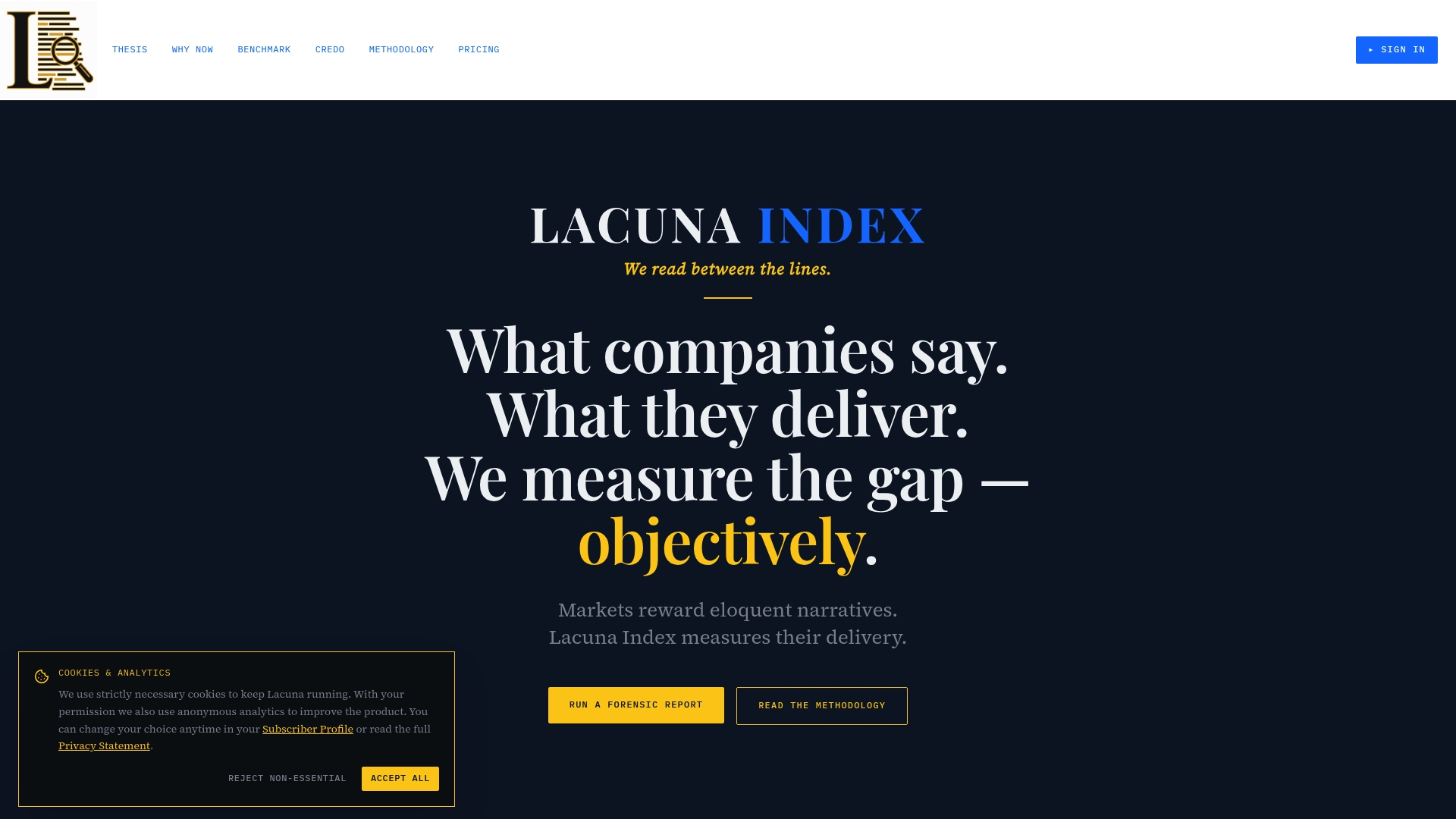
- Per-company analysis delivers a citation-rich execution score for individual companies.
- Sector Sweep benchmarks an entire industry classification.
- Cohort Pulse tracks a defined group of companies over time.
Readers who want to see the evidence trail before relying on it can review our methodology walkthrough or start with a free sector benchmark. For full company-level reports, our pricing page outlines subscription access.
FAQ
Is it free to use the EDGAR database?
Yes, EDGAR is free to use and provides public access to corporate filings required under federal securities laws. No subscription or account is needed to search, view, or download filings.
Who investigates stock market manipulation?
The SEC investigates securities law violations, including market manipulation, and offers whistleblower awards under the Dodd-Frank Act for qualifying tips that lead to successful enforcement actions. Tips are submitted through the SEC's Office of Market Intelligence using a documented TCR.
What information can I find on EDGAR?
EDGAR holds the full range of filings public companies submit under federal securities law, including annual reports (10-K), quarterly reports (10-Q), material event disclosures (8-K), insider transaction reports (Form 4), and beneficial ownership filings (Schedule 13D/G). It also hosts proxy statements, registration statements, and exhibits such as subsidiary lists.
What is EDGAR Law?
"EDGAR Law" is not an official legal term; it generally refers informally to the body of SEC disclosure requirements that govern what companies must file through the EDGAR system. These requirements stem from federal securities statutes rather than a single named law.
How do I search EDGAR for a specific company or topic?
Use EDGAR Full-Text Search for phrase or keyword queries across filing text, filtered by form type, company, or date range. For a known company's full filing history, searching by its name, ticker, or CIK number through EDGAR's company search returns a complete list of its filings.