
Under Item 303, an effective MD&A analysis ties management's causal claims to GAAP figures, reconciliations, and documented evidence, exposing any gap between the narrative and the underlying filings. The work centers on three areas: the drivers behind reported results, the sufficiency of liquidity and capital-resources disclosure, and the reasonableness of critical accounting estimates. An analysis succeeds only when every material claim in the MD&A can be traced to a specific GAAP number or a primary-source document.
TL;DR:
- Management's causal claims must be clearly linked to GAAP figures, reconciliations, and specific evidence to ensure compliance with Item 303 standards.
- Liquidity disclosures should be cross-checked against debt schedules, covenant terms, and actual cash balances to identify unsupported references or gaps.
- Decomposing results changes into volume, price, and other factors reveals whether management's explanations are detailed and supported by primary sources.
- Non-GAAP measures require clear definitions, prominence of GAAP equivalents, and complete reconciliation, with explanations for any significant adjustments or omissions.
- Critical accounting estimates must be described with methodology, sensitivity analysis, and aligned with auditor communications to meet disclosure quality standards.
Table of Contents
- What Item 303 requires and how to apply its principles-based standard
- Analyzing liquidity and capital resources: what to test and how
- Interpreting results of operations: decomposing management's causes
- Testing non-GAAP measures and KPIs: definitions, prominence, and reconciliations
- Evaluating critical accounting estimates: sensitivity, disclosure quality, and evidence
- Auditor role and PCAOB AT 701: what attestation provides and its limits
- A repeatable analyst workflow to test MD&A claims
- Disclosure controls, documentation, and AI drafting governance
- Applying the checklist in real reviews
- Lacuna Index: automating the evidence-mapping workflow
- Primary sources and guidance worth reading directly
- Sources
- FAQ
What Item 303 requires and how to apply its principles-based standard
Item 303 does not ask a registrant to restate its financial statements in prose. It asks management to analyze the trends, events, commitments, and uncertainties that a reasonable investor would need in order to judge the likelihood that past performance predicts future results. The SEC's interpretive guidance describes the standard as principles-based rather than a checklist, meaning the required depth of disclosure varies by registrant and by the materiality of the underlying trend, not by a fixed template.
The distinction between analysis and restatement is where many MD&A sections fail. A compliant disclosure explains which product lines or geographies drove the volume increase, whether the increase reflects price realization or unit growth, and whether the trend is expected to continue. The SEC's Financial Reporting Manual, Topic 9, reinforces this by instructing reviewers to look for the "key variables" management itself uses to run the business, on the premise that a disclosure omitting those variables is incomplete regardless of its length.
For analysts and counsel working through a filing, MD&A content is not confined to a single section. The core discussion sits in Item 7 of Form 10-K and Item 2 of Form 10-Q, but material updates frequently surface in subsequent Form 8-K filings, particularly under Items 2.02 and 7.01, and in the transcripts of related earnings calls. A complete review treats the 10-K or 10-Q MD&A as the baseline narrative and checks it against any intervening 8-K disclosures that update, contradict, or soften the original claims.

Analyzing liquidity and capital resources: what to test and how
The SEC's 2020 final rule replaced the old contractual obligations table with a principles-based requirement to discuss material cash requirements, including known contractual and other obligations, and the sources of funds expected to meet them. That shift places more of the disclosure burden on prose, which means analysts can no longer rely on a single tabular summary and must reconstruct the obligation picture from several parts of the filing.
The practical test is a cross-reference exercise: does the cash balance reported on the balance sheet support the liquidity narrative in the MD&A, does the debt footnote's maturity schedule match any timing claims about refinancing, and do stated covenant terms align with the headroom management describes. The same 2020 rule guidance notes that the highest-value checks are often off the income statement entirely, in the debt schedule, the commitments footnote, and working-capital movement.

Red flags worth documenting for escalation include a liquidity discussion that references "sufficient resources" without naming the facility or cash balance that supports the claim, a funding plan that depends on undisclosed asset sales or capital markets access, and covenant language that has weakened between periods without explanation. When these gaps appear, the escalation record should capture the specific MD&A sentence, the contradicting or unsupported figure, and the footnote or 8-K that should have reconciled them. This kind of chain-of-evidence documentation is the same discipline used in reconciling management narrative to filings, where the gap itself becomes the analytical finding.
Interpreting results of operations: decomposing management's causes
Management's explanation of a results change is a hypothesis, not a fact, and the analyst's job is to test it against the components that actually moved the number. A standard decomposition separates a revenue or margin change into volume, price, mix, foreign exchange, the effect of acquisitions or divestitures, cost inflation, and one-time items. When a company attributes a 5-point margin decline to "cost pressures" without allocating that figure across these categories, the disclosure has not met the analytical bar the SEC's interpretive release describes.
Each narrative claim should map to a specific source: segment footnotes for mix and geography effects, the acquisitions footnote for inorganic contribution, and any non-GAAP reconciliation for one-time or unusual items. Where the MD&A cites an operating metric that does not appear in the financial statements, the segment footnote or a related 8-K is usually the only place to verify it.
Metric instability is a particular warning sign. A company that renames a KPI, changes its calculation basis, or drops a previously disclosed metric without explanation has broken the period-over-period comparability an analyst depends on. Building a running KPI dictionary across filings, the same approach detailed in guidance on KPI definition consistency, catches this kind of quiet redefinition before it distorts a trend analysis.
Testing non-GAAP measures and KPIs: definitions, prominence, and reconciliations
Non-GAAP measures and KPIs are the most heavily engineered part of many MD&A sections, because they are the numbers management chooses to define. Regulation G and Item 10(e) impose specific, testable obligations on any registrant that presents them, and the SEC's non-GAAP staff guidance sets out the reconciliation and prominence requirements analysts should check against.
- Confirm the measure has a clear definition, a stated purpose, a consistent period, and a documented calculation method.
- Verify the most directly comparable GAAP measure appears with equal or greater prominence, not buried below the non-GAAP figure.
- Check that a full reconciliation from the GAAP measure to the non-GAAP measure is present, not merely referenced.
- Watch for individually tailored accounting principles or prohibited exclusions from liquidity measures.
- Where a forward-looking non-GAAP figure lacks a GAAP reconciliation, confirm the filing states why the reconciliation is unavailable without unreasonable effort.
The SEC's Financial Reporting Manual, Topic 8, catalogs common non-GAAP items and the staff interpretive positions on them, and is the reference point when a reconciliation looks unusual. The 2020 interpretive release on KPIs adds that a company disclosing a KPI should explain why the metric is useful to investors and how management itself uses it, which gives analysts a second test: does the stated purpose of the metric match how it is actually discussed in the surrounding narrative. A structured, repeatable version of this test appears in the six-point checklist for scoring non-GAAP adjustment quality.
Evaluating critical accounting estimates: sensitivity, disclosure quality, and evidence
The 2020 amendments added a distinct requirement, now codified at Item 303(b)(3), for registrants to discuss critical accounting estimates separately from the general accounting policy disclosures in the footnotes. The SEC's final rule directs companies to identify which estimates involve the greatest degree of subjectivity and to explain why, rather than simply listing every estimate that requires judgment.
A compliant disclosure goes beyond naming the estimate. It should describe the methodology used to develop the assumption, note the historical accuracy of similar estimates where relevant, and, where quantification is practicable, give a sensitivity range showing how the reported figure would change under different assumptions. An impairment estimate that discloses only the point conclusion, with no discussion of the discount rate or growth assumptions that drove it, has not met the standard the amendments were written to enforce.
Testing this disclosure requires reading it against the corresponding footnote, since the footnote typically carries the technical accounting detail while the MD&A is supposed to carry the analytical discussion of judgment and sensitivity. Where the two sections repeat identical language, the MD&A has likely failed to add the analytical layer Item 303(b)(3) requires. Auditor communications, including any critical audit matters described in the audit opinion, are a useful cross-check, since an estimate flagged as a critical audit matter that receives only cursory MD&A treatment is a mismatch worth documenting.
Auditor role and PCAOB AT 701: what attestation provides and its limits
MD&A is management's disclosure, not the auditor's. When an MD&A attestation engagement does occur, it operates under PCAOB AT Section 701, which covers whether the historical financial amounts in the MD&A are reconcilable to the underlying financial statements and whether the disclosed data reflects presentation consistent with those statements.
AT 701 is explicit that this work provides reasonable assurance, not absolute assurance, and is built on selective testing. The standard does not certify the reasonableness of management's forward-looking judgments or the completeness of the causal explanations offered for a given trend, and it does not protect against collusion or intentional omission that testing does not happen to catch.
For analysts, the practical implication is that an attestation, where one exists, should be read as a signal rather than a substitute for independent verification. A clean attestation confirms that historical figures tie to the financial statements; it says nothing about whether management's explanation of why those figures moved is complete or evenhanded. The analytical burden of testing causation and estimate reasonableness remains with the reader.
A repeatable analyst workflow to test MD&A claims
A consistent, documented workflow keeps MD&A review from becoming an unstructured read-through, and it produces a record that can be escalated or defended later.
- Read the MD&A overview once for orientation, noting the trends and priorities management chooses to lead with.
- Capture the core figures: revenue, margin, operating cash flow, capital expenditure, debt balances, and liquidity metrics.
- Decompose each material change using the volume, price, mix, FX, acquisition, and one-off framework.
- Cross-reference every causal claim against the relevant footnote, segment disclosure, or related 8-K.
- Test non-GAAP measures and KPIs for definition clarity, reconciliation, and prominence.
- Test the liquidity and capital-resources discussion against the debt schedule, covenant terms, and commitments footnote.
- Test critical accounting estimates for methodology, sensitivity, and consistency with auditor commentary.
- Document findings, including any claim that could not be reconciled to a primary source, with a specific citation to the gap.
Each step has a natural home for evidence capture. Footnotes carry the technical detail behind an estimate or a non-GAAP adjustment; 8-K filings often carry the update to a claim made in the prior 10-K; earnings call transcripts frequently carry the informal version of an explanation that the MD&A states more cautiously, and comparing the two can reveal where language has been softened. Methods for tracking this kind of drift across filing periods are set out in guidance on monitoring disclosure consistency.
Time-constrained reviews benefit from triage rules. A red-flag trigger, such as a newly introduced KPI, a dropped contractual obligations table with no substitute disclosure, or a critical estimate discussed only in boilerplate, should move a filing to the front of the queue for deeper review.
Pro Tip: Start every MD&A review by comparing the current period's language to the prior period's, sentence by sentence where practical; the sentences that changed are usually where the real information is.
Disclosure controls, documentation, and AI drafting governance
MD&A quality is inseparable from the disclosure controls that produce it. Rules 13a-15 and 15d-15 require registrants to maintain controls and procedures designed to ensure that material information is recorded, processed, and reported within the required time periods, and the 2020 interpretive guidance on KPIs specifically ties this obligation to the metrics companies choose to disclose. A KPI that changes definition without a corresponding update to the controls that validate it is a documentation gap worth flagging.
A forensic evidence-mapping approach applies the same discipline analysts use internally: every claim in the MD&A is linked to a primary public source, whether a footnote, a schedule, an 8-K, or a transcript, and that chain of evidence is preserved rather than summarized away. This is the practice described in how public disclosures reveal management gaps, and it applies equally to reviewing a company's own drafting process.
The growing use of generative tools in disclosure drafting raises a governance question rather than a legal one for most reviewers: does the company's disclosure-controls framework extend to AI-assisted drafts, is there a version history that shows what was generated versus edited, and is there documented human review before filing. None of this substitutes for legal judgment on adequacy, but the absence of any recordkeeping around an AI-assisted draft is itself a control gap worth noting in a review file.
Applying the checklist in real reviews
Limited review time should go first to the sections where narrative and numbers are most likely to diverge: liquidity language, non-GAAP reconciliations, and critical estimates, in that order, since these are where companies have the most discretion over presentation. Softening techniques recur across filings: a metric quietly redefined, a risk factor moved from specific to generic language, or a liquidity discussion that substitutes "adequate" for a disclosed number. Recognizing these patterns comes from comparing filings side by side, not from reading any single one in isolation.
— Glen
Lacuna Index: automating the evidence-mapping workflow
This checklist can be applied at scale, using only public records to score how well a company's stated claims match its delivered results. Some platforms produce forensic reports with execution scores built on an evidence-mapping approach, while sector benchmarks let analysts see how a company's narrative-to-delivery gap compares to its peers.
- Per-company analysis can turn manual cross-referencing steps into a structured, audit-traceable report.
- Sector benchmarks, available for sectors including Health Care, Consumer Staples, and Industrials, are free to browse.
- The Cohort Pulse and Sector Sweep plans give subscribers ongoing access to forensic scoring across covered companies.
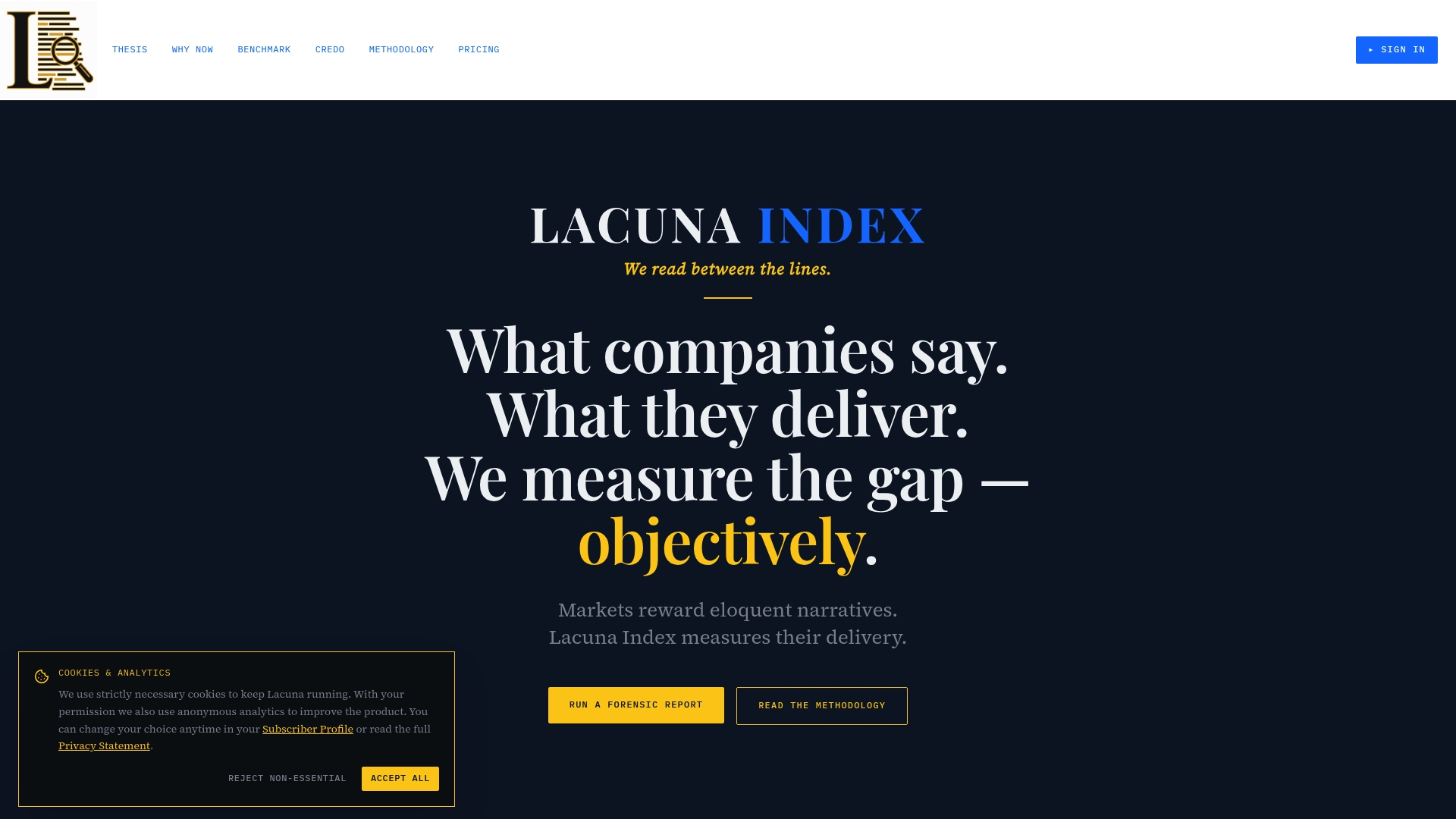
For a walkthrough of the scoring methodology behind these reports, see the methodology page, or check current plan details on the pricing page to see which subscription fits your coverage needs.
Primary sources and guidance worth reading directly
- The SEC's interpretive release sets the governing analysis-not-restatement standard.
- FRM Topic 9 details staff review expectations for liquidity and results discussion.
- The 2020 final rule governs current liquidity and critical-estimate requirements.
- PCAOB AT 701 explains attestation scope and limits.
For readers building footnote-level modeling skills alongside this workflow, a practical guide to reading financial footnotes and a guide to drawdown and cash-flow analysis offer useful supplementary techniques.
This article is general information, not a substitute for advice from a qualified financial advisor. Consult a qualified financial professional about your own circumstances before acting on anything here.
Sources
- Commission Guidance Regarding Management's Discussion and Analysis of Financial Condition and Results of Operations
- Financial Reporting Manual — Topic 9: MD&A
- Final rule: Management’s Discussion and Analysis, Selected Financial Data, and Supplementary Financial Information
- PCAOB AT Section 701 — Management's Discussion and Analysis
FAQ
Where can I find the MD&A section in SEC filings?
The MD&A appears as Item 7 in the annual Form 10-K and Item 2 in the quarterly Form 10-Q, both filed with the SEC and searchable through its EDGAR database. Material updates to prior MD&A disclosures often surface separately in Form 8-K filings between quarterly reports.
What can I learn from the MD&A section of a 10-K?
A well-analyzed MD&A reveals management's own explanation for changes in revenue, margins, cash flow, and liquidity, along with the critical accounting estimates that carry the most judgment. Reading it alongside the SEC's interpretive guidance helps distinguish genuine analysis from restated figures dressed up as explanation.
How does MD&A analysis fit into broader financial statement analysis?
MD&A analysis works best paired with the footnotes, the segment disclosures, and the auditor's report, since each source tests a different part of the narrative. The footnotes supply the technical detail behind an estimate or adjustment, while PCAOB AT 701 clarifies that auditor assurance over MD&A is reasonable assurance with inherent limitations.
What does an effective MD&A disclosure look like in practice?
An effective MD&A ties each material change to a specific cause, whether volume, price, mix, foreign exchange, or a one-time item, and reconciles any non-GAAP figure to its GAAP counterpart under Regulation G. Reports built on the Per-company analysis approach show how this reconciliation can be scored systematically across companies in the same sector.
Are AI-drafted MD&A sections a compliance risk?
AI-assisted drafting is not inherently a legal problem, but it raises a documentation question under existing disclosure-controls rules like 13a-15 and 15d-15. Reviewers should confirm that version history, human review, and recordkeeping cover any AI-assisted portions of the filing, since a company's own general counsel or compliance officer is best placed to assess adequacy for a specific filing.