
Yes, KPI definition consistency can be established from public disclosures alone, and it can be disproven just as reliably. A company's calculation methodology, scope, and prominence for a given metric should read as materially identical across every disclosure covering the same reporting period. When it doesn't, that gap is documentable, not speculative.
The proof rests on three evidence classes: the verbatim definition text itself, the quantitative reconciliation to GAAP required under Regulation G, and cross-channel matching across every filing and communication that mentions the metric. A Lacuna Index-style audit trail simply formalizes that comparison into a scored, reproducible record.
A minimally sufficient evidence package contains:
- The exact definition text from the 8-K, 10-Q, 10-K, press release, and slide deck
- The numerator, denominator, and adjustment items for each appearance
- The GAAP reconciliation schedule, where one is legally required
- A side-by-side table showing whether the label and prominence match across channels
Key Takeaways
KPI definition consistency is provable from public disclosures using Regulation G reconciliations, S-K Item 10(e) prominence rules, and cross-channel matching.
| Point | Details |
|---|---|
| Consistency is testable | Compare calculation rules, scope, period, and prominence across every disclosure for the same reporting period. |
| Reconciliation is mandatory evidence | Regulation G requires a quantitative GAAP reconciliation for historical non-GAAP measures when such measures are materially disclosed |
| Cross-channel checks catch the most violations | Press-release-to-filing mismatches are recognized as common triggers for SEC staff comments |
| Prioritize high-incentive periods | Sample quarters near compensation payouts, forecast surprises, and M&A activity first. |
| Lacuna Index automates the audit trail | The platform extracts definitions, runs reconciliation checks, and scores consistency against sector benchmarks. |
Table of Contents
- What KPI Definition Consistency Means in Public-Disclosure Forensics
- The Regulatory Baseline: Regulation G and S-K Item 10(e)
- The Forensic Checklist: What to Compare Across Every Filing
- Red Flags That Warrant Immediate Escalation
- Documenting Findings: A Reproducible Audit Trail
- How Lacuna Index Operationalizes the KPI Consistency Check
- Frequently Asked Questions
- Sources
What KPI Definition Consistency Means in Public-Disclosure Forensics
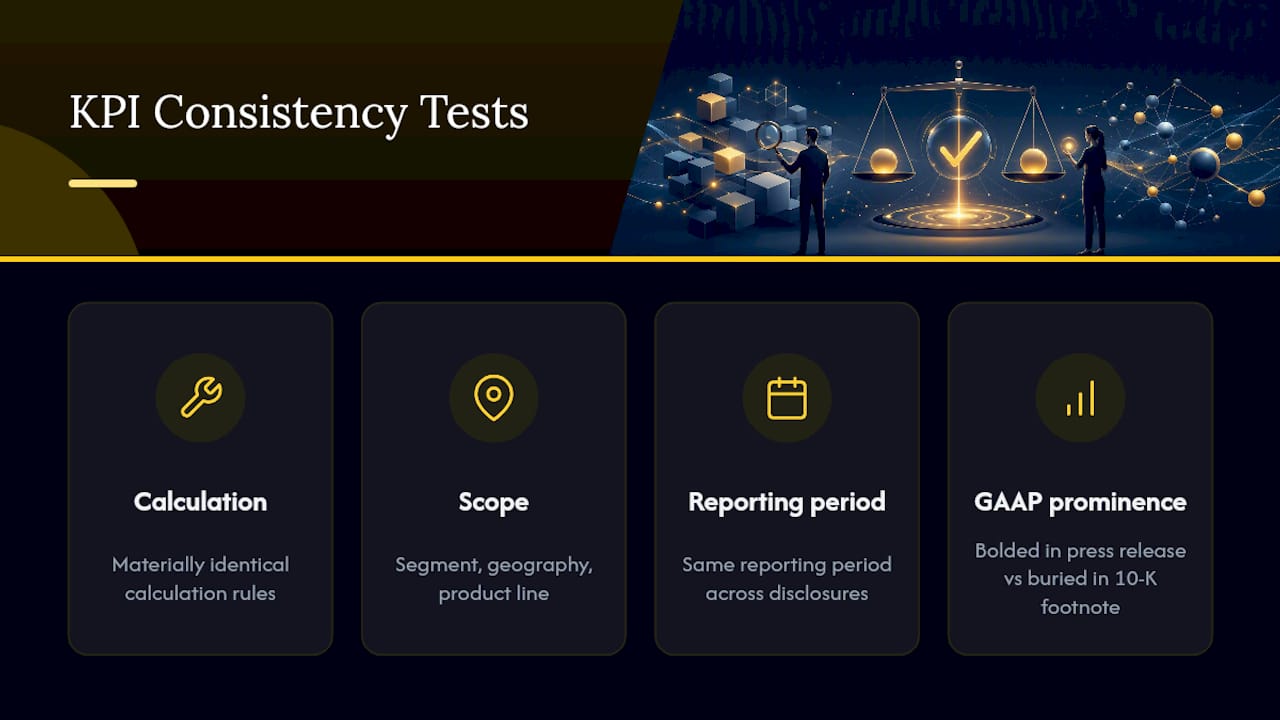
Consistency, in this context, means something narrower and more testable than "the company uses the same acronym everywhere." A KPI is consistent when its calculation rules, its scope (segment, geography, product line), its reporting period, and its relative prominence against the comparable GAAP measure remain materially identical across every public disclosure covering that period. Anything short of that, even a quietly redefined exclusion or a metric that appears bolded in a press release but buried in a footnote of the 10-K, counts as inconsistency for forensic purposes.
This scope excludes internal data-governance practices entirely. Whether a company's finance team standardizes KPI dashboards across business units is an operational question with no bearing on what shareholders can verify from the public record. The forensic question is narrower and more useful: does the disclosed metric mean the same thing every time it's disclosed?
Definition text worth capturing appears in predictable locations: MD&A narrative in the 10-K and 10-Q, footnotes to non-GAAP reconciliation tables, CD&A sections of the proxy statement, appendix pages of earnings press releases, and footnotes on investor slide decks. Regulators have never mandated a single calculation standard for popular metrics like EBITDA or free cash flow, which is precisely why comparability problems persist across firms and time and why forensic verification, rather than regulatory uniformity, does the work.
The Regulatory Baseline: Regulation G and S-K Item 10(e)
Two rules govern the legal floor, and both are checkable against the public record without any inside information.
Regulation G applies whenever a company discloses a material non-GAAP financial measure. It requires presentation of the most directly comparable GAAP measure and a quantitative reconciliation between the two for historical periods, codified at 17 CFR Part 244. The rule's operative prohibition is broader than a formatting requirement: a registrant cannot make public a non-GAAP measure that is, in itself or in the manner presented, misleading.
S-K Item 10(e) requires that the comparable GAAP measure be presented with equal or greater prominence than the non-GAAP measure, that management explains why the measure is useful to investors, and that any changes in calculation methodology be disclosed or appropriately recast. The SEC's Financial Reporting Manual and its Compliance and Disclosure Interpretations flesh out both rules with concrete examples.
Non-GAAP measures are often not comparable to similarly titled measures used by other companies, and staff guidance singles out prominence violations and missing reconciliations as recurring triggers for comment letters.
That last point matters for triage. SEC staff guidance treats inconsistency between a press release and the corresponding filed disclosure as one of the most common sources of misleading presentation, which is exactly where a forensic reviewer should start looking.
The Forensic Checklist: What to Compare Across Every Filing
The following six steps convert regulatory principle into a repeatable field procedure. Each step produces a discrete evidence item, and together they support a binary verdict: consistent or inconsistent.
- Extract the definition text verbatim. Pull the exact wording from MD&A, footnotes, the CD&A, the press release appendix, and slide footnotes. Paraphrasing at this stage destroys the evidence value.
- Map the calculation components. Record the numerator, denominator, reporting period, currency, segment scope, and every addback or adjustment into a standardized template.
- Verify the reconciliation. Confirm a quantitative schedule links the KPI to its most comparable GAAP measure for historical periods, as Regulation G requires.
- Compare labeling and prominence. Check whether the non-GAAP label is identical everywhere and whether the GAAP reconciliation gets equal visual weight. A quiet rename, "Adjusted revenue" becoming "Revenue, adjusted for X", often masks a calculation change rather than a cosmetic one.
- Cross-check timing and values between channels. Match the numbers in the press release and slide deck against the formally filed 8-K, 10-Q, or 10-K for the same period. Discrepancies here are the single most common flag in SEC staff guidance.
- Sample historical periods for methodology drift. Compare the current 10-Q's KPI definition against the prior 10-K's. Document any mid-series change and whether prior periods were recast.
Pro Tip: Sample the periods immediately surrounding executive incentive payouts, quarters where results beat or missed analyst forecasts, and any window bracketing an acquisition or restructuring. That is where definition pivots cluster, and where the incentive to redefine a metric is strongest.
A redacted extraction record looks like this in practice:
That single "new" cell, an addback appearing in the filing but absent from the press release, is the kind of discrepancy that turns a routine comparison into an escalation.
Red Flags That Warrant Immediate Escalation
Some inconsistencies are cosmetic. Others actively undermine an investor's ability to compare performance across periods, and those deserve immediate attention from a governance committee or outside counsel rather than a footnote in a research memo.
- Missing reconciliation where Regulation G requires one, particularly for a metric appearing prominently in a press release headline.
- Divergent values for the same KPI between the press release and the formally filed 8-K covering identical periods.
- Title reuse with quietly changed exclusions, where "Adjusted revenue" retains its label but drops or adds a component without disclosure.
- Failure to recast prior periods after a material methodology change, contrary to the best-practice guidance auditors and advisory firms recommend.
- KPI redefinitions timed just ahead of compensation-period settlement, a pattern forensic reviewers see disproportionately often.
Each of these erodes comparability, the entire point of a KPI, and each is a documented pattern behind recurring securities-fraud litigation that specifically targets key metrics rather than the financial statements themselves. A common variant: a metric gets a new exclusion added in the same quarter an incentive plan's target would otherwise have been missed, with no restatement of the comparable prior-year figure.
Documenting Findings: A Reproducible Audit Trail
An investigation that cannot be reproduced by a second reviewer is not forensic evidence, it's an opinion. The methodology needs four fixed steps: define the disclosure universe for the company and period, select sampling windows (prioritizing incentive-payout and earnings-surprise quarters), capture raw evidence with timestamps and source URLs, and assign each item a unique evidence ID.

A working evidence table needs these columns:
Best practice means capturing the filing's accession number and exact exhibit reference, preserving the precise wording used to define the KPI rather than a summary, and flagging whether prior-period recasting was required by the change and whether it actually happened. For internal governance review, that evidence set should carry a clear chain of custody; for external escalation to an audit committee, the package should add a short discrepancy narrative alongside the raw evidence table.
Why These Checks Matter More Than Standardization Debates
Forensic work on public disclosures keeps surfacing the same pattern: the problem isn't that KPIs lack a universal formula, it's that companies rarely disclose, consistently and prominently, which formula they're using this quarter versus last quarter. Analysts have long preferred methodological transparency over prescriptive standardization, and that preference is defensible. What isn't defensible is a company exploiting the absence of a single mandated formula to redefine its own metric without saying so.
Lacuna Index exists because that gap between narrative and delivery is measurable from public records alone, without insider access. A short forensic check, applied correctly, proves a narrower claim than a full audit: whether this quarter's disclosure matches last quarter's on the specific points that matter. A subscription report adds value when the finding needs sector context, a formal consistency score, or an audit trail built for escalation rather than a single analyst's notebook.
How Lacuna Index Operationalizes the KPI Consistency Check
The checklist above works as a manual exercise, but running it across a full coverage universe by hand doesn't scale, and that's the operational problem Lacuna Index is built to solve. The platform automates extraction of KPI definition text across 8-Ks, 10-Qs, 10-Ks, press releases, and investor decks, then runs a reconciliation engine that links every disclosed non-GAAP KPI back to its GAAP anchor. Change-detection flags mid-series definition shifts automatically, and every finding carries an audit-traceable evidence ID rather than an analyst's unlinked note.
Subscribers receive a forensic report structured around three outputs: an evidence table matching the format above, a consistency score benchmarked against sector peers, and a list of suggested escalation items ranked by severity. That sector context matters, since a metric that looks aggressive in isolation may be standard practice across an entire industry, or exactly the opposite. The sector benchmarks are free to browse for that comparative baseline. For the full breakdown of how a report translates raw filings into a scored verdict, the Lacuna Index user guide walks through exactly what a subscriber sees and how to read it.
Frequently Asked Questions
Is every non-GAAP KPI legally required to have a GAAP reconciliation?
Yes, when the measure is material and disclosed publicly. Regulation G requires a quantitative reconciliation to the most comparable GAAP measure for historical periods, with limited exceptions for certain forward-looking metrics.
What's the fastest single check for KPI definition consistency?
Compare the exact numeric value and definition text for the same KPI in the earnings press release against the formally filed 8-K. Mismatches here are among the most common patterns behind SEC comment letters and litigation.
Does a company have to recast prior periods when it changes a KPI's methodology?
Best practice, reflected in advisory-firm guidance, calls for recasting or clear disclosure of the change so investors can compare periods on a like-for-like basis. Silent, undisclosed changes can be a red flag indicating potential comparability issues
Can KPI inconsistency alone prove fraud?
No. Inconsistency is evidence of a comparability problem and a governance concern that may warrant escalation, but a fraud determination requires additional legal and factual analysis beyond a disclosure comparison.
Sources
- Conditions for use of non‑GAAP financial measures (SEC)
- CFR Title 17, Part 244 — Regulation G (govinfo)
- SEC staff guidance: Non‑GAAP financial measures