
Public disclosures are the primary mechanism by which management gaps become visible to investors, governance professionals, and analysts operating solely on public information. The standard industry term for this analytical process is "disclosure opacity assessment," and understanding how public disclosures reveal management gaps requires reading both what companies report and what they conspicuously omit. Regulatory frameworks like the SEC's periodic reporting requirements and the Government Sector Finance Act 2018 mandate structured disclosure precisely because accountability cannot exist without documented evidence. Yet volume of disclosure does not equal clarity. The most consequential management weaknesses often hide inside technically compliant reports that say very little of substance.
How public disclosures reveal management gaps: the core mechanics
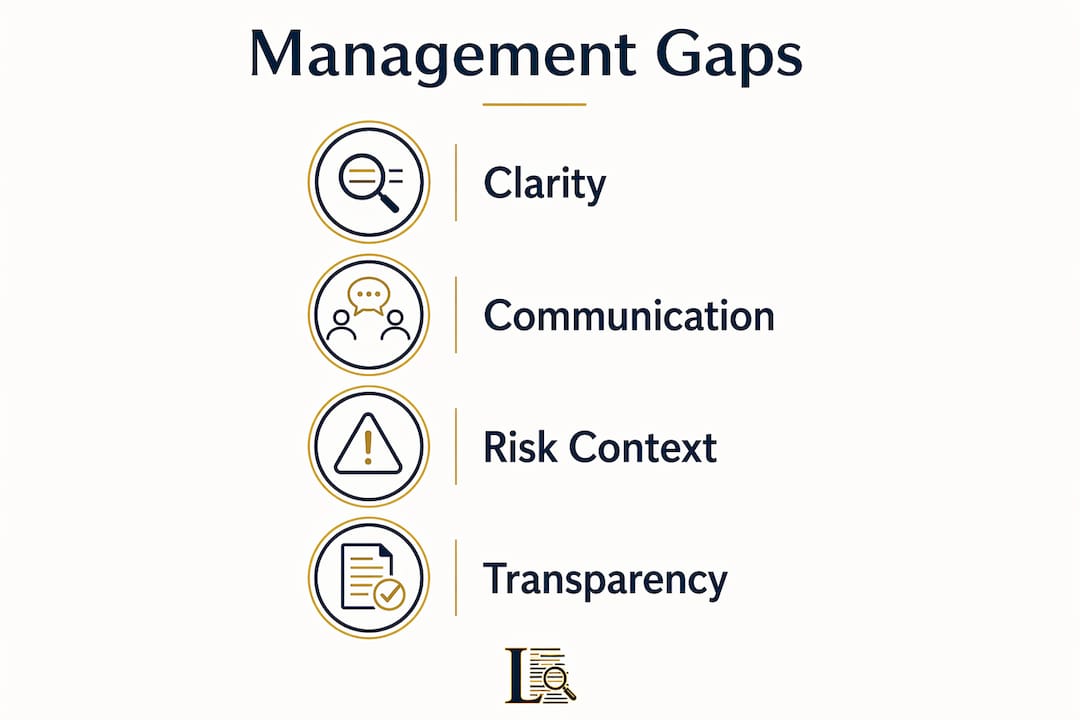
Management gaps in public disclosures fall into four distinct categories, each detectable through systematic reading of earnings calls, proxy statements, SEC filings, and sustainability reports.
The first category is the clarity-volume disconnect. Reports flood stakeholders with metrics while omitting context on negative indicators or strategy risks. A company may publish a 200-page annual report and still fail to explain why a key initiative missed its timeline or what corrective action management has taken. Emerging scholarship identifies this as a failure of substantive articulation: the obligation to clarify timing, attribution, and risk trajectory, not merely to disclose that a risk exists.
The second category is filtered internal communication. Research shows that up to 25% of managers withhold feedback, and 62% of employees perceive internal communications as filtered or misleading. That internal filtering pattern surfaces in public disclosures as sanitized language, absent negative KPIs, and earnings call responses that redirect rather than answer.

The third category is the absence of risk context. Disclosures that announce risks without specifying probability, timing, or management's response plan signal that leadership has not fully analyzed the exposure. This is a direct indicator of the aspiration-to-execution gap that forensic analysts track.
The fourth category is transparency theater. This includes sanitized town hall summaries published as governance evidence, final-decision announcements with no prior consultation record, and sustainability reports that correlate with higher public criticism precisely because detailed disclosure invites scrutiny that surface compliance cannot withstand.
Pro Tip: When reviewing an earnings call transcript, flag every question that management redirects without a direct numerical answer. A pattern of redirection across two or more consecutive quarters is a high-conviction signal of disclosure opacity.
How do disclosures impact investor and analyst assessments of management?
Detailed sustainability and ESG disclosures raise stakeholder expectations and create a higher standard against which management is measured. An analysis of more than 1,500 companies worldwide from 2007 to 2018 found that detailed sustainability reports correlate with more accusations of irresponsible conduct, not fewer. The finding is counterintuitive but logical: more disclosure creates more surface area for scrutiny.
Formal compliance with disclosure requirements does not satisfy the substantive articulation standard. A company that files an SEC Form 10-K on time but omits forward-looking risk context has technically complied while leaving analysts without the information needed to assess management quality. Governance experts now evaluate disclosures by asking whether timing, attribution, and foreseeable consequences are clearly stated, not merely whether the filing was submitted.
The consequences of disclosure gaps extend beyond reputational risk. Gaps in accountability reporting increase exposure to shareholder activism, elevate legal risk from securities litigation, and suppress the transparency premium that well-governed companies command in equity valuation. Analysts who identify these gaps early gain a material informational advantage.
Multi-rater feedback and 360-degree leadership assessments, when referenced in proxy statements or governance reports, provide a cross-source triangulation point. Their absence from governance disclosures is itself a signal. Companies that describe leadership evaluation processes in detail demonstrate a governance culture that tolerates scrutiny. Companies that omit this information often have accountability structures that cannot withstand it.
Pro Tip: Compare the language in a company's proxy statement governance section against its earnings call tone. Divergence between formal governance claims and informal management communication is a reliable indicator of disclosure shortcomings.
What are practical signs of management gaps in public reports?
Analysts can identify management weaknesses through specific disclosure patterns that recur across industries and reporting cycles. The following signals carry the highest diagnostic weight:
- Absence of negative KPIs. Reports that present only metrics trending upward omit the full performance picture. Genuine accountability reporting includes metrics that reflect setbacks and explains their cause.
- Asymmetric reporting cycles. Management that communicates frequently during positive periods and goes quiet after setbacks signals a filtered disclosure culture. Gallup research found that 29% of employees say leaders do not communicate clearly, and that pattern appears in public disclosures as information asymmetry between good and bad quarters.
- Final-decision announcements without prior consultation evidence. When a company announces a major restructuring, acquisition, or leadership change with no prior disclosure of the deliberation process, it signals that governance channels are not functioning transparently.
- Narrative incoherence between strategy and execution. A company that describes a five-year growth strategy in its annual report but shows no execution milestones in subsequent quarterly filings has a measurable aspiration-to-execution gap.
The table below maps these disclosure signals to the management accountability dimension each one reflects.
| Disclosure signal | Management accountability dimension |
|---|---|
| Absent negative KPIs | Performance measurement integrity |
| Asymmetric reporting cycles | Communication consistency |
| No prior consultation record | Governance process transparency |
| Strategy-execution narrative gap | Execution credibility |
| Redirected analyst questions | Risk disclosure completeness |
Governance professionals reviewing red flags in public disclosures should treat any two or more of these signals appearing simultaneously as a high-priority investigation trigger.
Why do transparency gaps persist despite more frequent reporting?
The transparency trap is the central paradox of modern corporate disclosure. Leadership assumes that visibility equals clarity, but the two are not the same. Jodie Shaw's analysis of leadership communication identifies this directly: leadership mistakes visibility for clarity, producing sanitized updates that lack essential context and cause stakeholders to fill informational gaps with worst-case assumptions.
"Transparency theater occurs when organizations increase the frequency and volume of reporting without increasing the substance of what is communicated. The result is a disclosure environment where stakeholders receive more data and less understanding. Analysts who treat reporting volume as a proxy for accountability quality will systematically misread the governance signals embedded in these disclosures."
Overreliance on dashboards, town halls, and quarterly updates creates a false sense of accountability. These formats favor positive framing and rarely surface the contextual information that analysts need to assess management quality. The corporate transparency challenges documented in financial firms show that board outreach can increase while consequential governance decisions continue to move through private channels.
The Harvard Corporation case illustrates this pattern at the institutional level. After pledging greater transparency, the board increased outreach frequency while its most significant decisions continued to occur privately. More visibility did not produce more accountability. The same dynamic appears in public company disclosures when boards publish governance reports that describe process without disclosing outcomes.
Cultural and leadership blind spots compound the problem. Leaders who have not experienced accountability from below tend to define transparency as information sharing rather than context sharing. The substantive articulation standard requires that disclosures explain not just what happened but why, when it became known to management, and what the foreseeable consequences are. Most disclosures fail this standard without leadership teams recognizing the failure.
How can analysts use public disclosures to uncover management shortcomings?
Effective disclosure analysis requires a structured methodology that moves beyond formal compliance review. The following process applies across SEC filings, proxy statements, earnings calls, and sustainability reports.
- Apply the substantive articulation test. For each material disclosure, ask whether the filing specifies timing (when did management know), attribution (who is accountable), and risk trajectory (what is the expected path forward). Filings that omit two or more of these elements fail the substantive articulation standard.
- Triangulate across disclosure sources. A single filing rarely tells the full story. Cross-reference the annual report narrative against earnings call transcripts, press releases, and proxy governance sections. Inconsistencies between these sources are high-conviction indicators of disclosure management rather than genuine transparency.
- Incorporate contextual analysis. Regulatory filings from the public company transparency framework provide a baseline for what substantive disclosure looks like in a given sector. Deviations from sector norms in risk language, KPI selection, or governance description warrant deeper investigation.
- Track disclosure patterns over time. A single quarter of asymmetric reporting may reflect circumstance. A pattern across four or more quarters reflects management culture. Build a longitudinal disclosure log for each company under review.
- Engage management directly on disclosure gaps. Shareholder engagement letters that cite specific disclosure shortcomings, referencing the substantive articulation standard, create a documented accountability record and often produce more informative responses than generic governance inquiries.
Pro Tip: Use the corporate transparency metrics framework to score disclosures against sector benchmarks. A company scoring below sector median on substantive articulation for two consecutive years carries elevated governance risk regardless of its formal compliance record.
Key Takeaways
Public disclosures reveal management gaps most reliably through the pattern of what is omitted, redirected, or sanitized across multiple reporting cycles, not through any single filing.
| Point | Details |
|---|---|
| Substantive articulation standard | Disclosures must specify timing, attribution, and risk trajectory to meet governance quality thresholds. |
| Volume does not equal clarity | More frequent reporting can mask accountability gaps when context and negative indicators are absent. |
| Cross-source triangulation | Comparing annual reports, earnings calls, and proxy statements surfaces inconsistencies that single-source review misses. |
| Disclosure pattern analysis | Asymmetric reporting across four or more quarters is a reliable indicator of filtered management communication. |
| Transparency theater risk | Increased board outreach without substantive outcome disclosure creates the appearance of accountability without the reality. |
The gap between reporting and accountability is wider than most analysts assume
After years of reviewing public disclosures across sectors, the most consistent finding is that governance professionals underestimate how much management culture shapes what gets disclosed and how. The formal compliance framework, whether SEC reporting, Government Sector Finance Act mandates, or ESG disclosure standards, sets a floor. It does not set a ceiling, and most management teams operate just above the floor.
The substantive articulation standard changes the analytical frame entirely. Instead of asking "did they disclose this?" the question becomes "did they explain this in a way that allows an informed reader to assess the risk?" That is a much harder standard to meet, and most disclosures fail it. The failure is not always intentional. Leadership teams that have never been held to this standard genuinely do not know what substantive disclosure looks like.
The counterintuitive finding from the 1,500-company sustainability study deserves more attention than it typically receives. Companies that disclose more face more criticism. That finding should not discourage disclosure. It should recalibrate expectations about what disclosure achieves. Disclosure does not protect management from scrutiny. It invites scrutiny. The companies that benefit from disclosure are the ones whose execution actually matches their narrative. For everyone else, more disclosure creates more exposure.
The practical implication for analysts is this: treat every disclosure as a hypothesis about management quality, then test that hypothesis against execution data. Lacunaindex does exactly this, measuring the gap between what companies claim and what they deliver across public records. That methodology is the most direct application of the substantive articulation standard available to institutional investors today.
— Glen
Lacunaindex: forensic analysis of management gaps in public disclosures
Identifying management gaps in public disclosures requires more than reading filings. It requires a systematic methodology that measures the distance between corporate narrative and actual delivery across every available public record.
Lacunaindex applies forensic analytics to earnings calls, SEC filings, proxy statements, and press releases to produce execution scores and aspiration-to-execution gap measurements for public companies. Governance professionals and institutional investors use these scores to benchmark management accountability against sector-level reference data and identify companies where disclosure opacity signals elevated governance risk. The platform classifies companies as earned, borrowed, or undervalued based on the relationship between their narrative claims and their documented delivery. That classification provides a structured basis for engagement, portfolio review, and governance assessment that public filings alone cannot support.
FAQ
What does "management gap" mean in the context of public disclosures?
A management gap is the measurable distance between what a company's leadership claims in public communications and what its documented execution record shows. Analysts identify these gaps by comparing narrative statements in earnings calls and annual reports against operational and financial outcomes across reporting periods.
Can public disclosures improve management accountability?
Yes, but only when disclosures meet the substantive articulation standard, meaning they specify timing, attribution, and risk trajectory rather than simply acknowledging that a risk exists. Research shows that detailed sustainability disclosures correlate with higher public scrutiny, which creates external pressure that can drive genuine accountability improvements.
What are the most reliable red flags in public reports?
The highest-conviction signals are absent negative KPIs, asymmetric reporting frequency between positive and negative periods, final-decision announcements without prior consultation records, and redirected analyst questions across consecutive earnings calls. Two or more of these signals appearing together indicate a filtered disclosure culture.
How does the substantive articulation standard differ from formal disclosure compliance?
Formal compliance requires that information be disclosed. The substantive articulation standard requires that the disclosure explain when management became aware of the issue, who is accountable, and what the foreseeable consequences are. Most filings satisfy formal compliance while failing substantive articulation.
How does Lacunaindex use public disclosures to assess management quality?
Lacunaindex mines earnings calls, SEC filings, proxy statements, and press releases to measure the gap between corporate narrative claims and actual delivery. The platform produces execution scores and classifies companies by archetype based solely on publicly available information, without requiring insider access or proprietary data.