
A forensic corporate-disclosure report follows one canonical structure: executive summary, scope and methodology, evidence exhibits, claim-by-claim analysis, findings separated from opinion, conclusions and limitations, and a working-paper archive behind all of it. Every headline claim in that report must trace to a numbered exhibit and a working paper that a third party could pull and independently verify without asking the author a single question.
TL;DR:
- A forensic report's core sections must include a detailed executive summary, clear scope, methodology, and claim-by-claim findings linked to specific exhibits.
- All evidence exhibits should be precisely titled, sourced from public filings, and reconciled to the original documents, with version-controlled working papers.
- Each claim needs to be structured with source citation, quantitative analysis, and a transparent reconciliation to ensure reproducibility and testability.
- Facts must be clearly separated from opinions, with factual findings tied to exhibits and interpretive statements explicitly labeled as opinions with their assumptions.
- Limitations from redactions, restatements, or data gaps must be openly disclosed with reproducibility checks, avoiding vague hedges or unverified assumptions.
Table of Contents
- What Belongs in a Forensic Report's Core Sections
- Sourcing the Evidence: What Goes Into the Exhibits
- Turning Narrative Claims Into Testable Numbers
- Writing Findings That Hold Up: Fact Versus Opinion
- Designing Exhibits and Managing the Working-Paper Trail
- Disclosing Limitations Without Undermining the Findings
- Putting the Report to Work: Investors, Boards, and Journalists
- Why Structure, Not Style, Determines a Report's Credibility
- Access Forensic Reports Built on This Exact Structure
- Sources
- FAQ
What Belongs in a Forensic Report's Core Sections
The executive summary carries more analytical weight than its name implies. It should state the scope, the period under review, the headline findings, and any caveats that bear on how those findings should be read. A reader who stops after page one should still walk away with an accurate, if compressed, picture of the disclosure-versus-delivery gap.
The scope and background section documents the engagement itself: the retention date, the stated objectives, and any constraints that shaped what could and could not be examined, including privilege boundaries where relevant. Skipping this section is how reports get accused of scope creep or selective framing after the fact.
Methodology deserves its own section, not a footnote. It should specify data sources, processing steps, coding rules for classifying narrative statements, and enough procedural detail that another analyst could rerun the work and land on comparable results. This is the section that separates a forensic report from an opinion column with charts.
Findings and recommendations should be organized by issue, not by document type, with each issue tied directly to its supporting exhibit. A useful structure includes:
- Executive summary: scope, period, headline figures, caveats
- Scope and background: objectives, retention date, constraints
- Methodology: sources, coding rules, reproducibility notes
- Findings by issue: each claim tested, each exhibit numbered
- Conclusions and limitations: what the evidence supports and where it stops
For a full walkthrough of how these sections interlock in practice, see this forensic financial analysis methodology.
Sourcing the Evidence: What Goes Into the Exhibits
A forensic disclosure report is only as strong as its underlying document set, and that set is entirely public. The core inputs are 10-K and 10-Q filings, 8-K event disclosures, proxy statements, earnings-call transcripts, press releases, and any SEC correspondence that surfaces during the review. Management's Discussion and Analysis sections deserve particular attention, since regulators expect MD&A to complement the financial statements directly under Item 303 of Regulation S-K, which makes it one of the highest-yield sources for mapping a stated claim to a measurable line item.
Exhibit formatting follows three non-negotiable rules:
- Title the exhibit precisely — what it proves, not just what it contains.
- Attach a source footnote citing the exact filing, form type, and filing date.
- Reconcile every number in the exhibit back to the source document's own line items.
Working papers behind each exhibit need an index key and version control, and each one should stand alone well enough that a reader who never opens the narrative report can still verify the underlying math. A guide to forensic accounting investigation practice treats this self-sufficiency as the defining test of exhibit quality.
Pro Tip: Number exhibits sequentially across the entire report, not by section. Renumbering within each findings section creates duplicate exhibit IDs that break cross-referencing the moment a reviewer prints two sections side by side.
Turning Narrative Claims Into Testable Numbers
The analytical core of any forensic disclosure report is claim extraction: pulling discrete statements out of transcripts and filings, then coding each one along four dimensions. A multi-dimensional disclosure-profiling framework developed by Beattie, McInnes, and Fearnley classifies each text unit by topic, time orientation (past, present, or forward-looking), financial versus non-financial content, and quantitative versus qualitative form. That four-way coding turns a vague transcript into a structured dataset that supports one-way, two-way, and full cross-tabulated analysis across periods.
Once a claim is coded, it has to become a testable proposition. A management statement that "bookings growth will translate to revenue in the back half" becomes an indicator: expected bookings figures compared against realized revenue lines in the following quarters' 10-Qs. A stated headcount reduction becomes a comparison against actual SG&A trends. The conversion step is what separates forensic analysis from a simple content summary.
The presentation format should follow a consistent chain for every claim: the claim itself, its source citation, the analytical steps applied, the numeric reconciliation, and the resulting finding. Writing this chain in prose rather than jamming it into a table keeps the logic visible. That structure matters:
- It forces the analyst to show the reconciliation math, not just the conclusion.
- It lets a reviewer trace disagreement to a specific step rather than the whole finding.
- It supports cross-period checks, since narrative-delivery gaps tend to show up as patterns of shifting or reframed language rather than isolated misstatements.
Interdisciplinary approaches that combine linguistic coding with financial analysis tend to catch impression management in narrative disclosures that a single-lens review would miss entirely.
Writing Findings That Hold Up: Fact Versus Opinion
Every factual finding needs an exhibit citation attached directly to the sentence, not buried in a footnote three paragraphs later. Interpretive judgment gets a different treatment entirely:
- Label interpretive statements explicitly as "Opinion" and state the assumptions behind them.
- Lead each findings section with the headline financial magnitude before the narrative explanation.
- Keep remediation recommendations in a clearly separated section, since investigative and litigation-support deliverables often need different handling regarding privilege and public distribution.
- Never let a recommendation's phrasing bleed into the factual findings section above it.
This separation protects the report's credibility more than any other single formatting choice, because a reader can trust the facts even when they disagree with the interpretation.
Designing Exhibits and Managing the Working-Paper Trail
An exhibit works only when it can defend itself without the narrative report open beside it. That means a clear title stating what it proves, a source footnote naming the exact filing and date, and a reconciliation showing how the exhibit's figures tie back to the numbers cited in the findings.
- Name working papers consistently — a file-naming convention tied to exhibit numbers prevents version confusion months later.
- Version everything, since forensic reviews often run through multiple drafts as new filings surface.
- Index every working paper so it stands alone, a principle practitioner guides treat as central to investigation report writing.
- Separate distribution tracks for investigative reports meant for a board or public audience versus litigation-support reports bound by privilege and expert-evidence rules.
Disclosing Limitations Without Undermining the Findings
Every forensic report runs into real data constraints: redacted filings, timing gaps between disclosure and delivery, and restated financials that shift the baseline after the fact. State these limitations plainly rather than burying them in a footnote.
- List the specific redactions or missing data points that affected the analysis.
- Note any restatements that occurred after the review period closed.
- Provide a reproducibility checklist: snapshot dates for each data pull, the exact search queries or filters used, and a plain-language description of the manual or automated steps applied.
- Attach a sensitivity note to any headline figure that would shift materially under a different assumption.
Pro Tip: State uncertainty as a range tied to a specific assumption, not a vague hedge. Verifiable financial magnitude examples should be based on supported data; vague hedging such as "Delivery appears weaker than promised" is not appropriate.
Putting the Report to Work: Investors, Boards, and Journalists
An institutional investor should read a forensic disclosure report the way a credit analyst reads a covenant package: prioritize the red flags with the largest financial magnitude first, weight execution-versus-delivery metrics into any sell, hold, or engage decision, and treat the narrative gaps as sector-relative signals rather than isolated events.
- Investors: Rank findings by financial magnitude, then check whether the gap recurs across prior periods before acting on it.
- Governance professionals: Present findings to audit committees with exhibits attached, and tie every remediation proposal to the specific claim it addresses.
- Journalists: Cite findings with the exhibit reference intact, preserve the source-document link for readers, and avoid extending a documented gap into a conclusion the evidence does not support.
Portfolio teams incorporating this kind of analysis into ongoing due diligence tend to treat it as a recurring input rather than a one-time read, checking forensic findings against position sizing at each earnings cycle rather than only at initiation.
Why Structure, Not Style, Determines a Report's Credibility
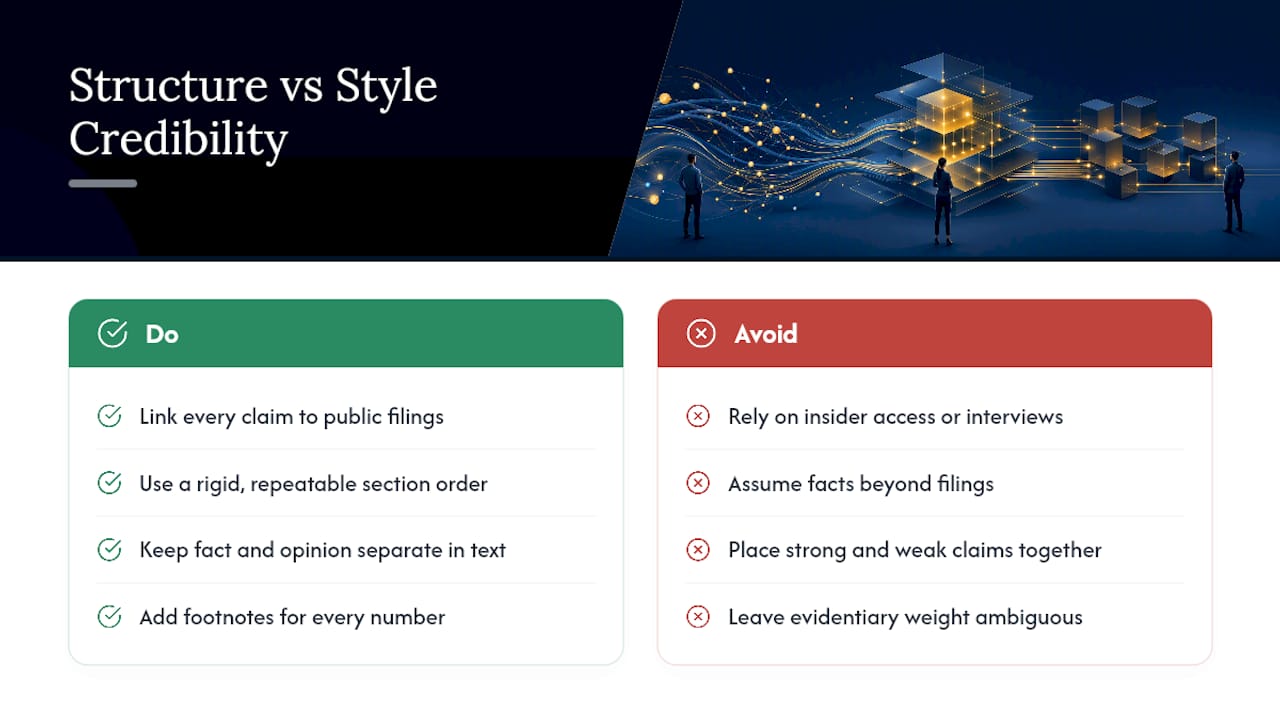
Lacuna Index builds its methodology around a simple constraint: no insider access, no management interviews, no forward assumptions beyond what public filings support. Every execution score traces back to a disclosure that any subscriber could pull and check independently, which is the same audit-traceability standard this article has laid out section by section.
The most common failure in forensic disclosure work is not bad analysis. It is a report structure that lets a strong finding sit next to a weak one with no visible difference in evidentiary weight. A reader cannot tell, from formatting alone, whether a claim rests on a reconciled exhibit or an analyst's hunch. That ambiguity is what erodes trust in forensic work long before anyone questions the underlying math. The fix is not more caveats. It is a rigid, repeatable section order where fact and opinion never share a sentence, and where every number carries its footnote into the reader's hands.
— Glen
Access Forensic Reports Built on This Exact Structure
Reports apply the same audit-traceable format covered above to every company analyzed: an executive summary, exhibit-linked findings, and an execution score built entirely from public filings, earnings calls, and proxy statements, with no insider input anywhere in the process. That structure is what separates a Lacuna report from a narrative summary written around a press release.
For readers who want to see the format applied before subscribing, the sector benchmarks page shows how execution scores compare across peer companies at no cost. Subscribers get full company-level reports with the exhibit trail intact, and the user guide walks through how to read such a forensic report section by section, including how to trace a finding back to its source exhibit. Start there before requesting access to a full report on a specific company.
Sources
Methodology grounding for this article comes from academic disclosure-profiling research and practitioner forensic accounting reporting guides, alongside methodology comparisons from sources like PennyStockScout.
- A multi-dimensional framework for disclosure profiling (Beattie, McInnes and Fearnley)
- A multi-dimensional analysis of MD&A narratives (ScienceDirect article)
- A guide to forensic accounting investigation (practitioner guide)
- The Forensic Accounting Report: Structure | ForensicSpot
FAQ
What sections must every forensic disclosure report include?
At minimum: an executive summary, scope and methodology, evidence exhibits, findings separated from opinion, conclusions with stated limitations, and a working-paper archive supporting every exhibit.
How is a forensic report different from a standard equity research note?
A forensic report ties every claim to a specific exhibit and public filing with a reconciliation trail, while typical research notes rely more heavily on analyst projections and management guidance without that same audit-traceable format.
What documents should analysts collect before starting the analysis?
10-K and 10-Q filings, 8-K disclosures, proxy statements, earnings-call transcripts, press releases, and any SEC correspondence tied to the period under review.
How do you separate facts from opinion in a forensic report?
State factual findings with a direct exhibit citation in the same sentence, and label any interpretive judgment explicitly as "Opinion" along with the assumptions behind it.
Can Lacuna Index's reports be used for investment decisions?
Lacuna Index's forensic reports and sector benchmarks are built for institutional investors and governance professionals who need audit-traceable evidence on narrative-versus-delivery gaps before making a position decision.