
Verifying a supply chain claim means testing a company's public statement ("responsibly sourced," "traceable to origin," "free of forced labor") against the evidence it has placed on the record: filings, certifications, customs documentation and its own disclosures over time. The method that holds up is systematic: decompose the claim, grade the evidence behind each element, and record what remains unanswered. Lacuna Index applies this logic to public companies by measuring the gap between narrative claims and delivery, using public records only.
TL;DR
- A verifiable claim states its scope, extent, timeframe, performance level, actions and attribution; a claim missing these elements cannot be tested.
- Evidence is graded by independence: auditable records and third-party verification rank above self-attestation, and a certification does not remove the claimant's duty to substantiate.
- SEC Form SD conflict minerals reports, California Transparency in Supply Chains Act postings and CBP guidance create a public paper trail against which claims can be compared.
- Incomplete evidence is a finding, not a dead end: record the gap, its size and what the company has not been asked.
- Lacuna Index sector benchmarks are free; company-level analysis is gated by subscription.
Table of Contents
- 1. What a verifiable supply chain claim contains
- 2. Attribution: the highest evidentiary bar
- 3. The public paper trail: where claims meet records
- 4. Grading evidence: audits, certifications and self-attestation
- 5. When evidence is incomplete or contradictory
- 6. Documenting a verification review
- 7. Applying the method at scale
- 8. Lacuna Index offers per-company analysis
- 9. Perspective
- FAQ
- Sources
1. What a verifiable supply chain claim contains
The Accountability Framework's operational guidance on reporting, disclosure and claims (March 2025) states that credible claims are clear, truthful, evidence-based, verifiable and free of misleading omissions. It lists six elements a claim should carry:
| Element | Question the reviewer asks |
|---|---|
| Topical scope | Which issue (deforestation, forced labor, conflict minerals) does the claim cover? |
| Extent | Which commodities, suppliers, volumes or facilities? |
| Timeframe | What period does the evidence describe? |
| Performance level | What was actually achieved, in measurable terms? |
| Company actions | What investments or programs are described? |
| Attribution | How much of the outcome is caused by the company? |
The same guidance indicates that snapshot and cumulative claims should typically rest on evidence no more than one year old. A sentence such as "our supply chain is ethically sourced" fails on extent, timeframe and performance level at once, which is why it produces a large aspiration-to-execution gap when compared with delivery data.
The FTC's Green Guides (16 C.F.R. Part 260) supply the regulatory parallel for environmental claims. They state that unqualified general environmental benefit claims are deceptive because marketers are unlikely to substantiate every reasonable interpretation, and that a reasonable basis often requires competent and reliable scientific evidence. They apply to all marketing media, including business-to-business transactions. They also treat technically true claims as potentially deceptive when they inflate a negligible attribute: a rug moving from 2% to 3% recycled fiber cannot be sold as "50% more recycled content" without misleading buyers.
2. Attribution: the highest evidentiary bar
Claims of impact are harder than claims of activity. The Accountability Framework guidance notes that attributing an outcome to a company's programs, for example a reduction in child labor, requires showing not only that the outcome occurred but that the company's interventions caused it, generally through a well-designed impact study with a control group. In a review, this separates three statements that are often blurred in sustainability reports:
- Activity: the company ran an audit program or training.
- Outcome: a measured condition improved in the supply base.
- Attribution: the improvement is caused by the company.
Most narrative claims assert the third while evidencing the first. Flagging that mismatch is a core step of a forensic review.
3. The public paper trail: where claims meet records
Three U.S. disclosure regimes give a reviewer independent reference points.
SEC conflict minerals reporting (Form SD)
Under Rule 13p-1, as described in the D.C. Circuit decision in National Association of Manufacturers v. SEC, issuers whose products contain tin, tantalum, tungsten or gold (the 3TG minerals) necessary to functionality must conduct a good-faith reasonable country of origin inquiry. If the minerals may have come from the Democratic Republic of the Congo or adjoining countries, the issuer must exercise due diligence on source and chain of custody and file a conflict minerals report, including a private sector audit, listing products not found to be "DRC conflict free."
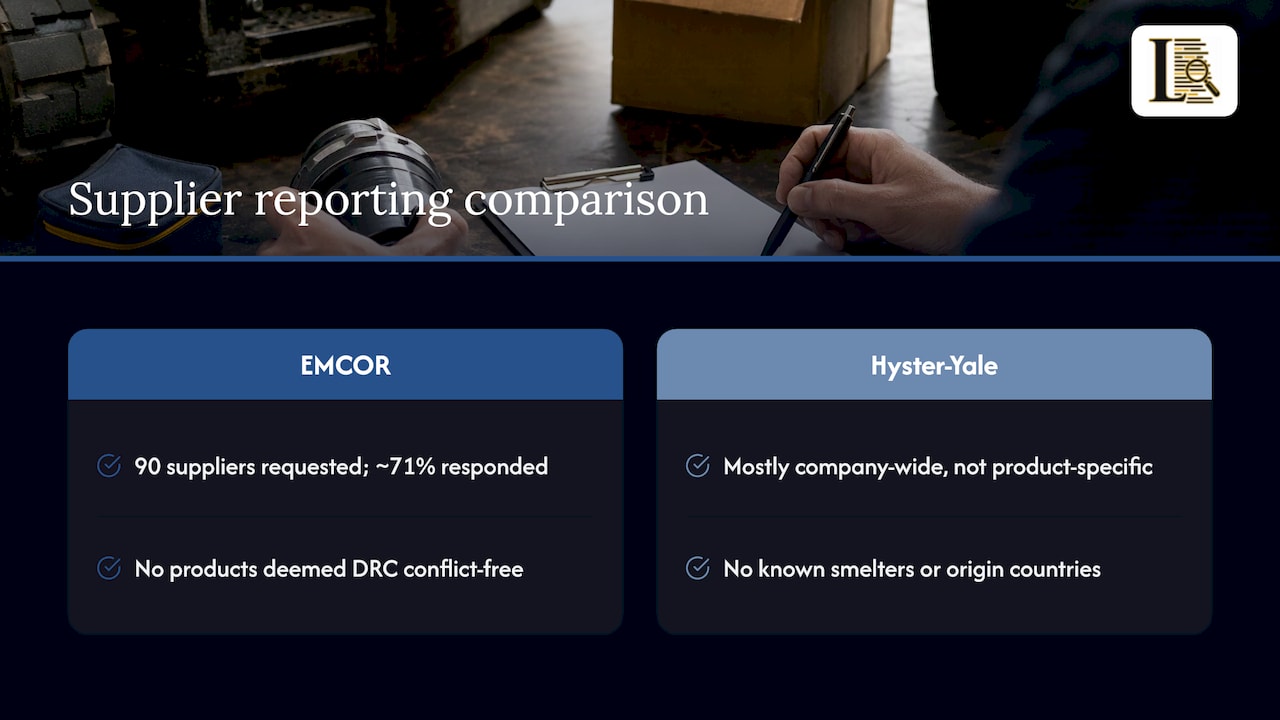
These filings show how thin supplier evidence often is. In its 2025 Form SD report filed May 8, 2026, EMCOR Group stated it sent Conflict Minerals Reporting Template requests to 90 suppliers, received responses from roughly 71%, and did not conclude that any in-scope products were DRC conflict free because smelter information was incomplete and supplier-provided sourcing could not be verified. Hyster-Yale's 2025 report states that most suppliers reported on a company-wide rather than product-specific basis, so the company could not report known smelters or countries of origin. For a reviewer, the comparison between a sustainability-report headline and the Form SD text is often the cleanest narrative-versus-delivery test available. Related filing-side techniques are set out in the public company transparency regulatory assessment guide.
California Transparency in Supply Chains Act
Per the California Department of Justice resource guide, since January 1, 2012, manufacturers and retail sellers doing business in California with worldwide gross receipts above $100 million must post a homepage disclosure on five areas: verification of supply chains for trafficking and slavery (stating if not performed by a third party), supplier audits (stating if not independent and unannounced), supplier certification, internal accountability and training. The Franchise Tax Board list identified roughly 1,700 likely covered companies. The homepage disclosure is a ready-made checklist: each of the five areas can be marked as disclosed, qualified (for example, audits that are announced or conducted internally) or absent.
CBP forced labor enforcement
Customs records show what a company can document when pressed. Goods with any input from the Xinjiang Uyghur Autonomous Region, or made by an entity on the UFLPA Entity List, are presumed made with forced labor, according to CBP's UFLPA FAQs. CBP's 2022 operational guidance lists tracing documentation: a description of every production stage, supplier lists, affidavits, invoices, payment records, inventory records, shipping manifests and bills of lading, and import and export records. The June 2026 Forced Labor Enforcement Operational Guidance adds that an exception requires clear and convincing evidence that goods were not made wholly or in part with forced labor, and encourages origin verification testing, including isotopic testing.
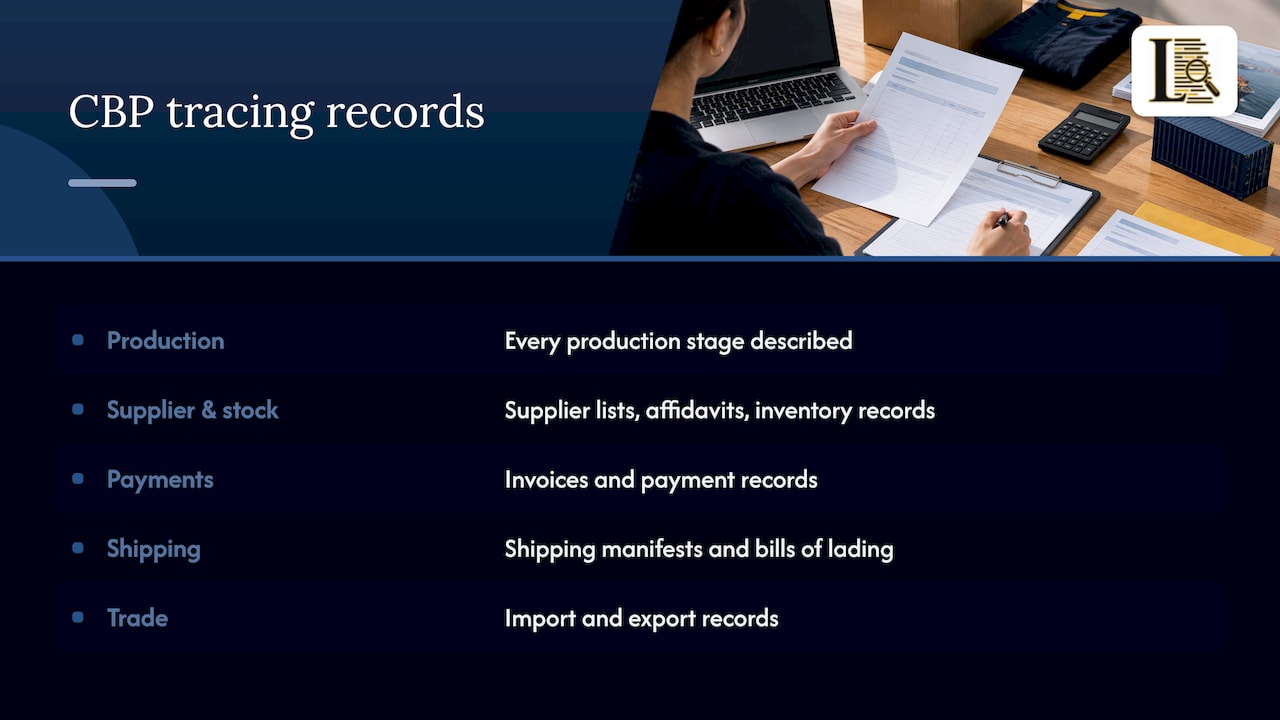
For an outside reviewer, this list defines what a complete evidence package looks like. A company asserting full traceability publicly but disclosing none of these record types has told the reader something about delivery.
4. Grading evidence: audits, certifications and self-attestation
Not all evidence carries equal weight. A practical grading ladder:
| Grade | Evidence type | Reviewer note |
|---|---|---|
| A | Independent third-party verification with a published statement | Check scope matches the claim's scope |
| B | Auditable transaction records, supplier lists, smelter lists | Check date and coverage percentage |
| C | Certification or seal | Confirm what the seal actually covers |
| D | Self-attestation, supplier questionnaires | Check response rate and verification |
| E | Unsupported narrative | Record as unsubstantiated |
The FTC's Green Guides (§260.6) state that third-party certification does not eliminate the marketer's obligation to substantiate every claim the certification reasonably conveys, and that seals not conveying their basis likely imply a general environmental benefit. A certification is therefore evidence of something specific, not a blanket proof.
The disclosure behind industry programs also varies. A March 2021 review of 75 Chinese smelters and refiners found that 19% published no due diligence information, only 5% published all three OECD-required components, and that membership in an industry responsible sourcing program did not ensure comprehensive public disclosure. Downstream parties could not independently verify OECD-standard due diligence from public reporting alone.
Company procurement standards show what a documented assurance route looks like. H&M Group's Material Sourcing Requirements (2026) describe third-party certification or verification as the preferred route for higher-risk materials, chain-of-custody claims and recycled-content claims, with minimum evidence covering material source and origin, certification route, chain of custody and traceability to the claim. That is a useful template for the evidence a claim of that type should be able to point to.
5. When evidence is incomplete or contradictory
Missing evidence is common, and a verification review has to handle it explicitly. NIST's Supply Chain Traceability Principles (NIST IR 8536, 2026) state that when direct supplier data is unavailable, traceability should rely on verifiable alternative evidence rather than absolute transparency, using bounded disclosures limited to what a risk or compliance requirement needs. The report sets no universal minimum threshold: the acquiring organization sets it according to the item's operational risk, with options including third-party verification, random physical audits or higher risk scores.
For an analyst, this translates into a procedure:
- Classify the gap: missing data, withheld data (trade secrets), or contradictory data.
- Look for alternative evidence: customs records, filings by counterparties, audit summaries.
- Scale the threshold to risk: a conflict-minerals claim for a high-risk input warrants a higher bar than a packaging claim.
- State the limitation: the finding is "not verifiable from public records" rather than "false."
The Accountability Framework guidance also expects companies to disclose suppliers, supply origins, and the status of non-compliances and grievances, and to make origin data available in searchable, downloadable formats. Where a company reports traceability, the proportion of volume traceable to production unit, sourcing area, country of origin, or not traceable should total 100% for each commodity. A claim of "full traceability" without such a breakdown is untestable.
6. Documenting a verification review
A review is only as credible as its record. The IFS Supply Chain Processes Check guideline (Version 1) calls for clear, measurable claim statements, a risk assessment covering market perception, legal obligations and the possibility of challenge, and documentation such as audit reports, third-party certifications, internal approval sign-off and supplier compliance records. A reviewer's file should mirror this from the outside:
- the verbatim claim, source document and date;
- the claim decomposed into the six elements;
- each piece of corroborating or contradicting evidence, its grade and its period;
- discrepancies, quantified where possible (for example, 71% supplier response against a claim of complete coverage);
- unanswered questions, including those the company was never asked on an earnings call.
The discipline of keeping every score traceable to a cited document is covered in six forensic steps to build an audit trail. Broader claim-testing across sustainability topics is in the corporate responsibility claims verification guide, and journalists can pair this method with accountability story angles.
For reviewers examining the reputational and regulatory exposure of weak environmental claims, a guide to corporate social responsibility evidence outlines how substantiation gaps translate into risk.
7. Applying the method at scale
One claim reviewed by hand is manageable; a coverage universe is not. Consistency is the constraint: if each analyst weighs evidence differently, scores cannot be compared across issuers. Lacuna Index addresses this by standardizing its methodology across all covered companies, publishing explicit governance logs for its scoring, and relying only on public records, with no proprietary data or insider access. Companies are classified into archetypes such as earned, borrowed or undervalued according to delivery and valuation metrics, and forensic reports carry execution and narrative scores.
Sector benchmarks, for instance for Industrials and Consumer Staples, are free and give a reference distribution against which a single company's supply chain narrative can be placed. The methodology walkthrough shows how scoring is built.
8. Lacuna Index offers per-company analysis
Institutions that need the company-level view can use the per-company analysis, which evaluates the narrative-versus-delivery gap from disclosures including SEC filings, earnings calls, proxy statements and press releases. Subscription plans, Cohort Pulse and Sector Sweep, are described on the pricing page.
9. Perspective
Supply chain claims are where narrative and delivery separate most visibly, because the claim is usually broad and the evidence is usually narrow. A company reports a headline commitment; the Form SD beneath it admits that supplier data could not be verified. Neither document is false. The gap between them is the finding.
We build every score so that it can be audited back to a public document. That is the reason we restrict ourselves to public records and apply one methodology across all issuers: comparability and traceability matter more than any single dramatic conclusion. An investor or proxy advisor can then see not only that a gap exists but which disclosure produced it, and which question was never asked.
The same discipline applies to this topic as to any other: decompose the claim, grade the evidence, state the limits. Done consistently across a sector, it turns scattered anecdotes about sourcing into a measurable accountability signal.
Glen
FAQ
What counts as sufficient evidence for a supply chain claim?
There is no single threshold. The Accountability Framework expects claims to be backed by evidence that is publicly available with the claim and auditable or independently verifiable. NIST's 2026 traceability report leaves the threshold to the acquiring organization, scaled to the operational risk of the item.
Does a third-party certification prove a claim?
Not by itself. Under the FTC Green Guides, certification does not remove a marketer's obligation to substantiate the claims the certification reasonably conveys. A reviewer should confirm that the certification's scope matches the scope of the claim.
Which U.S. filings are most useful for testing sourcing claims?
Form SD conflict minerals reports for companies using 3TG minerals, and California Transparency in Supply Chains Act homepage disclosures for large manufacturers and retailers doing business in California. CBP guidance indicates what documentation importers should be able to produce.
How should a reviewer treat missing data?
As a documented limitation. The finding is that a claim cannot be verified from public records, with the gap classified and the alternative evidence listed. It is not the same as a finding that the claim is false.
Sources
- Accountability Framework, Operational Guidance on Reporting, Disclosure and Claims (March 2025)
- FTC Green Guides, 16 C.F.R. Part 260
- National Association of Manufacturers v. SEC (2014)
- EMCOR Group Form SD conflict minerals report
- Hyster-Yale Form SD conflict minerals report
- California Department of Justice, Transparency in Supply Chains Act resource guide
- CBP, UFLPA FAQs
- CBP, UFLPA Operational Guidance for Importers (2022)
- CBP, Forced Labor Enforcement Operational Guidance for Importers (2026)
- NIST IR 8536, Supply Chain Traceability Principles (2026)
- Digging for Disclosure (March 2021)
- H&M Group Material Sourcing Requirements v1 (2026)
- IFS Supply Chain Processes Check guideline
- Corporate social responsibility: a 2026 guide for leaders