
Forensic sustainability report assurance is the practice of testing a company's public sustainability claims against verifiable evidence drawn entirely from public records, without relying on the company's own assurance provider. Used correctly, it produces an audit-traceable evidence trail with reproducible citations and a confidence classification, giving investors and reporters something formal assurance statements rarely deliver: a way to check the checker. The checklist and the Lacuna Index model that follow show how.
TL;DR:
- Many verified claims lack transparency, as companies often omit the assurance provider's name or scope, making external validation impossible.
- Rounding patterns in emissions data are a common anomaly that can quickly expose data integrity issues in voluntary disclosures.
- The five-step forensic verification process is critical for uncovering inconsistencies, cross-referencing filings, and accurately assessing claim credibility.
- Lacuna Index’s sector benchmarks and citation-based reports enable investors and journalists to verify claims independently and identify meaningful execution gaps.
Table of Contents
- What Is Sustainability Report Assurance in the Forensic Sense?
- Why Forensic Verification Matters Right Now
- The Five-Step Verification Workflow
- How Investors and Journalists Apply These Findings
- What a Lacuna Index Report Contains
- Why Rounding Anomalies Deserve More Attention Than They Get
- Getting Lacuna Index's Sector Benchmarks and Reports
- Sources
What Is Sustainability Report Assurance in the Forensic Sense?
The term "assurance" carries a specific meaning inside professional accounting circles: a formal attestation performed under a recognized standard, delivered by a named provider, with a defined scope. This article uses the term differently, and readers evaluating corporate sustainability claims should understand the distinction before applying either method.
Forensic sustainability report assurance is public-record verification. It draws exclusively on documents a company has already filed or published: 10-K and 10-Q filings, proxy statements, CDP climate disclosures, earnings call transcripts, press releases, and Science Based Targets initiative (SBTi) submissions. No auditor interviews, no site visits, no privileged access to internal data. Every claim gets tested against what the company itself has put on the record, elsewhere, at another time.
That evidentiary boundary matters for two practical reasons. First, it means the method is fully reproducible: any analyst with EDGAR access and a few hours can retrace the same citation trail. Second, it means forensic assurance answers a narrower but more actionable question than a formal attestation does. It does not certify that a reporting process met a named standard. It tells you whether a specific claim, made in a specific document, holds up against everything else the company has disclosed. For an analyst verifying corporate disclosure integrity, that narrower question is often the one that actually needs answering.
Why Forensic Verification Matters Right Now
The gap between what companies claim and what they can substantiate is wider than most disclosure frameworks admit. A 2026 University of Surrey study tested 606 promotional sustainability claims against audited public evidence and found that only a small fraction could be independently substantiated.
The substantiation gap: Fewer than one in fourteen promotional sustainability claims in the Surrey sample survived a public-record check. The other 93 to 95% either lacked supporting evidence or contradicted it.
Assurance claims themselves often obscure more than they reveal. A May 2026 UCLA Anderson review found that the majority of S&P 500 firms claim some form of independent verification, yet a significant portion of those omit the provider's name, the standard applied, or the scope covered. A verification claim with no named provider and no stated scope cannot be checked by anyone outside the company, which defeats the purpose of claiming it.
Numeric anomalies compound the problem. Deloitte's 2023 review of 500 climate reports found that a notable share contained statistically implausible emissions rounding, concentrated in extractive sectors. Rounding patterns this consistent rarely occur by chance in raw emissions data.
The Five-Step Verification Workflow
A forensic check on a single company claim follows a fixed sequence. Skipping steps is what turns a rigorous check into a plausible-sounding guess.
- Capture the claim verbatim. Record the exact wording, the document, the page or paragraph, the filing date, and the version. A claim paraphrased from memory cannot be cited later.
- Map the claim to primary filings. Cross-reference the 10-K, proxy statement, CDP submission, and recent earnings call transcripts for the same subject matter. A claim that appears only in a press release and nowhere in a regulated filing carries less evidentiary weight, since voluntary marketing disclosures and mandatory filings carry different weight for materiality and legal enforceability.
- Check data format and availability. Note whether supporting figures live in a machine-readable table or are buried in scanned PDF text. Format itself is a signal: companies that bury numbers in image-based PDFs make verification harder, intentionally or not.
- Run the forensic checks. Test for rounding anomalies, compare capital expenditure against stated targets, check Scope 3 completeness, and look for contradictions across documents filed in different years.
- Document citations and assign confidence. Every finding needs a linked source. Classify the claim as substantiated, partially substantiated, or unsubstantiated, and flag anything that warrants direct engagement with investor relations or further reporting.
Pro Tip: A missing metric is not the same as absent performance. Selective disclosure is common, and forensic auditing literature consistently shows that combining data analytics, cross-document checks, and format review catches inconsistencies that a simple presence-or-absence check misses entirely.
How Investors and Journalists Apply These Findings
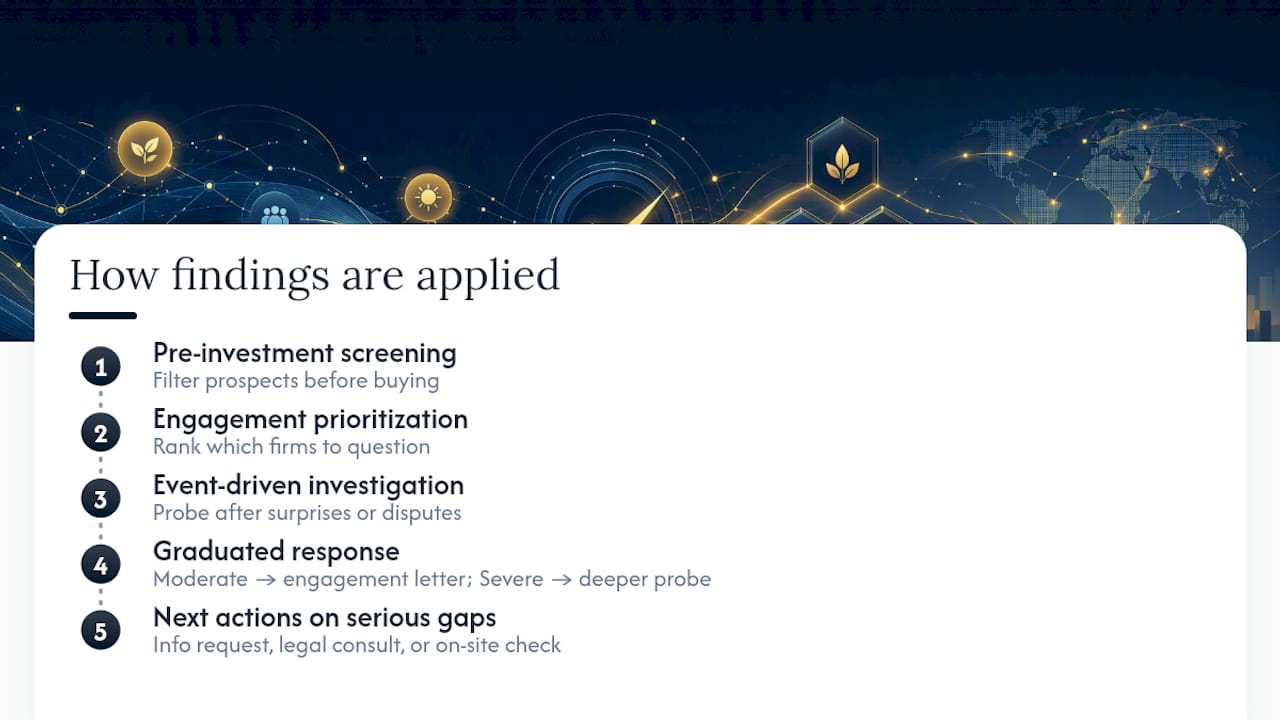
A forensic finding only earns its keep when it changes a decision. Institutional investors use these outputs in three distinct ways: pre-investment screening, engagement prioritization, and event-driven investigation triggered by an earnings surprise or a governance dispute. Financial journalists use the same evidence trail to source stories, since a documented contradiction between a proxy statement and an earnings call transcript is a stronger lead than a company's own press release.
Mapping a score to an action works best as a graduated response rather than a binary trigger. A moderate execution gap might justify a targeted engagement letter asking management to name its assurance provider. A severe, well-documented gap, particularly one involving numeric anomalies like implausible rounding, justifies deeper investigation before any reweighting decision. Systematic accountability scoring gives portfolio teams a consistent basis for that graduated response instead of an ad hoc reaction to whichever claim made headlines that week.
Forensic assurance has real limits. It cannot prove intent, and it cannot substitute for legal review when contradictions rise to the level of potential securities fraud. It also cannot verify anything that never appears in a public record. When a forensic check surfaces a serious discrepancy, the next step is usually a formal information request, a legal consult, or, where feasible, an on-the-ground check, not a public conclusion drawn from documents alone. Forensic corporate analysis works best as the first filter, not the last word.
What a Lacuna Index Report Contains
Lacuna Index runs this forensic methodology at scale. The platform mines public filings, earnings call transcripts, proxy statements, and press releases to measure the gap between what a company says and what its own record shows, without insider access and without input from the company's own assurance provider.
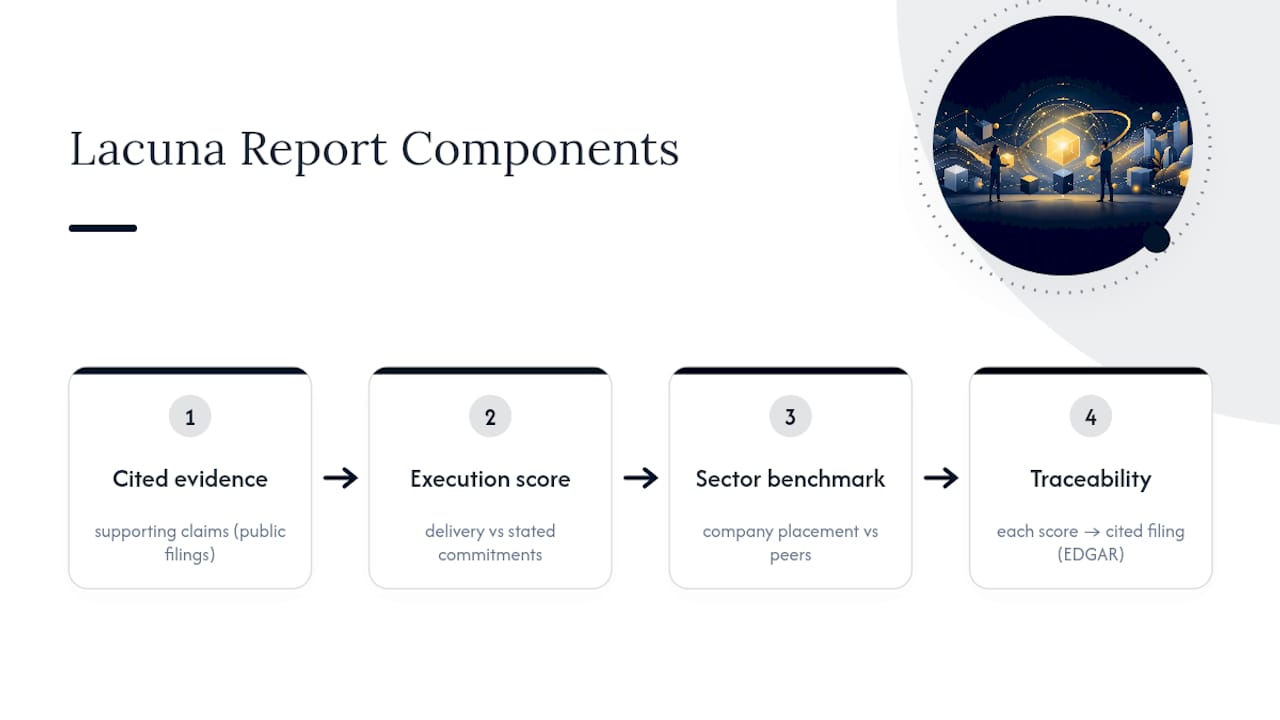
A Lacuna Index report contains three components: a set of cited evidence supporting each claim assessed, an execution score reflecting delivery against stated commitments, and a sector benchmark showing where the company sits against comparable peers. Companies are classified into archetypes, such as "earned" or "borrowed," based on how execution and valuation align. Every score traces back to a specific citation, which means a reader can pull the same underlying filing and retrace the logic independently, the same reproducibility standard demonstrated by large-scale ML-based ESG extraction research validated against human annotation. To check one claim from a Lacuna report, pull the cited filing directly from EDGAR and compare the wording against the report's characterization. That single check is the fastest way to judge whether the broader methodology holds up.
Why Rounding Anomalies Deserve More Attention Than They Get
The most underrated forensic check in this entire workflow is also the simplest: looking at how a company rounds its own emissions numbers. Analysts spend enormous effort parsing target language and comparing capex disclosures, and that effort is worthwhile. But a consistent, statistically improbable rounding pattern, the kind Deloitte found in nearly a third of the climate reports it reviewed, often surfaces a data integrity problem faster than any narrative analysis does.
The marginal value of forensic assurance is highest precisely where formal assurance statements are thinnest: unaudited voluntary disclosures, earnings call claims, and press releases that never touch a regulated filing. Apply the five-step checklist to one high-priority holding or story this week, then check that company against a sector benchmark before drawing conclusions in isolation.
— Glen
Getting Lacuna Index's Sector Benchmarks and Reports
Lacuna Index gives readers a way to see the execution gap directly, instead of relying on a company's own framing of its progress. The sector benchmarks are public and free, showing execution scores and industry norms without a subscription. For readers who want to understand a specific company's forensic report, capex-to-target alignment, and full citation trail, that level of detail sits behind a paid subscription built for institutional investors, governance professionals, and financial journalists.
Start with the user guide to understand how a report is structured and how each score traces back to its source documents. From there, check the free sector benchmarks for the industry you cover, and request access to a full company report when a specific holding or story warrants the deeper evidence trail. For a second layer of context on how portfolio teams translate evidence into action, Oracle Investments' framework for financial health analysis offers a useful complementary read.
Sources
- Profit alone a poor measure of success, study shows companies can look efficient while harming the planet — University of Surrey
- State of corporate sustainability disclosure — UCLA Anderson (May 2026)