
Public company accountability story angles are defined as narrative frameworks that reveal how public companies communicate, demonstrate, and fulfill their obligations to investors, regulators, and the public. These frameworks serve as the primary analytical lens for corporate governance professionals, institutional investors, and financial analysts who need to evaluate whether corporate disclosures reflect actual performance or engineered perception. The distinction matters because markets price narrative as readily as they price earnings. Regulatory developments from the SEC, governance structures like those debated in the SpaceX IPO, and forensic reporting on companies like Ensign Group all illustrate how accountability narratives shape investor confidence and valuation. Building a data-driven corporate accountability story requires understanding each of these angles with precision.
What are the main public company accountability story angles?
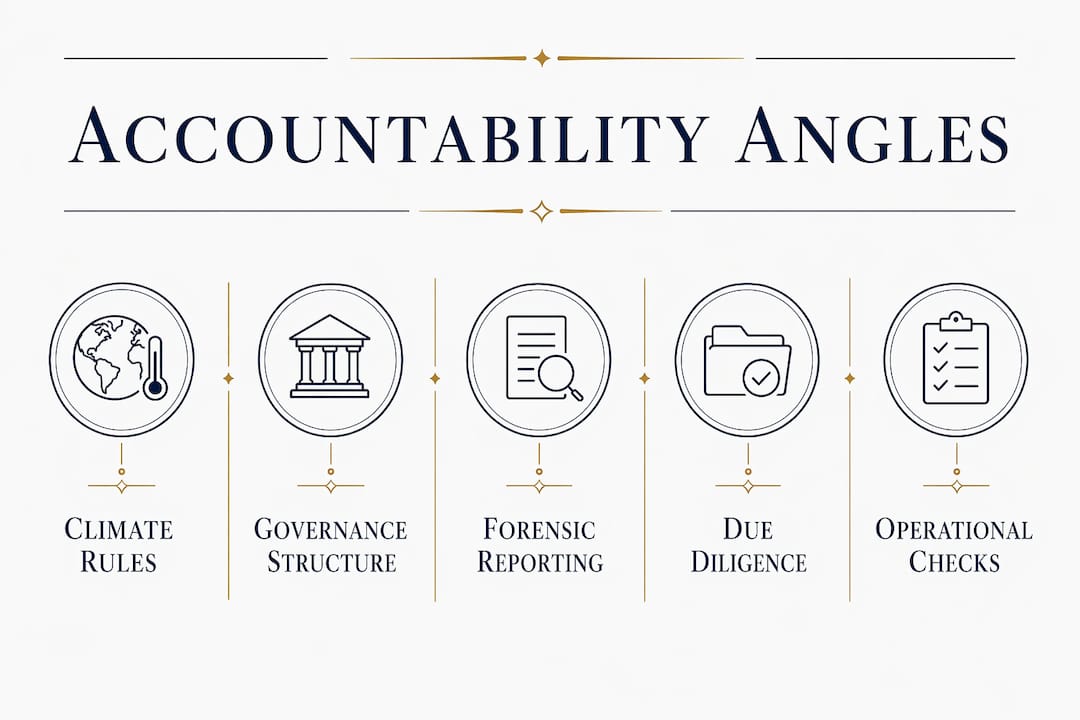
Corporate accountability narratives, as a recognized discipline in governance analysis, organize around four primary angles: regulatory disclosure compliance, governance and control structure, forensic evidence verification, and operational due diligence. Each angle tests a different dimension of the aspiration-to-execution gap. Analysts who apply all four produce a more defensible accountability assessment than those who rely on a single disclosure type. The goal is to treat every narrative claim as a testable hypothesis tied to specific disclosure points, with chains of evidence linking claims to reported metrics or observable signals.
How do SEC climate disclosure rules shape accountability narratives?
The SEC's regulatory posture on climate disclosure is the most actively contested accountability narrative angle in 2026. The SEC's June 2026 rescission proposal argues that existing principles-based requirements suffice and that the 2024 rules imposed disproportionate costs. That argument itself becomes a narrative signal: companies that welcomed the rescission may have been relying on the 2024 rules to justify disclosure opacity they would not have maintained voluntarily.
The critical technical point for analysts is that rescission of the 2024 rules does not suspend baseline obligations. Public companies must still disclose material climate risks under the SEC's 2010 guidance, regardless of what happens to the 2024 framework. Footnotes in SAB 74 disclosures must distinguish clearly between the rescinded rules and those baseline obligations. A company that conflates the two is either confused about its legal position or is deliberately narrowing its disclosure scope.
Analysts evaluating climate accountability narratives should examine the following disclosure elements:
- Whether the company's SAB 74 footnotes acknowledge the 2010 guidance as a continuing obligation
- Whether climate risk language has been materially reduced between the 2024 and 2026 annual reports
- Whether quantified climate-related capex or liability figures have been removed without explanation
- Whether the company's stated rationale for reduced disclosure aligns with the SEC's materiality standard or simply tracks the rescission timeline
Pro Tip: Flag any company that reduced climate disclosure scope in 2026 without citing a specific materiality determination. Timing a disclosure reduction to a regulatory rescission, without a documented materiality analysis, is a classic disclosure opacity signal.
The SEC's 2010 climate guidance remains the floor. Analysts who treat the 2024 rescission as a blanket reduction in disclosure obligations will misread the accountability narrative entirely.
How does governance structure define shareholder accountability narratives?
Governance design is the second major angle in corporate accountability narratives. The structure of voting power, the presence or absence of sunset clauses, and the degree of board independence all function as narrative signals about how much oversight shareholders actually hold. Concentrated control mechanisms decisively influence shareholder accountability perceptions, and governance narratives that fail to address oversight-preserving designs should be treated as incomplete.
The SpaceX IPO debate illustrates this angle directly. Governance discussions around the anticipated offering have focused on whether voting caps, sunset clauses, or independent board requirements would be included. Different jurisdictions apply different standards, as the table below shows.
| Governance feature | Investor-protective design | Concentrated-control design |
|---|---|---|
| Voting structure | One share, one vote or capped dual-class | Unlimited multi-class with founder control |
| Sunset clause | Mandatory after 5–10 years | Absent or indefinite |
| Board independence | Majority independent directors | Founder-aligned majority |
| Shareholder rights | Proxy access, say-on-pay | Limited or waived |
| India voting cap example | 74% foreign ownership cap as a control limit | No equivalent structural protection |
The accountability narrative angle here is not whether concentrated control is inherently wrong. The angle is whether the company's disclosures accurately describe the governance risks that flow from that control. A company that describes its board as "independent" while the founder controls the vote through a multi-class structure has an aspiration-to-execution gap in its governance narrative. Analysts should cross-reference proxy statements against the shareholder engagement checklist to identify these gaps systematically.
What does forensic evidence-based reporting reveal about accountability?
The third angle treats corporate narrative claims as allegations to be verified, not assertions to be accepted. This approach draws on open-source data, entity triangulation, and operational records to test whether disclosed performance matches observable reality. Linking shared addresses and officers through public registries enhances the rigor of this verification process and increases narrative credibility when discrepancies are found.
The Ensign Group case in 2026 demonstrates the forensic angle in practice. Activist forensic reports used site visit counts and violation estimates to challenge the company's patient care and legal compliance claims. The reports exposed discrepancies between disclosed performance and observable operational data. Ensign Group's shares fell as investor confidence eroded. The mechanism is straightforward: when a company's narrative cannot survive contact with its own operational records, the market reprices the gap.
Building a forensic accountability story requires a structured process:
- Identify the specific claim. Isolate the exact disclosure language, including the metric, the period, and the stated outcome.
- Locate the corroborating record. Find the public document, regulatory filing, or observable data point that should confirm the claim.
- Measure the gap. Quantify the difference between the claimed outcome and the corroborating record. Use absolute figures, not directional language.
- Triangulate with secondary sources. Apply entity triangulation using public registries, court records, or inspection databases to rule out alternative explanations.
- Assess materiality. Determine whether the gap is large enough to affect a reasonable investor's decision. Document the materiality rationale explicitly.
"Strong accountability stories rely on numerically verifiable allegations rather than rhetorical claims, enhancing narrative persuasiveness." — Ensign Group forensic reporting analysis
The Microsoft shareholder lawsuit over AI and Azure spending illustrates the same principle at the technology sector level. Quantified capex figures and alleged omissions serve as anchors for narratives contrasting disclosed versus actual performance. Specificity and definitional clarity are not optional in these narratives. They are the mechanism by which the accountability claim survives legal and analytical scrutiny.
How do OECD due diligence standards structure operational accountability narratives?
The fourth angle covers procedural accountability: whether a company's disclosures demonstrate that it has actually implemented the governance processes it claims to have. The OECD due diligence framework requires companies to communicate across five dimensions: policy commitment, risk identification, mitigation actions, tracking results, and grievance mechanisms. Each dimension maps to a specific disclosure element that analysts can test.
| OECD due diligence element | Disclosure signal to test | Accountability gap indicator |
|---|---|---|
| Policy commitment | Published code of conduct or ESG policy | Policy exists but is not referenced in filings |
| Risk identification | Named risks in 10-K or sustainability report | Generic risk language with no operational specifics |
| Mitigation actions | Described programs with timelines and owners | Actions listed without accountability assignments |
| Tracking results | Quantified outcomes versus prior-year targets | Targets stated but outcomes not reported |
| Grievance mechanisms | Accessible reporting channel with response data | Channel mentioned but no resolution data disclosed |
CFOs and internal controls functions are the operational accountability signal at the company level. CFOs acting as gatekeepers who stand up to boards and CEOs on disclosure integrity are a positive governance signal. Companies preparing for IPO or governance scaling events that cannot demonstrate CFO-level ownership of disclosure processes carry elevated narrative risk. The regulatory oversight gaps guide provides a structured framework for mapping these gaps against OECD expectations.
Pro Tip: When reviewing an IPO prospectus, check whether the CFO has a documented history of disclosure oversight at prior public companies. A CFO with no public-company disclosure track record is an operational accountability risk that rarely appears in the narrative but always shows up in the execution score.
Accountability narratives gain credibility when translated into repeatable evidence checks tied to due diligence disclosure requirements. A company that reports all five OECD elements with quantified outcomes and named accountability owners has a materially stronger accountability narrative than one that publishes a policy statement and calls it governance.
Key Takeaways
Corporate accountability narratives are most defensible when built on testable, numerically grounded claims tied to specific disclosure points across regulatory, governance, forensic, and operational dimensions.
| Point | Details |
|---|---|
| SEC climate baseline persists | Companies must still disclose material climate risks under 2010 SEC guidance regardless of 2024 rule rescission. |
| Governance design reveals risk | Voting structures, sunset clauses, and board independence are measurable signals of actual shareholder oversight. |
| Forensic verification tests claims | Site visit counts, entity triangulation, and capex figures convert narrative claims into testable hypotheses. |
| OECD framework maps disclosure gaps | Five due diligence elements provide a structured checklist for identifying procedural accountability failures. |
| CFO oversight signals execution quality | CFO-level ownership of disclosure integrity is a leading indicator of governance scaling readiness. |
The accountability narrative gap most analysts still miss
The four angles described here are well-established in governance literature, but most analysts apply them sequentially rather than simultaneously. That sequencing is the error. A company can pass a climate disclosure review, present a clean governance structure, and still carry a significant forensic gap at the operational level. The Ensign Group case is instructive precisely because the company's formal disclosures were not obviously deficient. The gap appeared only when operational data was placed alongside the narrative claims.
The regulatory uncertainty around climate disclosure in 2026 creates a specific risk: analysts who treat the rescission debate as a reason to reduce scrutiny of climate narratives will miss the companies that are using the regulatory noise as cover for disclosure reduction. The 2010 SEC guidance has not changed. The materiality standard has not changed. What has changed is the political environment, and political environment is not a materiality determination.
The most defensible accountability assessments I have seen treat narrative claims as hypotheses, not conclusions. They build an evidence index with clear corroborating records and sampling plans. They apply the OECD due diligence checklist as a minimum floor, not a ceiling. And they cross-reference governance disclosures against proxy statements rather than taking board composition claims at face value. That approach does not require insider access. It requires discipline and a consistent methodology applied to public records.
— Glen
How Lacunaindex supports corporate accountability narrative analysis
Lacunaindex applies a forensic, evidence-based methodology to public company disclosures, measuring the gap between what companies claim and what their public records confirm.
The platform mines earnings calls, SEC filings, proxy statements, and press releases to produce execution scores and narrative gap assessments without relying on insider access. Analysts and governance professionals can use the Lacuna report guide to interpret how execution scores map to the accountability angles covered here. For sector-level context, the financial sector benchmarks provide comparative reference points for assessing whether a company's disclosure practices are consistent with peers or represent an outlier risk. The methodology is consistent, repeatable, and grounded entirely in public records.
FAQ
What are public company accountability story angles?
Public company accountability story angles are analytical frameworks that evaluate how corporations disclose and fulfill their obligations to investors and regulators. They cover regulatory compliance, governance structure, forensic evidence, and operational due diligence.

Does the 2024 SEC climate rule rescission eliminate disclosure obligations?
No. Public companies must continue to disclose material climate risks under the SEC's 2010 guidance, regardless of the 2024 rule rescission. SAB 74 footnotes must distinguish between the two frameworks to avoid misleading investors.
How do governance structures function as accountability narrative signals?
Voting power structures, sunset clauses, and board independence levels are measurable governance design features. Companies like SpaceX, in pre-IPO governance debates, illustrate how concentrated control without protective mechanisms creates shareholder accountability risk.
What makes a forensic accountability story credible?
Credibility comes from numerically verifiable claims tied to specific public records. Activist reports on Ensign Group used site visit counts and violation data to challenge disclosed performance, demonstrating that operational data outweighs rhetorical claims in accountability analysis.
How does the OECD due diligence framework apply to accountability narratives?
The OECD framework requires companies to disclose policy commitments, risk identification, mitigation actions, tracked results, and grievance mechanisms. Analysts use these five elements as a structured checklist to identify procedural accountability gaps in public filings.