
An audit trail in research, in the forensic corporate sense, is an evidentiary chain of dated public disclosures that connects what a company says to what it actually delivers. It links an executive's earnings-call quote, an SEC filing, and a press release into a timestamped sequence that can withstand scrutiny. Built correctly, it lets an investor, governance professional, or journalist test a management claim against verifiable outcomes without needing insider access.
TL;DR:
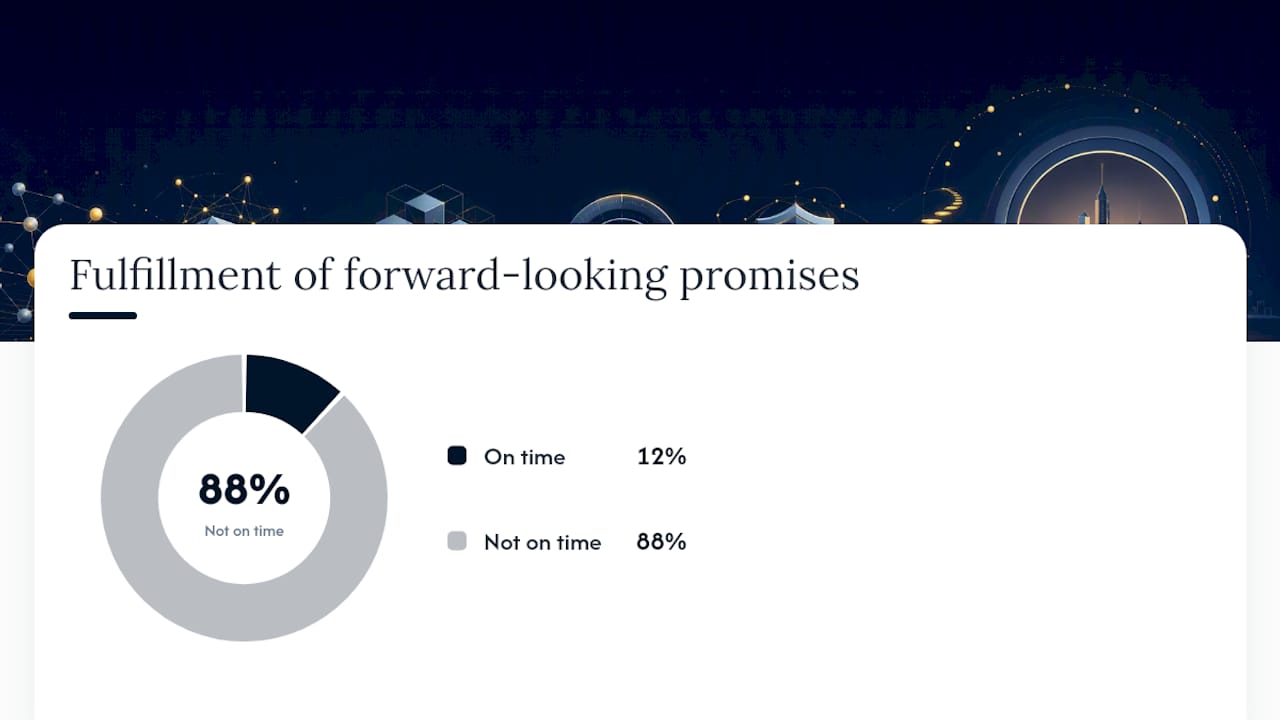
- Only about 12% of verifiable corporate promises made during earnings calls are fully fulfilled on time, highlighting widespread unmet commitments.
- Building an audit trail requires capturing exact quotes, filing identifiers, and timestamps across transcripts, filings, press releases, court documents, and third-party records.
- Validate claims through chronological mapping, timing checks, market reaction analysis, and corroboration from external sources to identify materiality and accuracy issues.
- Over 23% of corporate defendants experience significant market declines around legal filings, demonstrating the financial impact of disclosure pattern failures.
- Sector benchmarking accelerates evidence collection by providing pre-built, peer-comparison data on disclosure fidelity and execution scores for investment and governance analysis.
Table of Contents
- Why an Audit-Traceable Chain Matters for Investors and Governance Teams
- What Public Records Belong in the Evidence Chain
- How to Build the Chain From Claim to Verified Outcome
- Validation Tests and the Red Flags That Break a Chain
- How Lacuna Index Operationalizes This Method
- What Practitioners Get Wrong About Documentation Discipline
- Get Sector-Level Benchmarks Before You Build Your Own Chain
- Sources
Why an Audit-Traceable Chain Matters for Investors and Governance Teams
Disclosure chains carry legal and financial weight that goes well beyond documentation hygiene. A large sample of federal court filings between 2006 and 2021 found that 23% of corporate defendants experienced a market value decline exceeding 10% of current assets around the date a lawsuit was filed. That single statistic tells you court dockets are not academic footnotes. They are outcome anchors that move capital.
The content of the disclosure matters as much as its existence. Research on earnings-call transcripts found that objective, factual statements carry a stronger association with firm performance in the reporting quarter than subjective opinions do, while opinion-based language only gains explanatory power in later quarters, if at all. This is why a defensible audit trail weights verifiable commitments over sentiment. Separate research on UK earnings calls reinforces the point from the other direction: within-firm increases in concrete, verifiable disclosure language predicted a 1.33 percentage-point rise in next-quarter incident probability, showing that specific language, not vague reassurance, is what actually forecasts what happens next.
These mechanics feed three institutional use cases: investment due diligence that tests a thesis against filed evidence, governance escalation that documents a pattern of unmet commitments for a board or proxy fight, and investigative reporting that needs a chain a defamation lawyer will not shred. Each depends on the same underlying discipline, examined in more depth in Lacunaindex's framework on earnings-call credibility.
What Public Records Belong in the Evidence Chain
A defensible audit trail draws from a specific set of public-record categories, each contributing a different kind of proof and each requiring its own capture discipline.
- Earnings call transcripts. Capture the exact quote, the named speaker, the fiscal quarter, and the timestamp within the call. A paraphrase is worthless in a forensic context; the verbatim sentence is the evidentiary unit.
- SEC filings. Record the accession number alongside the filing type. An 8-K anchors a discrete event (a leadership change, an acquisition, a material contract). A 10-Q or 10-K anchors quarterly and annual results against which a prior promise gets tested. A proxy statement (DEF 14A) anchors executive compensation metrics and governance disclosures that often reference the same targets management touted on calls.
- Press releases and investor presentations. These frequently contain the specific figures and slide callouts that a transcript only alludes to. Archive the original PDF or slide deck, not just a screenshot, since decks get revised without notice.
- Court documents and dockets. A complaint's filing date and any subsequent order function as outcome anchors precisely because they are independently timestamped by the court system, not by the company itself.
- Third-party public records. USPTO patent filings, regulator inspection reports, and shipment or operational disclosures from industry bodies corroborate or contradict a company's own narrative using a source the company does not control.
Enterprise audit-trail research on internal systems, security logs, and accounting change tables offers a useful analog here: the same logic of dated, immutable record-keeping that fraud examiners apply inside a company's systems applies to the external public record, just assembled from disclosures rather than database logs. A parallel line of research on litigation-risk parsing shows that systematically mining 10-K language for risk signals can predict future lawsuits and correlate with actual corporate policy choices, which is exactly the kind of signal a well-built evidence inventory is designed to surface. For journalists building a similar inventory around a specific investigative angle, Lacunaindex's guide to public disclosures and investigative reporting walks through source prioritization in more detail.
How to Build the Chain From Claim to Verified Outcome
Constructing an audit trail is a repeatable procedure, not an ad hoc research exercise. Six steps take a claim from raw quote to tested conclusion.
- Freeze the claim. Capture the verbatim quote, the speaker's name and title, the exact date, and the source's accession number or URL. Nothing gets paraphrased at this stage.
- Translate the claim into a testable metric. "We expect margin expansion" becomes "gross margin reaches X% by Q3 2027." Vague language that resists this translation is a flag in itself, not a gap to explain away.
- Collect dated corroborating records. Pull the filings, transcripts, docket entries, and regulator feeds that sit between the original claim and the present.
- Build a timeline map. Sequence the original quote, every intermediate disclosure that touched the same topic, and the eventual outcome, in date order.
- Run verification tests. Check timing alignment (did the promised date pass without mention?), metric match (did the achieved number meet the stated target?), peer corroboration (do competitors or regulators confirm the pattern?), and counterfactual checks (would the outcome have happened anyway?).
- Produce the deliverables. An audit table (quote, source, accession number, date), a linked evidence index, and reproducible notes that another analyst could follow independently.
Pro Tip: Structure your evidence index with four columns: the verbatim claim, the claim's source with accession or timestamp, the testable metric you derived, and the outcome record with its own accession or timestamp. Retain a PDF snapshot of every source at capture time; filings get amended and press pages get quietly edited.
Tracking promises this strictly produces sobering numbers. One tracked sample of 1,161 quarters of earnings-call promises found that only about 12% of explicit, verifiable forward-looking statements were fully delivered on time. That kind of fulfillment rate is exactly why the operationalization in step two cannot be skipped. For a worked example of this method applied to a live filing, see Lacunaindex's walkthrough on validating corporate claims.
Validation Tests and the Red Flags That Break a Chain
Not every documented claim survives scrutiny, and the failure modes tend to repeat. Vague forward-looking language ("we're optimistic about the back half") resists the metric-translation step entirely, which is itself diagnostic. Post-hoc disclosures, where a company clarifies or "recontextualizes" an earlier statement only after a bad quarter, suggest the original claim was never meant to be tested. Rolling forecasts that shift the target date each quarter without acknowledging the miss are a related pattern. And any claim with no independent corroborating source, no regulator mention, no peer confirmation, no court record, carries lower evidentiary weight almost by default.
Three tests catch most of these problems before they compromise a conclusion:
- Materiality window alignment. Does the claim's timing line up with the period the outcome data actually covers?
- Pre/post disclosure market-impact checks. Did the market react at the time of the original claim, suggesting it was treated as material?
- Multi-source corroboration. Does at least one source outside the company's own disclosures confirm the pattern?
Modeling how disclosure language mutates across consecutive filings, tracking what gets repeated, newly added, or quietly deleted, has been shown to improve fraud detection accuracy over static, single-filing analysis. Litigation practice reflects the same underlying logic: courts examining corporate disclosure disputes focus heavily on "who knew what when," weighing analyst reactions and the full public record when assessing causation. An audit trail that cannot answer that question in sequence will not hold up under adversarial review.
How Lacuna Index Operationalizes This Method
Lacuna Index builds this evidentiary discipline into a repeatable analytical product rather than a one-off research exercise. Its forensic reports pair a narrative-versus-delivery score with an evidence index that cites accession numbers and filing dates for every claim it scores, and it maps timelines the same way described above, from initial statement through intermediate disclosures to measured outcome. Companies are then classified into archetypes (earned, borrowed, undervalued) based on how consistently their communicated promises match their filed results.
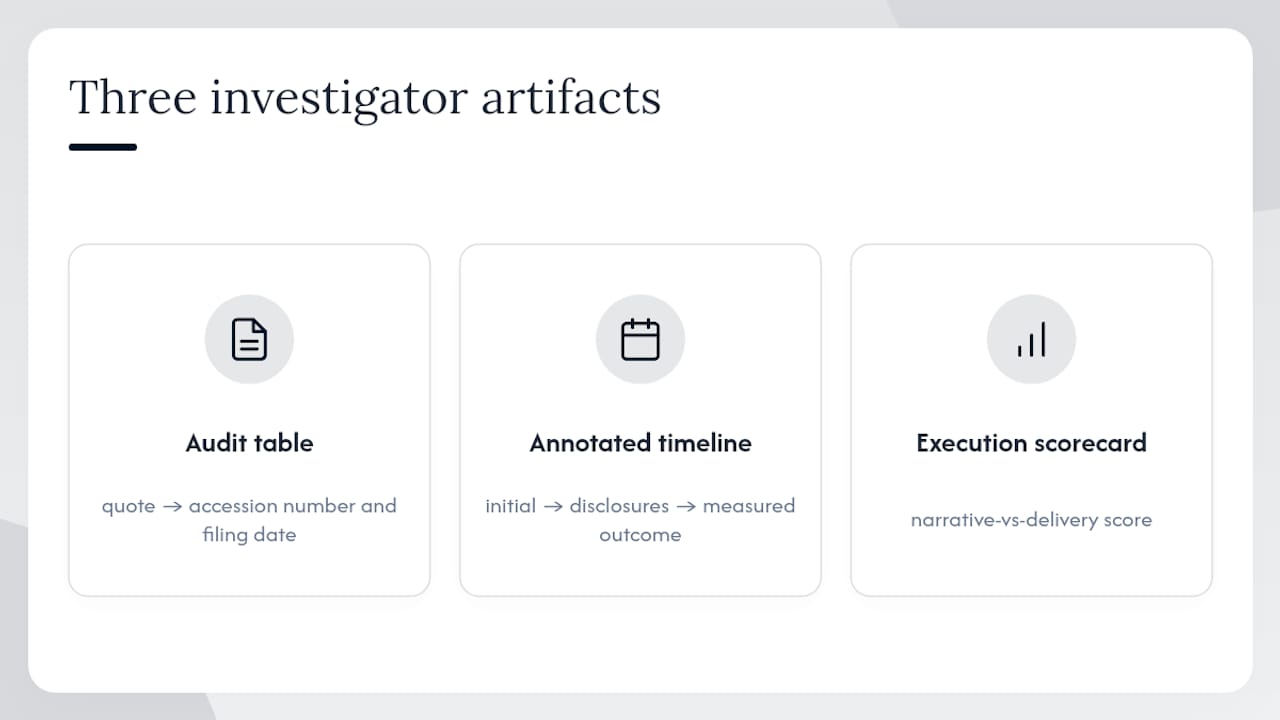
Investigators building their own chains should aim to produce the same three artifacts: an audit table linking quote to source, an annotated timeline, and an execution scorecard. Readers looking to apply this to a specific investment thesis can start with Lacunaindex's guide to disclosure-gap investment analysis, which walks through the scoring logic in practice.
What Practitioners Get Wrong About Documentation Discipline
The biggest operational failure I see is not sloppy analysis. It is poor information governance during the moments that matter most: the fast-moving weeks around an earnings release or a leadership change, when records get deleted, overwritten, or simply not preserved because nobody thought to capture them at the time.
Three habits prevent this. First, snapshot everything at capture, PDFs of filings, screenshots of press pages, saved transcripts, because source pages change without notice and accession numbers are your only permanent anchor. Second, resist the pull toward subjective language when building your metric translations; "on track" is not a testable claim, and treating it as one will contaminate your entire chain. Third, timestamp your own analytical notes as rigorously as you timestamp the source records themselves, since a chain that cannot show when you concluded something is only half a chain.
If you implement one thing this week, build the four-column evidence index (claim, source, metric, outcome) before your next earnings season starts, not after.
— Glen
Get Sector-Level Benchmarks Before You Build Your Own Chain
Building an audit table from scratch for every company you cover takes real analyst hours. Lacuna Index gives institutional investors, governance teams, and financial journalists a faster starting point: sector benchmarks with the evidence index already built, showing narrative-versus-delivery patterns across peer companies without requiring you to pull every filing yourself.
The sector benchmarks cover execution scores and public valuation reference points by industry, useful for analysts scoping a new sector or journalists looking for a story angle backed by cross-company comparison rather than a single company's filings. Governance professionals preparing for a proxy season can use the same benchmarks to see how a target company's disclosure patterns compare to its peer group before escalating a concern. Review the current benchmark set and request access to see how a specific sector's execution scores line up against the narrative each company has been telling.
Sources
- No. 229: When Cheap Talk Has Bite - TRR 266 Accounting for Transparency
- Incidence, Risk, and Disclosure of Corporate Litigation: Insights from Federal Court Filings
- Disentangling the content of earnings calls: How corporate messaging affects firms’ financial performance
- Optimization-based disclosure change trajectories for fraud detection (2023)