
Public company accountability benchmarks are quantifiable standards used to evaluate a public company's performance, transparency, and adherence to governance commitments. Governance professionals, regulatory analysts, and institutional investors rely on these benchmarks to detect the gap between what companies claim and what they actually deliver. Frameworks like the Just 100 Index, SEC EDGAR disclosure analysis, and CSRD double materiality assessments each represent distinct approaches to measuring that gap. Lacunaindex applies forensic analytics to the same public records, quantifying the aspiration-to-execution gap that standard compliance reviews routinely miss.
What are common public company accountability benchmarks?
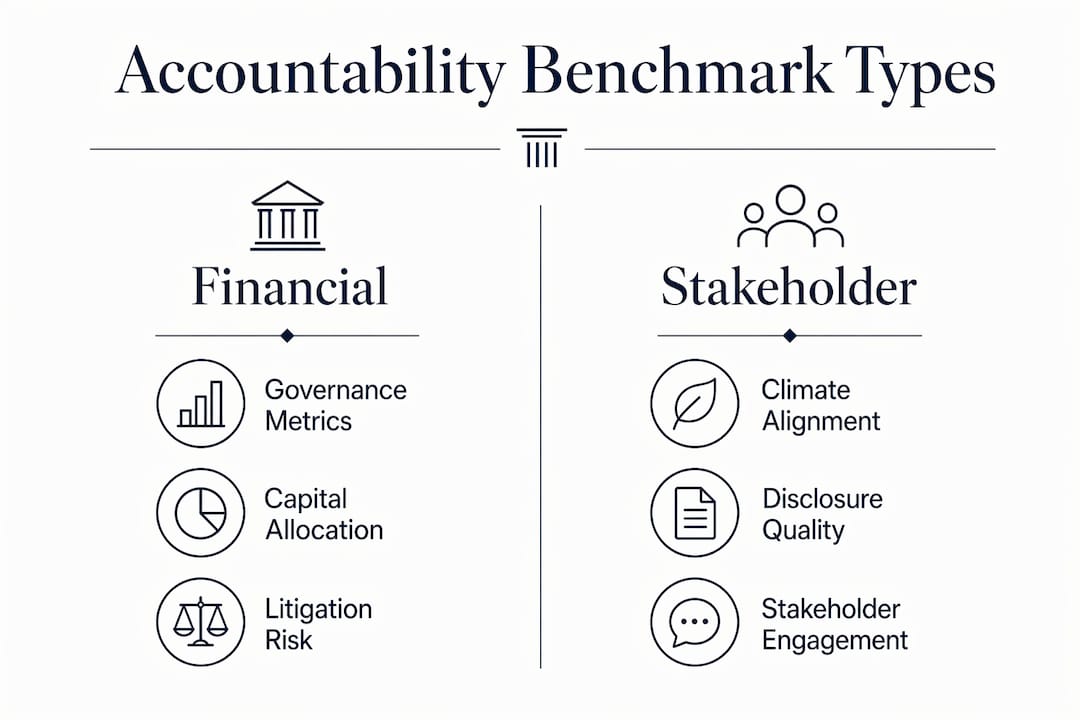
Public company accountability benchmarks fall into two broad categories: financial governance metrics and stakeholder performance metrics. Financial metrics include materiality thresholds, audit quality scores, and capital expenditure alignment. Stakeholder metrics cover workers, customers, communities, environment, and governance, the same five dimensions the Just 100 Index uses to evaluate Russell 1000 companies.
The Just 100 Index outperformed the Russell 1000 equal-weighted benchmark by 79% between 2021 and 2025. That result demonstrates that multi-stakeholder accountability metrics are not merely compliance tools. They carry direct financial signal.

Sector variation in these benchmarks is substantial. Top quartile companies align over 45% of capital expenditure to low-carbon initiatives, while oil and gas companies face a median of 18 active climate legal cases versus 2 in consumer goods. These ranges define what "accountable" looks like by sector, not in the abstract.
Pro Tip: When assessing a company's climate accountability, compare its capital expenditure alignment against sector quartile ranges, not against a universal threshold. A 30% low-carbon capex share means something very different in utilities than in retail.
The table below maps benchmark categories to their primary measurement focus and applicable sector context.
| Benchmark category | Primary measurement focus | Sector context |
|---|---|---|
| Climate capex alignment | % of capex directed to low-carbon assets | Energy, utilities, industrials |
| Active climate legal cases | Count of pending climate litigation | Oil and gas, mining |
| ESG KPI performance | Internal targets tied to compensation | All sectors |
| Double materiality assessment | Financial and impact materiality scoring | CSRD-regulated companies |
| Audit quality score | Internal control rigor and auditor attestation | All public companies |
CSRD implementation costs for large listed companies range between €250,000 and €1,200,000, and double materiality assessment completion takes 3 to 12 months across sectors. Those figures set a concrete cost and time benchmark for governance professionals evaluating peer compliance readiness.
How do methodologies differ for measuring corporate accountability?
The methodology behind any corporate accountability measure determines whether it captures real performance or merely documents compliance activity. Four distinct methodological approaches exist: internal KPI tracking, externally mandated ESG reporting, peer benchmarking via SEC EDGAR, and audit quality assessment.
-
Internal KPI tracking. ESG KPIs are internal metrics tied to management decision-making and compensation, whereas ESG reporting metrics are externally mandated disclosures that often serve compliance rather than performance improvement. Internal KPIs drive behavior. External reporting metrics document it after the fact.
-
Externally mandated ESG reporting. Frameworks like GRI, SASB, and TCFD require standardized disclosures. These create comparability across companies but do not guarantee that the underlying performance matches the reported figures. Disclosure opacity remains a persistent risk.
-
Peer benchmarking via SEC EDGAR. Peer benchmarking focuses on analyzing disclosure structure, risk factor specificity, and narrative completeness to reduce SEC comment risks and improve report quality. This methodology treats disclosure framing as evidence, not just content.
-
Audit quality assessment. Audit quality, budgetary discipline, and risk controls strongly influence corporate accountability, with audit quality identified as the most significant factor. Internal financial control systems form the foundation of credible governance claims. Without auditor attestation, sustainability disclosures carry limited evidentiary weight.
Materiality threshold calibration is the most contested element across all four methodologies. A threshold that is appropriate for a diversified manufacturer may be wholly inadequate for a financial services firm with concentrated counterparty exposure. Governance professionals must resist applying generic sector averages and instead anchor thresholds to the specific business model and value chain under review.
Pro Tip: When reviewing a peer's SEC filing for benchmarking purposes, focus on how the company frames emerging risks, such as AI governance or climate litigation, not just which risks it discloses. Narrative specificity is a leading indicator of disclosure quality.
Does disclosure volume reflect actual accountability performance?
High disclosure volume does not equal high accountability. This is one of the most consequential findings for governance professionals applying corporate accountability metrics in cross-regional analysis.
High ESG disclosure scores in APAC often correlate with low ESG performance and higher greenwashing, unlike advanced economies where high disclosure aligns with high performance. Regional governance maturity, not disclosure quantity, determines whether disclosures are credible.
The mechanism behind this divergence is assurance quality. Under CSRD, limited assurance is required for sustainability disclosures, which sets a floor but not a ceiling. Companies in markets with weaker auditor independence norms can produce voluminous disclosures that pass a limited assurance review while still misrepresenting material performance gaps. Governance watchdogs must treat assurance regime strength as a variable, not a constant.
"Quantity of sustainability disclosure does not necessarily reflect quality or true accountability. Regional and governance maturity factors impact greenwashing risks." — Bond University research on global sustainability disclosure
The practical implication for investors and analysts is direct. When interpreting a company's corporate disclosure accountability scoring, weight the assurance regime, the auditor's independence record, and the specificity of disclosed targets alongside the raw volume of reported metrics. A 200-page sustainability report with vague targets and no third-party verification carries less evidentiary weight than a 40-page report with audited KPIs tied to compensation.
- High disclosure volume without auditor attestation signals potential disclosure opacity.
- APAC companies with top-quartile ESG scores warrant additional scrutiny on performance delivery.
- Limited assurance under CSRD is a minimum standard, not a quality certification.
- Narrative completeness and risk specificity in SEC filings are stronger accountability signals than page count.
What practical steps apply accountability benchmarks effectively?
Governance professionals who apply accountability benchmarks effectively treat them as calibration points, not pass/fail thresholds. The following steps reflect current best practice for practitioners conducting regulatory analysis or investment-grade governance assessments.
-
Benchmark against peer disclosure structures. Use SEC EDGAR to compare how peers frame risk factors, emerging risks, and governance commitments. The goal is to identify gaps in narrative completeness and specificity, not just metric coverage. Lacunaindex applies this same disclosure mining process across earnings calls, proxy statements, and press releases to surface the aspiration-to-execution gap.
-
Ground double materiality assessments in company-specific evidence. Relying only on industry averages during double materiality assessments is risky. Defensible assessments must link to the business model, value chain, and direct stakeholder evidence. Auditors and regulators increasingly scrutinize assessments that cite sector benchmarks without company-specific substantiation.
-
Monitor sector benchmarks and legal developments continuously. Climate litigation frequency, AI governance regulatory developments, and supply chain due diligence requirements all shift sector benchmarks on a rolling basis. A governance professional who reviews benchmarks annually is working with stale calibration data. Quarterly review cycles are the current standard for high-exposure sectors.
-
Treat internal control rigor as the foundation for external claims. Internal financial controls such as audit quality and budget discipline act as ethical governance mechanisms. They are the prerequisite for trustworthy sustainability and accountability claims. A company with weak internal controls cannot produce credible external disclosures regardless of the reporting framework it uses. Governance professionals should review the shareholder engagement framework alongside internal control assessments to build a complete accountability picture.
-
Integrate execution scoring into peer comparisons. Comparing disclosed commitments against actual delivery, using execution scores derived from public records, separates companies with earned credibility from those operating on borrowed narrative. This is the core methodology Lacunaindex applies when classifying companies as earned, borrowed, or undervalued.
The role of sector benchmarks in regulatory analysis extends beyond compliance verification. Regulators use benchmark deviations to prioritize examination targets. Governance professionals who understand how regulators read benchmark data can anticipate scrutiny before it arrives.
Key Takeaways
Effective corporate accountability benchmarking requires sector-calibrated metrics, auditor-attested disclosures, and execution scoring grounded in public records, not disclosure volume alone.
| Point | Details |
|---|---|
| Sector benchmarks vary materially | Climate capex alignment and litigation frequency differ sharply by sector and performance quartile. |
| Internal KPIs drive accountability | ESG KPIs tied to compensation outperform externally mandated reporting metrics as accountability levers. |
| Disclosure volume misleads | High ESG disclosure in lower-governance markets correlates with greenwashing, not performance. |
| Audit quality is the strongest lever | Internal financial controls and auditor attestation are the foundation of credible accountability claims. |
| Double materiality needs specificity | Assessments built on generic sector averages fail auditor and regulator scrutiny. |
The accountability gap that benchmarks still miss
Governance professionals have more benchmark data available in 2026 than at any prior point. The irony is that the proliferation of frameworks, CSRD, GRI, SASB, TCFD, SEC climate rules, has made it easier for companies to appear accountable without being accountable. I have reviewed hundreds of sustainability disclosures where the benchmark scores were strong and the actual delivery was absent. The scores were technically accurate. The narrative was engineered.
The most important shift I have seen in sophisticated governance analysis is the move from measuring what companies report to measuring what companies deliver against what they claimed. That is a fundamentally different question. It requires forensic reading of earnings call transcripts, proxy statements, and press releases over time, not a single-period snapshot of disclosed KPIs.
Audit quality remains the variable that separates credible disclosures from performative ones. A company with a strong internal control environment and an independent auditor produces disclosures that can withstand scrutiny. A company with weak controls and a compliant auditor produces disclosures that look identical on the surface. Governance watchdogs who cannot distinguish between those two profiles are benchmarking the wrong thing. The high-risk narrative identification process is where the real analytical work begins.
— Glen
How Lacunaindex supports governance professionals with benchmarks
Lacunaindex is built for governance professionals who need more than a compliance checklist. The platform mines SEC filings, earnings calls, proxy statements, and press releases to quantify the gap between corporate narrative and actual delivery.
Lacunaindex publishes sector-specific benchmarks covering financial metrics, execution scores, and disclosure quality indicators across public company sectors. Each benchmark is derived from public records, with no reliance on company-supplied data or self-reported ESG scores. The Lacunaindex methodology walkthrough explains exactly how execution scores are calculated and how governance professionals can apply them to peer comparisons and regulatory analysis. For professionals who need a structured starting point, the sector financial benchmarks page provides the quantitative reference layer that underpins accountability assessments.
FAQ
What are public company accountability benchmarks?
Public company accountability benchmarks are quantifiable standards used to evaluate a company's governance performance, disclosure quality, and delivery against stated commitments. They include financial metrics, ESG KPIs, audit quality scores, and sector-specific indicators like climate capex alignment.
How do ESG KPIs differ from ESG reporting metrics?
ESG KPIs are internal metrics tied to management decisions and compensation, while ESG reporting metrics are externally mandated disclosures. Internal KPIs drive accountability; external reporting metrics document minimum compliance.
Why does high ESG disclosure not always mean high accountability?
High ESG disclosure scores in lower-governance markets, particularly in APAC, often correlate with higher greenwashing and lower actual performance. Assurance regime quality and auditor independence determine whether disclosures reflect real performance.
What is a double materiality assessment?
A double materiality assessment evaluates both the financial impact of sustainability risks on a company and the company's impact on the environment and society. Under CSRD, it must be grounded in company-specific business model and stakeholder evidence, not generic sector averages.
What is the most important factor in corporate accountability?
Audit quality is the strongest single factor in corporate accountability. Internal financial controls, including budgetary discipline and risk controls, form the foundation for credible governance and sustainability claims.