
A shareholder engagement checklist for governance is a structured, decision-linked instrument that corporate governance professionals use to plan, execute, and document every material interaction between a company and its investor base. The industry term for this practice is structured stakeholder engagement, governed in part by standards such as AA1000SES and SEC disclosure requirements. This checklist is not a procedural formality. It is the operational backbone of a shareholder communication strategy that determines whether a board retains investor confidence, survives proxy season, and demonstrates that governance commitments translate into verifiable action.
1. shareholder engagement checklist for governance: core components
A governance engagement checklist begins with stakeholder identification, the process of mapping every investor category by ownership tier, influence, and engagement history. This step must distinguish between registered holders and beneficial holders. Identifying beneficial holders alongside registered ones is critical, since missing this distinction leads to misdirected outreach and vote miscalculation.

The next core component is a materiality assessment. This assessment determines which governance topics, executive compensation, board composition, ESG commitments, capital allocation, require active dialogue versus routine disclosure. AA1000SES requires engagement to be decision-linked, meaning companies must document what was heard, what was prioritized, and what action followed. A checklist that lacks this linkage is a compliance exercise, not a governance tool.
Additional components include:
- Engagement channel selection: Specify which investors receive one-on-one meetings, which receive written engagement letters, and which are addressed through electronic proxy portals or virtual town halls.
- Internal coordination protocol: Define who speaks on each topic. Coordination across CEO, CFO, and legal teams is the standard that prevents contradictory messaging and activist skepticism.
- Proxy advisory firm interaction log: Track all communications with Institutional Shareholder Services (ISS) and Glass Lewis, including dates, topics, and outcomes.
- Feedback loop documentation: Record investor concerns and map each concern to a board response or disclosure update.
- Vote monitoring integration: Assign responsibility for tracking vote tallies in real time using tools such as Computershare Proxy Watch.
Pro Tip: Build the materiality assessment into the checklist as a standing agenda item for the Q4 board meeting, not as an ad hoc exercise triggered by a shareholder proposal. This positions the board to enter proxy season with documented priorities rather than reactive talking points.
2. how to implement the checklist throughout the year
Operationalizing a governance engagement checklist requires a defined annual calendar, not a single pre-meeting sprint. Full engagement cycles tied to materiality assessments occur every 2–3 years, while annual check-ins for Tier 1 stakeholders maintain continuity between those cycles. This cadence prevents the credibility erosion that results from engagement gaps.
A practical annual implementation sequence follows this structure:
- Q4 of the prior year: Conduct a post-proxy debrief. Document vote outcomes, investor feedback, and unresolved concerns. Update the stakeholder register.
- January through February: Initiate off-season outreach to Tier 1 institutional holders. Discuss governance priorities for the coming year before proxy advisors publish their guidelines.
- March: Finalize proxy statement disclosures. Cross-reference investor feedback from Q4 and January outreach to confirm alignment.
- April through May: Execute proxy season engagement. Monitor vote tallies using digital dashboards. Respond to late-breaking investor concerns with documented board rationale.
- June through September: Conduct mid-year ESG and governance updates with key holders. This is the window for materiality reassessment if market conditions or regulatory guidance has shifted.
- October through November: Begin the next annual cycle. Tier 1 check-ins, updated stakeholder mapping, and a board-level review of engagement outcomes.
Digitizing proxy voting processes improves shareholder participation rates by 35–45%. That gain is not incidental. Electronic proxy portals reduce friction for retail and institutional holders alike, and the participation data they generate feeds directly into the engagement log.
Pro Tip: Maintain a stakeholder engagement log as a living document, not an annual report appendix. Log every interaction, including the date, method, participants, topics discussed, and any commitments made. This log becomes your primary defense during regulatory review or activist campaigns.
3. comparing engagement methods and tools
Governance professionals have access to a wider range of engagement formats than most checklists account for. Selecting the right method for each investor segment is as consequential as the content of the engagement itself.
| Method | Best Use Case | Key Limitation |
|---|---|---|
| One-on-one meetings | Tier 1 institutional holders, activist situations | High resource cost, limited scale |
| Virtual town halls | Broad retail and mid-tier institutional outreach | Lower depth of dialogue |
| Engagement letters | Formal governance topic disclosure, ESG updates | One-directional without follow-up |
| Electronic proxy portals | Vote solicitation and participation tracking | Requires digital adoption by holder base |
| Surveys and focus groups | Materiality assessment, ESG priority mapping | Response rates vary by holder type |
| Proxy advisory meetings | ISS and Glass Lewis alignment before vote season | Limited influence over final recommendations |
Proactive, year-round engagement builds credibility and avoids the reactive posture that signals governance weakness to institutional investors. The method mix should reflect this principle. One-on-one meetings with top-20 holders should occur at minimum twice annually, not only during proxy season.
Digital tools extend the reach and analytical depth of any engagement program. Computershare Proxy Watch enables real-time vote tracking and risk identification during proxy season. Data dashboards that aggregate vote tallies, engagement history, and holder sentiment allow governance teams to identify emerging risks before they become public disputes.
For ESG integration best practices within the engagement framework, the most effective approach combines engagement letters with follow-up one-on-one meetings for holders who flag material ESG concerns. This two-step method documents the concern and the response, satisfying both AA1000SES decision-linkage requirements and SEC disclosure expectations.
4. common pitfalls in governance engagement checklists
The most consequential errors in governance engagement are structural, not tactical. They reflect gaps in checklist design rather than execution failures.
- Ignoring beneficial ownership: A checklist that targets only registered holders misses the institutional investors who hold through custodians and actually drive vote outcomes. Beneficial ownership mapping is a prerequisite, not an optional enhancement.
- Misaligned internal messaging: When the CEO, CFO, and general counsel communicate different governance narratives to different investor audiences, the inconsistency surfaces in proxy advisor reports and activist presentations. The checklist must include a messaging alignment step before any external engagement begins.
- Reactive engagement posture: Boards that engage only when a shareholder proposal appears or a negative ISS recommendation arrives have already lost the credibility argument. Engagement only near meetings risks losing investor confidence that continuous engagement would have preserved.
- Underestimating 2026 SEC policy shifts: The SEC's decline of no-action relief shifts the burden to companies to document engagement and board rationale to mitigate negative voting outcomes. A checklist that does not include a documentation protocol for board decision rationale is structurally non-compliant with current regulatory expectations.
- Treating engagement as a checkbox exercise: Engagement that fails to demonstrate how investor input drives strategy is indistinguishable from disclosure theater. The checklist must include a feedback-to-action mapping step.
- Discontinuous engagement cycles: Governance teams that suspend outreach between proxy seasons accumulate unresolved investor concerns that compound into vote-against campaigns.
"Shareholder engagement should be a tool for shareholder cultivation, framing dialogue to align shareholders with company strategy." This principle, drawn from current governance practice, defines the difference between a compliance checklist and a governance instrument.
Key takeaways
A governance engagement checklist is only as effective as its decision-linkage, documentation discipline, and year-round cadence. Without these three elements, the checklist functions as a procedural record rather than a governance instrument.
| Point | Details |
|---|---|
| Map beneficial ownership first | Targeting only registered holders produces incomplete outreach and inaccurate vote forecasting. |
| Align messaging across C-suite | CEO, CFO, and legal must communicate a consistent governance narrative before any investor contact begins. |
| Digitize proxy participation | Electronic portals improve shareholder participation rates by 35–45%, generating data that feeds the engagement log. |
| Document board rationale | SEC policy shifts in 2026 require companies to evidence engagement and board decision rationale to withstand proxy advisor scrutiny. |
| Engage continuously, not seasonally | Year-round Tier 1 check-ins and full materiality cycles every 2–3 years are the structural minimum for credibility maintenance. |
The checklist is a governance instrument, not a compliance form
The most persistent misunderstanding I encounter among governance teams is treating the shareholder engagement checklist as a pre-proxy season task list rather than a year-round governance instrument. The distinction matters because the two approaches produce fundamentally different outcomes. A task list gets completed and filed. A governance instrument generates data, informs board decisions, and creates a documented record of how investor input shaped company strategy.
The 2026 regulatory environment makes this distinction consequential in a way it was not three years ago. With SEC no-action relief declining, the documented engagement record is now a primary line of defense against negative vote recommendations and activist campaigns. Boards that cannot produce a chronological log of investor interactions, topics discussed, and board responses are exposed in ways their governance disclosures do not reveal.
The second structural gap I see consistently is the absence of cross-functional ownership. Shareholder engagement is treated as an investor relations function when it requires active participation from the general counsel, CFO, and in many cases the audit committee chair. The checklist must assign named owners to each engagement category, not generic departmental responsibility. When ISS or Glass Lewis requests a meeting, the response protocol should already be documented, including who attends, who speaks on which topic, and how the outcome gets logged.
For governance professionals integrating ESG commitments into their engagement programs, the board-level oversight checklist framework offers a useful structural parallel. The same modular, owner-assigned design that works for digital asset oversight applies directly to shareholder engagement governance. The underlying logic is identical: define the scope, assign accountability, document the outcome, and close the loop.
— Glen
How Lacunaindex supports governance engagement analysis
Lacunaindex applies forensic analytics to the exact gap that most shareholder engagement checklists fail to close: the distance between what a company communicates to investors and what its public disclosures actually evidence. For governance professionals building or auditing an engagement program, the Lacunaindex user guide provides a structured framework for interpreting engagement data against disclosed governance commitments.
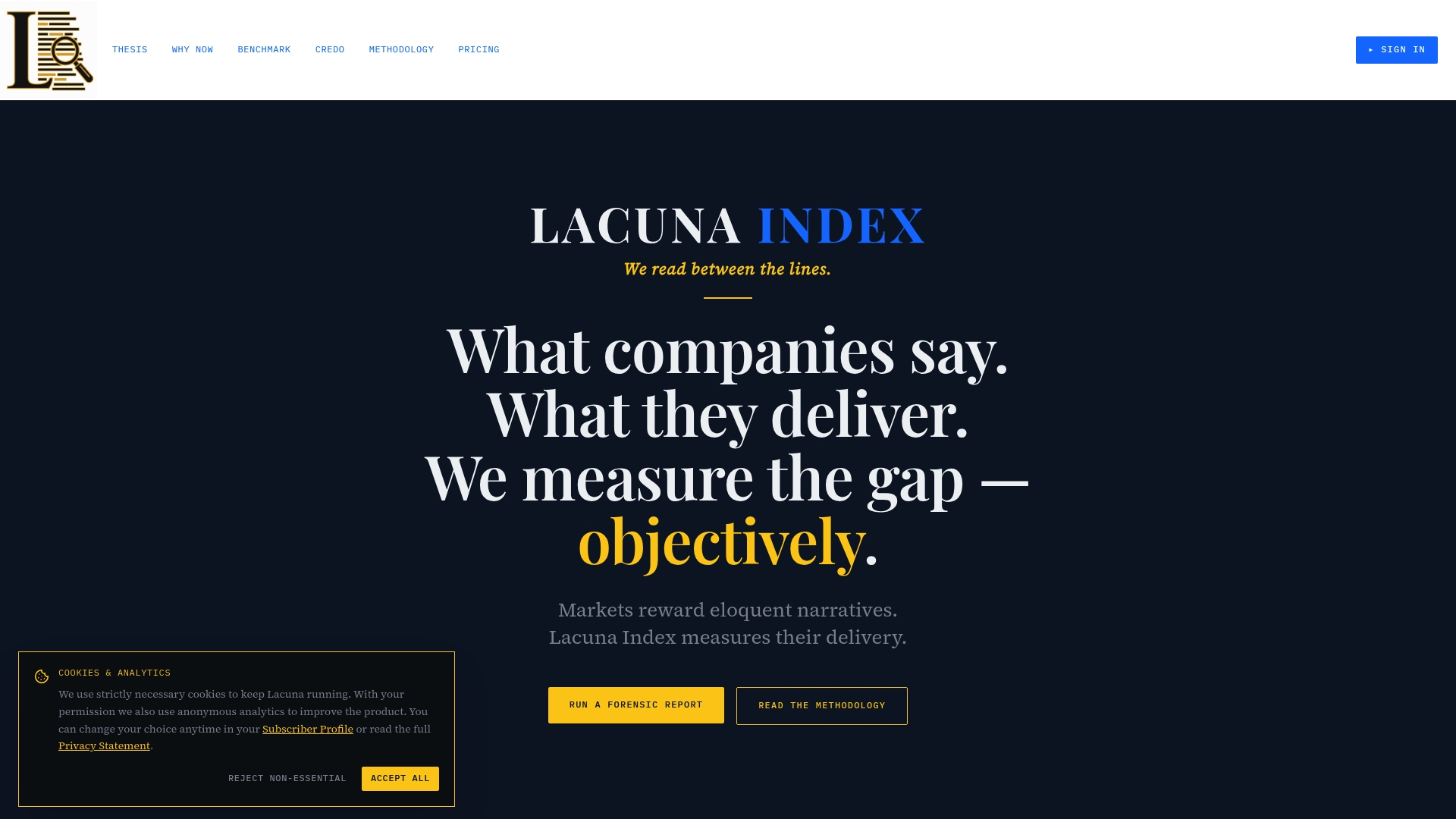
The platform's sector benchmarks allow governance teams to contextualize their engagement outcomes against peer companies, identifying where their disclosure-to-delivery gap is widest and which governance topics carry the highest investor scrutiny in their sector. For institutional investors evaluating portfolio companies, Lacunaindex execution scores provide an objective measure of whether governance narratives are supported by verifiable action. Explore the full methodology to understand how forensic analysis of public records translates into governance accountability metrics.
FAQ
What is a shareholder engagement checklist for governance?
A shareholder engagement checklist for governance is a structured document that guides corporate governance professionals through the identification, prioritization, outreach, documentation, and feedback analysis required to maintain effective investor relations. It operationalizes the principles of structured stakeholder engagement, including AA1000SES decision-linkage requirements and SEC disclosure standards.
How often should governance engagement cycles occur?
Full materiality-linked engagement cycles occur every 2–3 years, while Tier 1 institutional holder check-ins should occur at minimum annually. Off-season outreach in January and February, before proxy advisors publish guidelines, is the most effective window for substantive dialogue.
What tools support shareholder participation in governance?
Computershare Proxy Watch supports real-time vote tracking and risk identification during proxy season. Electronic proxy portals improve participation rates by 35–45% relative to paper-based processes, and data dashboards aggregate holder sentiment and engagement history for governance team review.
How do 2026 SEC policy changes affect engagement checklists?
The SEC's decline of no-action relief shifts the burden of proof to companies. Governance teams must now document board rationale and engagement evidence to defend say-on-pay and director election outcomes against negative proxy advisor recommendations.
What is the most common failure in shareholder engagement programs?
The most common structural failure is reactive engagement, where boards initiate outreach only in response to a shareholder proposal or negative ISS recommendation. Continuous, year-round engagement is the standard that builds the credibility required to withstand activist campaigns and adverse vote outcomes.