
Forensic analytics in institutional investing delivers defensible, reproducible signals — covering disclosure mismatches, fraud patterns, and systematic mispricing — that portfolio teams can convert into governance escalations, position adjustments, and litigation support. The recommended starting point is a scoped pilot on high-risk sectors or positions where the aspiration-to-execution gap is widest: run a structured validation set, document the audit trail, and measure signal lift against existing risk models. Lacunaindex provides public-record-based forensic reports, execution scores, and sector benchmarks that institutional teams can use as an entry point without requiring insider access or proprietary data feeds.
Key capabilities institutional teams should confirm before committing to any forensic analytics program:
- Reproducibility: Every signal must carry a documented audit trail linking back to the source disclosure or filing.
- Defensibility: Findings must be grounded in public records (SEC filings, earnings transcripts, proxy statements) and withstand legal scrutiny.
- Integration: Outputs must connect to existing portfolio management systems via API or structured export.
- Sector benchmarks: Relative scoring against peer companies is necessary to distinguish idiosyncratic risk from sector-wide disclosure patterns.
- Litigation support: ML and NLP-driven forensic findings can support regulatory inquiries and expert testimony when chain-of-custody is maintained.
Pro Tip: Before issuing an RFP, map your highest-risk positions by disclosure opacity score. Sectors with frequent restatements or high short interest are the most productive starting points for a forensic analytics pilot.
Table of Contents
- What does forensic analytics deliver for institutional investors?
- Which data sources and methods produce defensible forensic signals?
- How do you integrate forensic analytics into portfolio and risk workflows?
- What should you require from a forensic analytics platform?
- What does a pilot-to-production roadmap look like?
- How do you interpret forensic report outputs and act on signals?
- What are the limits and ethical guardrails institutional teams must observe?
- How Lacunaindex supports institutional forensic workflows
- Key Takeaways
- The case for forensic rigor in portfolio governance
- Request a sample forensic report from Lacunaindex
- Useful sources and further reading
What does forensic analytics deliver for institutional investors?
Forensic analysis in finance addresses a specific gap: the distance between what a company claims and what its disclosed records actually support. That gap, when quantified systematically, becomes an investable signal. Governance-focused forensic research produces at least six distinct use cases for institutional portfolios.
- Fraud and fraud-pattern detection: Anomalous revenue recognition, channel stuffing signals, and related-party transaction irregularities surfaced from 10-K and 10-Q filings.
- Disclosure vs. delivery validation: Comparing forward guidance language in earnings calls against subsequent reported results to score execution consistency over time.
- Mispricing detection: Identifying companies where market valuation diverges from forensically verified delivery, creating long or short opportunities.
- Litigation and regulatory support: Producing evidence bundles and timeline reconstructions for securities litigation, SEC inquiries, or activist campaigns.
- Governance scoring: Quantifying accountability across board composition, compensation alignment, and stated ESG commitments versus actual disclosures.
- Private-market look-through: Verifying portfolio company claims against available public records, court filings, and vendor data where accessible.
A practical example: an anomalous revenue recognition signal in a mid-cap software holding triggers a forensic review, which surfaces a pattern of accelerated contract bookings across three consecutive quarters. The portfolio team escalates to engagement rather than immediate exit, using the evidence bundle to frame questions for management. The signal changes the position sizing and monitoring cadence without requiring any non-public information.
Pro Tip: Prioritize use cases by expected alpha impact first, then regulatory exposure. Disclosure-vs.-delivery validation and mispricing detection typically generate the fastest measurable lift; litigation support has the longest lead time but the highest governance value.
Which data sources and methods produce defensible forensic signals?
The reproducibility of a forensic signal depends entirely on the quality and traceability of its inputs. Primary data sources for institutional forensic work include SEC filings (10-K, 10-Q, 8-K), earnings-call transcripts, structured proxy disclosures, publicly available contracts and court filings, vendor invoices where filed in litigation records, job-posting data, web-scraped operational indicators, and shipping records classified as alternative data. For private holdings, look-through analysis draws on whatever public-record equivalents exist: state filings, UCC records, and available financial statements.
Analytical techniques applied to these inputs follow a structured pipeline:
- Ingestion and normalization: Raw filings and transcripts are parsed, deduplicated, and aligned to a common entity and time-series schema.
- Feature extraction: NLP models extract sentiment, contradiction signals, and linguistic hedging patterns from narrative disclosures; time-series models flag statistical breaks in reported metrics.
- Anomaly detection: Machine learning models score deviations from peer-group and historical baselines, flagging candidates for deeper forensic review.
- Econometric mispricing models: Regression and factor frameworks separate forensic signal from systematic risk exposures, consistent with attribution approaches used in factor-based portfolio management.
- Rule-based forensic checks: Deterministic tests (e.g., Beneish M-Score components, accrual ratio thresholds) run in parallel to catch patterns that probabilistic models may miss.
- Signal scoring and audit trail: Each signal is assigned a confidence level, linked to its source records, and logged with model version and data lineage for reproducibility.
| Pipeline Stage | Primary Technique | Output |
|---|---|---|
| Ingestion | Parsing, entity resolution | Normalized disclosure corpus |
| Feature extraction | NLP, time-series analysis | Linguistic and quantitative features |
| Anomaly detection | ML classification | Ranked anomaly candidates |
| Mispricing modeling | Econometric regression | Valuation divergence score |
| Rule-based checks | Deterministic forensic rules | Flag set with source citations |
| Audit trail | Data lineage logging | Reproducible evidence record |
EY's forensic data analytics teams apply this same combination of ML, NLP, and robotic process automation to detect fraud and support regulatory responses at scale.

How do you integrate forensic analytics into portfolio and risk workflows?
Integration into portfolio management architecture is where forensic analytics creates the most measurable value, tying governance and risk signals directly to exposure, collateral, and performance metrics. The operational path from alert to action requires a defined escalation structure before the first signal fires.
Integration checklist:
- Map forensic signal outputs to existing risk-factor taxonomy and position identifiers.
- Confirm API compatibility or structured export format with the PM system (FactSet, Bloomberg, or equivalent).
- Define governance gates: which signals require committee review versus analyst-level triage.
- Build triage playbooks specifying response time, evidence-review steps, and escalation thresholds.
- Establish pilot KPIs: signal precision rate, false-positive rate, time-to-action, and governance escalation count.
Workflow sequence for a live signal:
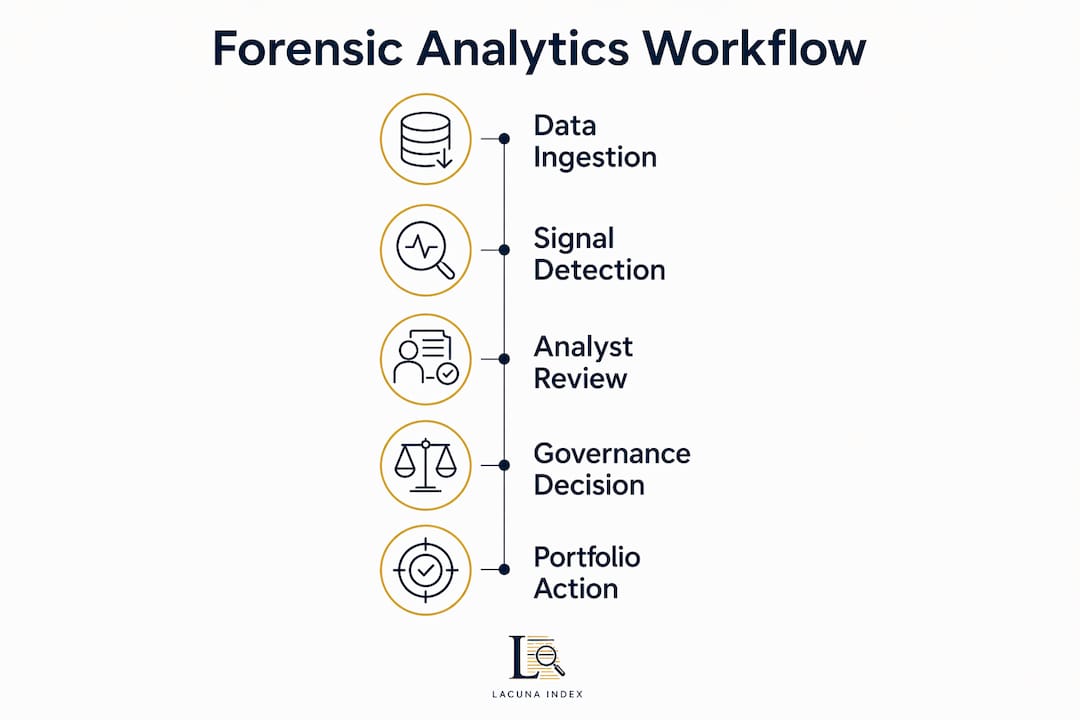
- Forensic platform fires an anomalous revenue recognition alert on a portfolio holding.
- Analyst reviews the evidence bundle: source filings, NLP contradiction flags, and execution score trend.
- Triage decision: escalate to risk committee or initiate direct engagement with management.
- Committee reviews forensic report alongside fundamental model; decides to reduce position by 20% and add to watchlist.
- Action is logged with rationale for audit trail and regulatory record.
Institutional platforms that centralize manager research and holdings analysis provide the benchmarking infrastructure forensic signals need to be interpreted in peer context. Portfolio analytics tools that support multi-asset data reconciliation and attribution are the natural integration layer for forensic outputs.
What should you require from a forensic analytics platform?
Managed forensic data services are replacing manual, siloed analysis as institutional buyers demand proactive surveillance and look-through transparency. Procurement criteria should be structured around five dimensions.
| Dimension | Must-Have | Should-Have | Nice-to-Have |
|---|---|---|---|
| Methodology transparency | Documented process, public-record-only sourcing | Whitepapers, sample reports | Academic validation |
| Reproducibility | Data lineage, model versioning, audit logs | Held-out validation datasets | Third-party audit |
| Integration | API or structured export | PM system connectors | Real-time webhook alerts |
| Data coverage | SEC filings, earnings transcripts, proxy statements | Alternative data, private look-through | Court filings, vendor invoices |
| Governance support | Evidence bundles, chain-of-custody documentation | Litigation-ready formatting | Expert testimony preparation |
Trust signals worth requiring during vendor evaluation: sample forensic reports for the relevant sector, documented methodology steps with reproducibility guarantees, sector benchmark comparisons, and a clear statement of what data sources are and are not included. Vendors who cannot produce a sample report for a named sector within a standard sales cycle are signaling a gap in coverage or process maturity.
What does a pilot-to-production roadmap look like?
A well-scoped pilot runs on a defined universe (typically 20–50 positions), a held-out validation set, and a 90-day evaluation window. The table below reflects typical durations; actual timelines vary by data-integration complexity and governance requirements.
| Phase | Typical Duration | Key Milestone |
|---|---|---|
| Pilot scoping and data mapping | several weeks | Agreed universe, KPIs, and data inputs confirmed |
| Signal generation and validation | multiple weeks | Precision and recall measured against validation set |
| Governance review and sign-off | multiple weeks | Risk committee approval of escalation playbook |
| Production rollout | multiple weeks | Full integration with PM system and live monitoring active |
Common cost drivers: data licensing for alternative data feeds, engineering hours for API integration, customization of signal thresholds to house risk taxonomy, managed-service hours for forensic report production, and model validation by an independent reviewer. Managed-service arrangements typically reduce engineering cost but add per-report or subscription fees; in-house builds offer more customization but require dedicated data-science capacity.
- Define success criteria before the pilot starts: a minimum signal precision rate, a maximum acceptable false-positive rate, and at least one governance escalation that the committee can evaluate end-to-end.
- Document all data lineage and model versions during the pilot; this record becomes the evidentiary foundation if findings are later used in litigation or regulatory proceedings.
How do you interpret forensic report outputs and act on signals?
A forensic report from a well-structured platform contains six standard elements: an evidence bundle (source filings with page citations), a timeline of disclosure events, a signal score with named drivers, reproducibility notes (data version and model version), recommended portfolio actions, and a confidence level. The confidence level is not a probability of fraud; it is a measure of evidentiary completeness relative to the signal type.
Lacunaindex classifies companies into archetypes based on the relationship between execution score and valuation:
- Earned: High execution score, valuation consistent with delivery. Standard monitoring cadence.
- Borrowed: High valuation, execution score declining or below peer median. Elevated monitoring; consider engagement or reduced exposure.
- Undervalued: Strong execution score, valuation below peer median. Potential long opportunity; verify with fundamental model.
- Engineered disclosure: Narrative claims systematically outpace verifiable delivery. Highest-priority forensic review; governance escalation warranted.
Decision flow for any signal: signal fires → analyst triage (evidence review, archetype confirmation) → governance decision (engage, hedge, reduce, exit) → portfolio action logged with rationale. The accountability scoring framework that underpins archetype classification is designed to make this decision flow auditable and repeatable across the portfolio.
What are the limits and ethical guardrails institutional teams must observe?
Forensic analytics multiplies analyst effectiveness but does not replace fundamental due diligence. False positives are an inherent feature of any anomaly-detection system; a signal is a prompt for investigation, not a verdict. Model drift is a real operational risk: disclosure language evolves, accounting standards change, and models trained on historical patterns require periodic revalidation.
Key limitations to document in any governance policy:
- Public-record blind spots: private companies, foreign-listed subsidiaries, and off-balance-sheet structures may have limited disclosure coverage.
- False-positive rate: even well-calibrated models produce signals that do not survive forensic review; triage capacity must be sized accordingly.
- Admissibility: forensic findings used in litigation require chain-of-custody documentation and, in most cases, counsel involvement before submission as evidence.
Legal and ethical checklist:
- Confirm data privacy compliance for any alternative data source (web-scrape, job postings) under applicable federal and state law.
- Maintain chain-of-custody logs for any finding that may be used in SEC inquiry or securities litigation.
- Involve legal counsel before sharing forensic findings externally or with regulators.
- Avoid any data collection method that requires unauthorized system access; public-record-only approaches are both legally cleaner and more reproducible.
- Document decision rationale at every escalation point for fiduciary and regulatory auditability.
Pro Tip: Treat every forensic signal as a hypothesis, not a conclusion. The evidentiary standard for a portfolio action is lower than for litigation; calibrate your escalation thresholds accordingly and document the distinction in your governance policy.
This article provides general informational content and does not constitute legal, financial, or investment advice. Institutional teams should consult qualified legal and compliance professionals before using forensic findings in regulatory proceedings or litigation.
How Lacunaindex supports institutional forensic workflows
Lacunaindex measures the aspiration-to-execution gap by mining public records exclusively: SEC filings, earnings-call transcripts, press releases, proxy statements, and public corporate disclosures. The methodology produces an execution score for each covered company, benchmarked against sector peers, and classifies the company into one of the archetypes described above. The process is fully reproducible; every score links back to the source disclosure and the model version that generated it, satisfying the evidentiary standards institutional compliance teams require.
A typical Lacunaindex report delivered to a risk committee contains:
- Execution score with trend: Current score, prior-quarter comparison, and peer-group percentile rank.
- Archetype classification: Current archetype with the primary evidence driving the classification.
- Evidence bundle: Source citations from SEC filings and earnings transcripts, with relevant passages flagged.
- Sector benchmark comparison: Positioning relative to the full sector coverage universe.
- Recommended monitoring actions: Specific next steps calibrated to the archetype and signal confidence level.
Lacunaindex applies a consistent, public-record-only forensic process to quantify the gap between corporate narrative and verifiable delivery — producing sector-benchmarked execution scores and archetype classifications that institutional teams can use directly in risk committee discussions and governance escalations, without requiring insider access or proprietary data.
Integration options include structured data exports, API access for PM system connectivity, and a sector benchmarks page that serves as a standing reference for peer-group positioning. Sample forensic reports are available at Lacunaindex sector benchmarks.
Key Takeaways
Forensic analytics delivers its highest institutional value when reproducible, public-record-based signals are integrated directly into portfolio management and governance workflows, with Lacunaindex providing execution scores, archetype classifications, and sector benchmarks as a structured entry point.
| Point | Details |
|---|---|
| Start with a scoped pilot | Define a position universe of moderate size, a held-out validation set, and an evaluation period before committing to production. |
| Require reproducibility and audit trails | Every forensic signal must carry documented data lineage, model versioning, and source citations to meet compliance and litigation standards. |
| Map signals to portfolio actions | Define escalation playbooks before the first signal fires: which archetypes trigger engagement, hedging, or exit, and who approves each action. |
| Evaluate vendors on methodology transparency | Require sample reports, sector benchmarks, and a documented public-record-only sourcing policy during procurement. |
| Lacunaindex as entry point | Lacunaindex provides execution scores, archetype classifications, and sector benchmarks derived solely from public records, with API and export integration options for PM systems. |
The case for forensic rigor in portfolio governance
The conventional framing of forensic analytics as a fraud-detection tool understates its portfolio value by roughly half. The more consequential application is systematic disclosure validation: measuring, quarter over quarter, whether a company's narrative is converging with or diverging from its verifiable delivery. Most fundamental models treat management guidance as a data input; forensic methodology treats it as a hypothesis to be tested against the evidentiary record. That distinction changes how a portfolio team sizes positions, structures engagement, and documents its fiduciary reasoning.
The governance dimension is equally underappreciated. Institutional investors who can demonstrate that their engagement decisions are grounded in reproducible, public-record evidence are in a materially stronger position with regulators, limited partners, and boards than those relying on qualitative judgment alone. The audit trail is not a compliance formality; it is the mechanism by which forensic analytics converts analytical rigor into institutional credibility.
Request a sample forensic report from Lacunaindex
Institutional teams evaluating forensic analytics for portfolio integration can request a sector benchmark or sample forensic report directly through Lacunaindex. The sector benchmarks page provides execution scores and archetype distributions across covered sectors, giving procurement teams a concrete basis for evaluating methodology and coverage before committing to a pilot.
Lacunaindex supports pilot scoping, API integration planning, and governance documentation for teams moving from evaluation to production. The platform's public-record-only methodology means no data-access agreements beyond standard licensing, and every output is reproducible from the source filing forward. Contact Lacunaindex through the benchmarks page to receive a sample report for your sector of interest and discuss pilot design with the methodology team.
Useful sources and further reading
- Integra FEC: Covers forensic data mapping, ML and NLP applications, and end-to-end litigation support for market-manipulation and structured finance investigations. Useful for understanding technical methodology and evidentiary standards.
- EY Forensic Data Analytics: Documents how professional services firms apply ML, NLP, and robotic process automation to fraud detection, risk transparency, and regulatory response. Relevant for benchmarking forensic service capabilities.
- Nasdaq eVestment: Explains centralized institutional intelligence for manager research, holdings analysis, and private-market benchmarking. Useful for integration planning.
- FactSet Portfolio Analytics: Describes multi-asset data reconciliation, attribution, and returns analysis. Relevant for understanding the integration layer forensic signals need to connect to.
- MSCI Barra PortfolioManager: Covers factor-based attribution and backtesting. Useful for interpreting forensic signals alongside systematic risk exposures.
- Lacunaindex: Forensic Corporate Analysis: Introductory guide to how forensic analytics fits institutional asset management workflows and investor decision-making.
- Lacunaindex: Forensic Financial Analysis Methodology Steps: Detailed methodology steps covering reproducibility, audit-trail requirements, and public-record-only sourcing standards.
- Lacunaindex: Governance Advocate Forensic Research Advantages: Evaluation of how forensic governance metrics contribute to transparent alpha and institutional accountability.
- Lacunaindex: Corporate Archetype Governance Implications: Defines earned, borrowed, undervalued, and engineered-disclosure archetypes and their governance implications for portfolio action.