
The four corporate governance archetypes identified by Martin et al. (2016) — shareholder value, communitarian stakeholder, enlightened shareholder value, and employee-ownership — each carry distinct governance implications that shape organizational strategy, human resource management, and sustainability outcomes in fundamentally different ways. Understanding which archetype governs a firm is not an academic exercise. It determines what HR investments are feasible, which stakeholder claims receive priority, and whether sustainability commitments can survive contact with the firm's underlying institutional logic.
Each archetype operates through a distinct combination of ownership structure and institutional logic:
- Shareholder value: Market-based, agency-led logic; board accountability runs primarily to investors; calculative HR practices dominate; short-term return maximization constrains long-term capital allocation.
- Communitarian stakeholder: Democratic logic; obligations extend to employees, suppliers, communities, and the environment; collaborative HR practices; most fully developed in continental European governance systems.
- Enlightened shareholder value: Hybrid archetype balancing market and stakeholder logics; strategy-led rather than purely agency-led; sophisticated HR practices that integrate both commitment and calculative elements.
- Employee-ownership: Hybrid archetype drawing on democratic and market logics simultaneously; promotes workforce stability and long-term investment; tension-laden when the two logics conflict.
The archetype in place also conditions a firm's capacity for genuine sustainability integration. Overlaying ESG commitments onto a shareholder value structure without altering the underlying governance logic tends to produce disclosure opacity rather than operational change. Corporate governance professionals working in the US context need to map archetype logic before designing governance frameworks, not after.
What are the theoretical foundations of corporate governance archetypes?

The academic framework underlying corporate archetype governance implications originates in the intersection of two bodies of literature: corporate governance theory, which centers on ownership and control questions, and institutional logics theory, which explains how societal-level belief systems constrain organizational behavior. Martin et al. (2016) synthesized these streams to produce a typology that moves beyond the familiar shareholder-versus-stakeholder binary.
Institutional logics function as the deep grammar of organizational decision-making. They define which goals count as legitimate, which actors hold authority, and which trade-offs are acceptable. A firm operating under a market logic treats capital efficiency as the primary metric of organizational health. One operating under a democratic logic treats collective voice and equitable distribution as equally valid performance criteria. These are not simply policy preferences; they are embedded in ownership structures, board compositions, legal frameworks, and executive incentive designs.
The two ownership-control questions that anchor the typology are: Who controls the firm? And whose interests does governance serve? Combining answers to both questions generates the four archetypes:
- Dominant logic archetypes (shareholder value and communitarian stakeholder) operate under a single coherent institutional logic, which simplifies governance alignment but limits adaptability.
- Hybrid archetypes (enlightened shareholder value and employee-ownership) operate under multiple logics simultaneously, creating either productive tension or systemic conflict depending on how well those logics align in practice.
The concept of institutional complementarities, drawn from Aoki and Jackson (2008) and Hall and Soskice (2001), explains why archetypes tend to cluster with particular HR systems, board structures, and capital market relationships. Governance choices are not made in isolation; they reinforce and are reinforced by surrounding institutional arrangements.
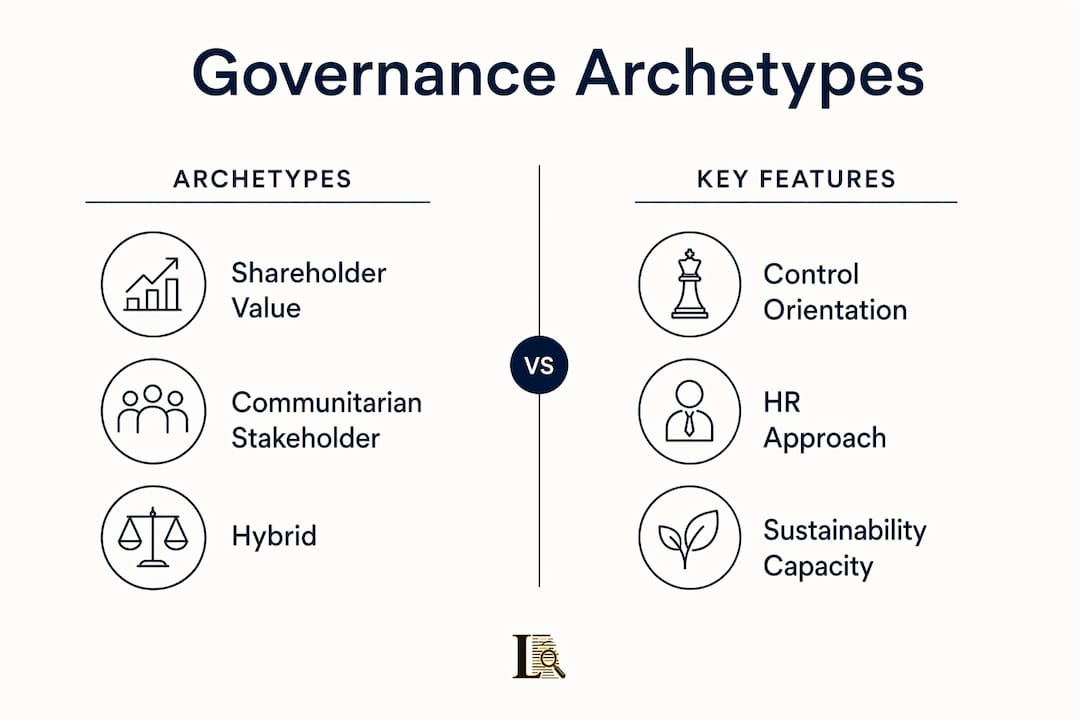
| Archetype | Dominant Logic | Control Orientation | HR Approach | Sustainability Capacity |
|---|---|---|---|---|
| Shareholder value | Market/agency | Shareholder primacy | Calculative | Constrained by short-termism |
| Communitarian stakeholder | Democratic | Broad stakeholder | Collaborative/commitment | Structurally embedded |
| Enlightened shareholder value | Market + stakeholder (hybrid) | Strategy-led | Sophisticated/mixed | Conditional on strategy alignment |
| Employee-ownership | Democratic + market (hybrid) | Workforce-inclusive | Stability-oriented | High potential, logic-conflict risk |
Hybrid archetypes present the most complex governance challenges. As Besharov and Smith (2014) note, multiple logics within a single organization can lead to either relative alignment or extensive contestation, depending on how compatible those logics prove in day-to-day practice. The enlightened shareholder value archetype manages this tension through what Courpasson (2000) termed "soft bureaucracy," where strategic direction substitutes for pure market discipline without fully embracing democratic governance. The employee-ownership archetype faces the opposite challenge: democratic participation can slow decision-making to the point of managerial inefficiency if the market logic is not given sufficient operational authority.
How governance archetypes shape strategic human resource management
The archetype a firm inhabits functions as a constraint on the range of feasible HR strategies, not merely as a preference. This distinction matters for governance professionals who often encounter sustainability-oriented HR proposals that are technically sound but institutionally incompatible with the firm's underlying governance logic.
Shareholder value archetype and SHRM
Under the shareholder value archetype, HR practices are predominantly calculative. Workforce investment is evaluated against short-term return metrics, which structurally limits expenditure on training, long-term talent development, and employee wellbeing programs that do not produce near-term financial returns. Executive compensation ties directly to total shareholder return, and board oversight of HR strategy focuses on cost discipline rather than human capital development. The result is a governance-SHRM alignment that is internally coherent but poorly suited to organizations facing talent scarcity or reputational risk from workforce practices.
Communitarian stakeholder archetype and SHRM
The communitarian stakeholder archetype, most fully developed in German codetermination structures and Nordic governance models, embeds HR commitments at the governance level rather than treating them as discretionary management decisions. Employee representation on supervisory boards, works council consultation rights, and long-term employment security are not HR policies in this archetype; they are governance architecture. This structural embeddedness gives sustainability-oriented HR practices institutional protection that the shareholder value archetype cannot replicate through policy alone.
Hybrid archetypes and SHRM complexity
The enlightened shareholder value and employee-ownership archetypes both attempt to resolve the tensions inherent in their dominant counterparts, but through different mechanisms. The enlightened shareholder value archetype deploys sophisticated HR practices that combine commitment-based approaches (long-term development, stakeholder engagement) with calculative discipline (performance metrics, incentive alignment). The employee-ownership archetype extends governance rights to the workforce itself, which can produce strong organizational commitment and stability but creates decision-making complexity when democratic and market logics conflict over resource allocation.
Three governance-SHRM misalignment risks cut across all archetypes:
- Logic substitution failure: Attempting to import HR practices from one archetype into another without changing the underlying governance logic produces surface compliance rather than behavioral change.
- Greenwashing through governance mismatch: Imposing sustainability-oriented HR commitments on a shareholder value structure without altering board incentives or ownership priorities generates disclosure without delivery.
- Hybrid logic contestation: In employee-ownership and enlightened shareholder value firms, unresolved tension between competing logics can produce organizational paralysis, particularly during strategic pivots or economic stress.
The practical implication for governance professionals is that SHRM and sustainability initiatives require archetype diagnosis before program design. A firm that has not resolved its governance logic cannot resolve its HR strategy.
How governance frameworks operationalize archetype priorities
The distinction between a governance archetype and a governance framework is analytically critical and frequently collapsed in practice. The archetype defines who governs and whose interests are served. The framework defines how governance is implemented through board structures, audit functions, risk management processes, and external accountability mechanisms.
Governance frameworks translate archetype priorities into operational controls through two categories of mechanism:
- Internal mechanisms: Board committee structure, executive incentive design, internal audit, and management reporting systems.
- External mechanisms: Capital market discipline, regulatory requirements, institutional investor engagement, and proxy advisory influence.
In the US context, the SEC's disclosure framework establishes a baseline of governance accountability for public companies. Institutional investors, including pension funds, mutual funds, and sovereign wealth funds, hold significant voting power and increasingly deploy it to press boards on director independence, sustainability strategy, and executive pay alignment. Proxy advisory firms translate institutional governance preferences into voting recommendations that can materially influence director elections.
The G20/OECD Principles of Corporate Governance, first issued in 1999 and revised most recently in 2023, provide the global benchmark against which national frameworks are assessed. The 2023 revision organized the Principles into six chapters: (I) ensuring the basis for an effective governance framework; (II) rights and equitable treatment of shareholders; (III) institutional investors, stock markets, and other intermediaries; (IV) disclosure and transparency; (V) board responsibilities; and (VI) sustainability and resilience. The addition of sustainability and resilience as a standalone pillar reflects the growing consensus that governance frameworks must address long-term systemic risk, not only near-term investor protection.
The Corporate Governance Institute's position, consistent with the OECD framework, holds that effective governance frameworks prevent institutional entropy by balancing competing stakeholder interests and securing organizational longevity beyond regulatory compliance. Compliance-based governance, doing only what regulation requires, is increasingly insufficient. Institutional investors expect boards to demonstrate proactive oversight of strategy, risk, and sustainability.
Statistic callout: 91% of companies by market capitalization disclosed sustainability-related information in 2024, up from 86% in 2022, according to OECD data. Europe led at 98%, followed by Developed Asia-Pacific excluding the United States at 94%, and the United States at 93%.
The framework components most sensitive to archetype type are executive incentive design and board committee scope. A shareholder value firm ties compensation to total shareholder return and structures board committees around audit and compensation. A communitarian stakeholder firm may incorporate employee engagement scores, safety metrics, or environmental targets into executive pay, and may seat employee representatives on the board itself. These are not cosmetic differences; they determine which performance signals receive board-level attention and which risks remain invisible to governance oversight.
What challenges do governance archetypes create, and where is the field heading?
Each archetype generates a distinct set of governance challenges that resist resolution within the archetype's own logic. Recognizing these structural tensions is the first step toward designing governance responses that are institutionally coherent rather than aspirationally inconsistent.
Shareholder value archetype challenges:
- Short-termism in capital allocation crowds out investment in human capital, R&D, and environmental risk mitigation.
- Agency-led governance creates principal-agent conflicts when executive incentives diverge from long-term shareholder interests.
- Sustainability commitments made at the disclosure level cannot be operationalized without board-level incentive realignment.
Communitarian stakeholder archetype challenges:
- Democratic governance processes can slow strategic decision-making, particularly in fast-moving competitive environments.
- Balancing the claims of multiple stakeholder groups requires governance mechanisms capable of adjudicating genuine conflicts of interest, not merely aggregating preferences.
- The archetype's institutional embeddedness in continental European legal systems limits its direct transferability to US corporate structures.
Enlightened shareholder value archetype challenges:
- The hybrid logic creates differentiation-legitimacy tensions: the firm must appear credible to capital markets while also demonstrating genuine stakeholder commitment.
- Soft bureaucracy, the governance mechanism that manages this tension, depends heavily on the quality of strategic leadership and can degrade rapidly under executive turnover.
- Sophisticated HR practices require sustained investment that becomes vulnerable during earnings pressure.
Employee-ownership archetype challenges:
- Democratic and market logics can enter direct conflict over dividend policy, workforce reduction decisions, and capital structure choices.
- Governance systems that give employees formal control rights must also maintain managerial efficiency, a balance that requires carefully designed interface mechanisms between ownership and operational authority.
- Succession and ownership transfer create structural vulnerabilities not present in publicly traded firms.
Research on IBEX35 firms found that sustainability governance maturity emerges through complex configurations of corporate cultural archetypes, with two distinct pathways capable of producing high governance maturity. One pathway is grounded in human-centered values and organizational openness; the other relies on technological rigor and procedural discipline, even where explicit ESG signaling is limited or absent. This equifinality finding challenges the assumption that high ESG disclosure scores are a reliable proxy for governance maturity.
The emerging normative direction in governance scholarship, consistent with the corporate sustainability literature, proposes sustainability as a meta-logic capable of bridging archetype tensions. Rather than selecting one archetype and accepting its constraints, this approach treats long-term organizational viability as the governing criterion against which archetype trade-offs are evaluated. Durable governance also requires what one systems-theoretical framework describes as a "priestly" interface function: a mechanism connecting high-level strategy with operational execution to prevent "Cooling," the gradual bureaucratic inertia and loss of organizational coherence that standard governance reports rarely detect. Without this interface, governance frameworks become procedurally compliant but strategically inert.
How forensic analytics can evaluate governance accountability across archetypes
Forensic analytics applies to governance evaluation the same evidentiary discipline that financial auditing applies to accounting records. The methodology compares corporate narrative claims, drawn from earnings calls, SEC filings, press releases, and proxy statements, against actual delivery metrics extracted from the same public record. The resulting aspiration-to-execution gap quantifies the distance between what a firm's governance structure claims to prioritize and what its operational decisions reveal about actual priorities.
Lacunaindex applies this methodology to classify public companies by governance archetype and measure delivery against narrative across dimensions including human capital investment, sustainability commitment, board independence, and executive incentive alignment. The classification produces execution scores that allow governance professionals to benchmark a firm's archetype performance against sector peers rather than against its own disclosed targets.
| Governance Dimension | Narrative Indicator | Execution Indicator | Gap Signal |
|---|---|---|---|
| Human capital investment | Training and development disclosures | Actual workforce expenditure trends | Disclosure opacity |
| Sustainability commitment | ESG report targets | Operational emissions and supply chain data | Greenwashing risk |
| Board independence | Director independence declarations | Voting record and committee composition | Structural capture |
| Executive incentive alignment | Pay-for-performance disclosures | Realized compensation vs. stated metrics | Incentive drift |
| Stakeholder engagement | Stakeholder consultation claims | Proxy voting outcomes and shareholder resolutions | Engagement theater |
The forensic approach is particularly valuable for identifying governance archetype misclassification, cases where a firm's public narrative positions it within an enlightened shareholder value or communitarian stakeholder archetype while its operational decisions reflect pure shareholder value logic. This misclassification creates accountability gaps that institutional investors and governance advocates cannot detect through disclosure review alone.
Pro Tip: When evaluating a firm's governance archetype, cross-reference its proxy statement's executive compensation design against its stated sustainability targets. Incentive structures that reward only total shareholder return while claiming stakeholder governance alignment are a primary indicator of aspiration-to-execution gap and warrant deeper forensic review of operational disclosures.
Sector benchmarks are essential context for this analysis. A firm whose sustainability disclosure rate matches the 93% US market rate is not necessarily performing well; it is performing at the disclosure floor. Lacunaindex's sector benchmark data allows governance professionals to compare execution scores within peer groups, separating firms that deliver on archetype commitments from those that engineer disclosure without operational follow-through.
How do US governance archetypes compare to international models?
The United States operates predominantly within the shareholder value archetype, a function of its dispersed ownership structure, common law legal tradition, and capital market architecture. The SEC's disclosure framework, the Delaware General Corporation Law, and the institutional weight of proxy advisory firms collectively reinforce shareholder primacy as the default governance logic for US public companies. This contrasts sharply with the governance structures prevalent in continental Europe, East Asia, and other major economies.
Germany's codetermination system embeds the communitarian stakeholder archetype at the statutory level. Supervisory boards of companies above certain employee thresholds must include employee representatives, giving workforce interests formal governance authority rather than consultative status. This structural difference means that sustainability-oriented HR practices in German firms are governance commitments, not management discretion. The contrast with US practice is not one of corporate culture but of institutional architecture.
Japan's keiretsu governance model, characterized by cross-shareholding among affiliated companies and main bank relationships, produces a variant of the communitarian stakeholder archetype with a distinctly relational character. Long-term employment commitments, supplier loyalty, and patient capital allocation are governance outputs of the keiretsu structure rather than voluntary HR policies. Recent Japanese governance reforms, including the Tokyo Stock Exchange's push for improved return on equity and board independence, represent an attempt to introduce market logic elements into a historically stakeholder-oriented system.
Family and concentrated ownership models, prevalent across Asia, Latin America, and Southern Europe, create a distinct governance dynamic where controlling shareholders exercise authority that dispersed-ownership structures cannot replicate. Minority shareholder protection, board independence, and internal audit capacity are governance priorities precisely because external market discipline, the threat of hostile takeover or activist pressure, is structurally weaker. The World Bank identifies state-owned enterprise governance as among the most complex variants of this pattern, where the government's simultaneous roles as owner, regulator, and policy-setter create principal-agent conflicts with no clean market resolution.
For US governance professionals operating across borders, the practical implication is that archetype-specific governance expectations vary by jurisdiction in ways that compliance-based frameworks do not capture. A board director at a US subsidiary of a European parent must navigate the parent's stakeholder governance logic while operating within US securities law. An executive managing operations in Germany must understand that codetermination rights are not HR policy but governance architecture with legal force.
What US legal and regulatory frameworks shape each governance archetype?
The US legal and regulatory environment does not mandate a single governance archetype, but it creates conditions that strongly favor the shareholder value model for publicly traded companies while providing limited structural support for communitarian stakeholder or employee-ownership alternatives.
Shareholder value archetype: The Delaware General Corporation Law, under which the majority of US public companies are incorporated, has historically interpreted the board's fiduciary duty as running primarily to shareholders. The SEC's disclosure framework requires public companies to report on material risks and financial performance in terms that institutional investors can evaluate against return expectations. The Business Roundtable's 2019 Statement on the Purpose of a Corporation, which expanded the stated purpose of corporations to include stakeholder interests, has not been codified into law and does not alter fiduciary duty standards under Delaware law.
Communitarian stakeholder archetype: The US lacks the statutory codetermination requirements that embed this archetype in German and Nordic governance systems. Worker representation on corporate boards is not legally mandated at the federal level, though some states have explored legislation in this direction. Benefit corporation statutes, available in most US states, allow companies to incorporate stakeholder obligations into their legal purpose, providing a limited structural alternative to pure shareholder primacy.
Enlightened shareholder value archetype: The SEC's expanding ESG disclosure requirements, including climate-related disclosure rules, push US public companies toward governance practices that acknowledge stakeholder and sustainability considerations without abandoning shareholder primacy. Institutional investor pressure, channeled through proxy advisory firms, reinforces this direction by making board responsiveness to sustainability concerns a factor in director election outcomes.
Employee-ownership archetype: Employee Stock Ownership Plans (ESOPs) provide the primary US legal vehicle for employee-ownership governance. The Employee Retirement Income Security Act (ERISA) governs ESOP fiduciary obligations, creating a regulatory framework that protects employee-owner interests while maintaining market discipline. Approximately 6,500 ESOP companies operate in the US, covering a substantial employee base, though the archetype remains a minority governance form in the public company context.
The corporate transparency requirements embedded in US securities law apply most forcefully to the shareholder value archetype, where disclosure to capital markets is the primary accountability mechanism. For employee-ownership and benefit corporation structures, accountability runs through different channels, including ERISA fiduciary standards and state benefit corporation reporting requirements, that are less visible to institutional investors and governance researchers.
How do governance archetypes affect shareholder relations and stakeholder engagement?
The archetype in place determines not only who receives governance attention but how engagement with shareholders and stakeholders is structured, what information flows to each group, and which claims can be adjudicated through formal governance mechanisms.
Under the shareholder value archetype, shareholder engagement is the primary governance accountability mechanism. Annual general meetings, proxy voting, and direct institutional investor dialogue constitute the formal engagement architecture. Activist shareholders can use this architecture to force board composition changes, capital allocation decisions, or strategic pivots. The governance implication is that boards operating under this archetype must maintain continuous investor relations capacity and respond to shareholder proposals with documented deliberation.
The communitarian stakeholder archetype distributes engagement obligations across a broader set of parties. Employee works councils, supplier consultation processes, community impact assessments, and environmental stakeholder dialogues are governance requirements rather than voluntary corporate responsibility initiatives. This distribution of engagement creates governance complexity but also builds the relational capital that supports organizational resilience during economic stress.
Hybrid archetypes face the most demanding engagement requirements because they must maintain credibility with both capital market actors and stakeholder constituencies simultaneously. The enlightened shareholder value archetype manages this through integrated reporting frameworks that translate stakeholder outcomes into investor-relevant metrics. The employee-ownership archetype manages it through governance structures that give employee-owners formal voice in decisions that affect both their financial interests and their employment conditions.
Disclosure integrity is the point where shareholder and stakeholder engagement most frequently breaks down. Firms that claim stakeholder governance alignment while structuring board incentives and capital allocation decisions around shareholder return metrics create an engagement theater that erodes trust with both constituencies. Forensic analysis of proxy statements, earnings call transcripts, and sustainability reports can identify this misalignment before it produces governance failures visible to the market.
Case studies illustrating governance archetypes in US corporations
Shareholder value archetype: General Electric's governance trajectory
General Electric's governance history from the 1980s through the 2010s illustrates the shareholder value archetype at scale. Under Jack Welch's leadership, GE's board structure, executive incentive design, and capital allocation decisions aligned tightly with shareholder return maximization. The governance logic produced exceptional short-term financial performance but also accumulated risks in GE Capital and deferred investment in industrial operations that became visible only after the logic was no longer sustainable. The subsequent governance failures, including restatements, dividend cuts, and asset divestitures under later leadership, reflect the structural vulnerabilities of a pure shareholder value archetype when market conditions shift.
Communitarian stakeholder archetype: US subsidiaries of European multinationals
US subsidiaries of German or Nordic parent companies frequently operate within a governance tension between the parent's communitarian stakeholder logic and the US subsidiary's shareholder-oriented legal environment. Siemens US operations, for example, must navigate parent-level governance expectations around employee consultation and sustainability reporting while complying with US securities and labor law frameworks that do not mandate these practices. The governance challenge is not one of compliance but of institutional logic translation across jurisdictions.
Enlightened shareholder value archetype: Johnson and Johnson's stakeholder governance evolution
Johnson and Johnson's Credo, first articulated in 1943, represents an early attempt to operationalize enlightened shareholder value governance by explicitly ordering the firm's obligations to customers, employees, communities, and shareholders. The governance implication of this ordering became visible during the 1982 Tylenol crisis, where the firm's response prioritized consumer safety over short-term financial protection in a way that a pure shareholder value governance logic would have made institutionally difficult. The Credo functions as a governance document, not merely a values statement, because it shapes board deliberation and executive decision-making during high-stakes situations.
Employee-ownership archetype: Publix Super Markets
Publix Super Markets, one of the largest employee-owned companies in the United States, operates under an employee-ownership archetype that distributes governance rights and financial returns to its workforce. The governance structure produces measurable differences in employee retention, customer service consistency, and long-term capital allocation compared to publicly traded grocery competitors. The archetype's sustainability advantage lies in the alignment between employee-owner interests and long-term organizational health, which reduces the principal-agent conflicts that characterize dispersed-ownership governance structures.
Key Takeaways
Corporate governance archetypes function as institutional constraints that determine which HR strategies, sustainability commitments, and stakeholder engagement mechanisms are structurally feasible for a given firm.
| Point | Details |
|---|---|
| Four distinct archetypes | Shareholder value, communitarian stakeholder, enlightened shareholder value, and employee-ownership each carry unique governance and SHRM implications. |
| Sustainability disclosure rates | 91% of companies by market capitalization disclosed sustainability information in 2024, up from 86% in 2022, according to OECD data. Europe led at 98%, followed by Developed Asia-Pacific excluding the United States at 94%, and the United States at 93%. Disclosure volume does not equal governance maturity. |
| Greenwashing risk | Imposing sustainability HR practices on a shareholder value archetype without altering governance logic produces disclosure opacity rather than operational change. |
| G20/OECD six pillars | The 2023 Principles added sustainability and resilience as a standalone chapter, signaling that governance frameworks must address systemic risk beyond investor protection. |
| Forensic analytics application | Comparing narrative claims against public-record delivery data identifies archetype misclassification and aspiration-to-execution gaps that disclosure review alone cannot detect. |
Lacunaindex: forensic governance analysis for accountability professionals
Governance professionals who need to move beyond disclosure review and assess actual archetype delivery can apply Lacunaindex's forensic methodology to public company records. The platform mines SEC filings, proxy statements, earnings call transcripts, and press releases to produce execution scores and aspiration-to-execution gap analyses that classify firms by governance archetype and measure delivery against stated commitments. Sector-level benchmark comparisons allow analysts to evaluate whether a firm's governance performance reflects genuine archetype alignment or engineered narrative. For governance researchers and institutional investors who require evidence-based accountability assessment, the Lacunaindex report guide provides the methodological framework for interpreting forensic findings within the archetype typology developed by Martin et al. (2016).