
Accountability scoring is defined as a structured methodology for quantifying how well governance decisions are documented, justified, and traceable to responsible parties. For corporate governance professionals and institutional investors, this discipline sits at the center of effective decision making: it converts abstract fiduciary obligations into measurable, auditable records. The practice draws on governance decision frameworks from bodies including the OECD, SEC guidelines, and proxy advisory norms to create a consistent standard for evaluating decision quality. Lacunaindex applies this logic forensically, measuring the gap between what companies claim and what public records confirm.
How does accountability scoring integrate with proxy advisory processes?
Accountability scoring governance decision making depends heavily on how proxy advisory workflows are structured. The proxy advisory process is the mechanism through which institutional investors receive voting recommendations on shareholder resolutions, director elections, and executive compensation plans. The risk is well documented: 94% of jurisdictions impose no engagement requirements before voting advice is issued. That figure means most proxy recommendations reach investors without any direct dialogue with the company being evaluated.
The SEC has addressed this gap directly. SEC officials stress that fiduciary accountability cannot be delegated mechanically, and investment advisers must document independent rationales for proxy votes rather than applying a blanket "vote-all" policy. This regulatory position makes accountability scoring a compliance necessity, not just a best practice. Governance professionals who rely on proxy advisors without independent review expose their organizations to regulatory scrutiny and reputational risk.
An effective accountability scoring proxy advisory workflow addresses these gaps through three core requirements:
- Policy documentation: Every vote must trace back to a written policy that specifies the criteria applied.
- Independent rationale: Non-routine votes require a documented explanation that goes beyond the proxy advisor's recommendation.
- Escalation records: Disagreements between internal analysis and proxy advisor output must be captured and reviewed.
These requirements transform the proxy advisory process from a passive input into an active governance performance evaluation. The accountability scoring proxy advisory process, when structured correctly, creates a defensible audit trail for every material vote.
Pro Tip: Treat proxy advisor recommendations as one data point among several. Cross-reference each recommendation against your own policy criteria before recording a final vote decision.
What frameworks and metrics underpin governance performance evaluation?
Governance maturity models provide the structural backbone for accountability scoring. The OECD AI Judgment Assurance framework uses verifiable tiering systems with levels 0 through 4 to measure decision governance maturity independently from any specific technology or AI architecture. Level 0 represents no formal governance process; level 4 represents fully documented, independently audited decision lifecycles. This tiering treats governance judgment as a deliberate institutional asset rather than individual intuition.
Quantitative metrics within these frameworks measure three core dimensions: fairness, explainability, and trust. Research on integrated governance architectures shows that full governance integration achieves trust scores near 0.813 and stability above 0.905, outperforming both partial and no-governance approaches. These numbers are not abstract. They represent the measurable difference between a governance process that holds up under audit and one that collapses under scrutiny.
The table below compares governance scoring approaches by integration depth:
| Governance approach | Trust score | Stability score | Audit defensibility |
|---|---|---|---|
| Full integration (fairness + explainability + accountability) | ~0.813 | >0.905 | High |
| Partial integration (one or two dimensions only) | Moderate | Moderate | Limited |
| No formal governance | Low | Low | None |
Auditability requirements add a third layer to this framework. Effective accountability scoring requires auditable lifecycle artifacts that capture context, alternatives considered, and rationale for any overrides, not just the final outcome. A governance record that shows only the decision made is incomplete. The record must show what was considered, what was rejected, and why.
Pro Tip: Map your organization's current governance process against the 0–4 maturity tiers before selecting any scoring tool. Knowing your baseline prevents you from buying capability you cannot yet use.
How do AI-driven tools enhance governance decision-making workflows?
AI changes the economics of governance evaluation without changing its fundamental obligations. Routine proxy research tasks, including policy matching, disclosure extraction, and vote categorization, can be automated at scale. AI-driven stewardship tools benchmark model performance against expert human-labeled datasets, achieving 99.2% alignment on routine proxy tasks. That level of alignment frees governance teams to concentrate analytical effort on the cases that actually require judgment.

The human-in-the-loop requirement is non-negotiable for complex or ambiguous cases. AI should defragment information from multiple sources to build evidence-backed rationales, not replace human judgment in governance decision making. The distinction matters legally and practically. An AI output that cannot be traced to a specific disclosure or filing is not a governance record. It is an unverified assertion.
Four best practices govern the responsible deployment of AI in accountability scoring workflows:
- End-to-end auditability: Test every stage of the AI pipeline, including retrieval, reasoning, and output, against manual expert-reviewed benchmarks. Aggregate accuracy claims mask stage-level failures.
- Evidence grounding: Every AI-generated rationale must cite a specific public document, such as an SEC filing, earnings call transcript, or proxy statement.
- Bias monitoring: Regularly audit AI outputs for systematic skew across company size, sector, or geography.
- Escalation pathways: Define which case types automatically route to human review before any vote is recorded.
"Evaluators must audit AI governance systems end-to-end, verifying the entire retrieval and reasoning pipeline with manual benchmarks to ensure trustworthy outputs. Relying on aggregate accuracy claims leaves organizations exposed to hallucinations at the stage level." AI and the future of proxy research
The shareholder engagement checklist for governance provides a practical reference for aligning AI tool deployment with stewardship obligations. Governance professionals who treat AI as an enabling layer rather than a judgment replacement build systems that hold up under regulatory review.
What practical steps improve accountability scoring implementation?
Accountability scoring governance decision making fails most often at the implementation stage, not the design stage. Organizations build frameworks on paper but do not embed them into daily workflows. The result is a governance process that looks complete in policy documents but produces no usable audit trail.
Most organizations underestimate the last 10% of cases requiring human review. These exception cases are not edge cases to be ignored. They are the calibration mechanism that prevents accidental precedent from hardening into unreviewed policy. A structured exception pathway captures these cases, routes them to the appropriate reviewer, and feeds the outcome back into policy documentation.
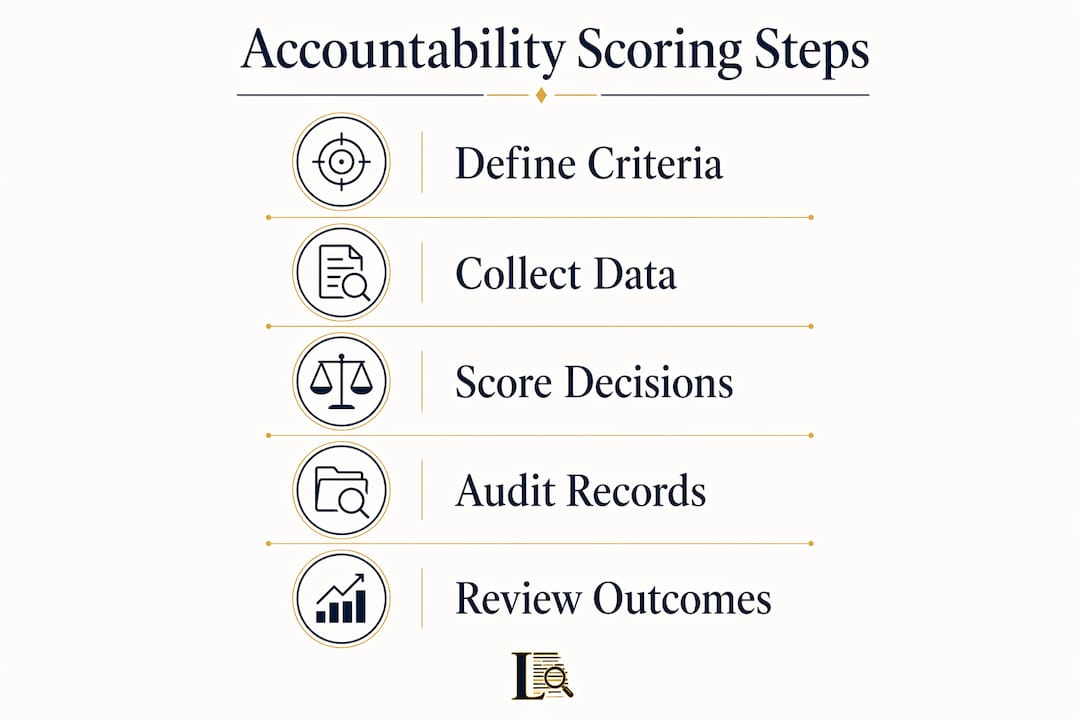
Practical implementation follows a defined sequence:
- Establish documented oversight policies: Write explicit criteria for when a vote requires independent review beyond proxy advisor input.
- Integrate scoring into annual compliance reviews: Treat accountability metrics as a standing agenda item, not a one-time audit exercise.
- Build exception feedback loops: Every escalated case should produce a written outcome that updates the relevant policy section.
- Disclose rationale transparently: For material votes, publish the reasoning in stewardship reports. Transparency in decision making is both a regulatory expectation and a trust signal for beneficiaries.
The table below maps implementation steps to their governance outcomes:
| Implementation step | Governance outcome |
|---|---|
| Documented oversight policies | Defensible audit trail for every material vote |
| Annual compliance integration | Continuous calibration of scoring criteria |
| Exception feedback loops | Prevention of untracked policy drift |
| Transparent rationale disclosure | Regulatory compliance and stakeholder trust |
Reviewing governance red flags in public disclosures alongside your internal scoring records provides an external validation layer. Companies that score poorly on disclosure quality tend to generate the highest volume of exception cases, which is itself a governance signal worth tracking.
Key Takeaways
Accountability scoring governance decision making requires documented policies, auditable decision artifacts, and structured exception management to produce defensible governance records at scale.
| Point | Details |
|---|---|
| Define before you score | Establish written criteria for every vote type before applying any scoring framework. |
| Auditability over accuracy | Full governance integration produces trust scores above 0.813; partial approaches leave audit gaps. |
| AI enables, humans decide | AI handles routine proxy tasks at 99.2% alignment; complex cases require documented human review. |
| Exceptions calibrate policy | The 10% of cases requiring human review prevent untracked precedent from distorting governance outcomes. |
| Transparency is compliance | Disclosing vote rationale in stewardship reports satisfies regulatory expectations and builds stakeholder trust. |
The accountability gap most governance teams ignore
I have spent years reviewing governance frameworks that look complete on paper and collapse the moment an auditor asks for the decision record behind a specific vote. The problem is almost never the scoring model. It is the assumption that a good policy document substitutes for a good process artifact.
The most revealing governance failures I have encountered involve the exception cases. Organizations that route ambiguous votes to a human reviewer but never document the outcome are creating untracked precedent. The next time a similar case appears, the institution has no record of how it was resolved or why. That is not a minor gap. It is a systematic accountability failure that compounds over time.
The shift toward AI-assisted proxy research makes this problem more urgent, not less. When AI handles 90% of routine tasks efficiently, governance teams naturally reduce their attention to the remaining 10%. That is precisely backwards. The 10% that requires human judgment is where fiduciary accountability is actually tested. Institutions that build structured escalation pathways for those cases, and document every outcome, are the ones that will hold up under SEC scrutiny and beneficiary challenge.
The aspiration-to-execution gap that Lacunaindex measures in corporate disclosures applies equally to governance processes themselves. A governance framework that claims full accountability but produces no auditable artifacts is borrowing credibility it has not earned.
— Glen
Lacunaindex: forensic accountability scoring for governance professionals
Governance professionals and institutional investors need more than a scoring rubric. They need a platform that applies consistent, evidence-based methodology to public records and produces reports that hold up under scrutiny.
Lacunaindex delivers forensic accountability reports built entirely from public disclosures, including SEC filings, earnings call transcripts, proxy statements, and press releases. Each report quantifies the gap between corporate narrative and actual delivery, classifying companies as earned, borrowed, or undervalued based on execution evidence. The Lacunaindex user guide explains how to read and apply each scoring dimension to your governance evaluation workflow. For sector-level benchmarking, the sector benchmarks provide performance comparisons across accountability metrics, giving governance teams the external reference point their internal scoring frameworks require.
FAQ
What is accountability scoring in corporate governance?
Accountability scoring is a structured methodology that quantifies how well governance decisions are documented, justified, and traceable to responsible parties. It converts fiduciary obligations into measurable, auditable records using frameworks such as the OECD Judgment Assurance model.
How does accountability scoring improve proxy advisory workflows?
Accountability scoring enforces independent review of proxy advisor recommendations by requiring documented rationales for every material vote. The SEC has stated that fiduciary accountability cannot be delegated mechanically, making this documentation a regulatory requirement.
What metrics define a high-quality governance scoring framework?
Full integration of fairness, explainability, and accountability dimensions produces trust scores near 0.813 and stability above 0.905, according to quantitative governance research. Partial integration on only one or two dimensions leaves measurable gaps in audit defensibility.
How should AI tools be evaluated for governance accountability scoring?
AI governance tools must be audited end-to-end, testing every pipeline stage including retrieval and reasoning against manual expert-reviewed benchmarks. Aggregate accuracy claims are insufficient because they can mask stage-level failures that produce unreliable outputs.
Why do exception cases matter in accountability scoring?
Exception cases represent the roughly 10% of governance decisions that require human review beyond routine AI processing. Documenting the outcome of each exception prevents untracked precedent from drifting into policy and provides the calibration data that keeps scoring frameworks accurate over time.