
Forensic corporate analysis is defined as the systematic examination of public company disclosures, financial statements, and operational records to detect fraud, misrepresentation, and material inconsistencies. The practice draws on forensic accounting in business, ratio analysis, and narrative scrutiny to measure the gap between what companies claim and what they actually deliver. The Private Securities Litigation Reform Act (PSLRA) established a legal standard requiring a "strong inference" of fraudulent intent, and forensic ratio analysis is the primary method practitioners use to meet that threshold. Platforms like Lacunaindex apply this methodology entirely from public records, classifying companies by execution scores and aspiration-to-execution gaps. For institutional investors and corporate professionals, understanding what forensic corporate analysis involves is no longer optional. It is the baseline for credible due diligence.
What forensic analysis techniques are used to evaluate public company filings?
Corporate forensic investigation relies on a structured set of techniques applied to SEC filings, earnings call transcripts, proxy statements, and press releases. Each technique targets a different layer of potential misrepresentation, from numerical manipulation to language-level impression management.
The most foundational method is forensic ratio analysis. Financial ratios leave identifiable fingerprints when financial statements are manipulated, making ratio analysis a highly effective forensic tool. A sudden improvement in accounts receivable turnover while revenue stagnates, for example, signals that revenue recognition may be accelerated artificially. Ratio analysis does not require insider access. It works entirely from public disclosures.
The four core forensic analysis techniques applied to public company filings are:
- Forensic ratio analysis. Examines account relationships across balance sheets, income statements, and cash flow statements to detect manipulation. Ratios like days sales outstanding, gross margin, and asset turnover reveal patterns inconsistent with stated business performance.
- Semantic and narrative analysis. Applies linguistic scoring to Management Discussion and Analysis (MD&A) sections in 10-K reports to identify vague, sentiment-heavy language that correlates with financial distress or impression management.
- XBRL-based automated extraction. Automated forensic extraction uses XBRL mapping across five industry classes to rapidly compare financial metrics and ratios at scale, enabling analysts to flag outliers across entire sectors without manual review.
- Earnings call transcript analysis. Examines word choice, hedging frequency, and topic avoidance in executive communications to identify disclosures that diverge from filed financial data.
Pro Tip: When reviewing a 10-K, cross-reference the MD&A narrative against the cash flow statement. Executives who describe strong operational momentum while free cash flow contracts are exhibiting a classic disclosure opacity pattern.
Lacunaindex applies all four techniques systematically, producing execution scores that quantify the degree to which a company's narrative aligns with its actual financial delivery. The result is an objective, evidence-based classification rather than an analyst's subjective read.
How do linguistic and narrative patterns contribute to forensic corporate analysis?
Narrative disclosures carry as much forensic weight as numerical data. The MD&A section of a 10-K report is the primary venue where executives frame performance, and the language they choose is measurable. Higher numerical content in MD&A sections correlates with better company performance, while sentiment-heavy language and vague disclosures often signal financial distress. That finding comes from a study covering 2003–2022 analyzing language in 10-K reports across thousands of public companies. The implication is direct: companies in trouble write differently than companies performing well.

Impression management theory explains why. Executives facing poor results shift from factual reporting to narrative framing, substituting concrete metrics with optimistic language to soften the disclosure's impact. Over two decades, increased use of vague and sentiment-heavy language in MD&A sections correlates with poorer financial performance. This pattern is consistent enough to function as a forensic signal.
Specific linguistic red flags in public company filings include:
- Declining numerical density. Fewer specific figures per paragraph compared to prior-year filings indicates a retreat from verifiable claims.
- Increased hedging language. Phrases like "we believe," "subject to market conditions," and "as appropriate" cluster in disclosures where management lacks confidence in stated outcomes.
- Topic avoidance. Material risks discussed in prior filings that disappear from subsequent MD&A sections without explanation warrant immediate scrutiny.
- Sentiment inflation. Excessive use of positive adjectives in quarters where operating metrics declined is a textbook impression management signal.
- Passive voice concentration. Shifting from active to passive constructions obscures accountability for specific decisions or outcomes.
Narrative analysis does not replace numerical forensic work. It complements it. When ratio analysis flags an anomaly and linguistic analysis confirms a concurrent shift toward vague language, the combined signal is substantially stronger than either finding alone. Lacunaindex integrates both dimensions into its corporate accountability assessments, producing a disclosure opacity score alongside execution metrics.
What practical applications does forensic corporate analysis have for investors?
Forensic corporate analysis serves four distinct functions for investors and corporate professionals: litigation support, investment risk assessment, governance oversight, and market mispricing detection.
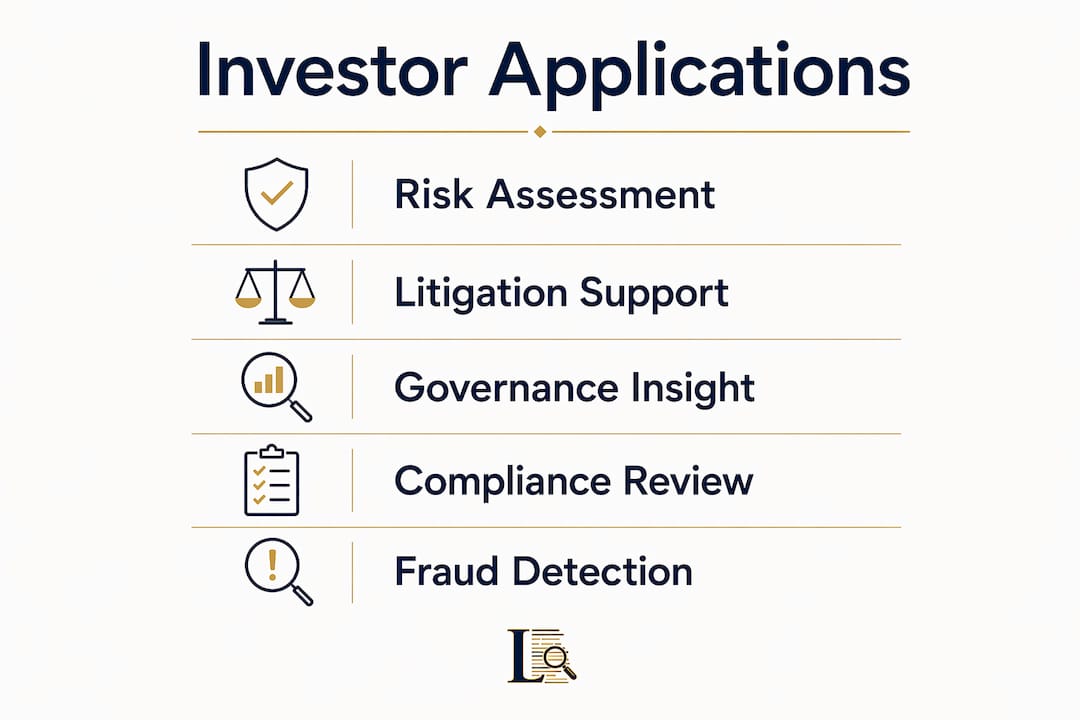
In securities fraud litigation, forensic accountants interpret complex global investigations by combining multidisciplinary expertise to uncover financial misconduct and quantify impact. Under the PSLRA, plaintiffs must demonstrate a strong inference of fraudulent intent before discovery begins. Forensic ratio analysis provides the quantitative evidence needed to clear that bar without requiring access to internal documents.
| Application | Primary Tool | Output |
|---|---|---|
| Securities fraud litigation | Forensic ratio analysis | Strong inference evidence under PSLRA |
| Investment risk assessment | Ratio and narrative analysis | Execution score and aspiration-to-execution gap |
| Governance oversight | Proxy and disclosure analysis | Accountability classification |
| Market mispricing detection | Sector benchmarking | Valuation versus delivery divergence |
For investors, the most direct application is risk assessment before capital allocation. Forensic data analysis goes beyond fraud detection, improving business efficiency by revealing growth opportunities and pinpointing risks through enterprise data mining. A company classified as "borrowed" by Lacunaindex, meaning its valuation exceeds its demonstrated delivery, presents a materially different risk profile than one classified as "earned." That distinction is invisible to analysts relying solely on consensus estimates or management guidance.
Governance professionals use forensic analysis to identify systemic corporate misreporting patterns that erode board accountability over time. Proxy statement analysis, combined with earnings call transcript review, reveals whether executive compensation structures align with actual performance or with narrative performance.
Pro Tip: Apply forensic ratio analysis to at least three consecutive annual filings before drawing conclusions. Single-year anomalies can reflect legitimate accounting changes. Persistent divergence across multiple periods is the signal that matters.
What are the emerging trends shaping forensic corporate analysis in 2026?
The forensic audit process is changing faster in 2026 than at any prior point in its history. The shift is driven by three converging forces: AI-enhanced analytics, automated data extraction at scale, and multidisciplinary team structures that combine legal, financial, and technological expertise.
AI and advanced analytics are transforming forensic processes by enabling faster discovery and more accurate risk assessments in large, complex datasets. The practical effect is that analysis which previously required weeks of manual review now runs in hours. That speed changes the economics of forensic investigation, making it accessible to mid-size institutional investors who previously could not justify the cost.
Key developments defining the 2026 forensic environment include:
- Proactive rather than reactive forensics. Practitioners now apply forensic screening to entire portfolios on a rolling basis, rather than initiating investigation only after a red flag surfaces publicly.
- XBRL-based sector comparison at scale. Automated extraction tools map financial metrics across industry classes simultaneously, enabling peer-group anomaly detection that manual analysis cannot replicate.
- AI-driven fraud pattern identification. Practitioners now use AI not only for discovery but also to transform enterprise risk management and rebuild stakeholder trust through fraud pattern identification.
- Multidisciplinary team integration. Forensic accountants now work alongside data scientists, legal counsel, and cybersecurity specialists in a single investigation workflow, producing findings that hold up in both regulatory and litigation contexts.
- Disclosure opacity scoring. Platforms like Lacunaindex quantify narrative risk as a scored metric, making it comparable across companies and sectors rather than a qualitative judgment.
Forensic data analysis has evolved into a vital tool for improving organizational efficiency, compliance, and revealing previously unknown risks and growth areas. For corporate professionals, this means forensic thinking is no longer confined to fraud investigations. It applies to any context where the gap between corporate narrative and actual delivery affects decision-making.
Key takeaways
Forensic corporate analysis is the most reliable method for measuring the gap between what public companies claim and what their disclosures actually prove, using ratio analysis, narrative scoring, and automated extraction from public filings.
| Point | Details |
|---|---|
| Ratio analysis is foundational | Financial ratios leave identifiable fingerprints when statements are manipulated, making them the primary forensic detection tool. |
| Narrative language is measurable | Vague, sentiment-heavy MD&A language correlates with poor performance and signals impression management. |
| PSLRA sets the legal standard | Forensic ratio analysis is the primary method for establishing strong inference of fraud under the PSLRA. |
| AI accelerates the process | AI-enhanced analytics now enable portfolio-wide forensic screening at a speed and cost previously unavailable to most investors. |
| Execution scores quantify the gap | Platforms like Lacunaindex classify companies by delivery versus narrative, producing objective accountability metrics from public records alone. |
What I've learned from years of reading between the lines
The most consequential forensic clues rarely appear in the headline numbers. Financial statement footnotes and earnings call transcripts hold critical forensic information that typical analysis misses entirely. A footnote disclosing a change in revenue recognition policy, buried on page 47 of a 10-K, can explain an entire quarter's apparent outperformance. Most analysts never read that far.
The other pattern I see consistently is the gap between what executives say on earnings calls and what the cash flow statement records. Optimism in the transcript is not evidence of performance. Free cash flow is. When those two signals diverge across consecutive quarters, the aspiration-to-execution gap is widening, and that gap is exactly what forensic analysis is designed to measure.
The governance dimension is equally underweighted. Proxy statements reveal whether boards are structured to hold management accountable or to protect it. Forensic analysis of corporate misrepresentation governance impact shows that weak board structures and disclosure opacity tend to appear together. That co-occurrence is not coincidental. It reflects a system where accountability has been engineered out of the disclosure process.
The investors who use forensic thinking consistently are not looking for fraud in every filing. They are looking for the degree to which a company's stated narrative is supported by verifiable evidence. That discipline, applied systematically, produces better capital allocation decisions than any amount of management access or consensus estimate review.
— Glen
Lacunaindex: forensic analysis built on public records
Lacunaindex applies the forensic methodology described throughout this article to public company filings, producing scored reports that quantify the aspiration-to-execution gap for each company it covers.
The platform's sector benchmark data enables peer-group comparison across financial metrics and execution scores, giving investors a reference point that goes beyond raw ratios. The Lacuna report reading guide walks users through each scored dimension, explaining how disclosure opacity, narrative sentiment, and ratio anomalies combine into a single accountability classification. For investors and corporate professionals who need objective, evidence-based assessments of public companies, Lacunaindex provides the forensic infrastructure without requiring insider access or proprietary data.
FAQ
What is forensic corporate analysis?
Forensic corporate analysis is the structured examination of public company filings, financial ratios, and narrative disclosures to detect fraud, misrepresentation, and accountability gaps. It relies entirely on publicly available records, including SEC filings, earnings call transcripts, and proxy statements.
How does forensic ratio analysis work in fraud detection?
Forensic ratio analysis examines account relationships across financial statements to identify patterns inconsistent with stated performance. Manipulated financial statements leave identifiable fingerprints in ratios like days sales outstanding and gross margin, which analysts use to establish fraudulent intent under the PSLRA.
What role does MD&A language play in forensic analysis?
The MD&A section of a 10-K report is a primary forensic signal. Research covering 2003–2022 shows that higher numerical content correlates with better performance, while vague, sentiment-heavy language correlates with financial distress and impression management.
How is AI changing the forensic audit process?
AI-enhanced analytics now enable faster discovery and more accurate risk assessments across large datasets, transforming forensic work from a reactive investigation into a proactive, portfolio-wide screening process.
What does Lacunaindex measure in its forensic reports?
Lacunaindex measures the gap between a company's narrative claims and its actual delivery, using execution scores and disclosure opacity metrics derived entirely from public records. Companies are classified as earned, borrowed, or undervalued based on that analysis.