
Forensic research in governance is defined as the systematic application of investigative science and data analysis to corporate oversight, audit, and accountability evaluation. The governance advocate forensic research advantages are concrete: higher detection accuracy, faster fraud identification, and stronger evidentiary standards that hold up under regulatory scrutiny. Platforms like Lacunaindex apply this methodology to public records, including SEC filings, earnings calls, and proxy statements, to measure the gap between corporate narrative and actual delivery. The Sarbanes-Oxley Act (SOX) and International Standards on Auditing (ISA) provide the regulatory backbone that forensic research methods now extend and reinforce.
1. Governance advocate forensic research advantages in detection accuracy
Forensic methodology increases finding accuracy by 40% over traditional methods, based on case data from 2015–2025. That gain is not marginal. It represents the difference between an audit committee acting on solid evidence and one acting on incomplete inference.
The methods driving this improvement include data anomaly detection, blockchain transaction tracing, and pattern analysis across financial disclosures. Each technique cross-references multiple data channels simultaneously, reducing the chance that a single manipulated figure escapes scrutiny. Governance professionals who rely solely on traditional audit sampling miss the correlations that forensic analysis surfaces.
- Data anomaly detection flags statistical outliers in revenue recognition, expense timing, and intercompany transfers.
- Blockchain tracing reconstructs transaction chains that standard ledger reviews cannot follow.
- Disclosure pattern analysis identifies language shifts across earnings calls and press releases that signal narrative engineering.
Pro Tip: Apply anomaly detection to at least three consecutive reporting periods before drawing conclusions. Single-period anomalies may reflect legitimate business events; multi-period patterns indicate systemic issues.
2. Integrating digital forensics with audit standards

Integrated digital forensic methods aligned with ISA 240 fraud standards produce a 70% reduction in time to first fraud indication. That speed advantage matters for audit committees operating under tight reporting cycles and regulatory deadlines.
The integration works by mapping forensic outputs directly onto ISA 240 risk categories: management override, revenue manipulation, and asset misappropriation. When forensic tools flag a transaction cluster, auditors can immediately classify it within an established risk framework rather than starting a separate investigation. This alignment shortens the gap between detection and response.
| Integration element | Traditional audit approach | Forensic-integrated approach |
|---|---|---|
| Fraud signal identification | Manual sampling, periodic | Continuous, automated anomaly detection |
| Evidence documentation | Narrative workpapers | Structured, legally defensible audit trails |
| Time to first indication | Weeks to months | Days, with 70% reduction documented |
| Regulatory alignment | ISA 240 applied retrospectively | ISA 240 embedded in real-time monitoring |
The barriers to this integration are real. Only 12% of senior auditors hold technical proficiency in Python or R, the languages most commonly used in forensic data analysis. That skill gap limits how deeply audit teams can engage with forensic outputs without external support.
Pro Tip: Build a role matrix that defines exactly which forensic outputs auditors interpret versus which outputs require a digital forensics specialist. Ambiguity about responsibility is the most common reason integrated workflows stall.
3. Proactive governance through continuous forensic monitoring
Forensic research is shifting from a post-fraud reactive tool to a proactive governance mechanism for real-time risk mitigation. This shift redefines the governance advocate's role from incident responder to continuous risk monitor.
Machine learning drives this transformation. ML-enabled fraud surveillance makes detection predictive and continuous rather than episodic. Boards and audit committees that adopt continuous assurance frameworks replace lagging indicators, such as annual audit findings, with real-time signals that allow intervention before material harm occurs.
The practical implications for governance professionals include:
- Continuous transaction monitoring replaces periodic sampling, covering 100% of transactions rather than a statistical subset.
- Predictive risk scoring ranks entities or accounts by fraud probability, directing investigator attention to the highest-risk areas first.
- Automated alert workflows route anomalies to the appropriate governance body within hours rather than weeks.
- Evidentiary audit trails document every detection event in a format compatible with regulatory and legal proceedings.
Legally defensible forensic evidence is the output that makes continuous monitoring valuable beyond internal governance. Boards need evidence that withstands SEC review, shareholder litigation, and enforcement action. Forensic methods produce that standard of documentation by design.
4. Addressing the skill gap and cost barriers
The forensic governance divide has two primary dimensions: skills and cost. Only 12% of senior auditors possess the technical skills required for forensic data analysis. That figure means most audit teams cannot independently operate the tools that generate the accuracy and speed gains described above.
Cost compounds the problem. Premium forensic analytics licenses for blockchain-enabled platforms often exceed $80,000 annually. Mid-tier organizations face a genuine budget constraint that limits access to the most capable tools.
Practical mitigations exist for both barriers:
- Cross-training programs pair auditors with data scientists for structured knowledge transfer, building internal forensic capacity over 12–18 months.
- Phased tool adoption starts with open-source forensic libraries before committing to enterprise platform licenses.
- Shared service models allow multiple governance teams within a conglomerate to split platform costs across business units.
- Leadership sponsorship is non-negotiable. Without board-level commitment, forensic integration stalls at the pilot stage.
Bridging the forensic divide through aligned methodologies and training is the prerequisite for sustainable forensic governance. Organizations that treat forensic capability as a one-time project rather than an ongoing competency consistently underperform on detection quality.
Pro Tip: Budget for forensic training as a line item separate from tool procurement. The skill gap costs more in missed detections than the training investment costs in time and money.
5. High false-positive rates and the role of expert judgment
AI-powered forensic tools generate high false-positive rates that require expert judgment to resolve. This is the most underappreciated operational challenge in forensic governance integration.
A false positive in a fraud detection context is not a minor inconvenience. It consumes investigator time, creates reputational risk for the flagged entity, and erodes confidence in the forensic process among board members and audit committees. Governance professionals who deploy forensic tools without a triage protocol quickly find their teams buried in alerts that do not lead to findings.
The solution is a structured collaboration model between digital forensic analysts and auditors. Analysts assess technical signal quality; auditors apply materiality judgment and regulatory context. Neither role alone produces reliable governance output. Collaboration between forensic experts and auditors improves detection quality and shortens audit cycles when the division of responsibility is explicit and documented.
6. Forensic research benefits for investment analysis and stakeholder trust
Forensic research uncovers hidden corporate irregularities that standard financial analysis misses, directly affecting valuation accuracy and investment risk assessment. The aspiration-to-execution gap, the distance between what management claims and what public records confirm, is the core metric that forensic analysis quantifies for investors.
Governance professionals who apply forensic methods to corporate accountability analysis produce accountability scores that institutional investors can use in portfolio construction and proxy voting decisions. That output converts forensic findings into a format that capital allocation decisions require.
Forensic research gives governance advocates the evidentiary foundation to move beyond narrative assessment. When a company's disclosure pattern diverges from its financial record, forensic analysis quantifies that divergence and assigns it a risk weight that traditional analysis cannot produce.
Transparency improvements from forensic governance also affect market integrity at a systemic level. When corporate transparency becomes measurable rather than assumed, investors price risk more accurately and capital flows toward companies with demonstrated delivery records rather than engineered narratives. Lacunaindex operationalizes this principle by classifying public companies as earned, borrowed, or undervalued based on the relationship between their execution scores and market valuations.
Key takeaways
Forensic research gives governance advocates a measurable, evidence-based method to detect corporate misrepresentation, improve audit accuracy, and support investment decisions grounded in actual delivery rather than disclosed narrative.
| Point | Details |
|---|---|
| Detection accuracy gain | Forensic methods increase finding accuracy by 40% over traditional audit approaches. |
| Speed of fraud identification | Integrated forensic-audit frameworks cut time to first fraud indication by 70%. |
| Skill gap is the primary barrier | Only 12% of senior auditors have the technical skills needed for forensic data analysis. |
| Cost limits mid-tier access | Enterprise forensic platforms exceed $80,000 annually, requiring phased or shared adoption strategies. |
| Continuous monitoring replaces episodic review | Machine learning enables real-time fraud surveillance, shifting governance from reactive to proactive. |
The case for treating forensic research as a governance core competency
I have watched governance teams treat forensic research as a specialist function called in after something goes wrong. That framing is the single most expensive mistake in modern corporate oversight.
The evidence is unambiguous. A 40% accuracy improvement and a 70% speed gain are not incremental refinements. They are structural advantages that change what governance professionals can claim to know about a company's actual performance. When I look at how Lacunaindex applies forensic methodology to public records, the output is not a supplementary report. It is a primary accountability signal that traditional audit simply cannot generate.
The skill gap is real, but it is a solvable problem. The organizations that close it fastest are the ones that treat forensic data literacy as a governance competency, not an IT capability. That distinction matters because it determines who owns the training budget and who sits in the room when forensic findings reach the board.
The future of governance advocacy runs through forensic analytics. Boards that build this capability now will have the evidentiary foundation to act decisively when disclosure engineering appears. Those that wait will continue reacting to problems that forensic monitoring would have surfaced months earlier.
— Glen
Lacunaindex forensic analytics for governance professionals
Governance professionals who want to apply forensic research to public company oversight without building an internal analytics team have a direct path forward.
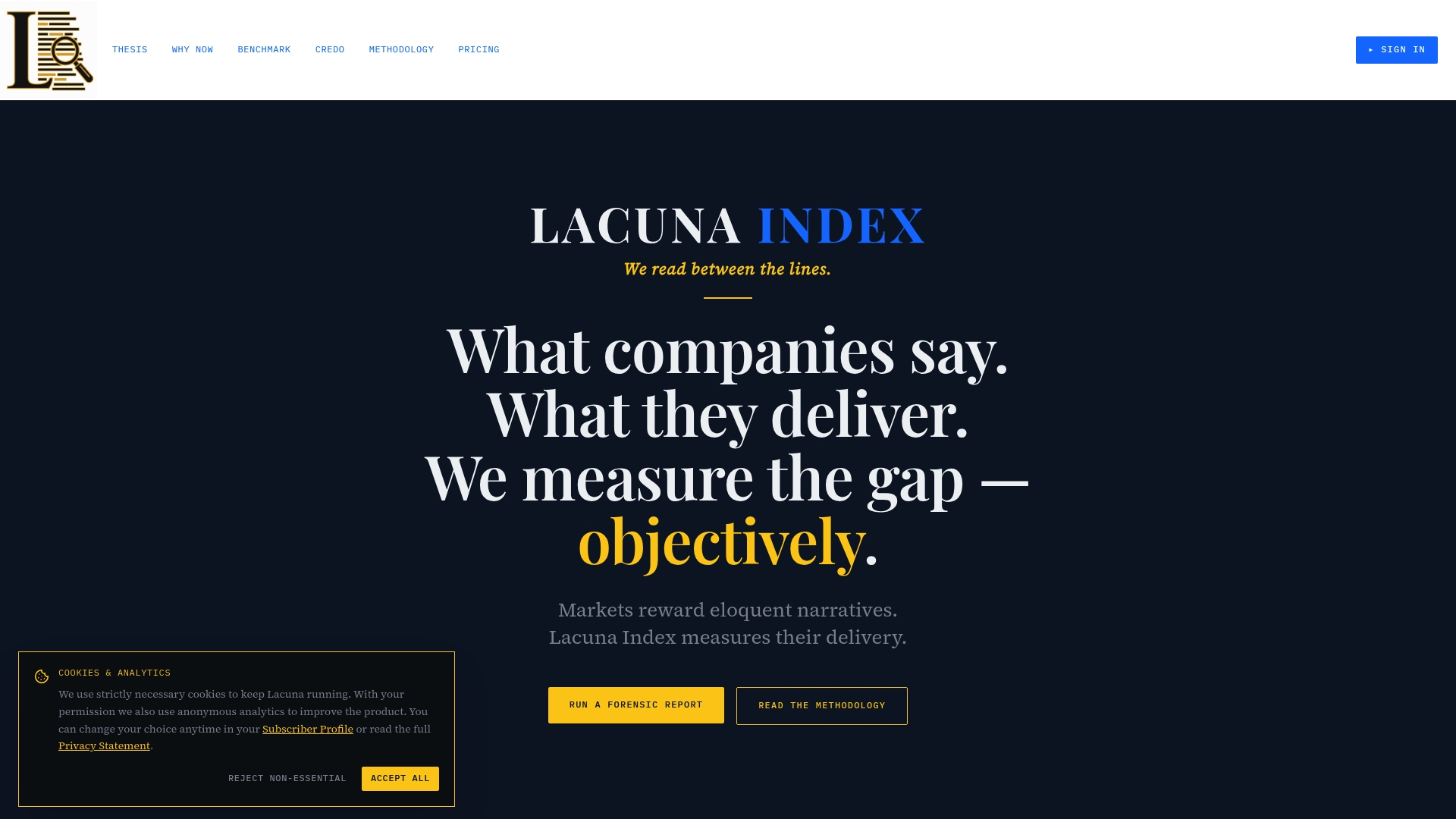
Lacunaindex mines SEC filings, earnings calls, proxy statements, and press releases to measure the gap between corporate narrative and actual delivery. The platform's sector benchmarks provide peer-referenced execution scores that give audit committees and institutional investors a forensic baseline for every major public company sector. Each report classifies companies by archetype, earned, borrowed, or undervalued, based on the relationship between disclosed claims and verified outcomes. For governance advocates who need forensic-grade accountability analysis without insider access, Lacunaindex delivers that output from public records alone.
FAQ
What are the main governance advocate forensic research advantages?
Forensic research increases governance finding accuracy by 40% over traditional methods and reduces time to first fraud indication by 70% when integrated with audit standards. These gains come from data anomaly detection, blockchain tracing, and continuous machine learning surveillance.
How does forensic research aid governance in investment analysis?
Forensic research quantifies the gap between management claims and public record outcomes, producing accountability scores that institutional investors use in valuation and proxy voting decisions. Platforms like Lacunaindex apply this methodology exclusively to publicly available disclosures.
What is the biggest barrier to forensic research adoption in governance?
The skill gap is the primary barrier. Only 12% of senior auditors have technical proficiency in the data analysis languages required for forensic work, and enterprise platform costs frequently exceed $80,000 annually.
How does forensic research support proactive governance?
Machine learning integration enables continuous transaction monitoring and predictive risk scoring, replacing periodic audit sampling with real-time alerts. This shifts governance from reactive incident response to ongoing risk oversight.
What role does ISA 240 play in forensic audit integration?
ISA 240 defines the fraud risk categories that forensic outputs map onto, including management override and revenue manipulation. Aligning forensic detection with ISA 240 gives audit committees a structured framework for classifying and acting on forensic findings.