
A high-risk narrative company is defined as any publicly traded entity where the gap between communicated corporate claims and verifiable operational reality is wide enough to create material mispricing risk. Financial analysts and institutional investors who rely solely on traditional financial metrics miss a structurally significant category of exposure. To identify high-risk narrative companies, oversight must extend beyond balance sheets into the forensic examination of earnings call language, SEC filings, press releases, and proxy statements. Tools like Pulsar Platform, RiskNarrative®, and automated due diligence scoring platforms now make this analysis systematic and scalable. Narrative risk tiers and real-time signals give analysts the early warning infrastructure that fundamental analysis alone cannot provide.
How do narrative risks shape company risk profiles?
Narrative risk is defined as the structural divergence between what a company communicates publicly and what its operations actually deliver. This is not a PR problem. Narrative risk is a structural force that, when unmanaged, inverts the burden of proof and forces companies to defend public perception rather than verifiable facts. The consequence for investors is direct: capital is allocated based on a fiction, and the correction is rarely gradual.
The most common narrative risk categories include product safety misrepresentation, leadership conduct divergence, cultural misalignment between stated values and employee experience, and forward guidance that systematically exceeds delivery. Each category carries a different velocity of market impact. Product safety claims unravel quickly under regulatory scrutiny. Leadership conduct risks tend to compound over time before a single event triggers repricing.
"The market punishes companies not for bad intentions, but when operational reality diverges significantly from communicated narrative, especially under high public attention."
Narrative misalignment at corporate inflection points, such as product launches, leadership transitions, or regulatory reviews, creates the highest concentration of existential market risk. The aspiration-to-execution gap widens precisely when investor attention is highest. That combination is the defining condition of a high-risk narrative company.
Key dimensions of narrative risk that analysts should track include:
- Volume anomalies: Sudden spikes in media mentions without corresponding operational events
- Velocity signals: Rate of narrative spread across atypical audience clusters
- Authority divergence: Credible journalists and regulators amplifying claims that contradict official disclosures
- Internal misalignment: Employee communications and Glassdoor-type signals contradicting external messaging
- Disclosure opacity: Vague or shifting language in SEC filings relative to prior periods
Which tools enable effective high-risk company assessment?
Automated due diligence platforms now aggregate risk signals from 18+ data sources and generate a 0–100 risk score in under 60 seconds. Those sources include SEC filings, sanctions databases, OSHA violation records, and active litigation. That speed matters because narrative risk does not wait for quarterly review cycles.
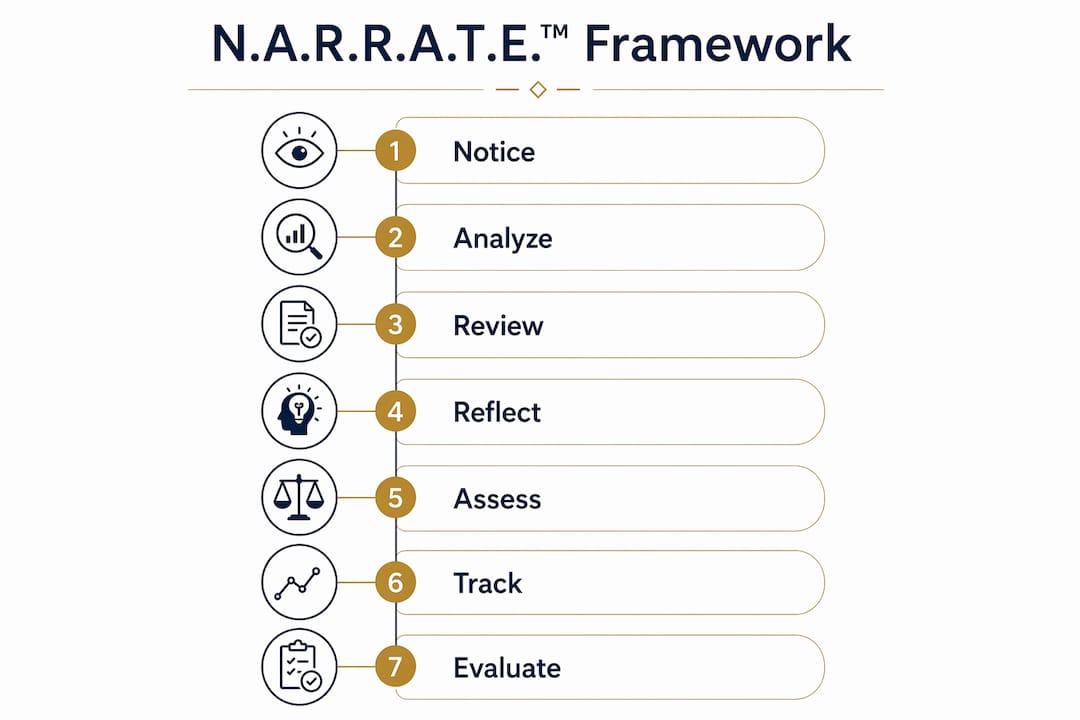
The N.A.R.R.A.T.E.™ framework, developed within narrative risk monitoring practice, provides a structured lens for evaluating corporate communications across seven dimensions: narrative coherence, authority of sources, reach across audience clusters, recurrence of themes, amplification velocity, tone shift detection, and evidence alignment. Each dimension produces a sub-score that feeds into an aggregate narrative risk rating.
The table below maps observable signals to their analytical significance:
| Signal Type | Observable Indicator | Risk Implication |
|---|---|---|
| Velocity anomaly | Narrative spreading faster than volume justifies | Coordinated amplification, possible crisis precursor |
| Audience cluster shift | Narrative moving from niche to mainstream communities | Mainstream media pickup likely within 72 hours |
| Journalist inquiry signal | Beat reporters filing information requests | Investigative story in preparation |
| Disclosure language drift | Hedging terms increasing in SEC filings | Management uncertainty or legal exposure |
| Internal signal divergence | Employee sentiment declining while external narrative is positive | Cultural misalignment, execution risk |
Best-in-class narrative risk monitoring uses a monthly 45-minute review that scores narratives on volume, velocity, and authority, with four response tiers: monitor, prepare, engage, and escalate. Critical-tier risks are those assessed as likely to reach mainstream media within 72 hours. That threshold is the operative decision point for institutional investors who need to act before repricing occurs.
Velocity anomalies and coordinated behavior signals precede mainstream media pickup by up to 72 hours. Volume jumps alone are less significant than velocity and coordinated behavior. An analyst who tracks only volume is measuring the aftermath, not the leading indicator.
Pro Tip: Set up a dedicated narrative risk dashboard that separates velocity metrics from volume metrics. A story spreading at 300% of its baseline velocity across journalist networks is a critical signal even if total mention count remains low.
How to build a proportional narrative oversight framework
Risk-based due diligence is the principle that investigation depth must match relationship risk, avoiding both wasteful over-scrutiny and insufficient analysis. Regulatory frameworks including FATF guidelines and SEC guidance require proportionate due diligence efforts. A one-size-fits-all approach is not a conservative strategy. It is a systemic oversight failure.
The following steps outline a proportional narrative oversight framework for institutional investors:
- Establish a baseline narrative score. Use automated platforms to generate an initial 0–100 risk score drawing on SEC filings, litigation records, and sanctions data. This score defines the starting tier.
- Map the score to an investigative tier. Low-risk scores (0–30) require standard monitoring. Medium-risk scores (31–60) require monthly narrative review and cross-functional team briefing. High-risk scores (61–100) require weekly review, legal-comms alignment, and escalation protocols.
- Document governance approvals. Every tier assignment and any change to that assignment must carry a governance sign-off. This creates an audit trail that satisfies regulatory expectations and internal risk committee standards.
- Validate scores periodically. Narrative risk scores are not static. Monthly narrative risk dashboards enable proactive shifts in response tiers and support timely executive decision-making. Engagement at the escalate tier requires cross-functional teams including the communications director and risk leads.
- Calibrate against sector benchmarks. A narrative risk score of 55 in the pharmaceutical sector carries different weight than the same score in consumer staples. Sector-specific benchmarks provide the reference point for accurate tier assignment.
The comparison below illustrates how oversight depth should scale with risk tier:
| Risk Tier | Score Range | Review Frequency | Team Involvement |
|---|---|---|---|
| Monitor | 0–30 | Quarterly | Analyst only |
| Prepare | 31–50 | Monthly | Analyst and risk lead |
| Engage | 51–70 | Bi-weekly | Cross-functional team |
| Escalate | 71–100 | Weekly | Executive, legal, comms |
What are the most common pitfalls in narrative risk evaluation?
Reactive monitoring is the most pervasive failure mode in narrative risk evaluation. Analysts who wait for a story to break in mainstream media are measuring the outcome of a risk event, not the risk itself. The greatest narrative risk occurs at the intersection of high public attention and a large gap between corporate claims and actual reality. By the time that intersection is visible in headlines, the repricing has already begun.
The second most common error is mistaking volume for velocity. A company receiving 10,000 mentions per day is not necessarily in a narrative risk event. A company whose mention velocity has increased 400% over 48 hours across journalist and regulatory communities is. The distinction requires purpose-built monitoring infrastructure, not a standard media clipping service.
Internal narrative misalignment is frequently underweighted in high-risk company assessment. Narrative defense requires governance alignment, stress exercises, and integration of legal prudence with communication disciplines. When internal communications contradict external disclosures, the gap is eventually surfaced by investigative journalists, whistleblowers, or regulatory inquiries. Analysts should treat persistent internal misalignment signals as a leading indicator of disclosure risk.
- Avoid: Treating narrative risk as a communications function rather than a governance function
- Avoid: Relying on a single data source for narrative scoring
- Avoid: Failing to document tier changes and the rationale behind escalation decisions
- Correct approach: Run crisis simulation exercises quarterly to test whether the company's narrative defense holds under adversarial questioning
Pro Tip: When evaluating a company's narrative defense capability, request or review any publicly available crisis communication records. Companies that have navigated a prior narrative risk event with documented governance protocols carry materially lower forward risk than those with no visible framework.
Key takeaways
Identifying high-risk narrative companies requires combining velocity-based signal detection, proportional due diligence tiers, and forensic examination of the aspiration-to-execution gap across public disclosures.
| Point | Details |
|---|---|
| Narrative risk is structural | It is a governance and legal risk category, not a PR issue, requiring anticipatory oversight. |
| Velocity beats volume | Narrative spreading at anomalous velocity across journalist networks is the primary early warning signal. |
| Proportionality is required | Risk-based due diligence must match investigation depth to risk tier under FATF and SEC frameworks. |
| Internal signals matter | Employee sentiment diverging from external narrative is a leading indicator of disclosure and execution risk. |
| Sector benchmarks calibrate scores | A narrative risk score only carries analytical weight when measured against sector-specific reference points. |
Why narrative risk is the structural blind spot institutional investors cannot afford
Glen here. After years of working through forensic financial analysis, the pattern that consistently surprises institutional investors is not the fraud they missed. It is the narrative misalignment they dismissed as a communications issue.
Narrative risk is not soft risk. When a company's forward guidance language shifts from specific commitments to aspirational framing across three consecutive earnings calls, that is a quantifiable signal. The aspiration-to-execution gap is measurable. The disclosure opacity index is measurable. What has been missing is the systematic infrastructure to measure it consistently across a portfolio.
The most successful investors identify misalignment between corporate narratives and operational reality as the primary risk at corporate inflection points. That observation is not a soft thesis. It is a repeatable pattern with a predictable market consequence. The companies that reprice most violently are almost always those where the narrative surface area was largest and the governance of that narrative was weakest.
My view is that blending quantitative risk scoring with qualitative oversight is not optional for institutional investors in 2026. The tools now exist to do both systematically. The analysts who treat narrative integrity as a first-class risk variable will identify the mispricing before the market does. Those who treat it as a secondary filter will read about it in the post-mortem.
The Lacunaindex methodology operationalizes exactly this approach, measuring the gap between what companies claim and what public records confirm. That gap is where the alpha lives.
— Glen
How Lacunaindex supports narrative risk oversight for analysts
Lacunaindex applies forensic analytics to the exact problem this article addresses: the gap between corporate narrative and verifiable delivery. The platform mines SEC filings, earnings call transcripts, press releases, and proxy statements to generate execution scores and aspiration-to-execution gap measurements for public companies.
Analysts can use the Lacunaindex user guide to understand how to read a forensic narrative report, interpret execution scores, and map findings to investment or governance decisions. The platform's sector benchmarks for financials provide the reference data needed to calibrate narrative risk scores against peer companies. No insider access is required. Every finding is grounded in publicly available records, making the output portable and defensible within existing investment workflows. Visit Lacunaindex to explore forensic reports and sector benchmarks built for institutional-grade narrative oversight.
FAQ
What is a high-risk narrative company?
A high-risk narrative company is one where the gap between public corporate claims and verifiable operational delivery is large enough to create material mispricing risk. The risk is highest at corporate inflection points where public attention and narrative divergence coincide.
How do you identify narrative risk before it hits the market?
Velocity anomalies, coordinated behavior in atypical audience clusters, and journalist inquiry signals precede mainstream media pickup by up to 72 hours. Monitoring these signals requires purpose-built narrative risk infrastructure, not standard media volume tracking.

What is risk-based due diligence in narrative oversight?
Risk-based due diligence is the practice of matching investigation depth to the assessed risk tier of a company. Under FATF and SEC frameworks, proportionality is required, meaning high-risk companies receive more frequent and cross-functional review than low-risk ones.
How often should narrative risk scores be reviewed?
Monthly narrative risk dashboards represent best practice for proactive oversight. Companies in the escalate tier (scores 71–100) require weekly review with cross-functional team involvement including legal and communications leads.
What is the difference between narrative volume and narrative velocity?
Volume measures the total count of mentions at a point in time. Velocity measures the rate of change in narrative spread across audience clusters. Velocity is the leading indicator of a developing risk event; volume is a lagging confirmation.