
Annual report credibility is defined as the degree to which a corporate disclosure demonstrates accountability, transparency, understandability, and accessibility across both financial and non-financial content. These four criteria, formalized by the Jersey Audit Office in its annually updated best-practice checklist, form the recognized industry standard for annual report credibility assessment. Governance quality is the primary driver of whether a report meets or fails these criteria. For investors, analysts, and governance professionals, annual report credibility governance analysis is not a supplementary review step. It is the core diagnostic for separating substantiated corporate performance from engineered narrative.
What criteria define annual report credibility governance analysis?
Credible annual reports are evaluated against four structured elements: accountability, transparency, understandability, and accessibility. The Jersey Audit Office scores reports at minimum, enhanced, and best-practice tiers across each element, tracking improvement trends across reporting years. This tiered approach makes it possible to distinguish a report that technically complies from one that genuinely informs.
The OECD Principles of Corporate Governance extend this framework by treating governance as a holistic system rather than a checklist. Board accountability, audit independence, and integrated financial and non-financial reporting are treated as interdependent. A report that scores well on disclosure volume but lacks documented board oversight fails the OECD standard at the structural level.
The table below compares how three major frameworks approach annual report credibility assessment criteria:
| Framework | Core Criteria | Scoring Method | Governance Emphasis |
|---|---|---|---|
| Jersey Audit Office | Accountability, transparency, understandability, accessibility | Tiered: minimum, enhanced, best practice | Report structure and stakeholder access |
| OECD Principles of Corporate Governance | Board accountability, audit independence, disclosure integration | Qualitative systems assessment | Structural governance integrity |
| ISSA 5000 / CSRD Practitioner Guide | Materiality governance, version control, sign-off documentation | Evidence chain verification | Decision-making documentation |
Each framework addresses a different layer of the credibility problem. The Jersey Audit Office targets output quality. The OECD targets governance architecture. ISSA 5000 targets the documentation chain behind non-financial claims. A complete corporate governance assessment uses all three in combination.
How does corporate governance drive annual report credibility?
Governance mechanisms translate board intent into disclosure quality. The most direct mechanism is the audit committee. Audit committee expertise positively correlates with higher ESG disclosure quality, according to 2026 panel data from Saudi-listed firms published in the Journal of Risk and Financial Management. That finding confirms audit committee competence as a strategic resource, not merely a compliance requirement.

Stantec's 2025 Annual Report SEC filing illustrates this in practice. The audit committee review process documents meeting cadence, explicit review of the MD&A, audited financial statements, and board approval as sequential governance checkpoints. Each step creates a verifiable evidence chain. Analysts who locate this chain in a filing can assess whether oversight was substantive or procedural.
The governance mechanisms that most reliably signal credibility include:
- Audit committee meeting frequency and documented agenda items covering both financial and non-financial disclosures
- Board approval statements attached to the final report, confirming executive accountability for content accuracy
- Explicit review of MD&A sections by the audit committee, not just the financial statements
- Integration of ESG and financial disclosures under a unified governance sign-off process
- Auditor independence disclosures specifying the scope of external assurance and any limitations
The OECD's systems approach reinforces this list. Governance structural gaps, such as an audit committee that reviews financials but not sustainability disclosures, create credibility asymmetries that surface as inconsistencies between the front and back halves of a report.
Pro Tip: When evaluating governance integrity, locate the audit committee charter and cross-reference it against the disclosures the committee claims to have reviewed. A charter that authorizes ESG oversight but a report that contains no evidence of that review is a material governance gap.
What red flags signal credibility risk in annual reports?
Forensic annual report credibility assessment criteria require distinguishing confirmed disclosure failures from data gaps. A missing related-party transaction section may indicate deliberate omission or a filing error. Treating both identically produces false risk signals. The forensic approach advises classifying each anomaly as either a confirmed issue or an access problem before drawing conclusions.
The front half of most annual reports contains marketing content: chairman letters, strategic narratives, and vision statements. The back half contains audited financials, governance disclosures, and committee reports. Credibility analysis focuses on the back half. When the front half makes claims that the back half cannot substantiate, the aspiration-to-execution gap is measurable and significant.
Common red flags in annual report credibility risk assessment include:
- Absence of related-party transaction disclosures in a company with known affiliate relationships
- No audit committee report or a report that lists no specific items reviewed
- Board approval language missing from the financial statements or the report as a whole
- ESG disclosures without assurance scope statements, leaving verification basis undefined
- Materiality assessment described in narrative only, with no reference to documented process or sign-off
- Inconsistencies between the CEO letter and audited financial results, particularly on revenue growth or margin claims
Pro Tip: Run a word-frequency check on governance terms across the full filing. A report that uses "oversight" and "review" frequently in narrative sections but contains no committee meeting minutes or charter references is substituting language for substance.
How does stakeholder trust shape ESG report credibility?
Stakeholder trust is not a soft variable in credibility analysis. A 2026 peer-reviewed survey of 217 ESG report users found that trust mediates expectation gaps and directly influences stakeholder reliance on ESG disclosures. That finding reframes the credibility problem: technical disclosure completeness is necessary but not sufficient.
The study identifies three expectation gap types: reasonable gaps, deficient standard gaps, and deficient performance gaps. Deficient performance gaps, where a company fails to deliver on commitments it had the capacity to meet, erode trust most severely. They also have the largest negative effect on perceived report credibility. This is the mechanism Lacunaindex measures through its execution score methodology.
"Rebuilding trust is more impactful to credibility perception than solely closing technical reporting gaps." — Springer Nature ESG Trust Study, 2026
The implication for analysts is direct. A company that consistently closes deficient performance gaps, even partially, rebuilds stakeholder reliance faster than one that adds disclosure volume without improving delivery. Governance performance evaluation must therefore track execution against prior commitments, not just current disclosure completeness. Reviewing ESG disclosure analysis techniques alongside governance documentation provides a more complete picture of where trust gaps originate.
What steps help analysts assess annual report credibility?
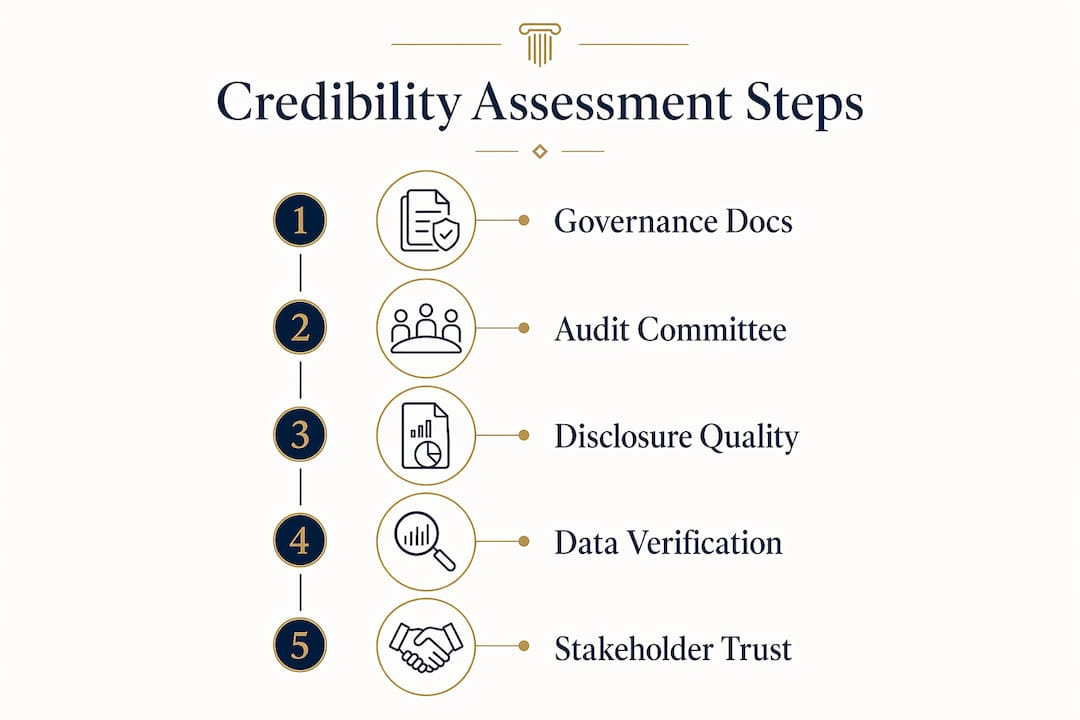
A structured evaluation process reduces the risk of missing governance failures that are obscured by polished narrative. The following steps apply the frameworks discussed above in a practical sequence:
- Locate the governance documentation chain. Identify the audit committee charter, meeting minutes, and any explicit references to items reviewed. Confirm that the charter scope matches the disclosures the committee claims to have reviewed.
- Apply the Jersey Audit Office tiered checklist. Score the report against minimum, enhanced, and best-practice criteria across accountability, transparency, understandability, and accessibility. Note which tier the report reaches on each dimension.
- Cross-check financial and ESG disclosure coherence. Identify claims in the sustainability section that are not supported by audited financial data or independently assured metrics.
- Classify anomalies as confirmed issues or data gaps. Do not treat a missing section as confirmed misconduct without first verifying whether the information exists elsewhere in the filing or in supplementary disclosures.
- Verify materiality assessment governance. Confirm that the materiality process includes documented decision-making with version-controlled files, stakeholder consultation records, and committee sign-off. Absence of this chain is a credibility deficit regardless of the topics selected as material.
- Benchmark against sector peers. A governance disclosure that appears adequate in isolation may be below sector norms. Sector benchmarks provide the reference point for relative credibility assessment.
The comparison below maps two leading analyst frameworks against the evaluation steps above:
| Evaluation Step | Jersey Audit Office Checklist | OECD Governance Principles |
|---|---|---|
| Governance documentation chain | Partially addressed via accountability scoring | Directly addressed via board accountability criteria |
| Financial and ESG coherence | Addressed via transparency scoring | Addressed via integrated disclosure requirements |
| Materiality assessment governance | Not explicitly covered | Addressed via disclosure and transparency principles |
| Sector benchmarking | Covered through multi-year trend analysis | Not explicitly covered |
Using both frameworks in parallel closes the coverage gaps each leaves individually. The OECD principles diagnose structural governance deficiencies. The Jersey Audit Office checklist measures output quality. Together, they support a complete financial report integrity review.
Key takeaways
Annual report credibility is determined by governance structure and disclosure documentation quality, not by narrative volume or report design.
| Point | Details |
|---|---|
| Four core credibility criteria | Accountability, transparency, understandability, and accessibility form the recognized evaluation standard per the Jersey Audit Office. |
| Audit committee expertise matters | Panel data from 2026 confirms audit committee competence directly improves ESG disclosure quality and overall report credibility. |
| Trust mediates credibility perception | Deficient performance gaps erode stakeholder trust more than technical omissions, per 2026 Springer Nature research on ESG assurance. |
| Red flags require classification | Distinguish confirmed disclosure failures from data gaps before drawing governance conclusions to avoid false risk signals. |
| Documentation chain is the evidence base | Governance credibility rests on charters, meeting minutes, explicit review records, and board approval, not on narrative claims alone. |
The part of annual reports most analysts skip
Most credibility reviews I observe concentrate on the audited financials and stop there. The governance disclosures in the back half of a report, specifically the audit committee report, the board approval statement, and the materiality assessment process, receive far less analytical attention than they deserve. That is where the real signal lives.
The growing complexity of ESG requirements has made this gap more consequential. Companies now produce sustainability disclosures under CSRD, TCFD, and GRI simultaneously. Each framework has its own governance documentation requirements. A report that references all three but provides no evidence of how the board reconciled their differing materiality definitions is not transparent. It is performing transparency.
What I find most telling is the disconnect between documentation quality and narrative polish. A report with a beautifully designed front half and a sparse audit committee report is almost always a credibility concern. The inverse, a plain report with detailed committee meeting records and explicit sign-off language, is almost always more reliable. Governance disclosures do not need to be elegant. They need to be specific, traceable, and complete.
The deeper integration of financial and non-financial governance assessment is not optional for analysts working in 2026. ESG claims now move valuations. A deficient performance gap in a sustainability commitment carries the same analytical weight as a missed earnings target. Treating them differently is a methodology error.
— Glen
How Lacunaindex supports governance and credibility analysis
Lacunaindex applies a forensic, evidence-based methodology to measure the gap between what companies claim and what their public records confirm. For investors and governance professionals working through annual report credibility governance analysis, the platform provides execution scores, sector benchmarks, and disclosure integrity assessments built entirely from public filings.
The Lacunaindex user guide walks analysts through how to interpret governance factors within a Lacuna report, including how execution scores are calculated and what disclosure patterns trigger credibility flags. For sector-level context, the financials sector benchmarks provide peer comparison data to calibrate whether a company's governance disclosures meet, exceed, or fall below industry norms. Explore the full methodology walkthrough to understand how Lacunaindex converts public records into structured credibility assessments.
FAQ
What are the four core annual report credibility criteria?
The four core criteria are accountability, transparency, understandability, and accessibility. The Jersey Audit Office scores annual reports against these elements at minimum, enhanced, and best-practice tiers.
How does audit committee expertise affect report credibility?
Audit committee expertise directly improves ESG disclosure quality and governance oversight effectiveness. A 2026 MDPI study of Saudi-listed firms confirms this relationship through panel data analysis.
What is the difference between a confirmed issue and a data gap?
A confirmed issue is a verifiable disclosure failure with evidence of omission or misrepresentation. A data gap is an absence of information that may reflect filing limitations rather than misconduct. Forensic credibility analysis requires classifying each anomaly before drawing conclusions.
How does stakeholder trust relate to ESG report credibility?
Trust mediates the relationship between expectation gaps and perceived credibility, according to a 2026 survey of 217 ESG report users. Deficient performance gaps, where companies fail on commitments they could have met, cause the largest trust erosion.
Which governance documents should analysts prioritize in a credibility review?
Analysts should prioritize the audit committee charter, meeting minutes, explicit review records for MD&A and financial statements, materiality assessment documentation, and the board approval statement. These form the governance evidence chain that substantiates or undermines the report's credibility claims.