
The most operationally sound approach to detecting engineered disclosure patterns is an audit-traceable, feature-based scoring pipeline applied to public narrative disclosures — one that flags topic-shifting, boilerplate drift, and tone–fundamentals gaps before these signals reach accrual-based models. Linguistic classification models built on executive narratives achieve roughly 50%–65% accuracy and deliver 4%–6% incremental predictive power beyond discretionary-accrual baselines, which means the narrative layer carries information the financial statements alone do not.
Three immediate steps for practitioners this week:
- Ingest the last three years of 10-K/10-Q MD&A sections, risk factors, and earnings call transcripts from SEC EDGAR for each company under review.
- Run a fast linguistic screen using Loughran & McDonald financial word lists and year-over-year cosine similarity on risk-factor text to surface boilerplate recycling and tone anomalies.
- Set engagement trigger thresholds at the 80th percentile of the combined narrative-risk score plus a corroborating financial anomaly (e.g., negative free cash flow paired with high forward-looking intensity).
Key Takeaways
Audit-traceable, feature-based scoring of public narrative disclosures — combining linguistic models that achieve 50%–65% accuracy and 4%–6% gains over accrual baselines, Coh–Metrix indices, and BERT fine-tuning reporting +12%–15% benchmark improvements — is the most operationally sound method to detect engineered disclosure patterns in SEC filings and earnings calls.
| Point | Details |
|---|---|
| Start with EDGAR ingest | Pull three years of 10-K, 10-Q, and earnings call transcripts; score MD&A and risk factors separately from Q&A sections. |
| Use multi-index textual features | Loughran & McDonald lexicons, Coh–Metrix cohesion indices, and YoY cosine similarity outperform single readability scores. |
| Stage your models | Run interpretable logit/elastic net screens first for triage; apply BERT-family classifiers for deeper ranking of borderline cases. |
| Set calibrated thresholds | Trigger engagement at the 80th percentile combined score plus a corroborating financial anomaly; escalate at the 95th percentile. |
| Lacunaindex for audit-traceable scoring | Lacunaindex provides public-record-only forensic reports with narrative-risk and execution-gap indices, archetype classification, and free sector benchmarks. |
Table of Contents
- How to spot engineered disclosure patterns: six concrete red flags
- Which public sources and forensic features should you extract?
- What models and validation approaches work for governance use?
- How to build an automated, audit-traceable detection pipeline
- How should institutional users act on detection scores?
- What are the limitations and ethical constraints of this approach?
- How Lacunaindex measures engineered disclosure patterns: the audit-traceable scoring approach
- Why a "suspicious state of mind" makes detection more reliable
- Lacunaindex forensic analytics: where to start
- Sources
How to spot engineered disclosure patterns: six concrete red flags
Engineered disclosures are not random noise. They follow recognizable structural patterns that, once codified, become detectable at scale. The six most operationally significant are:
Topic-shifting occurs when management pivots away from analyst questions toward pre-scripted talking points. Empirical analysis of conference calls shows topic-shifting is more frequent when CEOs hold greater power and when analyst questions are less specific — a measurable evasion signal, not a stylistic preference.
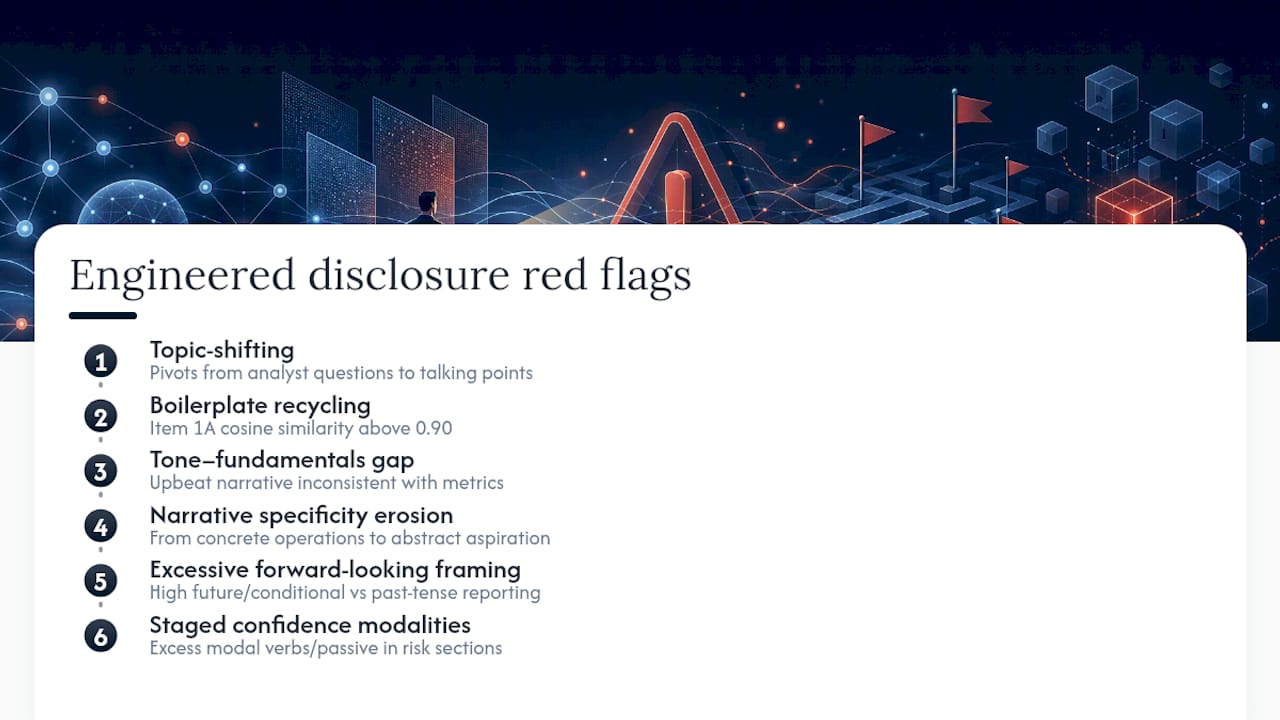
Boilerplate recycling manifests as low risk-factor novelty: year-over-year cosine similarity above 0.90 on Item 1A text, with no corresponding change in the firm's operating environment. Regulated disclosures carry some legitimate boilerplate, so novelty scores require industry-adjusted baselines.
Tone–fundamentals gap describes upbeat narrative claims inconsistent with contemporaneous performance metrics. An auditable pipeline extracting tone, uncertainty, and forward-looking intensity from 10-K filings can systematically detect this gap and relate it to enforcement outcomes.
Narrative specificity erosion appears as a gradual shift from concrete operational language ("expanded distribution to 14 new SKUs in Q3") toward abstract aspiration ("continued focus on growth initiatives"). Specificity indices derived from noun-phrase density and named-entity counts track this drift quantitatively.
Excessive forward-looking framing is a disproportionate ratio of future-tense and conditional constructions relative to past-tense operational reporting. Generative AI increases the risk of polished but strategically engineered narratives; teams should flag sudden increases in forward-looking intensity that outpace operational signals.
Staged confidence via modal verb and passive voice patterns — overuse of "may," "could," and "is expected to" in risk sections while the presentation layer uses declarative, confident constructions — signals asymmetric hedging designed to limit legal exposure while maintaining investor optimism.
Pro Tip: Topic-shifting combined with boilerplate reuse is a high-priority escalation signal. Either pattern alone may reflect legitimate communication choices; together, they indicate a systematic effort to control the narrative rather than inform it.
Which public sources and forensic features should you extract?
The table below maps each primary source to the sections worth parsing and the features most relevant to disclosure pattern analysis.
| Source | Sections to parse | Key features to extract |
|---|---|---|
| SEC EDGAR 10-K | MD&A, Risk Factors | Tone/uncertainty scores, risk-factor novelty (YoY cosine similarity), forward-looking intensity, Coh–Metrix cohesion indices |
| SEC EDGAR 10-Q | MD&A quarterly update | Quarter-over-quarter tone drift, specificity index, boilerplate reuse rate |
| Earnings call transcripts | Presentation section, Q&A section separately | Topic-shift frequency, modal verb density, presentation vs. Q&A tone divergence, passive voice ratio |
| Press releases | Full text | Sentiment polarity, named-entity density, forward-looking ratio |
| Proxy statements | CD&A, board narrative | Pay-for-performance narrative alignment, governance language novelty |
| Prior-year filings | All narrative sections | Boilerplate drift baseline, longitudinal specificity trend |
Coh–Metrix provides approximately 110 cohesion and readability indices that capture whole-text properties — referential cohesion, causal connectives, syntactic complexity — that outperform single-number readability formulas in discriminating fraud from non-fraud narratives. Financial word lists supply domain-calibrated positive, negative, uncertainty, and modal-verb lexicons purpose-built for SEC filings. Texture indices grounded in applied linguistics address the limitations of Flesch-like measures by capturing whole-text properties relevant to MD&A operating reviews.
Practical notes: earnings call transcripts require timestamp alignment — presentation and Q&A sections must be scored separately, not averaged, because managers who topic-shift in Q&A frequently combine evasive techniques with otherwise credible presentation sessions. Every extracted feature should carry a provenance record linking it to the raw text file, parsing snapshot, and tokenization output so the score can be audited to its source sentence.
What models and validation approaches work for governance use?
The recommended architecture pairs interpretable pipelines (logistic regression, elastic net) with fine-tuned transformer classifiers for deeper ranking. Interpretable models produce coefficients that governance teams can audit and defend; transformer models capture contextual nuance that bag-of-words approaches miss.
Empirical performance benchmarks to hold vendors against:
- Linguistic models based on CEO/CFO narrative patterns achieve 50%–65% accuracy and deliver 4%–6% incremental power over accrual-based baselines.
- BERT fine-tuned on MD&A sections outperforms textual and quantitative benchmarks by reported margins of +12%–15% in detection performance, identifying more suspicious firm-year observations per investigation unit.
- Corpus-based NLP scoring of annual-report narratives links disclosure quality indices to market outcomes including cost of capital, validating the relevance of narrative scores beyond classification accuracy alone.
Governance-relevant validation metrics: sensitivity (catch-rate for actual manipulation), precision (false-positive rate), AUC, and out-of-sample tests tied to enforcement actions or restatement events. A model validated only on in-sample accuracy is insufficient for governance use.
Pro Tip: Stage the models. Run interpretable feature screens first for triage — they are fast, auditable, and catch the majority of high-signal cases. Apply BERT-family classifiers as a second pass for borderline cases and deep ranking. This preserves explainability where it matters most while capturing the performance gains transformers provide.
How to build an automated, audit-traceable detection pipeline
A governance-grade pipeline requires five sequential stages, each with documented controls:
- Automated ingest — pull 10-K, 10-Q, and proxy filings from EDGAR feeds; acquire earnings call transcripts from a timestamped source; store raw files in an immutable archive with ingestion timestamps.
- Deterministic parsing and provenance tagging — parse each document into labeled sections (MD&A, Risk Factors, Q&A) using versioned parsing code; tag every text segment with its source file, section label, and character offsets.
- Feature extraction — run Loughran & McDonald lexicons, Coh–Metrix indices, n-gram similarity, and specificity measures against tagged segments; log the code version and random seeds used.
- Scoring engine — apply rules-based thresholds (e.g., novelty score below industry-adjusted floor) and model scores; compose into a narrative-risk index and an execution-gap index; record threshold versions and model artifact hashes.
- Human triage and audit log — route high-score items to analyst review; require disposition codes (escalate / monitor / dismiss) with rationale; retain the full audit trail for regulatory review.
Implementation controls checklist:
- Immutable raw-data store with ingestion timestamps
- Feature provenance records linking each score to its source sentence
- Model versioning with artifact hashes and training-set snapshots
- Threshold change logs with effective dates and approval records
- Human-review disposition codes and rationale fields
Minimum monitoring metrics: data freshness within 24 hours of EDGAR publication, false-positive rate below 15% on a held-out validation set, and time-to-escalation under 48 hours for high-priority flags.
How should institutional users act on detection scores?
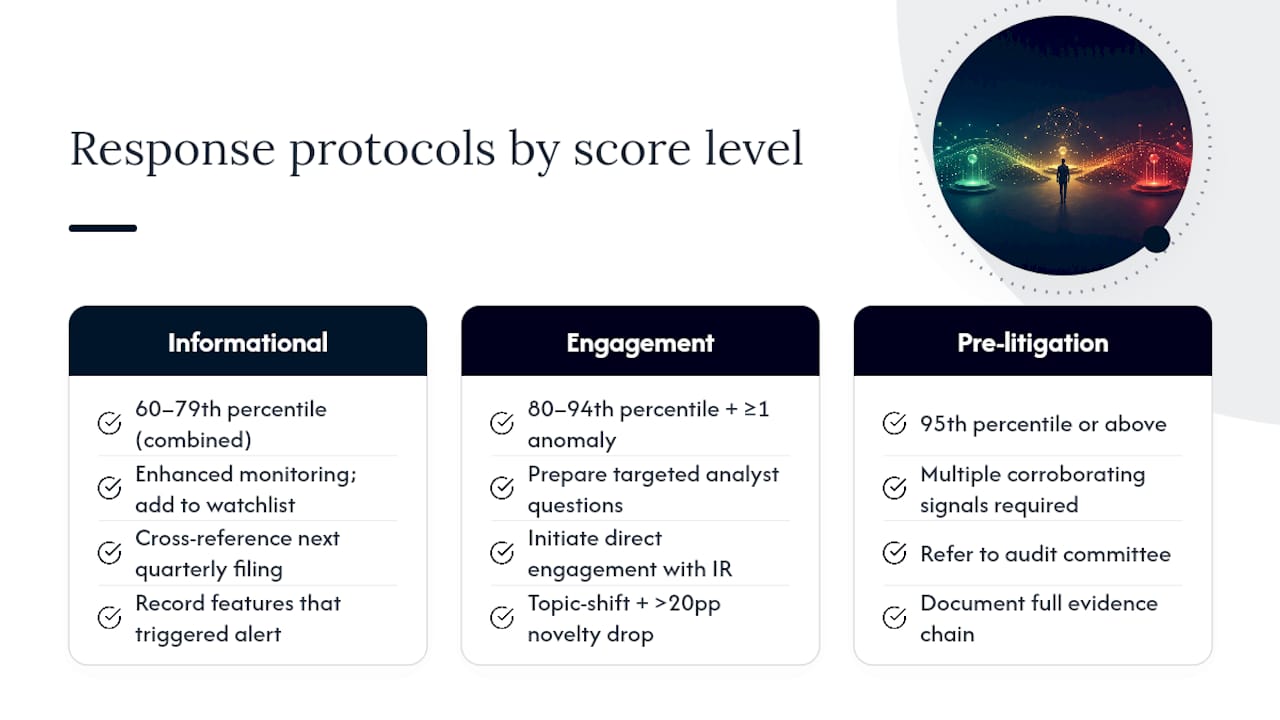
Score levels map to distinct response protocols. At the informational alert level (60th–79th percentile combined score), the appropriate action is enhanced monitoring: add the company to a watchlist, cross-reference the next quarterly filing, and note the specific features that triggered the alert.
At the engagement trigger level (80th–94th percentile, plus at least one corroborating financial anomaly), the governance team should prepare targeted analyst questions and initiate direct engagement with investor relations. Paired signals that warrant this level include topic-shifting plus a risk-factor novelty drop of more than 20 percentage points year-over-year, or repeated boilerplate reuse across three or more consecutive filings. For proxy advisors, this threshold should inform voting recommendations on say-on-pay or director elections where narrative accountability is a factor. The proxy decision-making playbook provides further guidance on integrating narrative-risk scores into voting frameworks.
At the pre-litigation escalation level (95th percentile or above, with multiple corroborating signals), the appropriate steps are referral to the audit committee, documentation of the full evidence chain, and — for journalists — an investigative request under the Freedom of Information Act or a formal inquiry to the company's disclosure counsel.
Sample engagement questions: "Can management specify which operational milestones underpin the forward-looking statements in the MD&A?" and "Why did the risk-factor language in Item 1A remain substantively unchanged despite the material change in competitive conditions disclosed in the 10-Q?"
What are the limitations and ethical constraints of this approach?
No detection system eliminates false positives. The most common sources of error are industry-specific jargon that scores as uncertainty without being evasive, legitimate boilerplate required by SEC rules (e.g., standard safe-harbor language in forward-looking statements), and multinational filings where translation introduces syntactic patterns that resemble engineered opacity.
Key limitations and mitigations:
- Industry jargon variance — calibrate all lexicon scores against sector-specific baselines, not universal thresholds.
- Regulated boilerplate — exclude legally mandated standard-form language from novelty calculations before scoring.
- Model drift — retrain or recalibrate classifiers annually as disclosure norms evolve, particularly given the accelerating use of generative AI in drafting.
- Non-defamatory escalation — all escalation communications must characterize findings as statistical signals warranting inquiry, not as conclusions of fraud or intent.
- Data provenance for non-US filings — GDPR and other data-protection frameworks may apply to personal data embedded in non-US filings; a qualified legal review is advisable before processing such data at scale.
Pro Tip: Conservative thresholding is not a weakness. Setting the engagement trigger at the 80th percentile rather than the 70th reduces false-positive escalations and preserves the credibility of the detection program with management and audit committees.
How Lacunaindex measures engineered disclosure patterns: the audit-traceable scoring approach
Lacunaindex operates a public-record-only ingest pipeline that extracts features with full provenance, applies a hybrid interpretable-plus-ML scoring architecture, and composes results into two primary indices: a narrative-risk index (measuring disclosure opacity, boilerplate drift, and tone–fundamentals gap) and an execution-gap index (measuring the aspiration-to-execution gap between stated commitments and reported outcomes).
Governance teams evaluating any forensic analytics vendor — including Lacunaindex — should request the following from the vendor:
- Raw-data snapshots for a sample filing period, with ingestion timestamps
- Feature definitions and lexicon versions (e.g., Loughran & McDonald list vintage)
- Model training sets, validation reports, and out-of-sample performance against restatement or enforcement outcomes
- Threshold rationales with change logs
- Sample forensic reports showing score decomposition to the feature level
Lacunaindex classifies companies into three archetypes based on the intersection of narrative-risk and execution-gap scores. Earned companies show low narrative-risk and high execution scores — their claims are substantiated by delivery. Borrowed companies carry high narrative-risk and execution gaps that exceed sector norms, indicating valuation supported by narrative rather than performance. Undervalued companies show low narrative-risk but execution scores that the market has not yet priced. Each archetype maps directly to an action recommendation: earned warrants continued monitoring, borrowed warrants engagement or short-side scrutiny, and undervalued warrants deeper disclosure gap analysis for long-side opportunity.
Why a "suspicious state of mind" makes detection more reliable
The behavioral dimension of detection is as consequential as the technical one. Research published in Management Science demonstrates that prompting a "suspicious state of mind" — suspending judgment and actively generating rival explanations — improves investors' ability to identify evasive responses and differentiate nonanswers from adequate ones in earnings calls. The implication for analytic workflows is concrete: a structured skepticism protocol, requiring analysts to document why alternative interpretations were rejected before closing a review, reduces the risk of being misled by smooth, well-constructed narratives.
Pro Tip: For every positive forward-looking claim in a filing, require a counterfactual narrative item in the review record: what would the disclosure look like if the claim were not supportable? If the actual text is indistinguishable from the counterfactual, the claim warrants deeper scrutiny.
Lacunaindex forensic analytics: where to start
Lacunaindex delivers audit-traceable forensic scores across public filings, earnings calls, and proxy statements — without insider access, proprietary data feeds, or subjective analyst judgment. Every score decomposes to the feature level, every feature traces to its source sentence, and every company receives an archetype classification that maps directly to an engagement or investment decision.
Sector benchmarks are available at no cost at Lacunaindex, where narrative-risk and execution-gap scores are published by sector for institutional reference. To request a sample forensic report or discuss subscription access for your governance or investment team, contact Lacunaindex directly through the benchmarks page.
Sources
- Detecting Deceptive Discussions in Conference Calls (working paper) — David F. Larcker & Anastasia A. Zakolyukina
- Overcoming Deceptive Evasions in Earnings Calls: The Role of Investor Suspicion — Management Science
- Generative AI and U.S. Financial Reporting Integrity: Detecting Narrative Manipulation, Risk Disclosure Gaming, and Fraud Signals in 10-K Filings — JEFAS
- Controlling the narrative: managers’ topic-shifting behavior in conference calls — Review of Accounting Studies
- Analysing narratives in the Corporate Financial Information Environment — CFIE project (Lancaster/CASS/LSE)
- Texture analysis for accounting narratives and its limitations vs single-index readability measures — Emerald