
SEC comment letters function as an advance, public, evidence-rich signal of disclosure risk and regulatory priority, and analysts who ignore them are working with an incomplete picture of accounting risk. The letters surface on EDGAR no sooner than 20 business days after staff review closes, and they cluster around a narrow set of topics, chiefly MD&A and non-GAAP measures. This correspondence can be considered as one input among many public records used to measure the gap between what companies say and what they deliver.
TL;DR:
- Comment letters primarily focus on MD&A and non-GAAP measures, which remain the most scrutinized topics by SEC staff despite overall volume declines.
- Analyzing the full exchange of comment letters, responses, and subsequent filings helps assess whether companies address or ignore staff concerns, indicating disclosure risk levels.
- Frequent, unresolved follow-up requests for the same accounting issue, especially regarding quantifications, suggest higher remediation risks and potential weaknesses.
- Firms with multiple comment rounds on key disclosures or contradictions with earnings calls face increased governance and legal risks over time.
- Systematic, technology-driven review of comment letters enables scalable, sector-wide monitoring and enhances an analyst's ability to detect disclosure gaps and potential concerns.
Table of Contents
- What Are SEC Comment Letters and How Do They Become Public?
- Why Analysts and Institutional Investors Should Track Comment Letters
- A Practical Forensic Workflow for Reading a Comment Letter
- Top Themes in 2025-2026 Comment Letters
- How to Search EDGAR and Handle Redaction Rules
- Limits, Caveats, and Red Flags to Watch
- How Comment Letters Differ Across Filer Types
- How Companies Typically Respond to SEC Comments
- Comment Letters, Enforcement Risk, and Legal Exposure
- Using Technology and Data Analytics for Comment Letter Research
- Where SEC Comment Letters Came From and Why They Exist
- How Lacuna Index Treats Comment-Letter Evidence
- Turning Comment-Letter Research Into a Repeatable Workflow
- Sources
- FAQ
What Are SEC Comment Letters and How Do They Become Public?
SEC comment letters are correspondence issued by the SEC Division of Corporation Finance during its review of a company's periodic or registration filings. Staff review a filing for compliance with disclosure rules and generally send one of a few requests back to the company:
- Supplement an existing disclosure with more detail or a clearer explanation.
- Revise language in a future filing rather than amend the current one.
- Provide additional context on a specific accounting position, such as a non-GAAP reconciliation or a segment disclosure.
The public timing matters as much as the content. The SEC releases these letters and the company's responses on EDGAR no sooner than 20 business days after the review is completed, which means the correspondence an analyst reads today may reflect a conversation that concluded weeks or months earlier. It is worth remembering that a comment letter reflects staff understanding of one filing at one point in time, not a comprehensive audit of the company's accounting.
Why Analysts and Institutional Investors Should Track Comment Letters
A comment letter is often the earliest public documentation that a specific accounting judgment drew scrutiny, well before an earnings restatement or a governance headline forces the market to react. That lead time is the entire value proposition for research teams building a disclosure-risk view. Analysts use the letters in three concrete ways:
- Flagging accounting positions (revenue timing, goodwill impairment triggers, segment aggregation) that deserve a second look in the model.
- Escalating engagement priorities with investor relations or the board when a company receives multiple comment rounds on the same issue.
- Setting a monitoring cadence around the next filing to see whether the disclosure actually changed.
Even with volume down, the year ended June 30, 2025 saw MD&A and non-GAAP measures remain the two most-cited topics in staff comment letters, a pattern that has held for several review cycles. That concentration matters for portfolio construction: two accounting areas account for a disproportionate share of the SEC staff's public disclosure feedback, a key insight for investors following the private equity healthcare thesis. A comment letter is not an enforcement action and should never be modeled as one. It is, however, a documented instance of the regulator's own scrutiny, and treating it as noise is a mistake analysts increasingly avoid, particularly when it lines up with a valuation thesis built on aggressive adjusted metrics.
A Practical Forensic Workflow for Reading a Comment Letter
Reading a single comment letter may provide limited insight. Reading the comment, the company's response, and the resulting amended filing together, in sequence, tells you whether the company closed the gap or talked around it. Examining the three-document chain, along with the dates of each round, is often considered the minimum unit of analysis.
Build the record in this order:
- Pull the full correspondence thread. EDGAR groups the comment letter (UPLOAD) and the company's response (CORRESP) under the same filer; note every round and its date.
- Map each comment to a topic. Tag it as MD&A, non-GAAP, segment reporting, revenue recognition, goodwill and intangibles, or another category, and note whether the request is a specific quantification demand or a general clarification.
- Check for missing exhibits or unresolved schedules the staff asked for but that never appear in a subsequent filing.
- Reconcile the informal record. Compare the accounting position at issue against language used on the same topic in earnings calls or press releases from the same period.
- Score the exchange on four dimensions: specificity of the staff's request, persistence across rounds, materiality of the dollar or disclosure item involved, and speed of remediation in the next filing.
Pro Tip: A single clarifying question resolved in one round is background noise. A repeated request for quantification or a supporting schedule across two or more rounds is a materially different signal and tends to correlate with elevated remediation risk.
This is close to how Lacuna Index structures its own scoring: comment-letter evidence feeds into the same public-records pipeline as earnings-call transcripts, proxy language, and press releases, and a persistent, unresolved comment thread pulls a company's execution score down independent of what management says about the issue elsewhere. Companies that talk confidently about a metric the SEC staff has already questioned twice may tend to have valuations running ahead of documented delivery. The workflow above is exactly the kind of check that supports public disclosure gap investment analysis.
Top Themes in 2025-2026 Comment Letters
Comment-letter volume declined in the fiscal year ended June 30, 2025. However, the topical concentration held steady or intensified in specific areas. That combination, fewer letters but sharper focus, is the trend analysts need to internalize going into 2026.
- MD&A and non-GAAP measures stayed the top two subjects by frequency, a pattern the EY comment-letter trends analysis confirms across the review period.
- Segment reporting drew rising scrutiny tied to ASU 2023-07, the standard requiring more granular disclosure of segment expenses; companies still adjusting to the standard are more likely to draw a comment.
- AI-related disclosure claims are an emerging area of staff interest as companies attach growth narratives to AI initiatives without matching quantitative support.
- Missing exhibits and mechanical items, such as debt covenant schedules or EPS computation detail, remain a recurring, lower-drama but still meaningful category.
Even as totals fell, individual letters released as late as January 2026 on non-GAAP inventory adjustments showed the substance of what staff flags has not softened. A smaller stack of letters does not mean a smaller signal; it means each one carries more weight. Analysts covering companies mid-transition on segment disclosure should treat any related comment as a prompt to revisit the segment reporting checklist before the next filing.
How to Search EDGAR and Handle Redaction Rules
Finding the right letter on EDGAR takes a specific search path, not a general company lookup. Use these steps:
- Search by filer at the EDGAR full-text search tool, then filter to the UPLOAD (staff comment) and CORRESP (company response) form types rather than scanning the full filing history.
- Note the accession number on each response letter, then cross-reference it against the amended 10-K or 10-Q that followed, since the resolution often lives in a filing the comment letter itself never names directly.
- Set a monitoring window of 30 to 90 days after a known filing review closes, since that is the practical range in which the 20-business-day EDGAR release rule tends to surface the correspondence.
Redactions complicate the record. A company can request confidential treatment for sensitive commercial or competitive detail and submit an unredacted copy on paper; the Division of Corporation Finance releases only the redacted version on EDGAR without conducting an independent substantive review of the redaction request itself. That means the public letter can omit the exact figure or customer name driving the staff's concern.
Pro Tip: When a letter references a redacted number, check the same period's earnings call transcript or investor presentation. Companies sometimes disclose informally what they withheld from the formal filing.
Limits, Caveats, and Red Flags to Watch
A comment letter documents a staff position on one filing, not a binding legal conclusion, and it is not evidence of wrongdoing by itself. Analysts who forget that distinction risk overreading routine correspondence as a scandal in progress.
Selection bias complicates interpretation further. Not every filing gets reviewed with the same intensity, and academic research on comment-letter incidence and firm characteristics has found correlations with factors like political connectedness, a reminder that a company's review history reflects more than pure accounting risk. Treating comment-letter frequency as a clean proxy for oversight rigor, without controlling for these factors, produces flawed conclusions.
Specific red flags worth escalating:
- Multiple rounds of comments on the same accounting topic without resolution.
- Language in staff comments that touches on restatement risk or material weakness.
- Disclosures on earnings calls that contradict or overstate what the filed 10-K or 10-Q actually says.
- Missing exhibits or supporting schedules the staff requested but that never appeared.
- Non-GAAP reconciling items that grow more aggressive after a comment letter rather than more conservative.
How Comment Letters Differ Across Filer Types
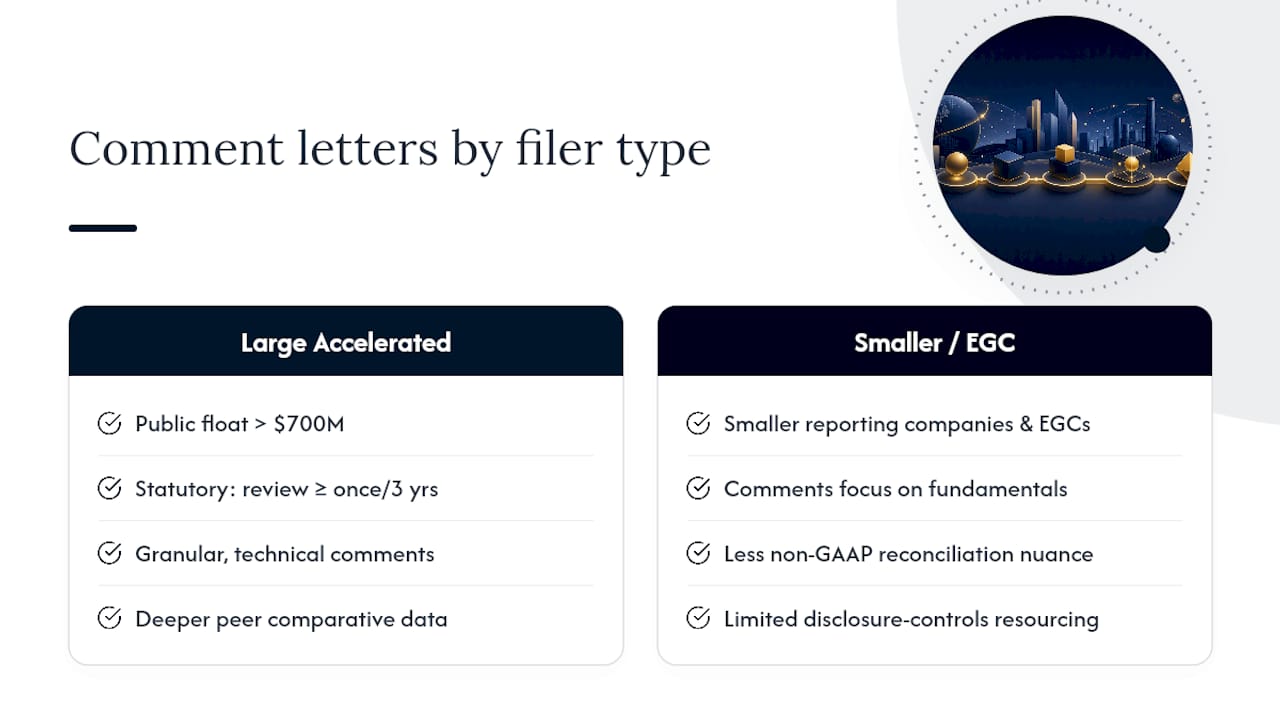
The SEC's review cadence is not uniform across filer categories, and that difference shapes how useful comment-letter analysis is for any given company in your coverage universe. Large accelerated filers, generally companies with a public float above $700 million, are reviewed under the same statutory mandate requiring at least one review every three years, but their filings tend to draw more granular, technically dense comments because the staff has deeper comparative data across peer companies of similar scale.
Smaller reporting companies and emerging growth companies often receive comment letters that read differently: more foundational questions about basic disclosure completeness, less about nuanced non-GAAP reconciliation mechanics. That is partly a function of resourcing on the company side. Smaller filers frequently lack the deep accounting and disclosure-controls infrastructure that large accelerated filers have built over multiple review cycles, so staff comments on smaller companies more often address gaps in the fundamentals: inadequate risk factor specificity, unclear related-party disclosures, or missing required exhibits entirely.
For an analyst building a coverage-wide risk view, this means a comment letter volume comparison across market-cap tiers is not apples to apples. A single comment letter to a smaller-cap company on basic revenue recognition disclosure may signal a more fundamental controls gap than a similar-topic letter to a large accelerated filer, where the same comment might reflect a narrower interpretive dispute over an already sophisticated disclosure framework. Weighing severity requires reading the specific request, not just counting rounds. This is precisely the kind of nuance that a raw comment-letter tally can miss and a company-level forensic read may capture.
How Companies Typically Respond to SEC Comments
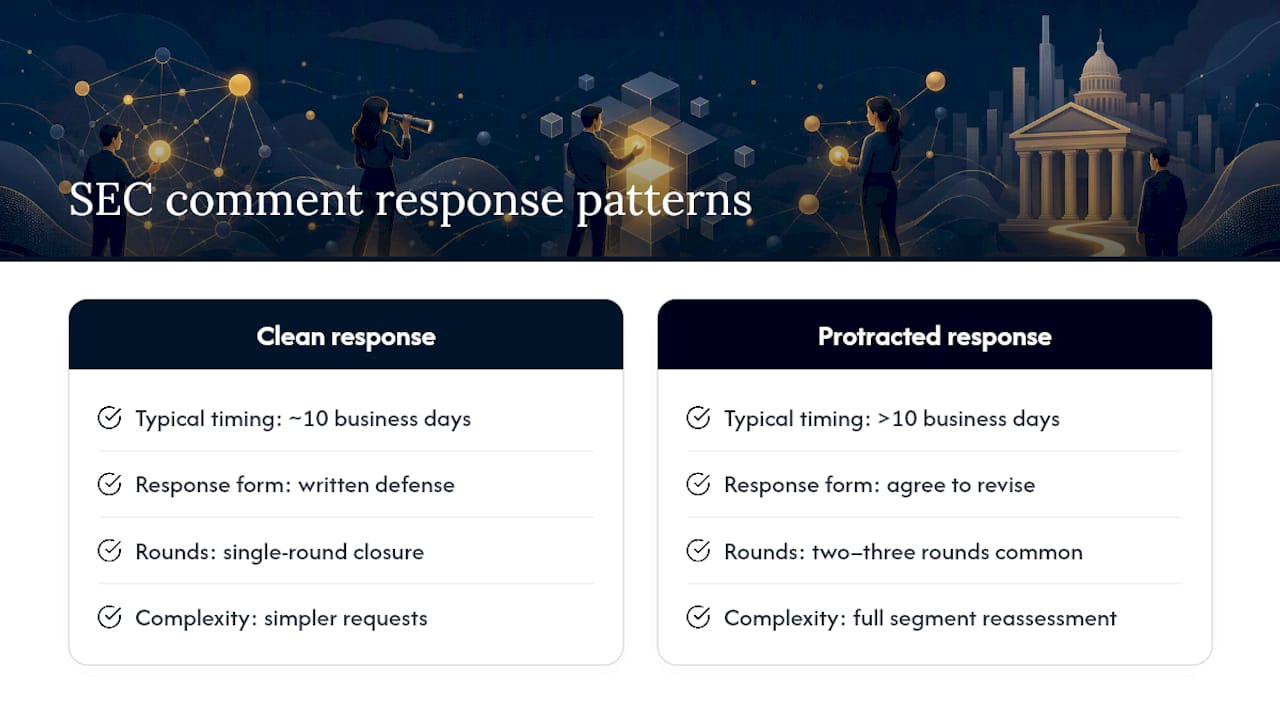
Once a company receives a comment letter, it generally has a defined but not statutorily fixed window to respond in writing, and SEC guidance for smaller companies confirms that companies can and should seek clarification directly from the staff examiner if a request is ambiguous. Most companies respond within roughly ten business days, though the timeline flexes based on complexity; a request involving a full segment-reporting reassessment takes longer than a request to clarify a single sentence in the liquidity discussion.
The response itself typically takes one of two forms: a direct written explanation defending the existing disclosure, or an agreement to revise language in the next periodic filing rather than amend the filing under review. Staff can and do issue follow-up rounds if the initial response does not fully address the concern, and it is common for a moderately complex accounting question to generate two or three rounds of correspondence before the file closes.
The regulatory implication for investors is straightforward: a resolved comment letter with a clean, single-round response signals that the company's disclosure controls caught and could defend a position quickly. A protracted multi-round exchange, especially one that ends with the company agreeing to change its approach rather than defending it, suggests the original disclosure had a real weakness. Neither outcome is enforcement, but the difference between the two response patterns is a meaningful data point when weighing management credibility against its public statements elsewhere, a comparison Lacuna's disclosure consistency monitoring approach is built to formalize.
Comment Letters, Enforcement Risk, and Legal Exposure
Comment letters are not enforcement actions, and the SEC staff who write them operate in a separate function from the Division of Enforcement. That structural separation is real and matters legally. Still, comment letters carry downstream legal risk that analysts and governance professionals should not dismiss.
A comment letter creates a documented, timestamped record of a specific accounting position and the company's defense of it. If that same position later becomes the subject of a restatement or a securities class action, plaintiffs' counsel and, in some cases, the Division of Enforcement itself, can and do point to the earlier correspondence as evidence the company was on notice of the issue. A company that received a comment questioning a non-GAAP adjustment, defended it in writing, and then restated the same metric eighteen months later faces a materially harder position than a company with no such paper trail.
This is why comment-letter responses tend to be drafted carefully, often with securities counsel involved even though the correspondence sits outside any formal legal proceeding. The practical takeaway for investors is that a comment letter's legal weight grows over time, not at the moment it is published. Analysts building a governance risk view should treat an unresolved or contentious comment thread as a contingent liability marker: not a current legal problem, but a documented fact pattern that could become one if the underlying accounting position turns out to have been wrong.
Using Technology and Data Analytics for Comment Letter Research
Reading comment letters one at a time does not scale across a coverage list of even modest size, which is why quantitative approaches to comment-letter research have grown alongside traditional manual review. Natural language processing tools can tag letters by topic, count round frequency across a filer's history, and flag repeated language patterns (words like "quantify," "reconcile," or "provide us") that tend to correlate with more substantive requests than routine clarifying questions.
Large-scale academic and market research has used exactly this kind of systematic tagging to establish base rates: studies have found that a meaningful share of listed companies, in some sample years between 20% and 40% of firms, received at least one comment letter, and that incidence correlates with observable firm characteristics beyond pure accounting risk. That scale of pattern recognition is not something a single analyst can replicate reading letters manually, one filer at a time.
For institutional research teams, the practical value of a technology-driven approach is comparability: scoring every comment letter in a sector against the same rubric for specificity, persistence, and remediation speed, rather than relying on an analyst's memory of which letters felt serious. Some forensic analytics platforms apply this discipline by folding comment-letter evidence into a standardized, audit-traceable scoring pipeline alongside earnings-call transcripts and proxy statements, so a company's regulatory correspondence can be weighed on the same scale as other public disclosures in its sector.
Where SEC Comment Letters Came From and Why They Exist
The SEC's filing review program traces back to the agency's core statutory mandate under the securities laws: ensuring that public disclosures give investors the information they need to make informed decisions. The Division of Corporation Finance formalized its systematic review cycle in the years following the Sarbanes-Oxley Act of 2002, which mandated that the SEC review every reporting company's filings at least once every three years, a requirement that turned comment letters from an occasional spot-check tool into a routine, recurring feature of the disclosure system.
The purpose has stayed consistent even as the volume and focus have shifted. Comment letters exist to correct or clarify disclosure before it misleads investors, not to punish past conduct. Early comment-letter practice focused heavily on financial statement mechanics: balance sheet classification, revenue recognition timing under legacy accounting standards. Over the past decade, the SEC staff's attention has moved toward areas where management has more discretion in how it frames performance, non-GAAP measures being the clearest example, because that discretion is exactly where the gap between disclosed narrative and underlying results tends to open up.
Public release of the correspondence itself is a relatively more recent transparency measure, adopted so that the broader market, not just the company under review, benefits from seeing where the SEC staff is focusing scrutiny. That is the same principle behind assessing public company transparency more broadly: disclosure quality is best judged not by what a company says about itself, but by what independent, public evidence shows about how that disclosure holds up under scrutiny.
How Lacuna Index Treats Comment-Letter Evidence
Comment letters are one input in Lacuna Index's broader public-records methodology, weighed alongside earnings-call transcripts, proxy statements, and press releases to measure the gap between what a company claims and what it delivers. A persistent, unresolved comment thread pulls a company toward the "borrowed" archetype in Lacuna's scoring, meaning market valuation is running ahead of what public evidence supports.
Portfolio teams use this for sector-level monitoring and for prioritizing which holdings warrant deeper engagement before an earnings call. The scoring may be designed to be audit-traceable, with signals tying back to specific public filings rather than unverifiable sources.
— Glen
Turning Comment-Letter Research Into a Repeatable Workflow
Reading comment letters manually across a full coverage list is not sustainable, and that gap is exactly where Lacuna Index fits. Sector-level monitoring across an entire coverage universe runs through Sector Sweep, while a specific company flagged by a persistent comment thread gets the deeper treatment through Lacuna's per-company forensic analysis. Teams that need both breadth and depth combine Cohort Pulse for peer-group tracking with the per-company reports when a name needs a closer look.
Every score ties back to a specific public filing, comment thread, or transcript passage, the same audit-traceable standard applied throughout this workflow. Institutional investors and governance professionals researching sector-wide exposure can start with the free sector benchmarks to see how a given industry scores before deciding whether a paid subscription fits the research need. Check current plan details for Cohort Pulse and Sector Sweep on the pricing page.
Sources
Primary verification starts with the SEC's own filing review process page for release timing and staff role, and the SEC's small-business filing review guide for response expectations. For topical trend data, the EY 2025 comment-letter trends analysis and PwC's comment-letter process viewpoint cover topical frequency and redaction mechanics respectively, while the National Law Review's January 2026 analysis covers recent volume trends.
- SEC | Filing review process (Division of Corporation Finance)
- EY | SEC reporting update: trends in 2025 SEC staff comment letters
FAQ
Where Can Analysts Find SEC Comment Letters?
Comment letters and company responses are searchable on EDGAR's full-text search tool using the UPLOAD and CORRESP form types filtered by company name or ticker.
Does a Comment Letter Mean the SEC Is Investigating the Company?
No. A comment letter is part of the routine filing review process conducted by the Division of Corporation Finance, a separate function from the Division of Enforcement, and it does not indicate an investigation.
How Long After Review Does a Comment Letter Become Public?
The SEC releases comment letters and responses on EDGAR no sooner than 20 business days after the review is completed, so the correspondence often reflects a conversation from weeks or months earlier.
Can Companies Redact Information in Public Comment Letters?
Yes, companies can request confidential treatment and submit an unredacted paper copy; the SEC releases only the redacted version on EDGAR without independently evaluating the redaction request's substance.
How Does Lacuna Index Use Comment-Letter Data in Its Scoring?
Lacuna Index folds comment-letter evidence into its public-records methodology alongside earnings calls and proxy statements, weighting persistent or unresolved comment threads against a company's execution score.