
Corporate misrepresentation is defined as the deliberate or negligent gap between what a public company communicates and what its records actually show. That gap directly degrades governance effectiveness, erodes investor confidence, and exposes firms to regulatory enforcement. For institutional investors and governance professionals, understanding the corporate misrepresentation governance impact is not a theoretical exercise. It is a prerequisite for sound capital allocation and fiduciary accountability. Platforms like Lacunaindex, forensic frameworks built on SEC filings and earnings call transcripts, and recent rulings from the Delaware Supreme Court have made systematic detection more tractable than at any prior point in the discipline's history.
How does corporate governance reduce the impact of misrepresentation?
Strong governance structures are the primary institutional defense against disclosure fraud. Empirical evidence confirms that CSR committees and internationally experienced board members significantly reduce greenwashing's negative effect on firm value, with an interaction coefficient of β = 0.094 (t = 3.462; p < 0.001). That result means governance architecture is not merely procedural. It produces measurable financial protection.

The mechanism is information asymmetry reduction. When boards include directors with cross-jurisdictional experience, they recognize disclosure patterns that domestic-only boards routinely miss. ESG disclosures, proxy statements, and earnings call language all carry signals that trained oversight bodies can interrogate. Without that interrogation, the gap between narrative and delivery widens unchecked.
Governance professionals should monitor the following early-warning indicators:
- Disclosure opacity scores: Filings that use vague forward-looking language without quantified milestones signal elevated misrepresentation risk.
- Auditor attestation gaps: Qualified opinions or scope limitations in audit reports indicate areas where management has restricted independent verification.
- Aspiration-to-execution gaps: Repeated failure to meet guidance targets, when cross-referenced against internal capability disclosures, reveals structural misalignment.
- Board composition shifts: Sudden departures of independent directors or audit committee members often precede disclosure failures.
- Related-party transaction density: High volumes of undisclosed or minimally disclosed related-party transactions correlate with governance opacity.
Pro Tip: Monitor the regulatory oversight gaps in public reporting to identify sectors where governance structures are thinnest and misrepresentation risk is highest.
| Governance Mechanism | Measurable Effect |
|---|---|
| CSR committee presence | Reduces greenwashing's firm value penalty |
| Internationally experienced directors | Improves cross-jurisdictional disclosure scrutiny |
| Independent audit committee | Limits management control over reported information |
| Structured ESG disclosure protocols | Reduces semantic inconsistency in sustainability claims |
What methods enable systematic detection of corporate misrepresentation?
Detection of corporate misrepresentation requires moving beyond surface-level document review. The Metadata Incoherence Score (MIS), measured on a scale of 0–15, diagnoses deficiencies in corporate filings by assessing structural and semantic consistency across digital disclosures. Transitioning from PDF to machine-readable formats such as HTML and XBRL reduces metadata incoherence and improves detection accuracy. That shift matters because unstructured ESG disclosures generate semantic inconsistencies that obscure material facts from both regulators and investors.
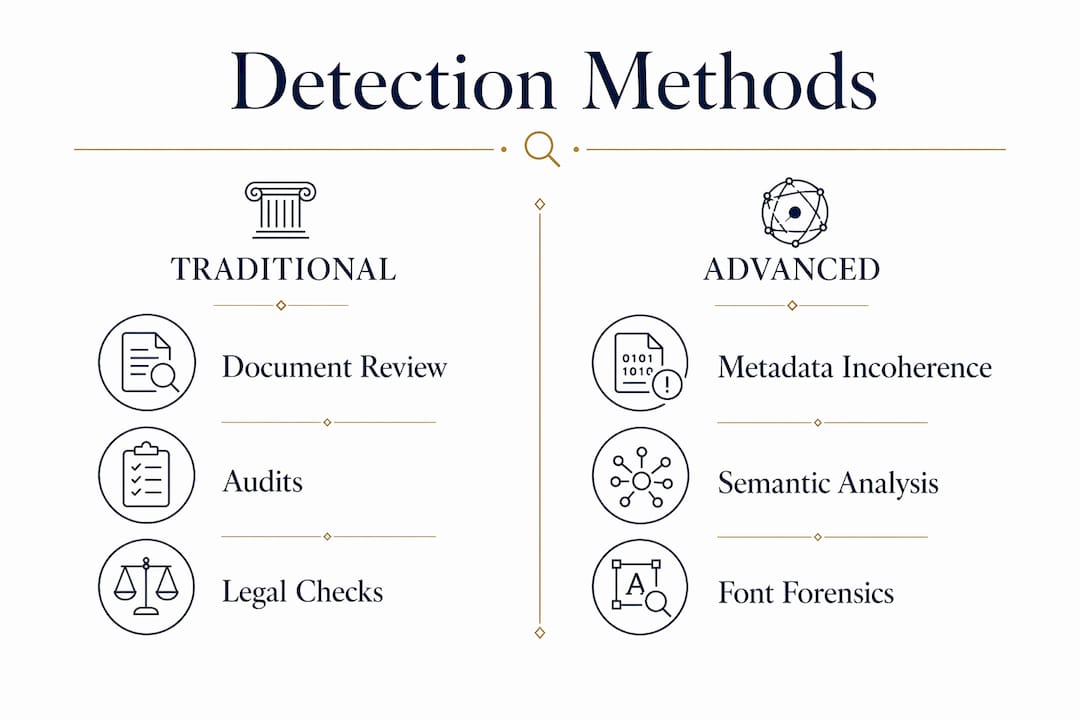
Courts have independently validated forensic document analysis as a detection standard. Courts increasingly depend on forensic analyses including font consistency checks, metadata timestamps, and behavioral pattern analysis to expose fabricated corporate records in control claims disputes. Public filings are not self-proving documents. They are assertions that require independent verification.
The following detection methods form a systematic framework for governance teams:
- Metadata coherence analysis: Compare filing timestamps, software version tags, and document revision histories against stated filing dates. Discrepancies indicate post-dated or altered records.
- Cross-filing semantic comparison: Run earnings call transcripts against 10-K and 10-Q language to identify shifts in tone, omitted topics, or contradictory claims across reporting periods.
- Regulatory database mining: Professional investigators find regulatory databases and court dockets more revealing than leaked documents for uncovering misrepresentation patterns.
- Font and formatting forensics: Inconsistent typefaces, spacing anomalies, or embedded object metadata in PDF filings signal document manipulation.
- Behavioral pattern tracking: Repeated restatements, late filings, or auditor changes within short windows indicate systemic disclosure instability.
Pro Tip: Governance teams that incorporate MIS scoring into quarterly disclosure reviews catch format-level misrepresentation before it compounds into material restatements. The corporate credibility assessment guide outlines how regulators apply these methods in practice.
| Detection Method | Format Dependency | Regulatory Acceptance |
|---|---|---|
| Metadata Incoherence Score (MIS) | Machine-readable (XBRL, HTML) | Emerging standard |
| Font and formatting forensics | PDF-based filings | Court-validated |
| Regulatory database mining | All public filings | Established practice |
| Cross-filing semantic comparison | All formats | Governance best practice |
Public company misrepresentation case types and their governance implications
Corporate misrepresentation divides into two primary categories: financial statement fraud and disclosure misalignment. Financial statement fraud involves fabricated or materially altered figures. Disclosure misalignment involves accurate individual facts presented in ways that omit material context, producing a false overall picture.
The Boeing case illustrates disclosure misalignment at scale. Boeing's governance failure involved the systematic omission of critical internal safety information from public disclosures, triggering SEC enforcement. The lesson is direct: disclosure accuracy is insufficient without completeness. A filing can be technically accurate and still constitute misrepresentation if it omits facts that a reasonable investor would consider material.
The Wirecard collapse represents a different failure mode. Wirecard's €20 billion governance failure was rooted not in accounting fraud alone but in the board's complete reliance on management-generated information without independent validation. No external intelligence was gathered. No independent stress-testing of disclosed figures occurred. The result was a governance system that could not detect what it was not designed to question.
"Governance failures often stem from relying exclusively on management-generated information without independent validation, increasing misrepresentation risks." — Applied Corporate Governance analysis of Wirecard
The Delaware Supreme Court's march 2026 ruling adds a legal dimension to this framework. Post-demand evidence is now admissible in books-and-records litigation, expanding the evidentiary scope available to shareholders challenging corporate disclosures. That ruling strengthens the position of institutional investors who pursue governance accountability through litigation.
The governance implications across case types share a common thread. Boards that lack independent verification mechanisms, whether for financial figures or disclosure completeness, cannot detect misrepresentation until it becomes public. At that point, investor losses and reputational damage are already realized. The annual report credibility guide details how governance teams can assess report integrity before that threshold is crossed.
How can institutional investors apply detection frameworks in practice?
Institutional investors must treat public filings as claims requiring verification, not as authoritative statements of fact. Public registries accept filings without fact-checking the underlying assertions, which means business identity hijacking and filing inaccuracies can persist undetected for extended periods. That structural reality shifts the verification burden to the investor.
Practical application requires building a corporate misrepresentation public record trail across multiple disclosure types. Governance teams should apply the following framework:
- Cross-source triangulation: Compare SEC filings, earnings call transcripts, press releases, and proxy statements for the same reporting period. Contradictions between sources indicate disclosure instability.
- Longitudinal commitment tracking: Document every forward-looking commitment made in public statements and track delivery against those commitments across quarters. The aspiration-to-execution gap is the single most reliable indicator of structural misrepresentation.
- Independent intelligence gathering: Use regulatory databases, court dockets, and OSINT tools to build a picture of corporate behavior that is independent of management-produced materials.
- Benchmark comparison: Sector benchmarks reveal when a company's disclosure patterns deviate from peer norms, signaling either genuine differentiation or disclosure manipulation.
- Engagement escalation protocols: When disclosure anomalies are identified, governance teams should escalate through structured shareholder engagement before assuming regulatory intervention will occur.
The shareholder engagement checklist provides a structured protocol for governance professionals to challenge disclosures through formal engagement channels. Lacunaindex applies this triangulation methodology systematically, classifying companies as earned, borrowed, or undervalued based on the measured gap between narrative claims and delivery evidence drawn entirely from public records.
Key Takeaways
Corporate misrepresentation governance impact is most effectively addressed by combining independent verification, forensic detection methods, and structured disclosure completeness testing across all public filings.
| Point | Details |
|---|---|
| Governance structures reduce misrepresentation risk | CSR committees and experienced directors measurably reduce the firm value penalty from disclosure failures. |
| Metadata analysis detects filing manipulation | MIS scoring and font forensics identify altered or fabricated filings before they reach regulatory review. |
| Disclosure completeness matters as much as accuracy | Boeing and Wirecard show that technically accurate but incomplete disclosures constitute misrepresentation. |
| Public filings require independent verification | Registries do not vet filing accuracy, placing the verification burden on investors and governance teams. |
| Longitudinal commitment tracking reveals execution gaps | Tracking forward-looking claims against actual delivery is the most reliable systematic detection method. |
The governance blind spot most boards still refuse to address
After years of reviewing governance failures across sectors, the pattern that stands out is not fraud. Fraud is detectable. The real problem is the institutional comfort with accuracy as a substitute for completeness.
Boards approve disclosures that are technically correct. Legal teams confirm that no individual statement is false. Auditors attest to the figures presented. And yet the overall picture that emerges from those disclosures is materially misleading because critical internal knowledge never made it into the external record. Boeing's SEC enforcement is the clearest recent example. The disclosures were not fabricated. They were curated.
What I find most troubling is that governance frameworks are rarely designed to test completeness. They are designed to test accuracy. Those are different problems requiring different tools. A board that asks "Is this statement true?" will miss the misrepresentation embedded in what was never stated. The question that actually protects investors is "What do we know internally that is not reflected here?"
Wirecard's board had access to information that should have triggered independent verification. It did not act because the governance machinery was oriented toward validating management's narrative, not stress-testing it. That orientation is the default state of most governance systems, not the exception.
The shift required is methodological. Governance reviews need to incorporate forensic metadata analysis, cross-filing semantic comparison, and longitudinal commitment tracking as standard practice, not as post-crisis responses. The tools exist. The research supports their use. The gap is institutional willingness to treat disclosure completeness as a governance obligation equal to disclosure accuracy.
— Glen
How Lacunaindex supports governance impact analysis
Lacunaindex is built for governance professionals and institutional investors who need to move beyond management-produced narratives. The platform mines SEC filings, earnings call transcripts, proxy statements, and press releases to measure the gap between what companies claim and what their public records show. Every company receives an execution score and an archetype classification based solely on verifiable public evidence.
The Lacuna user guide walks governance teams through interpreting forensic reports, including metadata coherence assessments and aspiration-to-execution gap scores. The sector benchmarks provide peer-level context so that disclosure anomalies can be identified against industry norms rather than in isolation. For teams building a systematic approach to detecting and documenting corporate misrepresentation, Lacunaindex provides the evidence base that internal governance reviews rarely generate on their own.
FAQ
What is corporate misrepresentation in governance terms?
Corporate misrepresentation is the gap between a company's public disclosures and its actual operational or financial reality. It includes both fabricated statements and material omissions that produce a misleading overall picture for investors and regulators.
How does governance structure reduce misrepresentation risk?
Boards with CSR committees and internationally experienced directors produce measurably lower misrepresentation risk. Research shows an interaction coefficient of β = 0.094 (p < 0.001) linking strong governance to reduced greenwashing impact on firm value.
What detection methods are most effective for identifying false filings?
Metadata Incoherence Score (MIS) analysis, cross-filing semantic comparison, and font forensics are the most validated methods. Courts have accepted forensic document analysis as evidence in control claims disputes involving fabricated corporate records.
What are the main public company misrepresentation case types?
The two primary types are financial statement fraud, involving altered figures, and disclosure misalignment, involving accurate but incomplete information. Boeing illustrates disclosure misalignment; Wirecard illustrates governance failure enabling both.
How should institutional investors verify public filings?
Investors should treat all public filings as unverified assertions. Cross-referencing SEC filings, earnings transcripts, and regulatory databases against each other, and tracking forward-looking commitments against actual delivery, produces the most reliable verification framework.