
The single highest-yield action when opening a new 10-K is a year-over-year redline of Item 1A against the prior filing, with immediate triage of any net-new, expanded, deleted, or reordered risk factor. These edits correlate with materiality far more reliably than the static text of any one year's filing, and they set the agenda for every cross-reference that follows in the analysis.
TL;DR:
- A new risk factor heading or a significant reordering towards the top of Item 1A indicates increased severity or a new material concern.
- Dollar figures, named counterparties, or specific dates within risk factors strongly suggest materiality and should be verified via footnotes or related disclosures.
- Deletions, reordering, or expansion of existing risk factors can signal operational changes, shifting risk profiles, or emerging issues requiring deeper cross-referencing.
- Lock in on boilerplate language, which is generic, hypothesis-based, and lacking specifics, versus material risks that include concrete data or named entities; the latter warrants prioritized review.
- A sudden increase in new risk disclosures or a volume spike in risk factors often signals recent legal or regulatory developments that may impact market perception.
Table of Contents
- What a 10-K Risk Factors Analysis Actually Requires
- Quick Triage Checklist: The 10 Highest-Value Items to Spot in Item 1A
- Spotting Boilerplate vs. Material Signal in Risk-Factor Language
- Top Risk Categories in Item 1A and the Red Flags That Matter
- Practitioner Workflow: A 30 to 90 Minute Analysis, Step by Step
- Research and Evidence Behind the Redline-and-Triangulate Method
- What Ten Years of Reading Risk Factors Should Teach an Analyst
- How Lacuna Index Scales This Analysis Across Sectors
- Authoritative Primary Sources and Further Reading
- Sources
What a 10-K Risk Factors Analysis Actually Requires
A 10-K risk factors analysis is the systematic comparison of a company's Item 1A disclosures against its own prior filings, its Management Discussion and Analysis (MD&A), its Item 3 legal proceedings, its footnotes, and its Item 9A auditor attestation, in order to separate defensive legal language from disclosures that reflect a genuine change in the business. Regulation S-K governs how these risk factors are structured, and SEC staff guidance makes clear that companies are expected to tailor disclosures to their specific circumstances and order them roughly by importance rather than recycle generic industry language. That expectation is precisely what makes redline analysis work: when a company edits, adds, or deletes a risk factor, it is making a disclosure decision, not just a stylistic one.
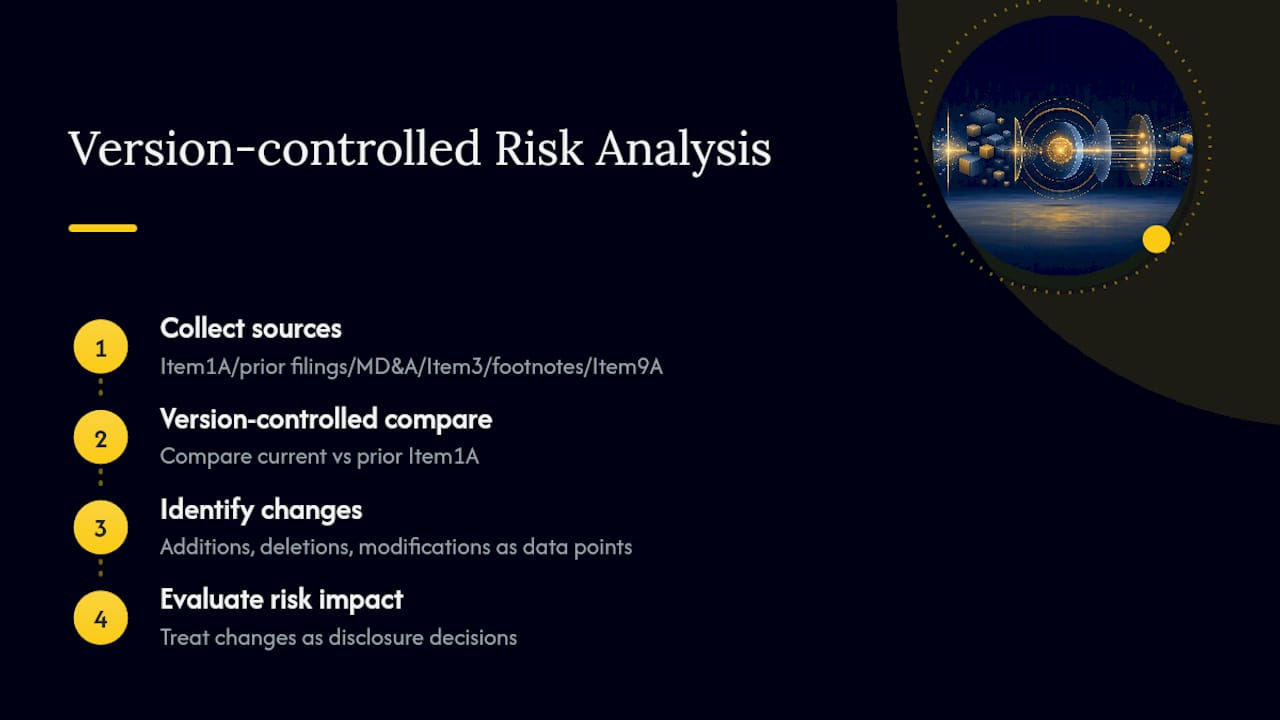
Most 10-K risk assessment work fails not because analysts lack access to filings, but because they read Item 1A as a static document rather than a version-controlled one. The static read treats forty pages of hedged legal prose as background noise. The version-controlled read treats every change from the prior year as a data point, and data points are what a risk factor evaluation for a 10-K is actually built on.
Quick Triage Checklist: The 10 Highest-Value Items to Spot in Item 1A
Before reading a single paragraph in depth, scan for these ten signals. Each one tells you whether to keep reading closely or move on.
- A brand-new risk factor heading. Any topic that did not appear in the prior year's filing deserves an immediate close read, because practitioner guidance treats net-new headings as the single highest-yield signal in the entire redline.
- A materially expanded paragraph. When a risk factor that used to run four sentences grows to four paragraphs, the added length usually carries new specifics worth extracting.
- A deleted risk factor. Removal often signals an operational change such as a divestiture, a resolved lawsuit, or an expired contract, and it should send you straight to the footnotes for confirmation.
- Reordering toward the front of Item 1A. Analysts widely treat the sequence of risk factors as management's own ranking of severity, so a factor that jumps from position twenty-two to position three is itself a disclosure.
- Named counterparties, customers, or lenders. Generic language protects the company legally; a named entity signals the company decided the specificity was unavoidable.
- Dollar or percentage figures embedded in the risk text. A sentence quantifying exposure ("approximately 18% of revenue," "$40 million in outstanding borrowings") is far more useful than a qualitative warning.
- Going-concern or liquidity language cross-referenced to Item 9A. If the auditor's report in Item 9A echoes the risk factor's concern, the disclosure has teeth.
- A new or expanded Item 1C cybersecurity cross-reference. Since the SEC's cybersecurity disclosure rules took effect, any Item 1A risk factor that leans on Item 1C material deserves a side-by-side read.
- Customer concentration flags with a specific percentage. A single customer at 15% of revenue is a different risk profile than the same customer at 40%, and the percentage usually only appears once you look closely.
- Newly named regulators, agencies, or litigation parties. When a risk factor names a specific regulatory body or references a named lawsuit for the first time, that is a governance signal, not boilerplate.
Each of these ten items falls into one of two buckets: an immediate read (something you resolve in the next five minutes by checking one other section) or a deeper cross-reference (something that requires pulling the proxy, the transcript, or a footnote before you can judge its weight). Named counterparties and dollar figures usually resolve fast. Going-concern language and reordering almost always require the deeper pass.
Pro Tip: Keep a running list of every risk factor heading from the prior year's 10-K open in a second window while you read the current one. The moment a heading fails to appear, you have found your first triage item before you have read a single new paragraph.
Spotting Boilerplate vs. Material Signal in Risk-Factor Language
Boilerplate risk factors share a distinct linguistic fingerprint: generic verbs ("could," "may," "might adversely affect"), no named parties, no dates, and phrasing that could apply to almost any company in the sector. Material risk factors break that pattern in specific, checkable ways.
The markers of boilerplate are consistent across filings. Watch for:
- Sentences that read almost identically to a competitor's filing in the same sector, often lifted from templated outside-counsel language.
- Verb choices that stay permanently hypothetical, with no anchor to a current event, contract, or dispute.
- An absence of any number, date, or named party across the entire paragraph.
- Cosmetic wording changes year over year that alter phrasing without altering substance, such as swapping "we may experience" for "we could experience."
- Sector-wide additions that appeared in dozens of filings the same season, usually a response to a new SEC rule or a widely publicized industry event rather than anything company-specific.
The markers of materiality run the opposite direction. A risk factor that names a specific customer, cites a percentage of revenue, references a dated event, or quantifies a covenant threshold has crossed from legal hedge into disclosure. Expansions that add a sensitivity analysis (what happens to margins if a tariff rate rises by a stated percentage) or that name a newly signed or newly terminated contract fall into this category. So do additions that reference a specific agency by name, since that level of specificity rarely survives outside counsel's review unless the underlying exposure is real.
This distinction matters because of a legal reality analysts sometimes overlook: risk-factor text is management's opinion, not a factual guarantee, and legal commentary on disclosure liability traces this back to the Supreme Court's Omnicare framework, which treats opinion statements differently from factual misstatements for liability purposes. That legal hedge is exactly why a risk factor should never be read as a standalone fact. It is a starting hypothesis that needs corroboration elsewhere in the filing.
Validating a risk factor's materiality means triangulating it against three or four other documents before drawing a conclusion. Start with the MD&A, where management is required to discuss known trends and uncertainties in narrative form. If a risk factor mentions customer concentration, the MD&A or the footnotes should carry the actual percentage, and customer concentration disclosure notes typically show up in the accounts-receivable or revenue-recognition footnote rather than in Item 1A itself. Then check Item 3, Legal Proceedings, for any litigation referenced obliquely in a risk factor. Finally, pull the most recent earnings call transcript. If management raised the same concern unprompted on a call, the risk factor is live. If the call never mentions it, treat the disclosure as a defensive placeholder until proven otherwise.
Pro Tip: When a risk factor cites a specific percentage, search the footnotes for that exact number before you trust it as current. Companies sometimes carry a stale percentage forward from the prior year's filing without updating it, and catching that lag is itself a signal about disclosure quality.
Top Risk Categories in Item 1A and the Red Flags That Matter
Every 10-K risk factors analysis eventually organizes itself around a familiar set of categories. What separates a useful read from a superficial one is knowing exactly which red flag to look for inside each category and exactly where in the filing to verify it.
- Liquidity and going concern. A substantive disclosure quantifies cash runway, states covenant thresholds, or references a specific credit facility by lender. Verify against Item 9A, where a going-concern qualification from the auditor should mirror the risk factor's language almost word for word; a mismatch between the two is itself worth flagging.
- Customer concentration. Look for a stated percentage of revenue tied to a single customer or a small group of customers. The customer concentration disclosure guide walks through where these percentages typically surface in the revenue footnote when Item 1A stays vague.
- Cybersecurity and Item 1C. Since the SEC's cybersecurity rules took effect, prioritize disclosures about board-level oversight, any material incident language, and vendor or third-party dependency risk. SEC guidance on technology and intellectual property risk treats governance structure and vendor exposure as the two areas most likely to reveal an operational gap that eventually becomes a measurable loss.
- Supply chain. A substantive disclosure names specific suppliers, regions, or logistics dependencies rather than warning generically about "disruptions." A 2025 study of supply-chain risk disclosures covering 18,468 observations from 2,822 firms between 2013 and 2022 found that companies disclosing supply-chain risk in specific terms tended to carry higher inventory slack and posted better returns during periods of market instability. The lesson for analysts: specificity in this category is not just a disclosure quality signal, it correlates with actual operational preparedness.
- Regulatory and legal. Substantive disclosures name the regulator, the statute, or the pending action. Cross-check Item 3 immediately, since a risk factor referencing "ongoing regulatory scrutiny" without naming the agency is weaker than one that names the SEC, the FTC, or a specific state attorney general.
- AI and technology risk. Law-firm client alerts tracking 2025 and 2026 disclosure trends note that AI, cybersecurity, and tariff exposure now appear as frequent Item 1A topics across large filers. A substantive AI risk factor names the specific application (model licensing, third-party vendor dependency, IP exposure) rather than warning broadly about "emerging technology."
- ESG and climate. Look for quantified exposure, such as facilities in a specific flood zone or a stated percentage of revenue tied to a jurisdiction with pending carbon regulation, rather than generic sustainability language.
- Capital structure and debt. Substantive disclosures state covenant ratios, maturity dates, and refinancing risk in specific terms. Verify against the debt footnote, where covenant thresholds are typically spelled out in full.
The common thread across every category: a dollar figure, a percentage, a named party, or a specific date turns a hypothetical warning into a checkable claim. Absent those specifics, treat the risk factor as a legal placeholder until another section of the filing corroborates it.
Practitioner Workflow: A 30 to 90 Minute Analysis, Step by Step
A repeatable workflow keeps a 10-K risk factors analysis from turning into an unstructured read of forty pages. This sequence is built for a single filing and scales to a full sector review once you have run it a few times.
- Pull the current and prior 10-K. EDGAR's full-text search and XBRL viewer let you jump straight to Item 1A without downloading the entire filing.
- Redline Item 1A against the prior year. A simple diff tool, or even a side-by-side paste into a word processor's compare function, surfaces every addition, deletion, and reordering in minutes.
- Flag every net-new, expanded, or reordered item using the ten-point triage checklist above, and note which ones carry a name, a number, or a date.
- Cross-reference each flagged item against MD&A, Item 3, the relevant footnote, and Item 9A. This step is where boilerplate gets separated from signal, and the Lacuna Index guide to identifying high-risk narrative companies walks through this cross-referencing discipline in more depth.
- Check the most recent earnings call and proxy statement for the same language. If management raised the concern unprompted, weight it heavily.
- Prioritize by specificity and exposure size. A named customer at 30% of revenue outranks a vague supply-chain warning every time.
- Escalate anything that changes the governance or trading picture, whether that means flagging it for a portfolio decision, raising it with an engagement team, or filing it for editorial follow-up.
On tooling: EDGAR's full-text search lets you search for a specific phrase across a company's filing history in seconds, which is faster than manually opening five years of 10-Ks. Word processor compare functions or dedicated redline software handle the diff step. For sample search terms, try the exact risk factor heading from the prior year in quotes; if it returns zero hits in the current filing, you have confirmed a deletion instantly. Budget roughly ten minutes for the redline itself, twenty minutes for cross-referencing the top three flagged items, and the remainder for the earnings call and proxy check.
What justifies immediate action rather than ongoing monitoring? A newly disclosed going-concern qualification that echoes into Item 9A, a customer concentration figure that has jumped by ten points or more, or a named regulatory action that did not appear in the prior filing. SEC sample comment letters show the areas where staff itself pushes companies for more specificity, particularly around country-specific and technology exposures, and those same areas are worth an analyst's fastest escalation.

Pro Tip: If a redline turns up more than three genuinely new risk factors in a single filing, treat that volume itself as a signal. A sudden spike in new disclosures often means legal counsel is getting ahead of a problem the market hasn't priced in yet.
Research and Evidence Behind the Redline-and-Triangulate Method
The redline-first approach is not just a workflow convenience. It holds up against recent empirical research on how risk-factor language relates to market outcomes.
A 2025 study analyzing 21,421 U.S. 10-K filings from 2002 through 2024 found that the tone of Item 1A risk factors is a statistically significant predictor of one-week-ahead returns for major U.S. stock indices, with increased optimism in that language correlating with higher future returns. GPT-4 based tone measures produced the highest predictive accuracy of any method tested.
That finding, from a study on decoding risk sentiment in 10-K filings, suggests that large language model based tone analysis can screen a large universe of filings for unusual optimism or pessimism shifts that merit a closer manual redline. It does not replace the redline. It flags where to point one.
By the numbers: the same research base includes a separate 2025 study of 18,468 observations across 2,822 firms from 2013 to 2022 tying specific supply-chain risk disclosures to higher inventory slack and stronger returns during unstable markets, reinforcing that specificity in risk language correlates with operational reality, not just disclosure hygiene.
Both studies carry real limits. Tone-based methods are trained on historical filing samples and can misfire on unusual sentence structures or heavily negated language, and a one-week return horizon says little about longer-run governance risk. That is precisely why the year-over-year redline matters as a complement rather than a substitute: comparing a company against its own prior disclosures, rather than scoring language in isolation, reduces the false positives that a pure tone model can generate.
What Ten Years of Reading Risk Factors Should Teach an Analyst
Most analysts overweight the newest, longest risk factor in a filing and underweight what got deleted. That is backwards. A company almost never removes a previously disclosed risk without a reason, and that reason is usually more informative than anything management chose to add.
The conventional wisdom treats Item 1A as a compliance exercise, forty pages of legal hedging that exists to protect the company rather than inform the reader. There is truth in that. But treating the entire section as noise misses the fact that every edit is a decision made by people who know more about the business than the market does. Lacuna Index was built on that premise: the gap between what a company says and what its own disclosures, filings, and public statements actually support is measurable, and it shows up most clearly in what changes year to year, not in what stays the same.
The forensic value in a 10-K risk factors analysis is not in reading Item 1A well once. It is in reading it as a longitudinal record and asking why the language moved.
— Glen
How Lacuna Index Scales This Analysis Across Sectors
Running a careful redline on one filing is manageable inside an afternoon. Running it across a full sector, quarter after quarter, is a different problem entirely, and that is the gap Lacuna Index's platform is built to close.
Lacuna Index applies the same forensic discipline described above at scale: systematic comparison of narrative claims against actual delivery across earnings calls, SEC filings, proxy statements, and public disclosures, producing an execution score and a narrative score for each company covered. A company that consistently expands and reorders its risk factors while its earnings-call language stays uniformly upbeat generates exactly the kind of narrative-delivery gap the platform is designed to surface. The free Sector Benchmarks tool lets any reader see how companies within a sector compare on these measures before deciding whether a deeper dive is warranted. Full company-level forensic reports, including detailed execution and narrative scoring, sit behind a paid subscription built for institutional investors, governance professionals, and financial journalists who need audit-traceable evidence rather than a one-time read. Start with the sector view, then request access to the underlying company reports for the names that warrant a closer look.
Authoritative Primary Sources and Further Reading
- SEC guide to reading a 10-K: the baseline reference for where corroborating figures live in a filing.
- SEC sample comment letters on country-specific disclosures: shows where SEC staff itself pushes for more specificity.
- Risk reporting checklist for finance executives: a practitioner-side view of the same disclosure obligations from inside the company.
- Stock risk assessment guide for investors: useful primer for readers newer to how risk disclosures feed investment decisions.
- Forensic corporate analysis overview: a deeper look at the evidence-based methodology referenced throughout this piece.
Sources
- Decoding risk sentiment in 10-K filings: Predictability for U.S. stock indices
- Supply-chain risk disclosures in 10-K filings: implications for inventory and returns