
Crisis communications analysis, in the forensic sense, is the systematic comparison of what a public company claims during a crisis against what its public records show it actually did, using only 8-Ks, 10-Ks, 10-Qs, earnings call transcripts, and press releases as evidence. The output is an audit-traceable finding, not an impression: a quantified divergence score backed by citations any third party can verify. Analysts should triage by materiality first, pulling the filings and transcripts issued in the 30 to 90 days surrounding the triggering event before anything else.
TL;DR:
- Divergence between sentiment or complexity of earnings calls and MD&A filings strongly predicts post-disclosure mispricing, especially when language becomes denser or more jargon-heavy.
- Repeated risk-factor language that remains unchanged after a known adverse event indicates a failure to update disclosures, increasing the risk of regulatory penalties.
- Escalation is justified only when discrepancies are corroborated across multiple independent record types, not from a single vague statement or isolated signal.
- The analysis workflow involves triaging based on materiality, collecting exact filings and quotes, and scoring divergence severity to support defensible findings.
- Automated forensic platforms provide standardized reports, evidence logs, and sector benchmarking, reducing the risk of oversight and increasing efficiency at scale.
- ✓Forensic reports
- ✓Execution scores
- ✓Sector benchmarks
Table of Contents
- What Counts as Crisis Communications Analysis (And What Doesn't)
- Five Forensic Signals That Predict Misrepresentation
- The Five-Step Forensic Checklist
- Building an Evidence Log That Survives Scrutiny
- What the SEC Actually Requires in a Crisis
- Operationalizing the Checklist at Scale
- Where Practitioners Go Wrong
- Get Audit-Traceable Crisis Reports Without Building the Workflow Yourself
- Selected Primary Sources
- Sources
- FAQ
What Counts as Crisis Communications Analysis (And What Doesn't)
Forensic crisis communications analysis is bounded by evidentiary discipline, not subject matter. It examines the written and spoken record a company generates once a materially adverse event occurs, and it stops at the edge of what is publicly verifiable. That boundary matters because it separates an audit-traceable finding from a subjective read on "tone" or "messaging quality."
The in-scope record set is narrow by design:
- Form 8-K disclosures filed around the triggering event and any amendments that follow
- MD&A sections of the 10-K and 10-Q filed in the same or subsequent reporting period
- Earnings call transcripts, particularly prepared remarks versus the Q&A segment
- Press releases and investor-relations statements issued during the crisis window
- Proxy statements when executive accountability or compensation clawbacks are at issue
A crisis-period window typically runs from the triggering disclosure (an 8-K, a regulatory notice, a stock-price shock) through the next two full reporting cycles, since that is where MD&A updates are legally expected to catch up with reality. Anything relying on internal memos, off-the-record sourcing, or insider tips falls outside this framework entirely. That constraint is what makes the resulting evidence log defensible in front of a compliance committee, an editor, or a regulator.
Five Forensic Signals That Predict Misrepresentation
Not every awkward sentence in an earnings call is evidence of wrongdoing. But a handful of measurable patterns show up again and again in cases where the narrative diverged from delivery, and each one has an academic or regulatory paper trail behind it.
Cross-channel tone and readability divergence is the strongest quantitative signal available. A study spanning 22,366 matched disclosure pairs across 1,762 firms found that when the sentiment or reading complexity of an earnings call diverges sharply from the MD&A filed around it, that divergence predicts post-disclosure stock returns. Sentiment divergence tends to produce a short-lived price reaction. Complexity divergence, measured with Loughran–McDonald style dictionaries, produces a persistent mispricing effect because investors take longer to process dense, jargon-heavy filing language than plain-spoken call remarks.
Managerial vagueness is the second signal, and it is measurable at the word level. Research covering 2010 to 2015 found that a one-standard-deviation increase in qualifying language, words like "approximately," "may," or "could potentially," measurably dampens the market's earnings response and correlates with elevated crash risk in later periods.
Three more signals round out the checklist:
- Coherence between what leadership says publicly and what the company subsequently does, particularly around executive dismissals or remediation commitments
- Stale MD&A language where risk-factor text is repeated verbatim from a pre-event filing without updating for a known, realized event
- Volume and tone shifts immediately following a restatement, recall, or breach disclosure, which often reveal where legal counsel began shaping the message
The Five-Step Forensic Checklist
Running a defensible crisis communications analysis is less about intuition and more about sequence. Skip a step and the resulting evidence log has gaps a governance committee or opposing counsel will find immediately.
- Triage. Flag the event using objective materiality triggers: an 8-K filing, a same-day stock move beyond the stock's normal trading range, a regulatory notice, or a credit-rating action. This step decides whether deep analysis is warranted at all.
- Collect. Pull the exact filing accession number, the transcript timecode for any quoted remark, and a snapshot (PDF or archived URL) of every press release referenced. Loose paraphrasing at this stage undermines everything downstream.
- Compare. Run the earnings call and the MD&A side by side using sentiment and readability measures, then match specific quotes to the calendar dates of the events they claim to address.
- Score. Rank each divergence on a severity tier, from minor wording inconsistency to outright contradiction between a public statement and a subsequent regulatory finding. A tier-one divergence (a repeated boilerplate risk factor after a known event) warrants continued monitoring; a tier-three divergence (a statement contradicted by a later enforcement action) warrants escalation.
- Report. Log the finding in a standardized template that includes the filing type, accession number, exact quoted language, and the specific claim being tested against it.
Pro Tip: Keep quoted excerpts short. Practitioner research on disclosure language found that longer excerpts dilute predictive signal rather than strengthening it, so a tightly bounded quote tied to one claim beats a paragraph of context every time.
Analysts building this workflow from scratch often start with a framework for reading public disclosures for management gaps, which maps closely onto the collection and comparison steps above.
Building an Evidence Log That Survives Scrutiny
An evidence log is only as strong as its weakest citation. Every entry needs enough specificity that a compliance officer, editor, or opposing counsel could locate the exact source document in under a minute, with no interpretation required.

The minimum field set includes the filing accession number, the exhibit or page reference, the exact quoted text (never a paraphrase), a timestamp for call-based quotes, the source URL, and a saved snapshot or archived PDF in case the original is later amended or removed. Timecodes matter more than most analysts initially assume: a claim made in prepared remarks carries different evidentiary weight than the same claim volunteered under analyst questioning.
Maintaining a change log is what separates a one-time observation from an audit trail. Each time a filing is amended or a prior statement is contradicted by later disclosure, that revision belongs in the log with its own timestamp, not layered silently over the original entry.
| Evidence field | What it captures | Why it matters |
|---|---|---|
| Filing accession number | Exact SEC filing identifier | Lets a third party pull the source document directly |
| Exhibit/page or timecode | Precise location of the quoted claim | Prevents disputes over context or paraphrase |
| Quoted text | Verbatim language, no summarizing | Preserves evidentiary integrity |
| Snapshot/archive link | Saved copy of the filing or release | Protects against later amendments or deletions |
| Uncertainty flag | Distinguishes contradiction from ambiguity | Keeps findings proportionate to the evidence |
Annotating uncertainty honestly is part of the discipline. A finding that shows outright contradiction (a statement directly refuted by a later 8-K) belongs in a different tier than a finding that merely shows unresolved ambiguity, and the log should say so explicitly rather than treating every flagged item as equally damning.
What the SEC Actually Requires in a Crisis
Item 303 of Regulation S-K sets the legal baseline analysts are measuring against. The rule requires disclosure of known trends, demands, commitments, events, and uncertainties that are reasonably likely to have a material effect on financial condition or operating results. The SEC's own interpretive guidance is explicit that MD&A disclosures must be updated once they no longer foreshadow what has actually happened, and that liquidity and contractual-obligation disclosures in particular need to evolve as conditions change.
Enforcement history shows what happens when they don't. The SEC's 2023 action against SolarWinds alleged the company misrepresented its cybersecurity practices and failed to disclose known risks, with the stock dropping sharply after the company's December 2020 Form 8-K disclosed the breach. That case, along with broader enforcement commentary on disclosure controls, illustrates a recurring pattern: regulators scrutinize not just whether a risk was disclosed, but whether risk-factor language was updated once the risk became a realized event rather than a hypothetical one.
Key elements to check against this standard:
- Whether risk-factor language changed at all between the pre-event and post-event filing
- Whether liquidity or contractual-obligation disclosures reflect the crisis's actual financial impact
- Whether voluntary statements (press releases, call remarks) are consistent with what the filings later confirm
Operationalizing the Checklist at Scale
Running this workflow manually on a single company is feasible for a governance committee or an investigative reporter working one story. Running it consistently across a coverage list of dozens or hundreds of issuers is a different problem, and it is the one Lacunaindex was built to solve.
The platform applies this exact sequence, public records only, no insider access, to generate an execution score and a narrative score for each covered company, then classifies the result into a delivery archetype so a reader can see at a glance whether a company's crisis-period claims were earned, borrowed, or unsupported by outcomes. Sector benchmarks give that score context: a divergence that looks alarming in isolation may be unremarkable against how the rest of an industry performed during the same disruption, or it may be the outlier that matters most.
What a subscriber receives:
- A forensic report per company with citation-linked evidence entries, not summary conclusions
- An execution score and narrative score, benchmarked against sector peers
- An evidence log formatted for governance or editorial use, structured for direct verification
The methodology walkthrough documents exactly how those scores are constructed.
Where Practitioners Go Wrong
The most common mistake is overreading a single signal. One vague sentence in a call transcript is not evidence of misrepresentation. A tier-three finding requires convergence: vagueness plus a coherence failure plus a stale MD&A item, not any one of those alone.
Escalation to counsel or a governance body makes sense once a divergence is corroborated across at least two independent record types, filing language and call transcript, or press release and subsequent 8-K. Short of that, the right move is continued monitoring, logged and dated, not a conclusion. Treat the evidence log as a living document, and let the pattern across quarters do the persuading.
— Glen
Get Audit-Traceable Crisis Reports Without Building the Workflow Yourself
A forensic analytics platform can serve as an alternative to building this forensic workflow in-house, one spreadsheet and one analyst-hour at a time. Instead of manually pulling accession numbers, timecoding calls, and scoring divergence tiers yourself, users can obtain pre-built execution and narrative scores for covered companies, sourced entirely from public records and benchmarked against sector peers.
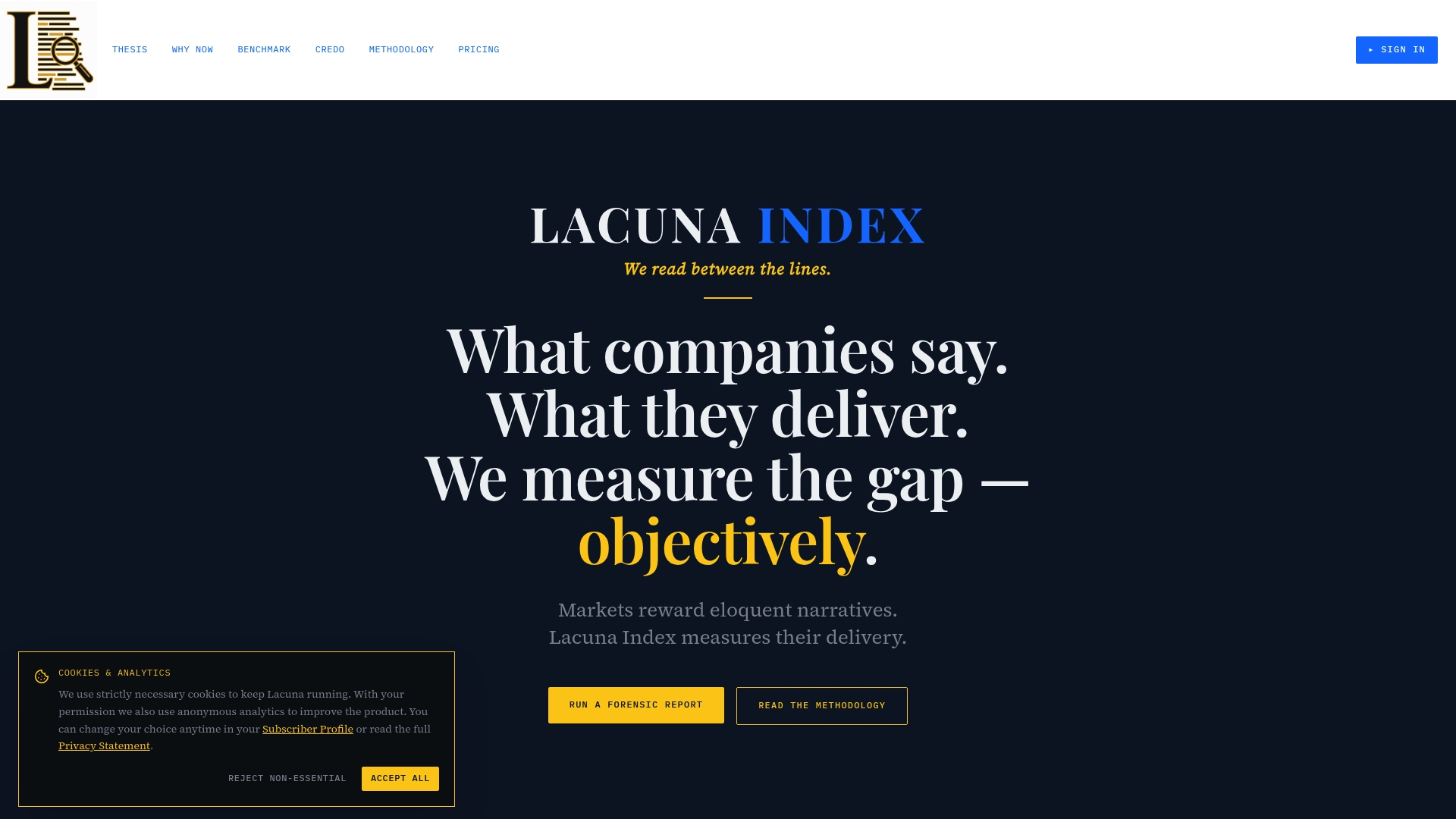
The Per-company analysis product delivers a full forensic report on a single issuer, with an evidence log formatted for direct citation. For coverage across an entire industry, Cohort Pulse and Sector Sweep extend the same scoring methodology to peer groups, so you can see whether a company's crisis-period divergence is an outlier or an industry norm. Free sector benchmarks are available to preview the scoring approach before subscribing. Full plan details and access are listed on the pricing page.
Selected Primary Sources
- SEC MD&A / Item 303 guidance
- Cross-channel divergence study
- SEC enforcement release (SolarWinds)
- Mixed Messages: Crisis Communication–Dismissal (In)Coherence
Sources
- Commission Statement About Management's Discussion and Analysis of Financial Condition and Results of Operations
- Cross-channel divergence study (matched disclosure pairs)
- Research on managerial vagueness and market response
- SEC press release on enforcement action (SolarWinds)
- Mixed Messages: Crisis Communication–Dismissal (In)Coherence and Shareholder Trust Following Misconduct
FAQ
What Is Crisis Communications Analysis in a Forensic Context?
It is the comparison of a company's public statements during a crisis against its subsequent filings and actions, using only public records like 8-Ks, MD&A sections, and call transcripts. The goal is a quantified, citation-backed divergence finding rather than a subjective read on messaging quality.
What Is the Biggest Red Flag in Crisis-Period Disclosures?
Repeated risk-factor language that goes unchanged after the risk becomes a realized event is one of the strongest signals, since it suggests the MD&A wasn't updated to reflect what management already knew. Item 303 guidance explicitly requires disclosure to evolve once prior statements no longer foreshadow actual events.
How Does Managerial Vagueness Affect Stock Price?
A one-standard-deviation rise in vague, qualifying language measurably reduces how strongly the market reacts to earnings and correlates with higher crash risk in later periods. That makes vagueness a trackable input rather than a stylistic quirk.
What Does Lacunaindex Charge for a Per-Company Report?
Pricing for the Per-company analysis, Cohort Pulse, and Sector Sweep products is listed on the pricing page, since exact plan terms vary by coverage scope. Free sector benchmarks are available without a subscription.
When Should a Finding Be Escalated to Counsel?
Escalation makes sense once a divergence is corroborated across at least two independent record types, such as a call transcript contradicted by a later 8-K, rather than resting on a single ambiguous statement. Isolated signals generally warrant continued monitoring and logging instead of immediate escalation.