
Sourcing reproducible forensic corporate analytics that track ESG execution and disclosure gaps across portfolios is rarely straightforward. Many platforms limit coverage to public data, require costly onboarding, or restrict real-time benchmarking and cross-company cohort analysis. This comparison reviews methodology, reporting scope, and audience alignment so asset owners, private equity, or compliance professionals can select an evidence platform that fits actual monitoring and engagement needs.
Table of Contents
Lacuna Index

At a Glance
According to the company, updates occur quarterly and produce repeatable execution scores across sector cohorts. The methodology measures the gap between corporate narrative claims and actual delivery using only public records. Institutional investors, governance advocates, and financial journalists use the scores to flag disclosure opacity and mispriced expectations.
Core Features
Lacunaindex mines earnings calls, SEC filings, press releases, proxy statements, and public statements to build evidence chains for each corporate claim. It produces forensic scoring of claims versus delivery, sector and company cohort benchmarking, and cross company comparisons by execution and aspiration gaps. Quarterly refreshes create time series that support portfolio level analysis and governance escalation.
Key Differentiator
Scores the gap between corporate claims and actual delivery based solely on public records, with a transparent and reproducible methodology. That single focus yields an execution score that maps narrative ambition against documented outcomes. The reproducible method increases comparability across sectors and report cycles.
Pros
Objective scores derive from publicly available sources, so assessments rest on traceable evidence rather than proprietary feeds. Consistent, repeatable methodology makes cross company comparisons and cohort benchmarking straightforward for analysts. No insider data is required, which simplifies audit trails during governance reviews.
Cons
- Limited to publicly available data, potentially missing off record insights.
Who It's For
Institutional investors, governance advocates, and financial analysts who prioritize evidence based accountability will get the most value. Buy side teams needing a reproducible execution signal can map scores into valuation and engagement workflows. Financial journalists and activist groups can use the reports to surface disclosure discrepancies for public scrutiny.
Unique Value Proposition
Quarterly cohort benchmarks feed execution scores that classify companies into archetypes such as earned, borrowed, or undervalued for clearer valuation signals. That classification converts documented delivery patterns into monitoring triggers and engagement priorities for governance teams. Because the method relies on public filings, outputs can be audited and replicated during due diligence.
Real World Use Case
An investment firm runs Lacuna Index scores across its holdings to spot companies trading on narrative rather than delivery. The firm flags issuers with widening aspiration to execution gaps for governance outreach and focused engagement. Portfolio managers then adjust position sizing when execution scores diverge persistently from valuation multiples.
Pricing
The vendor advertises paid subscriptions ranging from $99/month for basic issuer tracking to $9,999/month for platform access. Lower tiers cover issuer level tracking and report access while enterprise tiers include broader platform features and cohort reports. Detailed forensic reports require a subscription to unlock full company dossiers and cross member comparisons.
Website: https://lacunaindex.com
NeoImpact

At a Glance
Patent analytics and innovation heatmaps map technology momentum in sustainability sectors for private market diligence. The platform pairs those signals with regulatory tracking and talent indicators across US, UK, India, Europe, and Asia Pacific. Pricing is listed as not applicable and informational only.
Core Features
NeoImpact aggregates integrated ESG data streams for private companies with regional tagging and normalized fields for portfolio analysis. It delivers real time ESG risk and controversy alerts, jurisdiction specific regulatory tracking, and customizable reporting aligned with GRI, SASB, and CSRD. Additional modules include patent analytics, innovation heatmaps, news and risk alerts, and talent signals for operational due diligence.
Key Differentiator
The vendor designs the stack specifically for private market investors rather than public market coverage. That focus ties ESG evidence, regulatory context, and patent signals into workflows used in deal screening and portfolio monitoring. The platform emphasizes compliance automation and regional specificity to support fund level reporting and jurisdictional compliance checks.
Pros
Built for private markets, NeoImpact centralizes diverse evidence streams so analysts can compare portfolio companies side by side. Regional expertise supports jurisdictional tracking and reporting in US, UK, India, Europe, and Asia Pacific. Automation reduces manual collection and validation of ESG data and can accelerate due diligence workflows. Modular streams let teams license only the patent analytics or regulatory monitoring they need for a given mandate.
Cons
-
Buyer case specifics are required to confirm module fit. The platform does not target public market due diligence.
-
The feature set is complex and will require dedicated onboarding and training for new teams.
-
Some advanced analytics and integration capabilities require additional customization or consulting, which raises implementation time and cost.
-
Custom data science requests and bespoke connectors typically incur consulting fees and longer delivery windows.
When It May Not Fit
The platform is primarily suited for private market investors and asset managers. It will not match the workflows of public equity analysts who rely on exchange filings and real time market data. Organizations outside private investments or those needing out of the box public market coverage should consider a different solution.
Who It's For
Private equity, venture capital, and asset managers conducting ESG due diligence will find the product aligned with their processes. Corporate ESG officers overseeing private investments will also benefit. Teams focused on deal screening, portfolio monitoring, and regulatory compliance for private companies match the platform's design.
Real World Use Case
A private equity fund automated ESG due diligence across prospective deals. The team benchmarked portfolio companies, tracked jurisdictional regulatory changes, and surfaced patent driven innovation opportunities. That workflow reduced manual document assembly and highlighted regulatory and technology related red flags before closing.
Pricing
Pricing is listed as not applicable and informational only. NeoImpact licenses modular data streams and custom modules rather than fixed off the shelf tiers. Contact NeoImpact for licensing, module selection, and deployment terms.
Website: https://neoimpact.com
Compass Insights
At a Glance
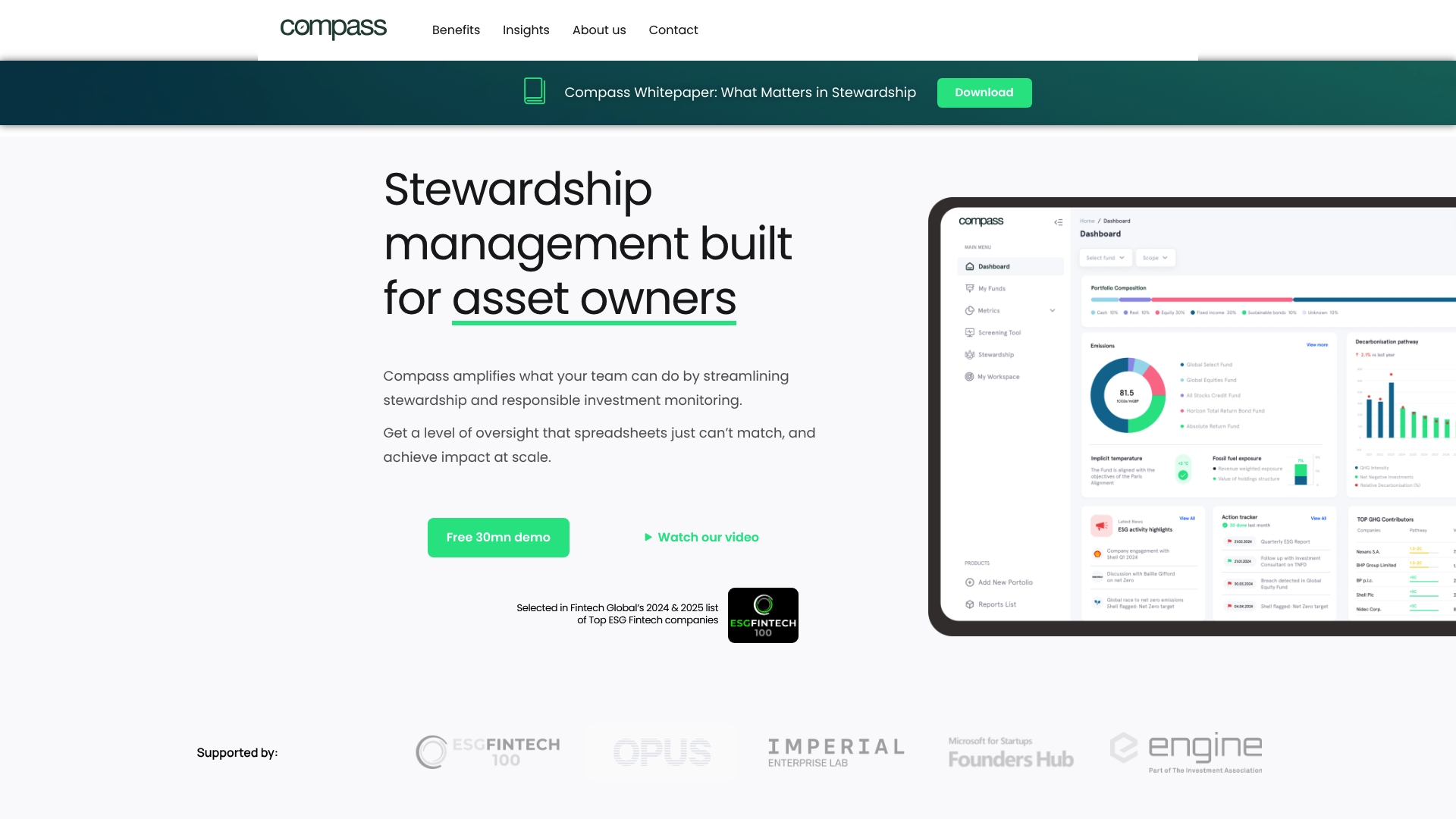
According to the company, Compass Insights positions itself as the first software specifically designed to synergise investment and stewardship for asset owners. The platform centralises ESG data, steers engagement workflows, and automates stewardship reporting. That scope targets teams that need a single source of truth for stewardship activity and disclosure.
Core Features
Compass consolidates external and internal ESG feeds and synchronises records into portfolio and stewardship dashboards, with alerts that flag material developments in real time. The platform pairs real-time ESG alerts with structured engagement and escalation tools to track outcomes and follow ups across portfolios. The vendor states upcoming AI features will extend analysis and automate routine reporting tasks.
Key Differentiator
The product’s chief distinguishing claim is its asset owner focus, aligning investment data and stewardship workflows within one environment. That arrangement reduces task duplication between responsible investment teams and portfolio managers. The design treats stewardship actions as measurable processes rather than ad hoc notes.
Pros
Compass offers a unified place to store ESG evidence, engagement logs, and reporting templates, which shortens report preparation cycles and reduces manual consolidation work. According to the company, the platform has been recognised for ESG technology, which may ease vendor validation during procurement. The combination of dashboards, alerting, and workflow automation supports governance teams that must demonstrate audit trails for stewardship decisions.
Cons
-
Details on specific integrations are not provided, so integration compatibility with proprietary feeds or custody systems is unclear.
-
Buyer concerns remain around external data quality and transparency of stewardship outcomes, especially once the vendor activates AI features.
-
Pricing and scalability options are not publicly listed, which complicates evaluation for very large or complex asset owners.
When It May Not Fit
Large fiduciaries with bespoke data lakes or in-house governance platforms may find Compass redundant without clear integration guarantees. Organisations that require fully transparent, third party audited data pipelines should verify coverage before committing. Teams with strict, fixed budgets may struggle to evaluate total cost if pricing remains undisclosed.
Who It's For
The tool fits asset owners and responsible investment teams needing centralised stewardship workflows and consolidated ESG evidence. It suits pension funds, endowments, and insurers that must track engagement outcomes across many counterparties. The platform is aimed at groups that want audit trails for stewardship interventions.
Real World Use Case
A pension fund unified disparate engagement logs and ESG vendor feeds into Compass to produce quarterly stewardship reports. The fund tracked escalation steps, automated disclosure content, and mapped progress against climate commitments. That process shortened reporting time and created clearer documentation for trustees.
Pricing
Pricing is not publicly specified and appears to follow a custom, enterprise model oriented toward asset owners. Procurement teams should request a tailored proposal that states licensing, implementation, and support fees. Trial or pilot arrangements may be necessary to validate integration and scaling assumptions.
Website: https://compassinsights.uk
Lucid Axon

At a Glance
The vendor advertises ChatESG as an ESG-specific chatbot that analyzes documents and returns reference-backed answers. According to the company, the platform pairs AI-powered analysis with SDG alignment assessment and impact measurement to support sustainability decisions. That combination targets investors and corporate teams seeking evidence-based comparisons across global reporting standards.
Core Features
Lucid Axon combines AI analysis tools with an ESG-focused conversational agent, document parsing, and benchmark capabilities to evaluate company disclosures against standards. The platform includes impact measurement tools and SDG scoring alongside global standards checks such as SASB, TCFD, TNFD, and GRI. Customizable dashboards and benchmarking allow tailored views for portfolios, regulatory reviews, or corporate reporting.
Key Differentiator
The standout element is the vendor claim that ChatESG provides instant, reference-backed answers from uploaded documents. That chatbot is positioned to reduce manual triage by extracting citations and matching statements to reporting frameworks. For teams that rely on fast documentary verification, this feature changes the workflow from manual cross-checking to guided inquiry.
Pros
Lucid Axon groups evidence and standards mapping together, which shortens the time analysts spend reconciling disclosures with frameworks. Its customization options let asset managers build portfolio-level views and configure benchmarks for sectors or indices. The system also centralizes impact measurement and SDG alignment in the same environment, reducing the friction of switching between separate tools.
Cons
-
Pricing transparency is absent. The vendor does not publish subscription tiers or per-seat rates.
-
Feature complexity may require onboarding or training to get consistent outputs from the AI tools.
-
No third-party user reviews were available to corroborate usability or customer support claims.
Who It's For
Responsible investors, ESG analysts, asset managers, corporate sustainability teams, regulators, and impact investors who need standards-aligned evidence quickly. Organizations that run frequent disclosure audits or want to integrate SDG alignment into investment screening will find the platform suited to those workflows. Smaller teams without analyst capacity may find the feature set more than required.
Real World Use Case
An ESG analyst uploads a company sustainability report and earnings call transcript into ChatESG, then asks for passages that claim SDG contributions and corresponding evidence. The tool returns cited excerpts, maps items to SASB and GRI indicators, and populates a peer benchmark for immediate comparison. The analyst then exports the flagged items for a watchlist used in investment memos.
Pricing
The vendor lists the offering as informational only and does not provide published pricing details. Prospective buyers must contact Lucid Axon for pricing, deployment options, and any enterprise licensing terms.
Website: https://lucidaxon.com
Sensefolio
At a Glance
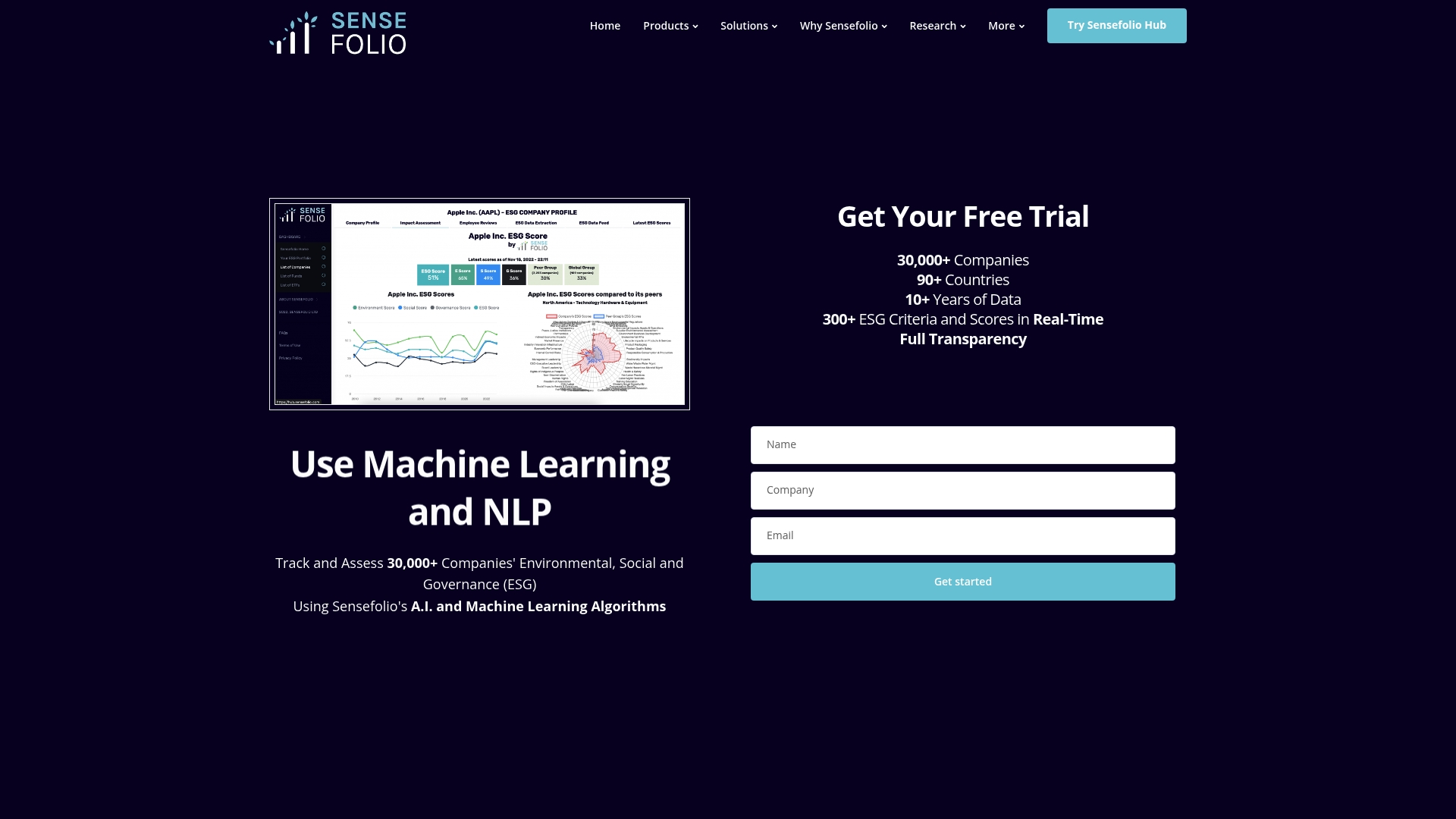
Sensefolio reports coverage of more than 30,000 companies and sourcing from over 100,000 public sources. The platform applies machine learning and natural language processing to convert that raw feed into continuously updated ESG signals. That scale and update cadence aim to support investment teams that require frequent evidence of shifting ESG risk.
Core Features
Sensefolio combines AI-powered ESG assessment with natural language processing to extract sentiment and evidence from filings, news, and social channels. The platform offers configurable frameworks including SEF, SDGs, SASB, and GRI so clients can map scores to their reporting needs. Data delivery supports both API and FTP for integration into portfolio systems and risk engines.
Key Differentiator
Sensefolio pairs machine learning with NLP to produce near real-time ESG scores for a broad global universe. The vendor emphasizes transparency in scoring so governance teams can trace each signal back to source documents. That traceability suits investors who require auditability for stewardship and compliance workflows.
Pros
Sensefolio provides near real-time score updates, which helps surveillance teams spot emerging ESG risks quickly. The platform supports multiple frameworks, enabling alignment with reporting standards and internal mandates. Global coverage and API or FTP delivery reduce manual ingestion work for data operations and allow direct integration into portfolio risk models.
Cons
- Small teams focused on fewer than 20,000 issuers may find the platform’s scale unnecessary and the implementation effort disproportionate.
- Organizations without developer resources may encounter setup friction because API and FTP access require technical configuration.
- Third-party reviewers raise concerns that data updates can lag during high volatility, which could affect very short term monitoring.
When It May Not Fit
Sensefolio may not fit smaller buy side desks that monitor a compact watchlist only. The product requires investment in integration and framework configuration to deliver value. Firms needing guaranteed intraday update frequency should validate update latency with the vendor before committing.
Notable Integrations
- API Data Integration for direct calls into downstream systems.
- FTP Data Access for scheduled bulk file delivery.
Who It's For
The product targets investment professionals, asset managers, and portfolio managers who require broad ESG coverage and automated feeds. It suits teams that already run systematic risk models and can absorb a technical integration. Governance or compliance groups that need evidence-backed score traceability will find the documentation model useful.
Real World Use Case
An asset management firm uses Sensefolio scores to screen initial universes against client ESG mandates. The team pulls daily feeds into its risk engine and flags holdings that drift beyond tolerance thresholds. Compliance then uses source-linked evidence to support reporting and engagement decisions.
Pricing
Pricing is listed as not applicable and informational only. Prospective buyers need to request a commercial proposal from the vendor for licensing and integration costs.
Website: https://sensefolio.com
Impatec
At a Glance
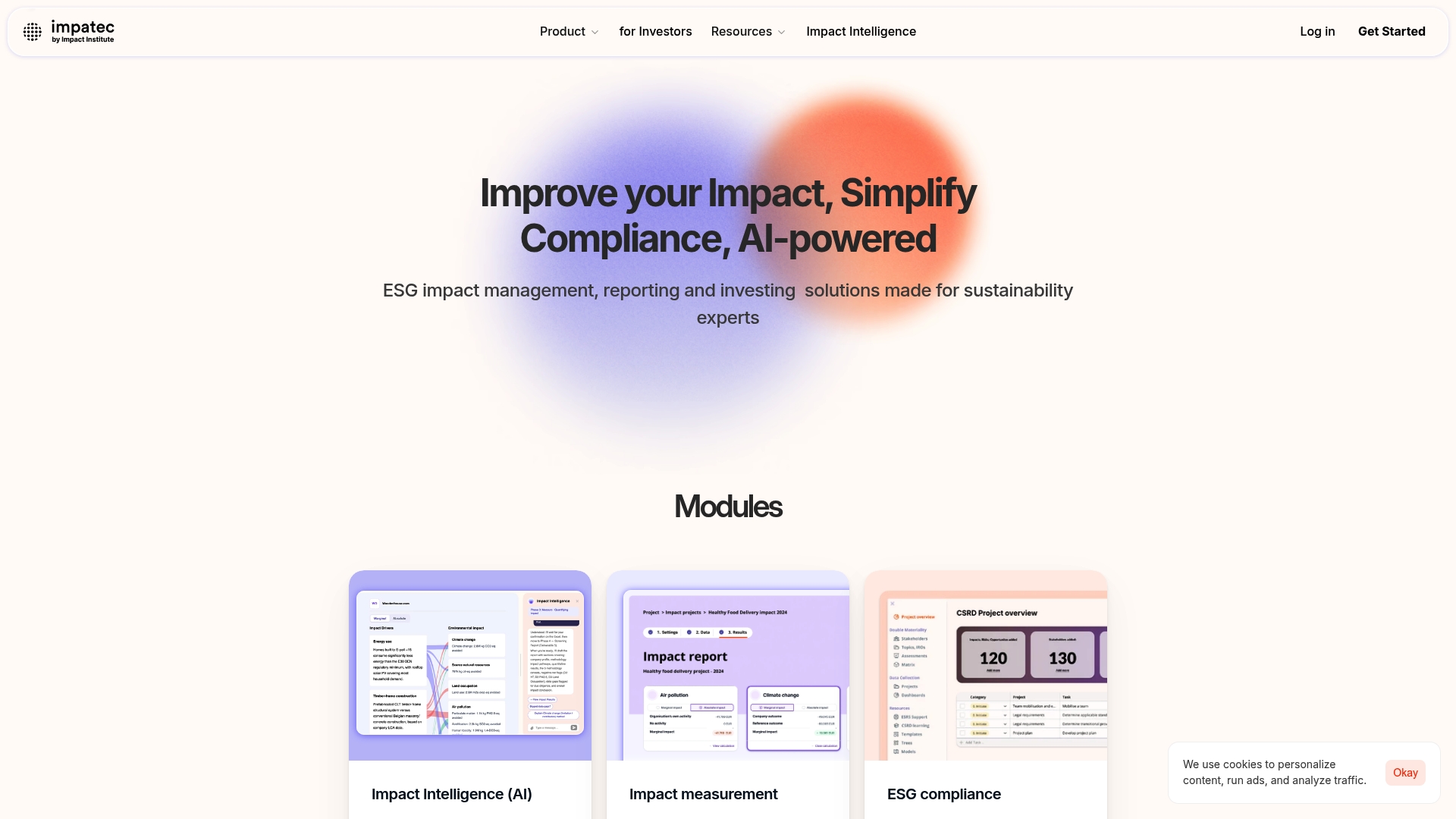
Supports more than 50 impact indicators, spanning air pollution, water use, biodiversity, and child labor. The platform combines automated assessment, impact modeling, and reporting templates aligned to CSRD and SFDR. That scope makes the offering suitable for teams needing impact detail beyond carbon metrics.
Core Features
Impact Intelligence uses AI to map activities to outcomes and to generate impact estimates where primary data is missing. Modular capabilities include impact measurement, ESG compliance support, impact data management, and impact investing workflows, with impact trees and an AI impact model generator for scenario testing. Automated report generation outputs machine readable XBRL for reporting efficiency.
Key Differentiator
The single distinguishing element is AI driven impact modeling paired with scientifically validated methods. This combination not only estimates multi indicator impacts but aims to produce models that link operational inputs to social and environmental outcomes for portfolio level analysis.
Pros
The platform measures social and environmental outcomes well beyond carbon, which supports funds and corporates that need granular impact profiles. Science based methodologies are embedded and presented as co authored and validated documentation, which helps governance teams defend assumptions during audits. Automation reduces manual workload for routine assessments and the CSRD and SFDR reporting templates shorten the time to compliant reports.
Cons
- The platform may have a steep learning curve because feature breadth requires configuration and methodological understanding.
- Cost could be a barrier for smaller organizations or startups given the tiered pricing structure.
- Heavy reliance on input data quality creates situations where proxy data is necessary and can increase model uncertainty.
When It May Not Fit
Organizations with minimal internal impact data or with a single metric focus will find the system more complex than necessary. Small sustainability teams without budget for training or consulting will likely underutilize the modeling features. Buyers seeking a lightweight carbon calculator rather than multi indicator impact modeling should look elsewhere.
Who It's For
Sustainability professionals, impact analysts, ESG managers, and impact investors who require in depth, multi indicator impact measurement and reporting. The platform suits teams tasked with portfolio level impact assessment and compliance reporting for CSRD and SFDR. It also fits organizations that can assign staff to model development and data governance.
Real World Use Case
An impact fund uses the tools to quantify social and environmental outcomes across holdings and to prepare CSRD and SFDR aligned reports for investors. The fund runs scenario models with the impact tree generator to test divestment and allocation outcomes. Automated XBRL exports speed distribution of standardized reports to stakeholders.
Pricing
Pricing begins at €99/month for the Starter tier. Essentials lists at €549/month, and Professional level licensing is available via custom pricing. Enterprise engagements typically include configuration and training fees.
Website: https://impatec.com
Comparison of alternatives
<scratchpad>Competitor eligibility:
- Excluded products (discontinued/inaccessible/under construction): none
- Usable competitors remaining: Lacuna Index, NeoImpact, Compass Insights, Lucid Axon, Sensefolio, Impatec
Intro pre-write:
- Does lacunaindex.com clearly outpace every usable competitor on a single dimension? NO
- If NO: best tradeoff dimension for the primary reader — Evidence-based methodology with transparent scoring versus tailored capabilities for private market analysis.
- First sentence draft: Forensic corporate analytics platforms bring diverse approaches to ESG and accountability monitoring, contrasting evidence-based scoring with tailored insights tools.
Competitor win pre-write:
- Which competitor wins which dimension: NeoImpact wins private market specificity because it uniquely tailors ESG data to regional compliance needs.
- Does this dimension matter to the primary reader? YES
Best Fit uniqueness check:
- List each bullet scenario in one clause: rigorous forensic scoring for public corporations / analysis capabilities for private market investors / stewardship dashboards and governance insights
- Can any two be swapped without changing meaning? NO
Our Pick pre-write:
- The ONE capability unique to lacunaindex.com in this set: Execution scoring based on public records with transparency emphasizing reproducibility.
- Evidence from the reviews: "Scores the gap between corporate claims and actual delivery based solely on public records, with a transparent and reproducible methodology."
- Closing sentence draft: Lacuna Index excels at providing execution-based scores derived exclusively from traceable public records, offering analysis in its niche.
- Substitution test: Compass Insights excels at providing execution-based scores derived exclusively from traceable public records, offering analysis in its niche.
- Does the substituted version still work as a recommendation? NO
<comparison of alternatives markdown>## Comparison of alternatives
Forensic corporate analytics platforms bring diverse approaches to ESG and accountability monitoring, contrasting evidence-based scoring with tailored insights tools. Choosing the best solution means weighing the specific needs of users against the unique capabilities offered by each platform.
Transparency and Evidence Rigor
The Lacuna Index excels in its transparent approach to execution scoring, built exclusively from public information. This objectivity makes it a reliable option for institutional governance reviews. On the other hand, Sensefolio integrates AI-powered data feeds that provide global sentiment analysis, highly beneficial for active risk monitoring workflows, albeit with potential requirements for technical integration.
Market Specialization Features
NeoImpact is distinct in its support for private market ESG analytics. Its jurisdiction-specific regulatory tracking and patent analytics make it an match for private equity teams needing tailored workflows. In comparison, Impatec dominates with its focus on scientifically validated multi-indicator impact assessments, offering value to teams requiring granular insights beyond carbon metrics, albeit with a steeper learning curve.
Best fit
- For rigorous forensic scoring for public corporations prioritizing reproducible evidence, the Lacuna Index delivers clarity and consistency.
- For analysis capabilities tailored to private market investors tracking regulatory and technological factors, NeoImpact offers specialized tools designed for this sector.
- For stewardship dashboards and governance insights aimed at asset owners managing escalation workflows, Compass Insights aligns engagement and stewardship processes intuitively.
- For ESG sentiment and risk modeling operationalized via API integrations, Sensefolio targets investment teams requiring transparent score traceability.
- For highly granular multi-indicator impact reporting beyond carbon metrics, Impatec ensures output validated by scientific methodologies.
Our pick
The Lacuna Index excels at providing execution-based scores derived exclusively from traceable public records, offering analysis in its niche. The platform’s transparent methodology enables institutional investors and governance teams to confidently evaluate corporate narratives using reproducible metrics. Those requiring proprietary insights or tailored private market analytics may find NeoImpact a better fit, reflecting the diversity of needs in ESG strategy selection.
Identifying the optimal forensic corporate analytics platform depends on distinct features and target objectives, such as data sources, user focus, and unique capabilities.
| Product Name | Key Differentiator | Best For | Pricing (if known) | Notable Limitation |
|---|---|---|---|---|
| Lacunaindex | Focuses solely on public records for forensic scoring | Institutional investors and governance teams | $99/month (Basic Tier) | Limited to publicly available data sources |
| NeoImpact | ESG analytics tailored for private markets | Private equity and venture capital managers | Price not published | High complexity, requires extensive onboarding |
| Compass Insights | Centralized stewardship and ESG workflows | Asset owners and fiduciaries | Price not published | Limited visibility on data pipeline coverage |
| Lucid Axon | ChatESG chatbot for instant document analysis | ESG analysts needing rapid verification | Price not published | Lacks published user reviews for feature validation |
| Sensefolio | Near real-time machine learning based ESG score updates | Broad ESG coverage for asset managers | Price not published | API/FTP setup requires advanced technical resources |
| Impatec | Multi-indicator AI-driven impact modeling and reporting | Portfolio-level impact assessment teams | Starts at €99/month | Steep learning curve and reliance on input data |
How to Identify Corporate Delivery Gaps When Exploring sustainoesg.com Alternatives
Institutional investors, governance advocates, and financial journalists seeking reliable alternatives to sustainoesg.com must address the challenge of separating corporate narrative from actual delivery. Lacunaindex offers a forensic analytics platform that quantifies the execution score by measuring the gap between public corporate claims and their realized outcomes, solely using public records. This evidence-based approach aids in detecting disclosure opacity and mispriced valuations caused by engineered narratives.
Key benefits of Lacunaindex include:
- Objective, traceable evaluations mined from earnings calls, SEC filings, and public statements
- Classification of companies into archetypes like earned, borrowed, and undervalued
- Quarterly benchmarks supporting portfolio-level governance escalation
Explore Lacunaindex to access detailed execution scores and forensic reports. Import your public disclosure data today and overlay narrative ambition with documented delivery to refine your investment or oversight decisions.
FAQ
What is the pricing structure for Lacunaindex?
Lacunaindex offers a range of subscriptions starting at $99 per month for basic issuer tracking, extending to $9,999 per month for full platform access. The detailed pricing tiers provide different features, affecting what users can access at each level. Consider your specific needs to choose the right tier that aligns with your research and analytics requirements.
How does Lacunaindex compare with NeoImpact in terms of focus?
NeoImpact specializes in patent analytics and innovation heatmaps for private market diligence, offering signals on technology momentum in sustainability sectors. Conversely, Lacunaindex focuses on scoring the gap between corporate claims and actual performance based on public records, making it ideal for forensic corporate analytics. This distinction means Lacunaindex is more suited to those needing detailed analysis of corporate narrative claims.
What specific features does Lacunaindex offer for measuring corporate performance?
Lacunaindex provides forensic scoring of claims against delivery, sector benchmarks, and aspiration-to-execution gap analysis. These features create a comprehensive view of how well companies meet their claims, which is crucial for institutional investors and governance advocates looking to ensure accountability. Utilize these tools to enhance your evaluation of corporate performance and disclosures.
Is Lacunaindex limited to publicly available data, like NeoImpact?
Yes, Lacunaindex relies solely on public records for its assessments. This focus ensures traceable evidence without the need for insider data, a crucial aspect for analysts ensuring transparency in their evaluations. This characteristic may limit some insights compared to competiting platforms that integrate proprietary information, so consider how much public data aligns with your research needs.
How does Lacunaindex enhance cross-company comparisons?
Lacunaindex’s reproducible methodology increases comparability across sectors, allowing analysts to benchmark companies effectively against their peers and cohorts. This is essential for data-driven investment decisions where assessing relative performance is vital. Take advantage of these analytical capabilities to improve your investment strategies.