
Filtering forensic disclosure analytics platforms for defensible corporate metrics often reveals gaps between evidence scoring, sector benchmarks, and narrative delivery methodologies. Many alternatives demand enterprise subscriptions, restrict transparent scoring rule access, or do not disclose integration limits for smaller analyst teams. This comparison equips analysts to align forensic disclosure tools with workflow needs and defensibility constraints before engaging procurement or subscription trials.
Table of contents
- Lacuna Index
- MSCI ESG Investing Solutions
- Sustainalytics
- ISS ESG Solutions
- Reprisk
- Comparison of alternatives
Lacuna index
At a glance
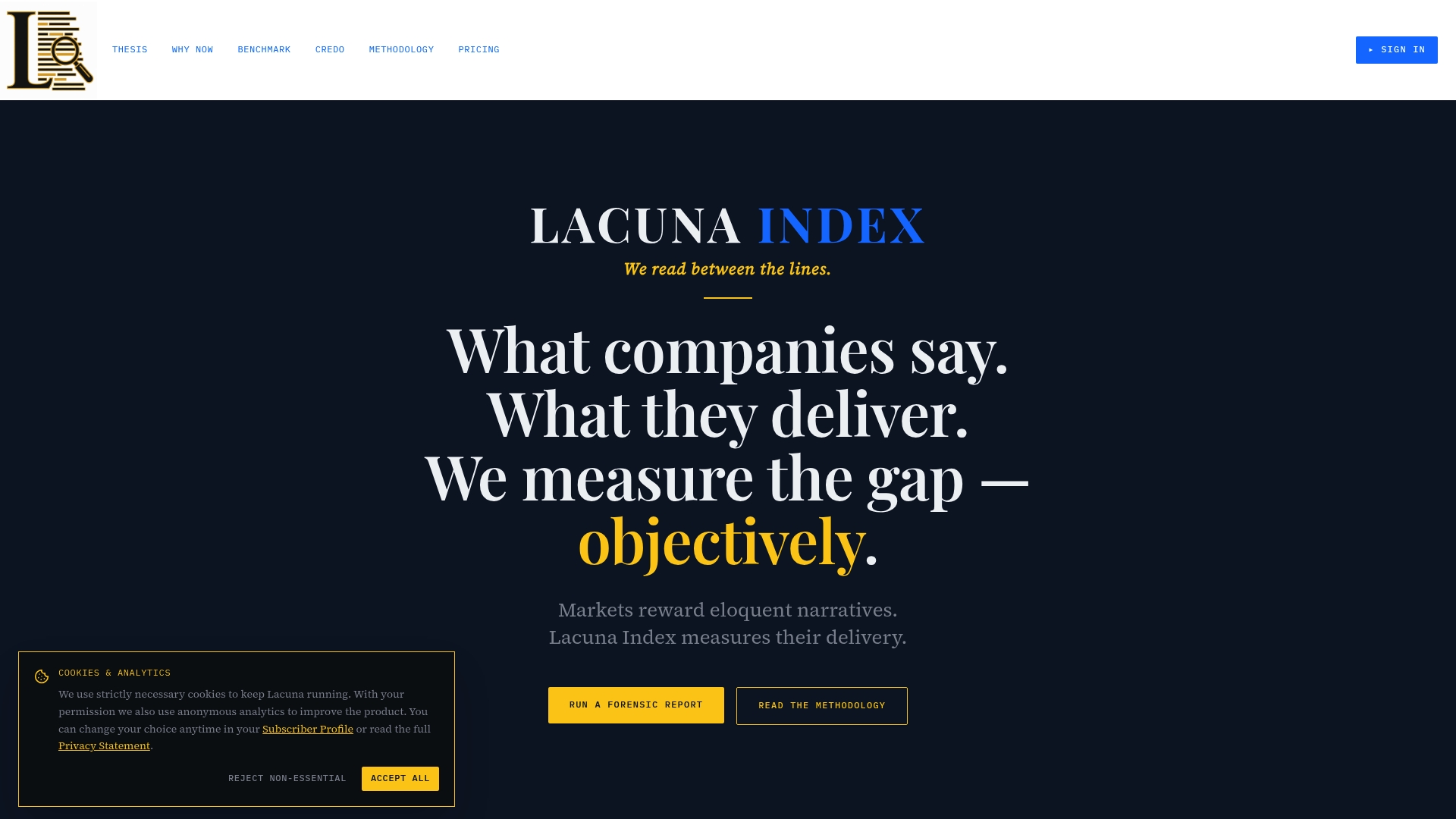
Lacuna Index issues execution scores and classifies companies into archetypes such as earned, borrowed, or undervalued. It derives those outputs exclusively from public records including earnings calls, SEC filings, press releases, proxy statements, and public statements. The result is a reproducible set of measures designed to reveal gaps between corporate narrative claims and observable delivery.
Core features
- Forensic analysis sourced from public records. The system mines standard disclosures and public statements to build evidence sets for each claim.
- Objective scoring across several dimensions. Scores cover evidence, disclosure, execution, narrative, and financial delivery.
- A reproducible methodology applied uniformly. Scoring rules and caps are explicit so results repeat across analysts.
- Sector benchmarks for peer comparison. Benchmarks let analysts compare a company score to its sector cohort.
- Transparent evidence hierarchy that governs how claims translate into score weight.
Key differentiator
Systematic, evidence based measurement of the gap between corporate claims and actual delivery using public records. Lacuna Index maps discrete public statements to scored evidence items and aggregates those items into execution metrics. That process focuses on what companies have demonstrably delivered versus what they claim. The methodology avoids insider feeds and relies only on publicly available documents.
Pros
-
Automates claim verification at scale. This reduces manual disclosure review and produces consistent scoring across many companies.
-
Improves transparency and reproducibility. The explicit scoring rules let an analyst audit how a final score was produced.
-
Helps investors and watchdogs prioritize inquiries. Scores highlight where narratives lack supporting evidence and where valuation may reflect engineered messaging.
-
Uses only public information. This removes dependence on proprietary or insider data and keeps findings defensible in public reporting.
-
Provides sector context. Benchmarks clarify whether a company is out of line with peers on disclosure quality or execution.
Cons
- Limited to public disclosures. The service can miss non public actions or misrepresentations that do not appear in standard filings or statements.
Who it's for
Institutional investors, governance advocates, and investigative journalists who evaluate public company disclosures. Compliance teams and financial analysts who require a reproducible, evidence based view of corporate claims will find the output useful. The tool is not a substitute for private due diligence when non public data matters.
Unique value proposition
Execution scores tied to a transparent evidence hierarchy and capped scoring rules. That design converts qualitative corporate claims into quantitative metrics that can be fed into valuation models or risk screens. The platform also maps scores to archetypes so an analyst can link disclosure credibility to possible mispricing in the market.
Real world use case
An investment firm runs Lacuna Index across a target sector before committing capital. The firm flags companies where narratives outpace evidence and then prioritizes deeper diligence on those names. That workflow shortens the list of candidates and focuses analyst time on the highest disclosure risks.
Pricing
Not applicable — informational only. Publicly visible materials describe the methodology and sample outputs. Subscription access is required for the full forensic reports and controlled access tiers for detailed company dossiers.
Website: https://lacunaindex.com
MSCI ESG investing solutions
At a glance
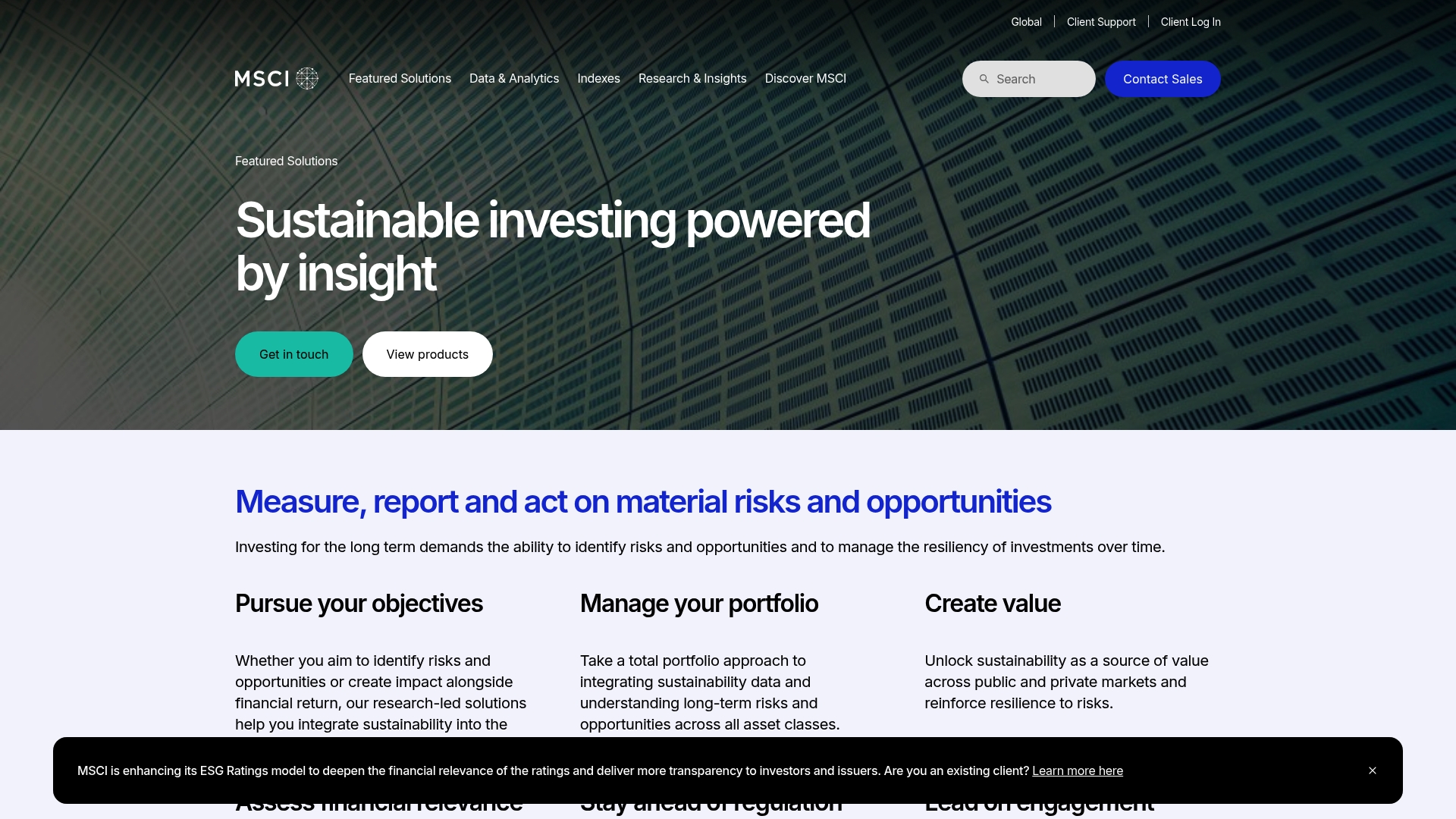
According to the company, MSCI offers conversational AI that lets analysts query index composition and related ESG signals. The vendor emphasizes proprietary ESG Ratings and index analytics as core inputs for portfolio risk work. That toolset targets institutional workflows for benchmarking, risk management, and regulatory reporting.
Core features
-
ESG Ratings to evaluate company exposure across environmental, social, and governance vectors. These ratings feed portfolio screening and risk flags.
-
Sustainability Reporting tools for regulatory disclosures and investor reporting workflows. The feature set maps to common reporting templates.
-
Corporate Sustainability Insights for sector benchmarking and deeper company-level analysis using MSCI data.
-
Impact Solutions aligned with measurable societal or environmental outcomes for clients seeking alignment strategies.
-
Index Composition Viewer to inspect how index inclusion links to sustainability criteria and potential capital flows.
Key differentiator
MSCI pairs broad proprietary datasets with index-level tooling to connect ESG signals to market structure. That combination supports analysis of index construction, inclusion mechanics, and capital-flow implications for large portfolios. Unlike Lacunaindex, which quantifies aspiration-to-execution gaps from disclosures, MSCI focuses on dataset breadth and index transparency for decision support.
Pros
-
Deep data coverage. The vendor delivers large ESG data sets and ratings that integrate with portfolio risk workflows.
-
Research-led approach. MSCI combines proprietary data and published methodologies to support analyst due diligence.
-
Coverage across public and private markets. Offerings include climate, regulatory reporting, and private-market analytics.
-
Index and reporting tools. The Index Composition Viewer and reporting modules help connect ESG signals to benchmark exposure.
-
Client footprint. The firm cites a global institutional client base that uses these products for benchmarking and compliance.
Cons
-
Steep learning curve reported by third parties for new users. The product suite can require time to map to existing workflows.
-
Limited public detail on customization and integration options. Available information does not specify connector or API depth.
-
Pricing not publicly disclosed. The vendor does not list standard entry-level packages or self-serve plans.
Who it's for
Institutional investors, asset managers, asset owners, private-market investors, and corporate sustainability teams that require extensive ESG data and index transparency. The product suits teams that allocate resources to integrate vendor data into risk models and reporting chains.
Real world use case
A leading asset manager uses MSCI’s ESG Ratings and the Index Composition Viewer to flag high ESG risk issuers. The team benchmarks portfolio exposure against sustainable indices and produces regulatory-ready sustainability reports for investors and regulators.
Pricing
Pricing is not publicly specified. The vendor appears to use subscription or tailored enterprise agreements rather than off-the-shelf self-serve plans.
Website: https://msci.com/our-solutions/esg-investing
Sustainalytics
At a glance
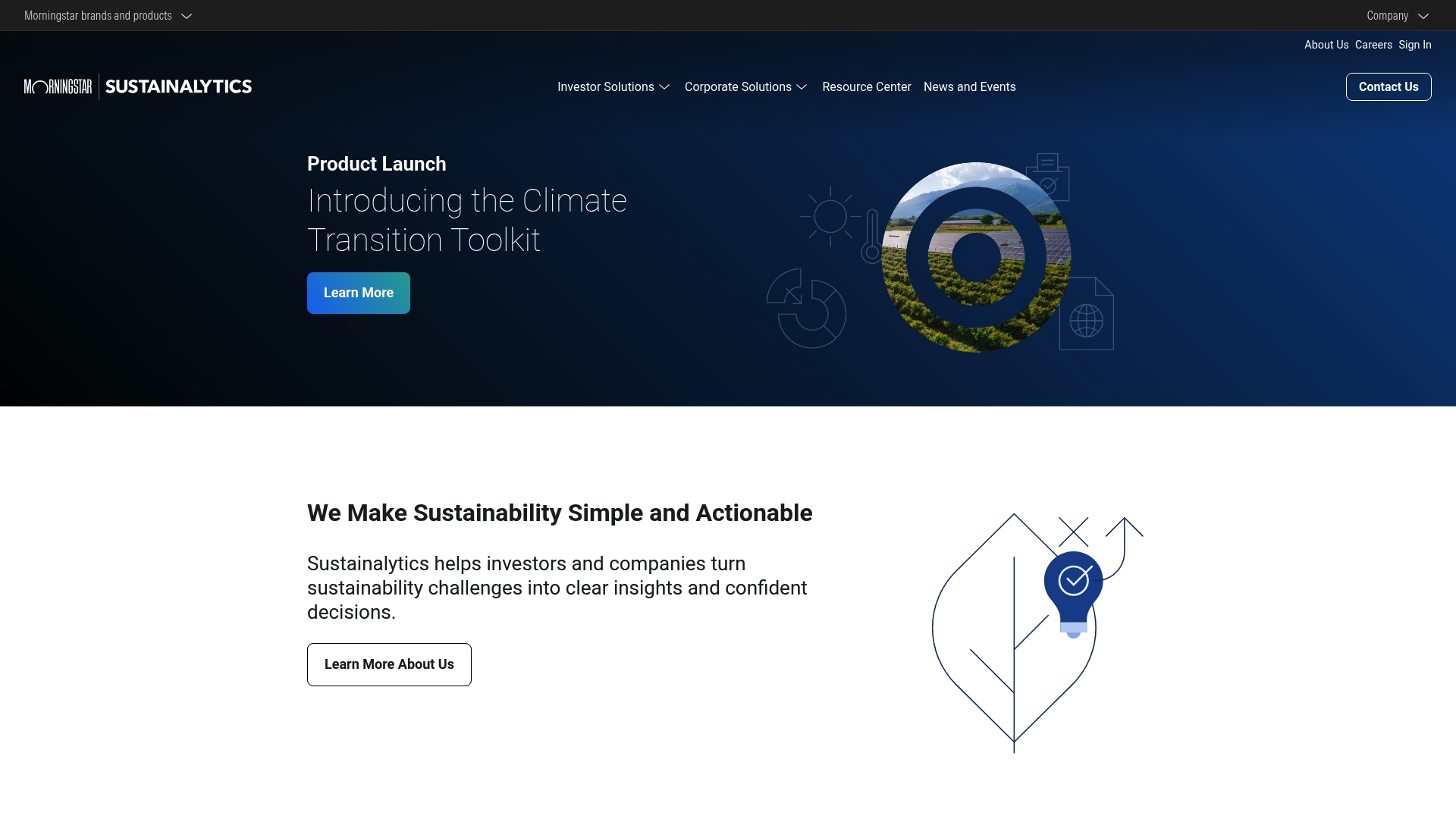
Part of Morningstar, Sustainalytics pairs ESG risk ratings with climate transition analysis and API data feeds. The suite covers investor and corporate workflows from screening to regulatory reporting. That mix makes it a frequent choice for firms that need granular, disclosure-based ESG inputs.
Core features
- ESG risk ratings and research. Ratings derived from public filings and company disclosures to map material ESG exposures.
- Climate risk and transition analysis. Scenario-based tools and metrics for transition planning and physical risk assessment.
- Regulatory compliance and screening. Rule-driven screening for mandates, exclusions, and regulatory reporting.
- API and data feed solutions. Machine-friendly feeds and connectors for portfolio systems and internal models.
- Customizable dashboards and models. Configurable views for portfolio managers, compliance teams, and corporate sustainability groups.
Key differentiator
According to the company, Sustainalytics offers one of the most comprehensive and granular ESG risk ratings with a proven track record of transparency and quality. That claim maps to broad coverage across sectors and deep issue-level scoring. The vendor combines research outputs with feedable data and regulatory tooling, so teams can move from signal to operational use without rebuilding models.
Pros
- Strong reputation for methodological clarity and disclosure tracing. The research links ratings to cited public documents, which aids auditability.
- Extensive and granular coverage across companies and ESG topics. Coverage supports issue-level due diligence and portfolio-level aggregation.
- Climate and regulatory modules designed for institutional workflows. The modules include scenario outputs and screening rules practical for compliance teams.
- Flexible delivery options via API services and data feeds. This reduces manual export work and feeds internal systems directly.
- Vendor support oriented toward regulatory and risk use cases. Sustainalytics provides implementation help for reporting requirements.
Cons
- Complex data structures often require advanced technical expertise to integrate. Smaller teams may need developer time or consultancy support.
- Pricing and licensing are generally tailored and may be costly for smaller organizations. The vendor typically negotiates enterprise contracts rather than offering fixed public tiers.
- The breadth of data can feel overwhelming without a clear ingestion plan. Organizations must design internal models to synthesize signals.
When it may not fit
Organizations with one-off ESG needs or limited engineering capacity will likely find Sustainalytics too heavyweight. Smaller asset managers or boutique research shops that cannot commit to integration resources may prefer simpler, packaged data. Teams that need commodity ESG scores for a spreadsheet may also find the product more than required.
Notable integrations
- API services. Direct programmatic access for ratings and scores.
- Data feeds. Batch and streaming feeds for portfolio systems.
- Dashboard tools. Connectors to visualization stacks and client portals.
Who it's for
Institutional investors, asset managers, and corporate sustainability teams that require in-depth ESG analysis and regulatory solutions. The product fits organizations that plan to operationalize ESG data across risk, compliance, and investment decision processes.
Real world use case
An asset manager integrates Sustainalytics ESG risk ratings via API services into their portfolio system. The feeds populate risk dashboards and compliance screens. Portfolio teams then filter holdings by issue-level exposures and generate regulatory reports from the same data source.
Pricing
Pricing is not published and is negotiated on a contract basis. The product data indicates arrangements are tailored to enterprise needs and use cases rather than fixed public plans.
Website: https://sustainalytics.com
ISS ESG solutions

At a glance
DataDesk and RiskDesk deliver publisher-level regulatory datasets and climate analytics aimed at institutional workflows. The platform aggregates raw ESG datapoints, scored sustainability ratings, and screening tools for issuer and portfolio analysis. That scope targets compliance, stewardship, and portfolio risk teams rather than research groups focused on narrative versus delivery gaps. The offering suits firms that require validated inputs for reporting and risk models.
Core features
- Raw environmental, social, and governance datapoints mapped to issuers and funds for programmatic analysis.
- Sustainability ratings and rankings designed for comparative screening and portfolio overlays.
- Screening tools for issuer selection and portfolio research across sectors.
- DataDesk and RiskDesk platforms that surface regulatory datasets and climate and nature risk metrics.
Key differentiator
The vendor positions its strength in combining proprietary, validated datasets with an enterprise analytics layer for global ESG and climate risk assessment. That combination emphasizes dataset provenance and chain of evidence for compliance workflows. Compared with Lacunaindex, the emphasis is on data ingestion, scoring, and regulatory alignment rather than forensic delivery scoring from public narratives.
Pros
-
Extensive global coverage. The platform covers companies, sovereigns, funds, and controversies for cross-asset work.
-
Transparent methodology claims. The vendor documents scoring logic to support audit and compliance needs.
-
Climate and nature analytics. Tools translate physical and transition risk inputs into portfolio-level exposures.
-
Engagement and stewardship support. Bespoke services help stewardship teams manage issuer dialogues and escalation.
-
Issuer and portfolio access. Platform views allow both issuer-level deep dives and aggregated portfolio reporting.
Cons
-
Complexity may require a dedicated data or quant team to onboard and operationalize effectively.
-
Pricing information is not publicly detailed, which may slow procurement for midmarket teams.
-
The breadth of features can overwhelm smaller investment teams that need a narrow, rapid signal set.
When it may not fit
Firms without a data engineering resource will struggle to extract full value. Smaller asset managers and individual investors may find cost and feature depth excessive for their needs. Users seeking forensic narrative gap metrics similar to Lacunaindex will find the focus different and less aligned with delivery-versus-claim analysis.
Who it's for
Large institutional investors, asset managers, and compliance teams that must integrate ESG and climate data into regulatory reporting and investment processes. Treasury and risk teams that run portfolio exposures and need audited data chains will benefit most. Boutique research shops will likely find the offering heavier than required.
Real world use case
A pension fund uses the climate analytics to quantify transition risk across equity and credit holdings and to generate regulatory disclosures. The fund feeds issuer-level datapoints into scenario models and uses stewardship services to prioritize engagements aligned with net-zero targets. That workflow aligns data, analytics, and engagement in a single procurement.
Pricing
The vendor lists pricing as not applicable and informational only, indicating enterprise commercial engagement is required for cost details. Procurement typically proceeds via tailored quotes and consultancy scoping rather than published tiers.
Website: https://issgovernance.com/esg
Reprisk

At a glance
According to the vendor, Reprisk has operated for two decades and works with major financial institutions and international agencies. The service combines machine learning signals with expert human review to surface reputational and ESG risk across global companies and projects. That mix targets compliance teams and asset managers that need continuous alerts tied to public disclosures and media tracking.
Core features
Reprisk delivers AI driven risk analysis combined with expert human review for contextual judgment. It monitors companies and projects worldwide and issues real time alerts when material events or allegations appear. The platform supports portfolio screening, third party due diligence, and configurable filters to focus on specific risk themes and geographies. Data export and feed options let teams integrate signals into compliance and risk management workflows.
Key differentiator
Reprisk pairs automated detection with human validation to reduce false positives and add nuance to complex allegations. That approach creates narrative context for each risk event rather than a raw signal alone. The vendor claim about long tenure and institutional clients signals that the product is optimized for large scale regulatory and fiduciary workflows, a different audience than tools focused solely on disclosure scoring.
Pros
-
Broad global coverage and multi sector tracking. This helps surveillance of supply chains, projects, and counterparties across jurisdictions.
-
Combination of machine signals and expert review improves signal quality. The human layer clarifies ambiguous cases and reduces noise.
-
Designed for compliance and investment workflows. It supports portfolio screening and third party checks that feed into governance processes.
-
Flexible filters and real time alerts. Teams can tune feeds to their policy thresholds and get notified on relevant events.
-
Vendor reports long standing use by major institutions. That claim suggests operational maturity for enterprise deployments.
Cons
-
Data complexity requires training and time to interpret risk outputs. New users will need onboarding and governance rules.
-
Pricing is not publicly disclosed and appears targeted at enterprise budgets. Smaller firms may find cost a barrier.
-
Extensive tracking raises privacy questions for some legal teams. That concern will require review against internal policies.
When it may not fit
Organizations that lack dedicated risk analysts will struggle to extract value from the feed. Small firms with constrained budgets will likely find the subscription model misaligned with their needs. Teams seeking a pure disclosure scoring product without narrative context should evaluate lighter alternatives.
Notable integrations
- Data feeds into compliance, risk management, and reporting systems. This allows ingest into existing case management and portfolio analytics platforms.
Who it's for
Large financial institutions, asset managers, and corporate compliance functions with dedicated risk teams. It suits groups that need continuous monitoring, regulatory defensibility, and integration into enterprise workflows.
Real world use case
A multinational bank integrated Reprisk feeds into its onboarding and monitoring pipelines to detect ESG allegations among new clients. Alerts triggered enhanced due diligence workflows and reduced exposure to counterparties with repeated adverse events.
Pricing
Pricing is not publicly disclosed. The vendor indicates enterprise subscription licensing, typically negotiated by coverage scope and feed volume.
Website: https://reprisk.com
Comparison of alternatives
Evaluating the leading platforms for forensic disclosure analytics reveals distinct methodologies and tailored utilities among the options, catering to various organizational needs and regulatory requirements.
Core methodologies and transparency
Lacuna Index excels in transforming corporate disclosure data into objective and reproducible execution scores through its defined scoring caps and explicit evidence hierarchies. In continuous ESG monitoring, Reprisk provides valuable real-time alerts but lacks the in-depth narrative analysis offered by Lacuna Index. Sustainalytics and MSCI ESG Solutions support granular benchmarking yet primarily focus on portfolio-level integration rather than singular corporate disclosure narratives.
Data integration and use case focus
Sustainalytics shines with its extensive API and customizable datafeed services, which support integration into internal systems of asset management or compliance. However, these advancements require significant planning and resources for utility. ISS ESG Solutions concentrates on providing desk-style platforms suitable for stewardship frameworks, excelling in scenarios requiring compliance with stringent regulations. MSCI delivers strength in ESG index compositions, blending proprietary ESG ratings into portfolio risk management workflows.
Best fit
- For prioritizing inconsistencies in company disclosures, Lacuna Index offers clarity through its structured execution scoring system.
- Firms embedding ESG metrics into financial indices will appreciate MSCI ESG Investing Solutions for its dynamic portfolio tools and industry adaptations.
- Teams seeking to incorporate advanced issue-level data into internal models will benefit from Sustainalytics' integrations and feeds.
- For necessitating real-time reputational risk alerts, Reprisk supplies tailored, insights for global operations.
Our pick
Lacuna Index distinguishes itself through its execution scores derived from public records using a replicable and transparent methodology, which empowers teams to identify narrative gaps with substantiated evidence. For institutions already leveraging bespoke ESG datasets, options like Sustainalytics or MSCI may better address integration requirements. Lacuna Index uniquely addresses its niche for stakeholders demanding content audits focused on public disclosures, enabling profound governance and accountability assessments.
To select the most suitable forensic disclosure analytics platform, consider each product's unique methodology and target audience.
| Product | Core Feature | Key Differentiator | Best For | Notable Limitation |
|---|---|---|---|---|
| Lacunaindex | Evidence-based scoring from public records | Transparently links corporate claims to execution metrics | Investors and governance advocates | Limited to public information sources |
| MSCI ESG Investing Solutions | ESG ratings and sustainability reporting | Links index-level tooling with broad proprietary datasets | Institutional investors and asset managers | Steep learning curve for new users |
| Sustainalytics | ESG risk ratings and regulatory screening | Comprehensive material ESG exposure analysis | Institutional investors and compliance teams | Technical integration expertise required |
| ISS ESG Solutions | ESG and climate risk analysis datasets | Enterprise analytical tools for compliance workflows | Large institutional investors | Complexity requires data team support |
| Reprisk | Real-time ESG risk monitoring | Combines machine learning and human validation | Financial institutions and compliance teams | Pricing not transparent for smaller users |
Lacunaindex as an analytical alternative to esgauge.com
The challenge presented by exploring esgauge.com alternatives rests heavily on uncovering the disparity between corporate narratives and verifiable delivery metrics. Lacunaindex addresses this gap through its forensic analytics platform which exclusively leverages public records such as SEC filings and earnings calls. This methodology yields execution scores and company archetypes that reveal hidden mispricing risks and narrative opacity often overlooked by traditional ESG data aggregators.
Key advantages of Lacunaindex include:
- Objective, reproducible scoring with transparent evidence hierarchy
- Focus on the aspiration-to-execution gap, not mere disclosure presence
- Sector benchmarks that provide nuanced peer comparisons
Explore Lacunaindex to access detailed forensic reports that prioritize corporate accountability based solely on observable delivery. Use this tool to refine your investment or governance decisions with a rigorous, evidence-based lens that identifies disclosure gaps and valuation inconsistencies. Start by analyzing a sector to identify companies where narratives outpace actual delivery and prioritize your due diligence accordingly.
Visit Lacunaindex to integrate execution scores into your workflow and elevate assessment precision beyond typical ESG ratings.
FAQ
What are the main features of Lacunaindex?
Lacunaindex provides objective scoring across dimensions such as evidence, disclosure, execution, narrative, and financial delivery. It utilizes forensic analysis drawn exclusively from public records, ensuring a transparent and reproducible methodology for assessing corporate narratives against actual metrics.
How does Lacunaindex compare to sustainalytics?
Sustainalytics offers a comprehensive suite of ESG risk ratings and climate transition analysis, emphasizing regulatory compliance and screening for investment teams. Lacunaindex, on the other hand, specializes in forensic disclosure analytics, focusing on mapping corporate narratives to executed outcomes and identifying discrepancies.
Which platform is better for regulatory reporting: Lacunaindex or MSCI ESG solutions?
MSCI ESG Solutions is designed for deep data coverage and regulatory reporting, providing extensive ESG data sets and ratings. Conversely, Lacunaindex is more tailored towards institutional investors seeking precise metrics on disclosure transparency and execution discrepancies.
What should i consider when choosing between forensic disclosure analytics tools?
Consider your specific needs regarding data sources and the type of insights you are seeking. While Lacunaindex excels in analyzing gaps between corporate claims and actual performance, other platforms may offer broader ESG data that is useful for compliance reporting.
Does Lacunaindex support sector benchmarking for disclosures?
Yes, Lacunaindex provides sector benchmarks allowing users to compare a company's execution scores with its peers, enhancing the context in which its narrative and performance can be understood. This capability assists analysts in evaluating disclosure quality against industry standards.