
Calculation and sign errors, inconsistent element selection across periods, and custom extension overuse are the three highest-impact XBRL data quality issues in regulatory filings today. The correct triage order is blockers first, then high-impact non-blockers, then cosmetic warnings. Blocking errors are those that can trigger EDGAR suspension; element inconsistency and extension overuse degrade downstream analytics without stopping a filing, which is exactly why they persist for years inside a dataset before anyone notices.
- Blockers: file-syntax and EDGAR-specific validation failures that can halt acceptance outright.
- High-impact non-blockers: calculation mismatches, sign errors, and inconsistent element choice that pass validation but corrupt comparability.
Early empirical work on XBRL submissions found that roughly 25% of filings contained computational errors, averaging 1.8 errors per filing and about seven errors among filings with at least one flaw. Any remediation plan should be built around EDGAR's own validation guide, the Data Quality Committee's rule taxonomy, and the XBRL Formula specification, since those three sources define what "correct" actually means in a filing.
TL;DR:
- Most filing errors are calculation, sign, or element inconsistency issues that harm analysis but often do not trigger EDGAR suspension.
- Running validation early and addressing blocker errors first can prevent filing rejection and reduce overall error recurrence over time.
- Standardizing element selection across periods maintains data comparability, which is vital for accurate trend analysis and screening.
- Tracking error metrics like error rate trends and rule triggers helps identify systemic issues before they cause regulatory or analytical problems.
- Focusing solely on EDGAR acceptance ignores ongoing data quality problems caused by custom extensions and inconsistent tagging that weaken downstream analysis.
Table of Contents
- What Validation Checks Does an XBRL Submission Undergo?
- What Are the Most Common XBRL Errors?
- How Should Filers Fix Recurring XBRL Errors?
- Which Metrics Track XBRL Data Quality Over Time?
- Why Tagging Errors Distort Narrative-Versus-Delivery Analysis
- An Editorial Take: Stop Treating XBRL Validation as a Compliance Checkbox
- Key Takeaways
- Sources
What Validation Checks Does an XBRL Submission Undergo?
EDGAR applies validation in five distinct layers, and understanding which layer catches which problem tells you how urgent a fix really is. The EDGAR XBRL Guide describes a model that runs from basic file mechanics up through submission-specific business logic.
- File syntax: confirms the instance document is well-formed XML and machine-readable at all.
- EDGAR-specific syntax: checks restrictions unique to SEC submissions, such as namespace and file-naming conventions.
- Semantic instance consistency: verifies that calculations, contexts, and units behave logically within the document itself.
- Metadata and context consistency: confirms that periods, entities, and dimensional contexts match what the filing claims to report.
- Submission and form-specific checks: apply rules unique to the form type, such as 10-K versus 10-Q tagging expectations.
A failed check produces either an error, which can cause suspension, or a warning, which does not block acceptance but still flags something worth reviewing. Beneath these layers sits the XBRL Formula and Variables specification, the standardized syntax that lets regulators and software vendors write machine-testable business-rule assertions rather than relying on prose guidance. The Data Quality Rules Taxonomy, maintained by the XBRL US Data Quality Committee, builds on that Formula mechanism to encode specific, tested rules that filers can run before submission. Rules that get added to the DQCRT tend to show measurable drops in error rates over time, because filers adjust their tagging practices once a rule exists to catch a mistake.
Pro Tip: Run DQCRT rules against your draft instance document before EDGAR validation, not after. Catching a calculation inconsistency internally costs you an hour; catching it via an SEC comment letter costs you a filing amendment.
What Are the Most Common XBRL Errors?
Five error categories account for most of the practical damage analysts and regulators encounter, and they rarely appear in isolation.
- Sign and balance-type errors. A value displayed with parentheses in the human-readable statement does not automatically carry a negative tag value. Filers who mirror the visual presentation instead of the underlying balance type invert the arithmetic, and every downstream calculation built on that fact inherits the error.
- Calculation and footing errors. The declared calculation relationships in the taxonomy do not match the arithmetic shown in the financial statements themselves, so a total that foots correctly on paper fails a calculation check in the instance document.
- Inconsistent element selection across periods. Tagging the same line item with a different standard element from one quarter to the next breaks time-series analysis and is a frequent trigger for SEC comment letters.
- Custom extension overuse. Creating a company-specific extension element instead of using an existing standard tag hides that value from research tools and screening models built around standard taxonomy elements.
- Context, unit, and period mismatches. Misaligned reporting periods, currency units, or dimensional contexts create misleading comparisons that look plausible until someone checks the underlying context references.
The Thomson Reuters study cited above found an average of seven errors concentrated in the filings that had problems at all, which tells you these categories cluster. A filer with a broken calculation relationship in one statement is statistically more likely to have a sign error or context mismatch elsewhere in the same submission.
How Should Filers Fix Recurring XBRL Errors?
A workable remediation workflow treats validation as a continuous process during drafting, not a final gate before submission.
- Validate early and often. Run DQCRT rules and EDGAR-style checks against every draft, not just the version intended for filing.
- Fix blockers first. Any error capable of causing EDGAR suspension takes priority over everything else, regardless of how minor it looks.
- Correct calculation and sign issues next. These corrupt arithmetic and comparability even when they never trigger a hard error.
- Standardize element selection. Replace ad hoc extension tags with standard elements wherever a suitable one exists, and document the mapping.
- Diagnose root causes. Check whether a recurring error traces back to a taxonomy update, a vendor system change, an outdated mapping table, or staff turnover on the reporting team. The Deloitte practitioner note on validation pitfalls points out that many persistent errors pass EDGAR syntax checks but fail semantic consistency, usually because teams optimize for system acceptance rather than accurate tagging.
- Build prevention into process. A documented element governance map, a pre-release checklist, and vendor service-level clauses covering tagging accuracy all reduce recurrence far more reliably than one-time cleanup.
Pro Tip: A warning is diagnostic, not a verdict. Treat it as a prompt for human review of the underlying fact, not proof the number is wrong, and not proof it's right either. Firms that internalize this distinction find fewer surprises during SEC comment letter reviews and shorten their remediation cycles. For a broader look at pre-submission verification practices, see this guide on validating corporate claims in public disclosures.
Which Metrics Track XBRL Data Quality Over Time?
Tracking quality as a trend, rather than a pass/fail snapshot per filing, is what lets a team or a vendor relationship actually improve.
- Percent of filings with errors, measured quarter over quarter against your own filing history.
- Average errors per filing, distinguishing blocking errors from non-blocking warnings.
- Top DQC rule triggers, pulled directly from Data Quality Committee trend reporting to prioritize which rule category to fix first.
- Element-consistency score, tracking whether the same line item uses the same standard element release after release.
| Metric | What it signals |
|---|---|
| Percent filings with errors | Whether error rates are improving or regressing across filing cycles |
| Average errors per filing | Overall filing hygiene and vendor process reliability |
| Top DQC rule triggers | Which specific rule categories need immediate remediation focus |
| Element-consistency score | Whether time-series comparability is holding across periods |
A dashboard that plots these four metrics against known events, a taxonomy update, a vendor system change, a new preparer, usually explains a spike faster than a manual review does. For guidance on watching disclosure consistency systematically, see this 2026 guide to monitoring disclosure consistency across filings. Continuous validation output also belongs in vendor service-level agreements: a filing agent who cannot show a declining error trend over several quarters is a governance risk, not just an operational inconvenience.
Why Tagging Errors Distort Narrative-Versus-Delivery Analysis
Lacunaindex's forensic methodology measures the gap between what a company claims in earnings calls, proxy statements, and press releases and what its underlying disclosures actually show. XBRL tagging errors sit directly in that gap zone. An inconsistent element choice can quietly shift a metric out of a peer comparison; a custom extension can remove a value entirely from the standard-element screens that most analytical tools rely on. Neither error is fraud. Both produce the same practical effect as one: a distorted picture that a company never has to explain, because the mechanism looks like a filing mistake rather than a disclosure choice.
- Confirm whether an outlier traces to a genuine element inconsistency or a real operational change.
- Check whether the same line item used a standard element in prior periods before assuming continuity.
- Cross-reference the tagged value against the primary financial statement text, not just the rendered viewer output.
Repeated triggers on the same Data Quality Committee rule, paired with a vendor or taxonomy change log, tell a forensic analyst whether an anomaly is process failure or something closer to engineered disclosure.
For a structured approach to this kind of verification, this forensic guide to cross-referencing public filings walks through the technique in more depth, and sector-level tagging consistency shows up clearly in Lacunaindex's sector benchmark data.
An Editorial Take: Stop Treating XBRL Validation as a Compliance Checkbox
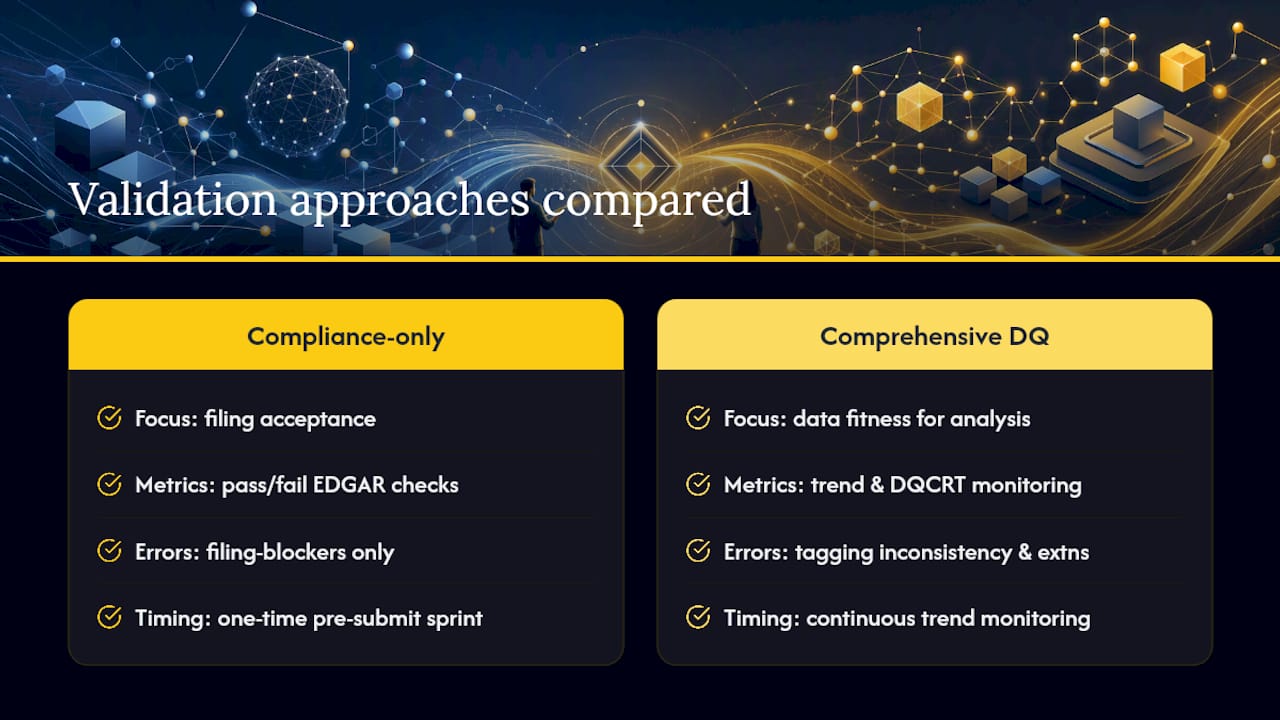
The evidence here points to an uncomfortable conclusion for most reporting teams: the errors that get fixed are the ones that block filings, and the errors that matter most to analysts are the ones that never do. Conventional guidance treats XBRL validation as a pass or fail gate, EDGAR either accepts the submission or it doesn't. That framing misses the entire category of damage that inconsistent element selection and custom extension overuse cause over multiple reporting periods, quietly and without triggering a single suspension.
What should change first is not the software. It's the assumption that a clean EDGAR acceptance equals clean data. It doesn't. A filing can pass every EDGAR check and still be functionally useless for time-series analysis if the preparer swapped tags between quarters. Teams that prioritize DQCRT trend monitoring over one-time validation sprints catch these problems while they're still cheap to fix. Everyone else finds out when a research platform, or a regulator, notices the pattern first.
— Glen
Key Takeaways
XBRL data quality depends less on passing EDGAR's initial checks and more on catching the non-blocking errors, inconsistent elements and custom extensions, that erode comparability over time.
| Point | Details |
|---|---|
| Triage by impact, not severity label | Fix EDGAR-blocking errors first, then calculation and sign errors, then element inconsistency. |
| Warnings require human judgment | Treat validation warnings as diagnostic signals, not automatic proof a figure is wrong. |
| DQCRT rules reduce recurrence | Run Data Quality Committee rules pre-submission since embedded rules measurably lower error rates over time. |
| Element consistency protects analytics | Standardize element choice across periods so time-series comparisons and screening tools stay reliable. |
| Monitor trends, not single filings | Track error rate, errors per filing, and top DQC triggers on a dashboard to catch regressions early. |
Sources
- EDGAR XBRL Guide (August 2026)
- Data Quality Committee meeting highlights (March 26, 2025)
- Thomson Reuters: XBRL cuts AI errors in reading company filings (study finds)
- XBRL validation specification (2009)