
Accountability-focused earnings coverage is defined as a structured, factual analysis of quarterly or annual results that prioritizes transparency, timing, and substantive interpretation over narrative recitation. The standard institutional format calls for 8–12 pages, 1–3 summary tables, and 8–12 charts, published within 24–48 hours of a results release. The focus is exclusively on new information: beats, misses, guidance revisions, and thesis-level implications. Analysts who write accountability-focused earnings coverage distinguish themselves not by volume but by the quality of interpretation they apply to every line item. Disclosures must move beyond formal compliance to substantive articulation that clarifies timing, attribution, materiality, and risk trajectory for investors.
What do you need before writing accountability-focused earnings coverage?
Preparation determines the quality of the final note. Analysts build coverage lists aligned to client holdings and expected results windows, segmenting by sector and market cap to prioritize the names most likely to move portfolios. Without this pre-season structure, the 24–48 hour publication window becomes unmanageable.
The core research inputs for each covered name include:
- SEC filings: 10-Q, 10-K, and 8-K releases for the current and prior three quarters
- Earnings call transcripts: prepared remarks and Q&A sessions, not just the press release
- Segment-level data: revenue, margin, and volume by business unit, not consolidated totals only
- Non-GAAP reconciliation tables: to assess what management is adjusting and why
- Consensus estimates: EPS, revenue, and key operating metrics from institutional data providers
- Prior guidance: the exact language used in the previous quarter's outlook statement
Regulatory frameworks such as SEC Regulation S-K and IFRS 8 set minimum disclosure floors. They do not guarantee analytical sufficiency. Blockchain-enabled accounting shows measurable improvements in reporting transparency, but enforcement strength varies significantly by market. Analysts relying solely on disclosed figures without probing accruals and provisioning assumptions will consistently miss the signal.
The table below maps the key elements of a professional earnings update against their analytical purpose.
| Element | Analytical purpose |
|---|---|
| Headline EPS vs. consensus | Establishes beat/miss magnitude and market expectation gap |
| Segment revenue and margin | Reveals operational mix shifts not visible in consolidated results |
| Accruals and provisions | Indicates earnings quality and sustainability of reported margins |
| Guidance revision language | Signals management confidence and forward risk trajectory |
| Non-GAAP adjustments | Tests whether exclusions are recurring or genuinely one-time |
| Management Q&A tone | Surfaces confidence level and areas of deliberate vagueness |
Speed is a structural advantage. Top analysts build templates pre-season so they can parse filings on results day and capture precise, impactful items within minutes of release. A template that pre-populates consensus figures, prior-quarter actuals, and key line items cuts writing time by a material margin.

How to write an accountability-focused earnings report step by step
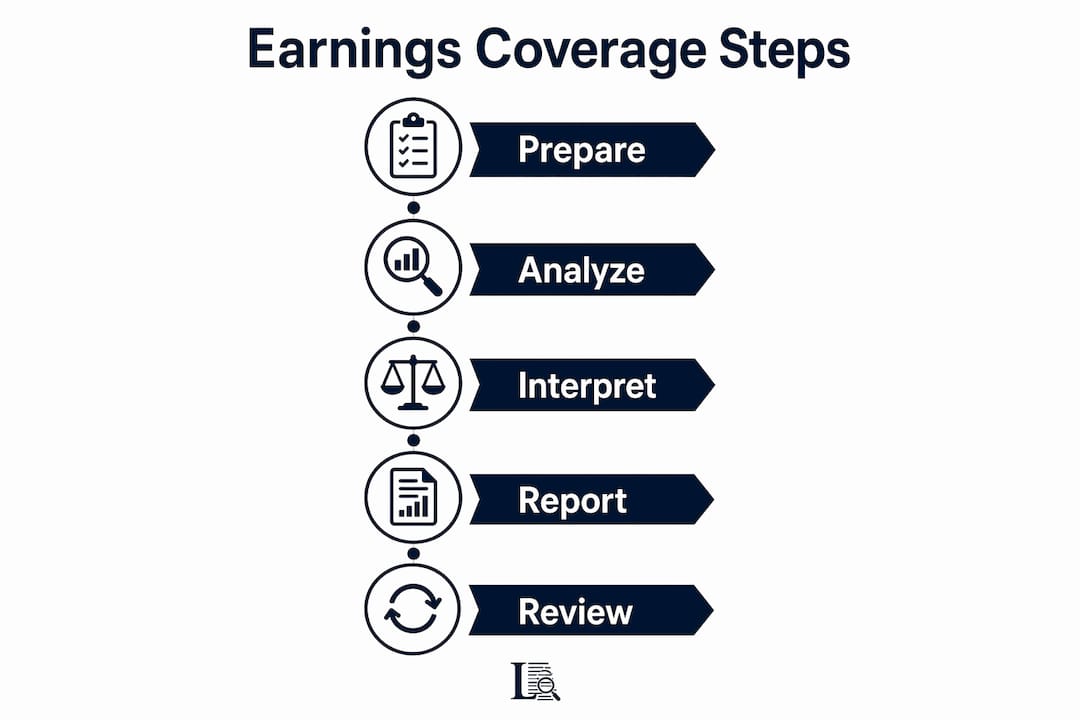
A disciplined structure produces consistent, high-quality output. The following sequence applies to any covered name regardless of sector.
-
Open with headline numbers in context. State EPS and revenue versus consensus, then versus the prior year. Quantify the beat or miss in dollar and percentage terms. Do not editorialize at this stage. The reader needs the raw fact before the interpretation.
-
Explain material margin moves. Gross margin, operating margin, and EBITDA margin each tell a different story. A gross margin expansion driven by pricing is more durable than one driven by volume mix. Identify the driver, quantify its contribution, and flag whether it is structural or transitory.
-
Isolate one-off items. Restructuring charges, litigation settlements, and asset write-downs distort headline earnings. Restate the adjusted figure, then assess whether management's non-GAAP exclusions are defensible. Recurring "one-time" items are a red flag, not a footnote.
-
Address guidance revisions with precision. A guidance raise of 2% on revenue with a flat EPS outlook signals margin pressure ahead. A guidance cut accompanied by vague macro attribution signals execution risk. Quote the exact language management used, then interpret the delta from prior guidance in numerical terms.
-
Assess earnings quality through accruals. Earnings quality is revealed in accruals such as freight provisions, open purchase orders, and depreciation assumptions, not in headline net profit. A company reporting strong net income while building receivables and drawing down payables is consuming cash, not generating it. This distinction separates durable earnings from engineered ones.
-
Interpret management commentary and Q&A. Optimistic tone signals confidence; vague or repeatedly evasive answers in Q&A indicate risk areas. Note which analyst questions were deflected and whether the deflection pattern is new or recurring.
-
State a thesis view without a trade call. Accountability-focused notes center on facts and thesis rather than buy/sell recommendations. A sentence such as "Results confirm the margin recovery thesis, though working capital deterioration warrants monitoring" delivers institutional value without triggering compliance review.
Pro Tip: Pre-populate your template with the prior quarter's exact guidance language before results day. The gap between what management said and what they delivered is often the most important sentence in the note.
What are the most common pitfalls in earnings coverage?
The most frequent failure in earnings report analysis is over-summarizing history at the expense of new information. An analyst who spends half the note recapping what the company did two years ago has produced a document with minimal incremental value. Every sentence should answer: "What does this result tell us that we did not know before?"
Narrative framing is the second major trap. Companies present results through a chosen lens, emphasizing favorable metrics and burying unfavorable ones in footnotes. Analysts who reproduce management's framing without independent verification are not writing coverage. They are transcribing a press release.
"Investors benefit from recognizing 'interpretive thinness' where companies meet disclosure rules but fail to clearly explain risks. Formal compliance is not the same as substantive articulation. A disclosure that satisfies Regulation S-K but omits the timing and attribution of a margin decline leaves the reader no better informed than before."
Provisioning requires particular discipline. Over-provisioning, the cookie jar effect, degrades earnings quality as much as aggressive accounting. Provisions should reflect genuine liabilities and be reversed only when the underlying facts change. An analyst who accepts provisioning at face value without testing it against cash flow conversion will systematically misread earnings quality.
Non-GAAP adjustments demand the same scrutiny. The key questions are: Is this item truly non-recurring? Has it appeared in prior periods? Does the adjusted figure align with free cash flow generation? A company with consistently high adjusted EBITDA and consistently negative free cash flow is signaling a structural disconnect that headline analysis will miss. Tracking misreporting patterns across multiple quarters makes these disconnects visible.
How does earnings coverage reveal investment risks and opportunities?
Multi-quarter earnings scorecards are the most reliable tool for separating signal from noise. Tracking EPS, revenue, gross margin, free cash flow, and guidance accuracy across eight consecutive quarters reveals patterns that single-quarter analysis cannot detect. A company that consistently beats on revenue but misses on EPS is compressing margins. A company that consistently revises guidance downward mid-year has a forecasting problem, not a macro problem.
Accrual analysis combined with qualitative management signals produces the clearest picture of operational reality. Distinguishing reported performance from operational reality requires examining freight provisions, open purchase orders, and depreciation assumptions to detect sustainable earnings. When accruals are building while management expresses confidence, the divergence is the risk signal. When accruals are releasing while management guides conservatively, the divergence is the opportunity signal.
Comparing results against accountability benchmarks adds a cross-sectional dimension that single-company analysis lacks. A company reporting 18% operating margins in a sector where the median is 12% warrants scrutiny of its accrual assumptions, not celebration. Conversely, a company trading at a discount to peers while delivering above-median cash flow conversion may represent a mispricing driven by narrative rather than fundamentals.
Pro Tip: Build a one-page scorecard for each covered name before earnings season. Populate it with eight quarters of EPS, revenue, gross margin, free cash flow, and guidance accuracy. The pattern across those eight rows will tell you more than any single quarter's press release.
Regulatory gaps compound the risk. Oversight gaps in public reporting mean that companies can satisfy disclosure requirements while omitting material context. Analysts who rely on disclosed figures without probing the accrual machinery beneath them are operating with incomplete information. The gap between what is disclosed and what is material is where investment risk concentrates.
Key Takeaways
Accountability-focused earnings coverage requires substantive articulation, accrual scrutiny, and multi-quarter pattern recognition to deliver institutional-grade analysis beyond headline numbers.
| Point | Details |
|---|---|
| Publish within 24–48 hours | Institutional standards require timely notes focused on new information, not historical recap. |
| Scrutinize accruals, not just EPS | Earnings quality lives in freight provisions, open POs, and depreciation assumptions, not net profit. |
| Interpret management Q&A | Evasive or repeated deflections in Q&A signal risk areas that prepared statements conceal. |
| Track eight quarters of metrics | Multi-quarter scorecards reveal margin compression and guidance accuracy patterns invisible in single-quarter analysis. |
| Separate disclosure from articulation | Formal compliance with SEC or IFRS rules does not guarantee that material risks are clearly explained. |
Why most earnings notes miss the point
Most earnings notes I read fail at the same place: they describe what happened without explaining what it means. A company reports a 3% revenue miss and the note says "revenue came in below consensus." That sentence is not analysis. It is a timestamp.
The analysts I respect most treat every result as a test of a prior thesis. They enter earnings season with a written hypothesis about what the quarter should reveal, and they measure the actual result against that hypothesis. When the result diverges, they explain why, and they update the thesis explicitly. That discipline separates coverage that builds institutional trust from coverage that merely fills an inbox.
The transparency question has also shifted in 2026. Institutional clients no longer accept notes that reproduce management language without interrogating it. They want to know whether the accrual assumptions are conservative or aggressive, whether the guidance language is more or less specific than last quarter, and whether the Q&A deflections are new. Those are not compliance questions. They are analytical ones. Analysts who treat corporate disclosure integrity as a floor rather than a ceiling will consistently produce better work than those who treat it as a destination.
The uncomfortable truth is that most earnings coverage is written to satisfy a publication schedule, not to inform a decision. The analysts who resist that pressure, who take the extra hour to test the accruals and read the full Q&A transcript, produce the notes that clients actually act on.
— Glen
How Lacunaindex supports accountability-driven earnings analysis
Analysts who want to write earnings coverage with genuine depth need more than raw filings. They need a systematic way to measure the gap between what companies claim and what they deliver.
Lacunaindex provides sector-level benchmarks that let analysts compare a company's execution score against its peer group using only public records. The platform mines earnings calls, SEC filings, press releases, and proxy statements to quantify the aspiration-to-execution gap for each covered name. Analysts can use Lacunaindex's forensic reports to validate accrual assumptions, identify disclosure opacity, and classify companies as earned, borrowed, or undervalued based on delivery versus narrative. The Lacunaindex user guide walks through the methodology step by step, making it straightforward to integrate accountability scoring into an existing coverage workflow.
FAQ
What is accountability-focused earnings coverage?
Accountability-focused earnings coverage is a structured earnings note that prioritizes new information, substantive interpretation, and accrual scrutiny over narrative recitation. It distinguishes reported performance from operational reality using public disclosures alone.
How long should an institutional earnings note be?
Professional earnings update reports should be 8–12 pages with 1–3 summary tables and 8–12 charts, published within 24–48 hours of results. The focus is on beats, misses, guidance revisions, and thesis impact.
What is interpretive thinness in earnings disclosures?
Interpretive thinness occurs when a company meets formal disclosure requirements but fails to clearly explain the timing, attribution, or materiality of key risks. Formal compliance with SEC or IFRS rules does not guarantee that investors receive sufficient context to assess performance.
How do accruals reveal earnings quality?
Earnings quality is built into accruals such as freight provisions, open purchase orders, and depreciation assumptions, not declared in headline net profit. A company with strong reported earnings but deteriorating accrual positions is signaling unsustainable margins.
Can earnings notes avoid buy/sell calls and still add value?
Descriptive, accountability-focused notes without price targets deliver more clarity and are favored by institutional clients. A reasoned thesis view tied to specific financial metrics provides decision-relevant insight without triggering compliance review.