
Corporate transparency is defined as the systematic disclosure of a company's governance practices, decision-making processes, and performance data to stakeholders, enabling accountability and informed oversight. Understanding why corporate transparency matters for governance is not a compliance exercise. It is the structural condition that separates boards capable of earning trust from those that merely claim it. The OECD positions transparency and accountability as embedded governance system features, not optional communications outputs. Without visible governance, investor protection weakens even when financial results appear strong. The UK Financial Reporting Council and Glass Lewis have each documented how disclosure quality directly shapes stakeholder confidence and market behavior.
Why corporate transparency matters for governance and investor protection
Corporate transparency protects investors by making board oversight legible and verifiable. The OECD's governance framework treats transparency as a core design feature of governance systems, not a reporting afterthought. When governance decisions are visible, investors can assess whether management is acting in their interest or drifting from stated commitments.
Quarterly and annual disclosures serve a monitoring function that goes beyond regulatory compliance. Frequent, audited reports allow investors to track management credibility over time, identify emerging risks early, and adjust capital allocation accordingly. Glass Lewis notes that changing disclosure cadence directly affects investor risk premiums and trading liquidity. That finding means reducing reporting frequency is not a neutral administrative decision. It is a governance choice with measurable market consequences.
The connection between transparency and investor protection operates through several mechanisms:
- Disclosure frequency creates a regular audit trail that deters mismanagement before it compounds.
- Auditor attestation adds external verification, reducing information asymmetry between boards and shareholders.
- Comparability across reporting periods allows investors to detect narrative drift, where stated priorities shift without explanation.
- Board accountability records, including committee minutes and vote disclosures, signal whether governance structures function as described.
Transparency is the enabling condition for accountability. Without clear visibility into governance decisions, investor protection is weakened even if financial performance appears strong.
Effective transparency also reduces the cost of capital. Research from the ICA confirms that transparent governance practices lead to lower capital costs, stronger stakeholder confidence, and greater organizational stability. Boards that disclose governance decisions with specificity signal lower risk to the market, and that signal has a direct effect on valuation.
Does "comply or explain" actually produce meaningful disclosure?

The UK's "comply or explain" governance code is one of the most cited frameworks in corporate governance best practices. Its premise is sound: companies that depart from code provisions must explain why, giving boards flexibility while preserving accountability. The problem is execution.
The UK Financial Reporting Council found that many companies report compliance while omitting transparent explanations for actual departures. Reports describe adherence to principles without specifying how those principles were applied or what decisions they informed. That pattern produces disclosures that look complete on the surface but carry no real information for investors assessing governance quality.
Boilerplate language is the most common failure mode. Phrases like "the board considers this approach appropriate given the company's circumstances" satisfy the letter of the requirement while communicating nothing. The FRC's guidance is direct: meaningful governance disclosure requires companies to explain how board responsibilities were discharged, not simply assert that they were.
The distinction matters because disclosure quality influences investor assessment. A well-explained departure from a code provision can actually strengthen confidence. It signals that the board understands the principle, has considered it seriously, and has made a deliberate choice with documented reasoning. A generic explanation signals the opposite.
Pro Tip: When drafting governance disclosures, test each explanation against this question: could an informed investor reconstruct the board's reasoning from this text alone? If not, the disclosure is boilerplate, regardless of its length.
Governance professionals should audit existing disclosures for the following warning signs:
- Explanations that reference "company circumstances" without specifying what those circumstances are.
- Compliance statements that describe governance structures but not governance decisions.
- Departures from code provisions acknowledged without any explanation of the rationale or expected duration.
- Language copied verbatim from prior year reports without updating for current board composition or strategy.
Addressing these gaps is not a communications task. It requires governance teams to document decisions at the point they are made, so that disclosure reflects actual practice rather than reconstructed narrative.
How does transparency affect governance and market confidence?
Transparency functions as a market mechanism, not just an internal governance tool. The level and quality of public disclosure shapes how investors price risk, how analysts model future performance, and how markets respond to governance events. Reporting cadence and transparency shape stewardship incentives and market trust in ways that governance professionals must anticipate.
The table below maps the practical effects of high versus low transparency on key market factors.
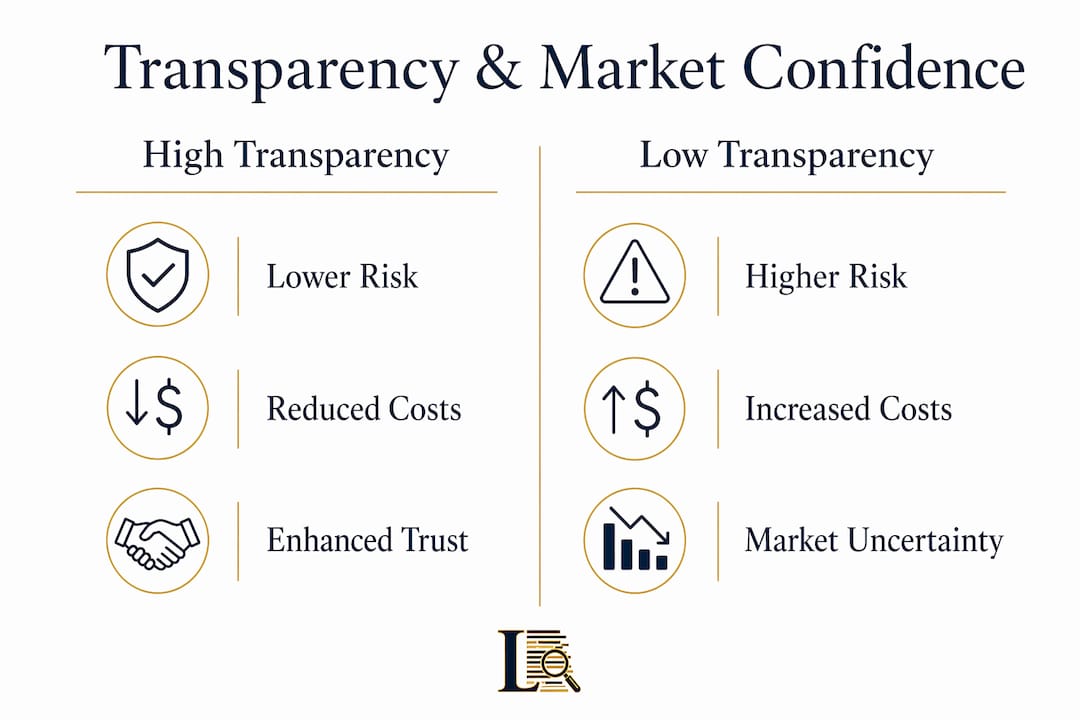
| Market factor | High transparency | Low transparency |
|---|---|---|
| Risk premium | Lower, reflecting reduced information asymmetry | Higher, as investors price uncertainty |
| Trading liquidity | Stronger, supported by frequent audited data | Weaker, with wider bid-ask spreads |
| Analyst coverage | More accurate, based on standardized disclosures | More variable, relying on voluntary releases |
| Activist exposure | Lower, when governance is well-documented | Higher, when gaps invite scrutiny |
| Cost of capital | Reduced through stakeholder confidence | Elevated through perceived governance risk |
When companies reduce disclosure frequency, investors shift toward voluntary disclosures, management guidance, and informal signals. Those sources lack external assurance and standardization. Glass Lewis warns that this shift increases market volatility and information asymmetry. The transparency premium in equity valuation is real and measurable. Boards that treat disclosure as a cost rather than a governance asset systematically underestimate that premium.
External assurance is a critical variable. Audited disclosures carry a credibility signal that unaudited voluntary releases cannot replicate. Comparability across periods and across peer companies gives investors the reference points they need to evaluate whether governance claims reflect actual practice. Without those reference points, even accurate disclosures lose their interpretive value.
Practical approaches for embedding transparency into governance workflows
Transparency becomes durable when it is built into governance processes, not added at the reporting stage. The OECD's systems approach treats transparency as a structural protection requiring existing governance evidence, meaning disclosures should document decisions already made through formal processes, not construct narratives after the fact.
Governance teams can embed transparency through the following workflow practices:
- Board pack discipline. Board materials should record the information directors received before each decision, including risk assessments, dissenting views, and management recommendations. This creates a contemporaneous record that supports accurate disclosure.
- Committee minute standards. Minutes should capture the substance of deliberations, not just resolutions. Audit, remuneration, and nomination committee minutes are primary evidence of governance quality for investors and regulators.
- Risk reporting cadence. Risk disclosures should be updated at a frequency that matches the actual pace of risk evolution in the business. Annual risk summaries that do not change materially year over year signal that the process is formulaic rather than substantive.
- Disclosure review at source. Governance teams should review draft disclosures against the underlying board records before publication. Gaps between what boards discussed and what reports describe are the primary source of disclosure opacity.
- Technology for secure information management. Board portals and governance management platforms support version control, access logging, and audit trails. These tools make transparency evidence-based rather than assertion-based.
Pro Tip: The most common transparency failure is not dishonesty. It is the gap between what boards actually deliberate and what governance teams are able to document. Closing that gap requires process design, not better writing.
Regulatory oversight gaps in public reporting frequently originate in workflow failures rather than intentional concealment. Boards that invest in governance infrastructure, including documentation standards and disclosure review protocols, produce more credible reports with less effort at the reporting stage.
Transparent board refreshment is one area where workflow discipline has become a governance priority. Documented board renewal processes now signal governance quality and manage activist pressure more effectively than undisclosed succession planning. Shareholders increasingly treat board composition disclosure as a leading indicator of governance health.
Key takeaways
Corporate transparency is the structural condition that makes governance accountability verifiable, and boards that treat it as a built-in process rather than a reporting task consistently earn stronger stakeholder trust.
| Point | Details |
|---|---|
| Transparency enables accountability | Without visible governance decisions, investor protection weakens even when financial results look strong. |
| Disclosure quality matters more than volume | Boilerplate explanations undermine trust; specific, reasoned disclosures build it. |
| Reporting cadence affects market behavior | Reducing disclosure frequency raises risk premiums and increases information asymmetry. |
| Transparency must be process-built | Embedding disclosure into board packs, minutes, and risk cadence produces more credible reports. |
| Board refreshment signals governance quality | Documented, transparent renewal processes reduce activist exposure and reinforce board legitimacy. |
The governance transparency gap most boards still ignore
Governance professionals often focus on what gets disclosed. The more consequential question is whether the disclosure reflects what actually happened in the boardroom. After working with governance documentation across multiple sectors, the pattern that stands out is not deliberate concealment. It is the aspiration-to-execution gap between board deliberation and formal record.
Boards discuss risk, strategy, and succession with real depth. Then governance teams produce disclosures that describe structures rather than decisions. Shareholders read those disclosures and conclude that governance is formulaic. Activists read the same disclosures and identify the gap as an opportunity. The board never intended either outcome, but the workflow produced it.
The emerging pressure from shareholder activism and board refreshment campaigns is making this gap more visible and more costly. Institutional investors now treat public company accountability as a measurable governance attribute, not a soft reputational factor. Boards that cannot demonstrate how their governance processes produced their stated outcomes face increasing scrutiny regardless of financial performance.
The practical implication is that transparency improvement is a governance design problem. It requires boards to ask whether their documentation standards, committee processes, and disclosure review protocols are capable of producing the evidence that stakeholders now expect. Compliance with disclosure codes is the floor. Governance leaders who treat it as the ceiling will find that the market eventually prices the difference.
— Glen
How Lacunaindex supports governance transparency analysis
Lacunaindex applies forensic analytics to public company disclosures, measuring the gap between what companies claim and what their records demonstrate. For governance professionals assessing disclosure quality across a portfolio or peer group, the platform's execution scores and sector benchmarks provide an objective reference point that internal review alone cannot replicate.
The Lacuna report guide explains how to interpret governance findings drawn entirely from SEC filings, proxy statements, earnings calls, and press releases. For sector-level transparency benchmarking, the sector benchmarks provide comparative data that supports governance committee analysis and investor engagement preparation. Lacunaindex does not rely on insider access. Every finding is grounded in the public record, making it a credible reference for governance teams, institutional investors, and financial journalists.
FAQ
What is corporate transparency in governance?
Corporate transparency in governance is the systematic disclosure of a company's decision-making processes, board practices, and performance data to stakeholders. The OECD defines it as a core governance system feature that enables accountability and investor protection.
Why does disclosure quality matter more than compliance?
The UK FRC found that many companies report code compliance while omitting substantive explanations for governance departures. Investors assess governance quality through the reasoning behind decisions, not the fact of disclosure alone.
How does reducing disclosure frequency affect investors?
Glass Lewis documents that less frequent reporting increases investor reliance on voluntary disclosures, which lack external assurance and standardization. That shift raises risk premiums and reduces trading liquidity.
What does "comply or explain" require from governance teams?
"Comply or explain" requires companies to provide specific, context-sensitive explanations for any departure from governance code provisions. Generic or boilerplate explanations fail the standard and undermine stakeholder confidence.
How can boards embed transparency into governance workflows?
Boards embed transparency by documenting decisions in board packs and committee minutes at the point they are made, maintaining a consistent risk reporting cadence, and reviewing disclosures against underlying governance records before publication.