
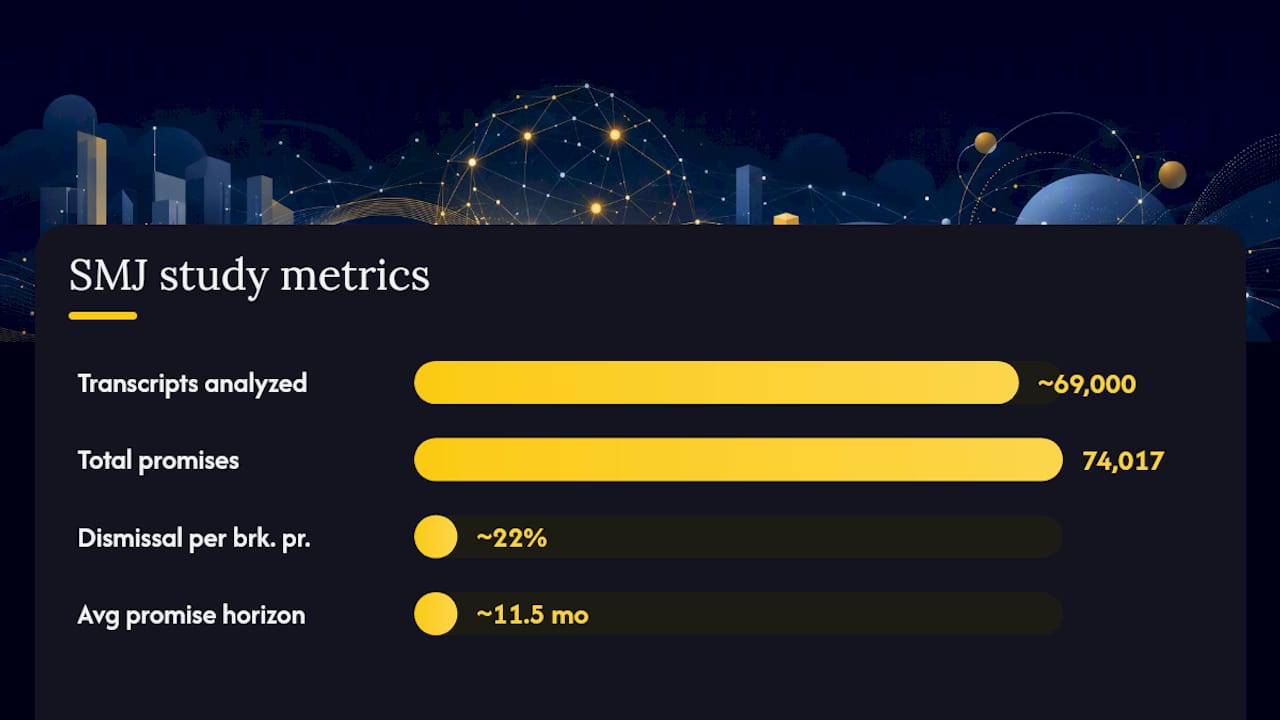
Companies overpromise on earnings calls because managers capture an immediate market and reputational upside from optimistic language while facing almost no short-term cost when the promise later breaks. A large-scale analysis of S&P 1500 transcripts covering 2010 through 2022 identified 74,017 discrete CEO promises across roughly 69,000 earnings calls. The incentive to keep making them persists because the penalty arrives late and lands mostly on the CEO's own tenure. That penalty is not trivial: missing a public commitment raises the probability of involuntary CEO dismissal by approximately 22% per broken promise.
For an investor sitting on a live call, the first move is mechanical, not emotional.
- Write down every forward-looking claim verbatim, including the qualifiers around it.
- Ask whether the claim carries a measurable metric and a specific date.
- If it lacks both, flag it for follow-up in the next filing cycle rather than pricing it in immediately.
Boards increasingly treat it as a performance problem with a personnel consequence attached, which is exactly why the incentive to overpromise, though rational in the short run, carries real long-run risk for the executive making the claim.
Key Takeaways
Companies overpromise on earnings calls because the incentive structure rewards immediate optimism far more reliably than it punishes a delayed miss, and the consequences fall disproportionately on the CEO who made the claim.
| Point | Details |
|---|---|
| Core driver | Managers gain immediate stock and reputational benefits from optimistic guidance while facing deferred, diffuse costs for missing it. |
| Empirical scale | Research covering 69,000 transcripts identified 74,017 CEO promises across S&P 1500 companies from 2010 to 2022. |
| Personal stakes for executives | Each broken promise raises involuntary CEO dismissal probability by about 22%. |
| Strongest red flag | Qualifier stacking and metric substitution without a stated date signal strategic ambiguity over genuine commitment. |
| Immediate investor action | Log every specific promise verbatim during the call, then cross-check it against filings within 24 hours. |
| Monitoring solution | Lacunaindex scores execution against narrative using only public disclosures, giving investors a reproducible way to track promise fulfillment over time. |
Table of Contents
- Why Companies Overpromise on Earnings Calls: The Incentive Structure
- What Behavioral Biases Push Executives to Overpromise?
- Straight Talk vs Strategic Ambiguity: How Do Companies Phrase Promises?
- How Firms Operationalize Overpromising Through Disclosure Choices
- What Happens When a Company's Promises Fail?
- Red Flags: How Can Investors Spot Overpromising in Real Time?
- What Does the Research Say About Promise Frequency and Fulfillment?
- A Timed Checklist for the Days and Months After a Call
- Why Promise-Gap Monitoring Matters for Market Integrity
- How Lacunaindex Turns Promise Tracking Into an Investor Workflow
- Frequently Asked Questions
- Sources
Why Companies Overpromise on Earnings Calls: The Incentive Structure
Executives overpromise because the compensation architecture built around most public companies rewards short-term optimism more reliably than it punishes long-term inaccuracy. Equity awards vest on schedules tied to stock price and revenue milestones, and a confident forward statement on a call can move the share price the same afternoon. The cost of that statement, if it turns out to be wrong, usually surfaces two, three, or four quarters later, often under a different set of analysts asking different questions.
Tenure plays a distinct role here. A CEO in the first 18 months of the job has limited operating history to lean on, so promises become a substitute credential. The Strategic Management Journal study found that promise frequency rises specifically when CEOs need to establish legitimacy, a pattern that shows up disproportionately among newly appointed executives trying to signal command of the business before the numbers can speak for themselves.
Catering behavior compounds the incentive. Research on earnings guidance shows managers deliberately bias forward statements upward after a period of poor stock returns, a pattern documented in the Journal of Financial and Quantitative Analysis catering theory study. The guidance moves the price. The mispricing then partially corrects once actual earnings arrive, but by then the near-term goal, calming an unhappy shareholder base, has already been achieved.
Several conditions make overpromising even cheaper for management:
- High analyst dispersion, where no single forecast anchors expectations tightly enough to catch an inflated claim.
- Metrics defined internally rather than through standardized accounting, which removes an external check.
- Guidance issued far in advance of the reporting period it covers, stretching the gap between claim and verification.
What Behavioral Biases Push Executives to Overpromise?
Overconfidence is not a moral failing among executives so much as a documented statistical pattern. Managers who exhibit overoptimism disclose subjective forward-looking information more often than their more measured peers, according to research published in the Journal of Business Finance & Accounting. The market is not naive about this: it applies a discount to disclosures from managers with a track record of optimism, which in theory should reduce the volume of unfounded claims. In practice, the discount is often smaller than the short-term benefit of making the claim in the first place.
Impression management explains a second, related pattern. After a miss or a period of analyst scrutiny, executives frequently respond to pointed questions with confident, forward-looking language rather than a direct accounting of what went wrong. The promise becomes a way to redirect the conversation from a completed failure to an anticipated success, and it works because analysts, like most people, weigh a vivid future claim more heavily than a dry explanation of a past shortfall.

Loss aversion on the investor side makes this tactic effective rather than transparent. Once investors have absorbed a period of underperformance, they anchor to a reference point of "getting back to normal," and a management team that offers a specific, hopeful timeline exploits that anchor directly. This is the behavioral mechanism underneath the catering effect described above: it is not just that guidance moves prices, but that investors are psychologically primed to want the guidance to be true.
A common tell shows up in Q&A rather than prepared remarks. An analyst asks why margins compressed, and the answer pivots to next year's cost initiatives instead of addressing this year's cause. That pivot is impression management in its purest form, and it happens on nearly every call where results disappoint.
Straight Talk vs Strategic Ambiguity: How Do Companies Phrase Promises?
Companies choose their language deliberately, and the choice falls along a spectrum researchers describe as straight talk versus strategic ambiguity. A NBER working paper on managerial communication styles frames this as a stylistic choice with real trade-offs: straight talkers commit to specific, checkable claims and absorb more volatility when those claims miss, while vague talkers dampen analyst expectations with qualifiers and protect themselves from a hard accountability moment later.
Strategic ambiguity is not laziness. It is a documented pattern where executives deliberately extend the promise horizon and reduce specificity to preserve room to maneuver. The average promise horizon runs around 11.5 months, but that average masks wide variation: promises tied to sustainability, DEI, or energy transition initiatives tend to stretch far longer, often because the underlying uncertainty genuinely justifies a longer runway.
| Style | Typical language | What it protects | What it risks |
|---|---|---|---|
| Straight talk | Specific numbers, named dates, "we will deliver X by Q3" | Credibility with analysts who value precision | High reputational cost on a miss |
| Strategic ambiguity | "Positioned for growth," "over time," "we remain optimistic" | Flexibility to pivot without a visible breach | Erodes trust slowly if overused |
| Metric substitution | Shifting from a hard number to a qualitative description | Cover when the hard number is unfavorable | Signals evasion to alert analysts |
Vague language creates what researchers call a zone of acceptable fulfillment, a range wide enough that management can later claim success even when the specific numerical outcome falls short of what a literal reading of the original promise implied. Phrases like "meaningful progress," "well positioned," and "on track" are built to occupy that zone.
- A specific commitment sounds like: "We expect gross margin to reach 42% by the fourth quarter."
- A strategically ambiguous version of the same idea sounds like: "We're confident in our margin trajectory as we move through the year."
Firms lean toward specificity when they want to rebuild credibility after a period of doubt, and toward vagueness when the underlying business genuinely faces more uncertainty than the market wants to hear about.
How Firms Operationalize Overpromising Through Disclosure Choices
The rhetoric on a call rarely stands alone. It connects to specific disclosure mechanisms that give the optimistic language a structural home in the company's reporting.
Earnings guidance is the most visible channel. Companies choose when to issue it, how specific to make it, and how far in advance of the reporting period it applies. Guidance issued a full year out, with wide ranges and soft qualifiers, anchors analyst models without creating a clean, checkable commitment.
Selective metric choice does similar work at the numbers level. A company that highlights adjusted EBITDA, bookings growth, or a custom engagement metric while downplaying GAAP net income is choosing the frame that flatters the current story. Non-GAAP measures are not inherently deceptive, but they become a mechanism for overpromising when the adjustments consistently move in the same convenient direction quarter after quarter.
Framing techniques round out the toolkit:
- Bundling a strong headline number with a cost or risk disclosure buried several paragraphs later in the same release.
- Describing a cost increase in vague terms ("some near-term investment") while quantifying the associated revenue benefit precisely.
- Comparing results to a prior period chosen specifically because it makes the current quarter look stronger than a sequential comparison would.
Each of these mechanisms can create a false impression of momentum without any single sentence being technically false, which is exactly why they are effective and why they are hard to regulate directly.
What Happens When a Company's Promises Fail?
Markets react quickly, but not always completely, when a promise breaks. The catering theory research from JFQA documents that the mispricing created by optimistic guidance is only partially corrected once actual earnings are announced, which means some of the inflated valuation lingers in the stock price well past the moment the truth becomes public.
Governance consequences tend to build over a longer arc than the stock price reaction. A single missed promise rarely triggers board action on its own, but repeated misses accumulate into a pattern that boards and proxy advisors track closely, particularly when the missed commitments touch on strategic priorities the board itself endorsed publicly.
The personal cost to the executive making the promise is the sharpest data point in this entire body of research. Each additional broken promise raises the probability of involuntary CEO dismissal by roughly 22%. That is not a one-time penalty. It compounds with every subsequent miss, which means a CEO who breaks three separate public commitments over a two-year window faces a meaningfully different dismissal risk than one who breaks a single promise and corrects course.
A typical sequence after a missed promise looks something like this:
- Day of announcement: Share price drops on the immediate gap between promised and actual results.
- Following weeks: Analyst notes and downgrades reference the specific broken commitment by name.
- Following quarters: If the pattern repeats, proxy advisors and institutional shareholders begin raising the issue directly with the board.
- Following year: Persistent gaps show up in CEO turnover data and executive compensation clawback discussions.
Red Flags: How Can Investors Spot Overpromising in Real Time?
Detection works best as a live habit built during the call itself, not a retrospective exercise after the transcript is published. A few warning signs recur often enough across journalism covering executive earnings-call jargon to serve as a working checklist.
- Watch for qualifier stacking. Phrases like "we believe we're generally well positioned to potentially benefit" pack in four separate hedges around a single claim.
- Track metric substitution. If a company swapped its headline metric from last quarter's presentation without explanation, treat the new metric with more skepticism than the old one.
- Note the absence of a date. A promise with no timeline is not a commitment; it is an aspiration dressed as one.
- Flag optimism that follows a miss too closely. A confident forward statement delivered immediately after acknowledging a shortfall is a classic impression-management pattern.
- Compare the Q&A tone to the prepared remarks. Scripted opening statements are polished by design; unscripted answers under direct questioning reveal more.
Specific questions force specificity back onto the executive team. Asking "what is the measurable milestone and the date you'll report against it" is far more useful than accepting a general assurance. Asking "how does this claim compare to what you said on this exact topic last year" tests consistency directly.
Data triage should happen fast:
- Pull the prior year's transcript and compare language on the same topic side by side.
- Check the most recent 10-Q or 10-K for whether a previously stated milestone actually appears, met or unmet.
- Cross-reference the claim against sector peers making similar statements, since an industry-wide vague claim is a weaker signal than an isolated one.
An escalation trigger worth setting in advance: if a company breaks the same category of promise twice within four quarters, that pattern alone justifies a formal governance review or a valuation model reset, independent of the stock's near-term price action. Lacunaindex's analysis of governance red flags in public disclosures covers how to formalize that kind of trigger into a repeatable process.
What Does the Research Say About Promise Frequency and Fulfillment?
The empirical backbone of this entire subject rests on a single large-scale effort to measure promises directly rather than infer them from sentiment analysis. The Strategic Management Journal study applied language models to roughly 69,000 earnings-call transcripts from S&P 1500 companies between 2010 and 2022, identifying 74,017 discrete promises and coding each one for specificity, horizon, and topic. The scale matters: a dataset this size lets researchers separate genuine patterns, like the legitimacy effect among newly appointed CEOs, from noise that would dominate a smaller sample.
Two findings from that research anchor everything else in this article. First, promise frequency rises measurably when a CEO needs legitimacy, a pattern most visible in the early months of a new appointment. Second, strategic ambiguity increases under genuine business uncertainty, meaning vagueness is not always evasive; sometimes it reflects an honest inability to forecast precisely.
| Metric | Value | Source |
|---|---|---|
| Transcripts analyzed | ~69,000 (S&P 1500, 2010 to 2022) | SMJ study |
| Total promises identified | 74,017 | SMJ study |
| Increase in CEO dismissal probability per broken promise | ~22% | Duke Fuqua Insights |
| Average promise horizon | ~11.5 months | Duke Fuqua Insights |
Lacunaindex builds its forensic methodology on the same core principle these academic studies establish: promises are measurable, and the gap between what a company says and what it delivers can be scored using only public disclosures. The approach mines earnings-call transcripts, SEC filings, press releases, and proxy statements, then cross-checks stated commitments against subsequent filings to produce an execution score rather than a sentiment score. Because the entire process relies on public records, the scoring is reproducible by any analyst willing to do the same cross-referencing manually, an approach detailed further in Lacunaindex's guide on measuring CEO promise fulfillment rate.
For an investor, the practical translation is straightforward: a company with a documented pattern of specific, dated promises followed by consistent fulfillment carries a different risk profile than one whose public commitments trend vague and whose fulfillment rate, tracked over multiple quarters, sits well below its stated targets.
A Timed Checklist for the Days and Months After a Call
Detection on the call itself is only the first stage. What an investor does in the following hours, days, and quarters determines whether the observation turns into an actionable position change or gets forgotten by the next earnings cycle.
- During the call and immediately after: Log every specific promise with its exact wording, the date it was made, and any attached metric or timeline. Request clarification live if a claim lacks both.
- Within 24 hours: Cross-check the new guidance against the most recent 10-Q, prior guidance on the same topic, and at least two sector comparables making similar claims.
- Within 30 to 90 days: Track whether disclosed milestones actually appear in subsequent filings, press releases, or investor updates, and update a probability-weighted forecast rather than taking the original claim at face value.
- Ongoing: Set an escalation rule in advance, for example: two broken promises on the same strategic theme within a rolling four-quarter window triggers a formal governance review or a valuation model reset.
Lacunaindex's framework for public disclosure gap investment analysis walks through how to build this kind of rolling tracker so the checklist becomes a repeatable part of a portfolio process rather than a one-off exercise after a single bad call.
Why Promise-Gap Monitoring Matters for Market Integrity
Overpromising on earnings calls is not a fringe behavior confined to a handful of aggressive management teams. It is a rational response to an incentive structure that rewards short-term optimism and defers accountability, and the research summarized above suggests it shows up across thousands of companies and tens of thousands of calls. What varies is not whether the incentive exists but how disciplined a given management team is about resisting it.
Repeated overpromising, left unmeasured, does something more corrosive than mislead any single investor. It degrades the information value of the earnings call itself, forcing analysts to discount every forward statement by some unknown margin, which raises the cost of capital for honest and dishonest companies alike. That is the systemic argument for measuring promise gaps rather than treating each miss as an isolated disappointment: the pattern, tracked across a company's full disclosure history, tells you more than any single quarter can.
Lacunaindex was built around the premise that this measurement should not depend on insider access or a proprietary tip. Every promise a CEO makes on a call, every filing that confirms or contradicts it, and every proxy statement that discusses executive accountability is already public. The work is in the cross-referencing, done consistently, across every company and every quarter. That discipline is what turns a vague sense that "management overpromises" into a scored, comparable, and auditable record. Lacunaindex's own take on how public disclosures reveal management gaps extends this argument further for readers who want the governance angle in more depth.

How Lacunaindex Turns Promise Tracking Into an Investor Workflow
Lacunaindex gives investors a way to score promise fulfillment the way the academic research above measures it, systematically, across public filings, without relying on sentiment or guesswork about tone. The platform mines earnings-call transcripts, SEC filings, proxy statements, and press releases for a given company, then compares stated commitments against what actually got delivered in subsequent reporting periods.
One concrete output of that process is a company's execution score paired with a narrative score, letting you see at a glance whether a management team's public claims tend to track its actual results or drift consistently optimistic. Lacunaindex also classifies companies into archetypes, including firms that are "earned" (delivery matches or exceeds narrative), "borrowed" (narrative currently outpaces delivery), and others, giving you a fast way to triage which names in a sector deserve deeper diligence before an earnings call rather than after one. If you want to see exactly how these reports are structured and how to read an execution score against a narrative score, the Lacuna Index user guide walks through a full report end to end.
Frequently Asked Questions
Why do companies overpromise on earnings calls? Companies overpromise because executives capture an immediate market and reputational benefit from optimistic guidance while the cost of a broken promise, including a roughly 22% increase in CEO dismissal risk, arrives months or years later.
Is strategic ambiguity the same as lying to investors? No. Strategic ambiguity typically reflects genuine uncertainty about outcomes and a deliberate choice to preserve flexibility, whereas overpromising involves a specific claim the company had strong reason to doubt at the time it was made.
What is the single biggest red flag on an earnings call? Qualifier stacking around a claim with no attached date or metric is the clearest sign that a statement is aspirational rather than a real commitment.
How does overpromising affect stock prices over time? Optimistic guidance tends to move prices immediately, but research on catering behavior shows the resulting mispricing is only partially corrected once actual results are announced.
Can investors quantify how often a company breaks its promises? Yes. Platforms built on public-disclosure mining, including Lacunaindex, score companies on the gap between stated commitments and delivered results using transcripts, filings, and proxy statements alone.
This article is general information, not a substitute for advice from a qualified financial advisor. Consult a qualified financial professional about your own circumstances before acting on anything here.
Sources
- Shaping expectations, losing flexibility: A study of CEO promises as strategic communication tools — Strategic Management Journal (SMJ)
- A Catering Theory of Earnings Guidance: Empirical Evidence and Stock Market Implications — Journal of Financial and Quantitative Analysis
- Managerial overoptimism and discretionary disclosure — Journal of Business Finance & Accounting (JBFA)
The Lacuna Index user guide is linked in the promo section above for readers who want the product-specific walkthrough of report outputs and execution scoring.