
Investor-facing material disclosure omissions fall into eight core types, each representing a distinct pattern of withheld or selectively presented information that distorts the total mix available to a reasonable investor. SEC MD&A guidance establishes that companies must evaluate material information disclosed outside filed documents, including earnings calls and investor presentations, to determine whether omission would render the filed MD&A misleading. Lacunaindex applies this framework systematically, classifying omissions across public records using audit-traceable evidence. The eight types:
- Omitted KPIs/metrics: A performance indicator present in prior periods or peer filings disappears without explanation.
- Selective disclosure: Material information reaches a subset of analysts or investors before the broader public, in tension with Regulation FD.
- Timing/scope omission: A disclosure is delayed, truncated, or narrowed relative to prior cadence or peer practice.
- Omitted liabilities/contingencies: Pending litigation, off-balance-sheet exposure, or contingent obligations are absent or understated in MD&A.
- Missing forward-looking guidance: Guidance previously provided is withdrawn without explanation, or guidance scope narrows materially.
- Obfuscatory/qualifying language: Hedging language, passive constructions, or excessive qualifiers obscure a material deterioration.
- Omitted related-party or conflict facts: Transactions with affiliates, executive compensation arrangements, or conflicts of interest are absent or incomplete.
- Channel inconsistency: A metric or claim appears in an earnings slide or press release but is absent from or contradicts the concurrent 10-K/10-Q.
Key Takeaways
Material disclosure omissions fall into eight forensic types, each detectable through audit-traceable cross-channel checks and quantifiable via a composite disclosure-gap score built from frequency, duration, magnitude, and market-reaction proxy metrics.
| Point | Details |
|---|---|
| Classify before investigating | Assign one of the eight omission types first; the type determines which channels and signals to prioritize. |
| Compute the disclosure-gap score | Combine normalized frequency, duration, magnitude, and market-reaction proxy into a single composite score for triage. |
| Apply escalation thresholds | A disclosure-gap score above 0.65 or duration exceeding four quarters warrants senior analyst review and formal documentation. |
| Distinguish gap from fraud | A measured disclosure gap is a forensic signal, not a legal finding; engage counsel before any legal characterization. |
| Lacunaindex as the evidence layer | Lacunaindex forensic reports provide audit-traceable execution and narrative scores, archetype classification, and sector benchmarks for immediate contextualization. |
Table of Contents
- 1. What each omission type looks like in public records
- 2. How to quantify the size of a disclosure gap
- 3. How omission types map to forensic archetypes
- 4. Regulatory context analysts need to know
- 5. A prioritized analyst workflow for detecting and escalating omissions
- 6. Analytic limits and ethical cautions
- 7. The Lacunaindex perspective on omission forensics
- Lacunaindex forensic reports map directly to your investigation workflow
- Sources
1. What each omission type looks like in public records
Each omission type produces distinct forensic signals across the primary channels analysts mine: 10-K/10-Q filings, 8-Ks, earnings call transcripts, investor presentations, press releases, and social feeds. Cross-filing consistency checks are the first line of detection.
| Omission Type | Primary Channels | Key Forensic Signals |
|---|---|---|
| Omitted KPIs/metrics | 10-K, earnings slides, prior 10-Ks | KPI present in T-2 filing, absent in T; XBRL tag dropped; non-GAAP reconciliation table truncated |
| Selective disclosure | Earnings call transcript, 8-K, Form 4 | Buy-side analysts receive follow-up questions; material item in call not in concurrent 8-K |
| Timing/scope omission | 8-K filing dates, press release timestamps | 8-K filed >4 business days after triggering event; guidance scope narrows vs. prior quarter |
| Omitted liabilities/contingencies | 10-K footnotes, MD&A, legal proceedings | Litigation item present in prior 10-K footnote disappears; reserve change unexplained |
| Missing forward-looking guidance | Earnings release, investor day transcripts | Guidance withdrawn with no stated rationale; prior-year guidance section absent |
| Obfuscatory language | MD&A prose, call transcripts | Passive constructions spike; hedging density increases vs. prior period; linguistic complexity rises |
| Omitted related-party facts | Proxy statement | Related-party table row count decreases; compensation committee disclosure truncated |
| Channel inconsistency | Earnings slide vs. 10-Q | Non-GAAP metric in slide has no 10-Q reconciliation; revenue figure differs across channels |
Research on conference call participation finds that management tends to grant follow-up questions preferentially to buy-side analysts, and that buy-side tone differs systematically from sell-side tone, offering a detectable selective engagement signal. For obfuscatory language, studies using linguistic decomposition show that complexity and tone on calls influence institutional trading behavior and can indicate disclosure quality issues.
Pro Tip: Before flagging any signal as anomalous, normalize it against a sector peer baseline. A KPI dropped by one company in a quarter when three peers also dropped it carries far less investigative weight than a company-specific disappearance.
2. How to quantify the size of a disclosure gap
Reproducible quantification requires four core metrics, each with defined inputs and an audit trail. A forensic financial analysis methodology should record every step against a filing CIK, filing date, XBRL tag, transcript timestamp, and original slide filename.
Metric definitions:
- Frequency (F): Count of periods in which the omission occurs divided by total comparable periods in the peer set.
- Duration (D): Number of consecutive quarters the omission persists from first detection.
- Magnitude (M): Numeric gap between the last disclosed value and the inferred current value, normalized as a percentage of the prior disclosed figure or a sector-median proxy.
- Market-reaction proxy (MRP): Abnormal return or volume in the 3-day window surrounding a corrective disclosure or analyst question that surfaces the omitted item.
The SEC has noted that trading volume and price movements serve as evidence of materiality in enforcement contexts, which supports using MRP as a corroborating signal rather than a standalone measure.
| Metric | Inputs Required | Example Calculation |
|---|---|---|
| Frequency (F) | Omission count, peer-period count | 3 omissions / 8 peer-quarters |
| Duration (D) | First-omission quarter, current quarter | 8 quarters |
| Magnitude (M) | Last disclosed value, inferred current value | (Prior KPI – Inferred KPI) / Prior KPI |
| Market-reaction proxy (MRP) | Corrective-event date, 3-day return window | Abnormal return vs. sector index on event date |
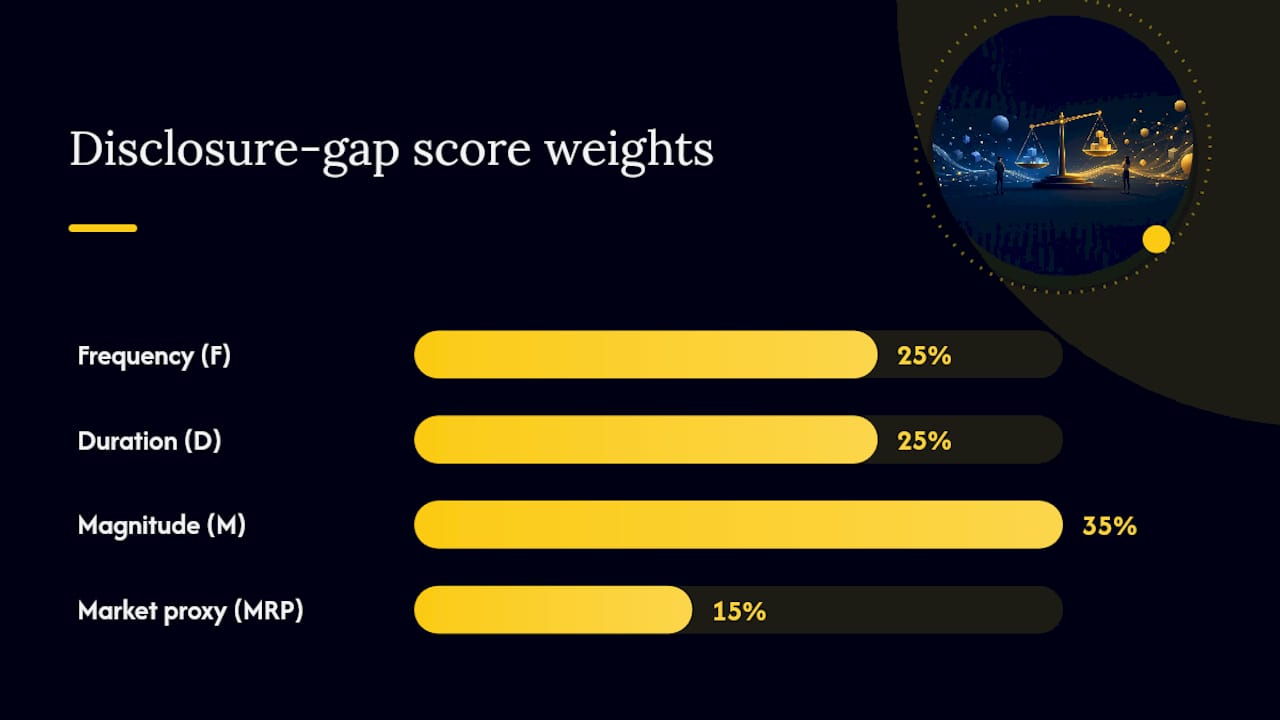
A composite disclosure-gap score can be computed as a weighted sum: (0.25 × normalized F) + (0.25 × normalized D) + (0.35 × normalized M) + (0.15 × normalized MRP), where each component is normalized to a 0–1 scale against the sector peer distribution. Experimental work on automated discrepancy detection using transformer-based classifiers has demonstrated high accuracy on labeled disclosure pairs in study-specific settings, providing a methodological precedent for automated magnitude estimation, though those results should not be generalized off-the-shelf.
Step checklist for applying metrics to a target company:
- Pull all 10-K/10-Q filings for the target and three to five sector peers for the prior eight quarters.
- Map every KPI and non-GAAP metric across periods; flag any that disappear or change definition.
- Record the filing CIK, filing date, and XBRL tag for each flagged item.
- Compute F, D, and M for each flagged omission using the peer distribution as the normalization baseline.
- Identify any corrective-disclosure event and compute MRP from the EDGAR filing timestamp.
- Calculate the composite disclosure-gap score and rank omissions by score, based on qualitative assessment without specific numeric thresholds.
3. How omission types map to forensic archetypes
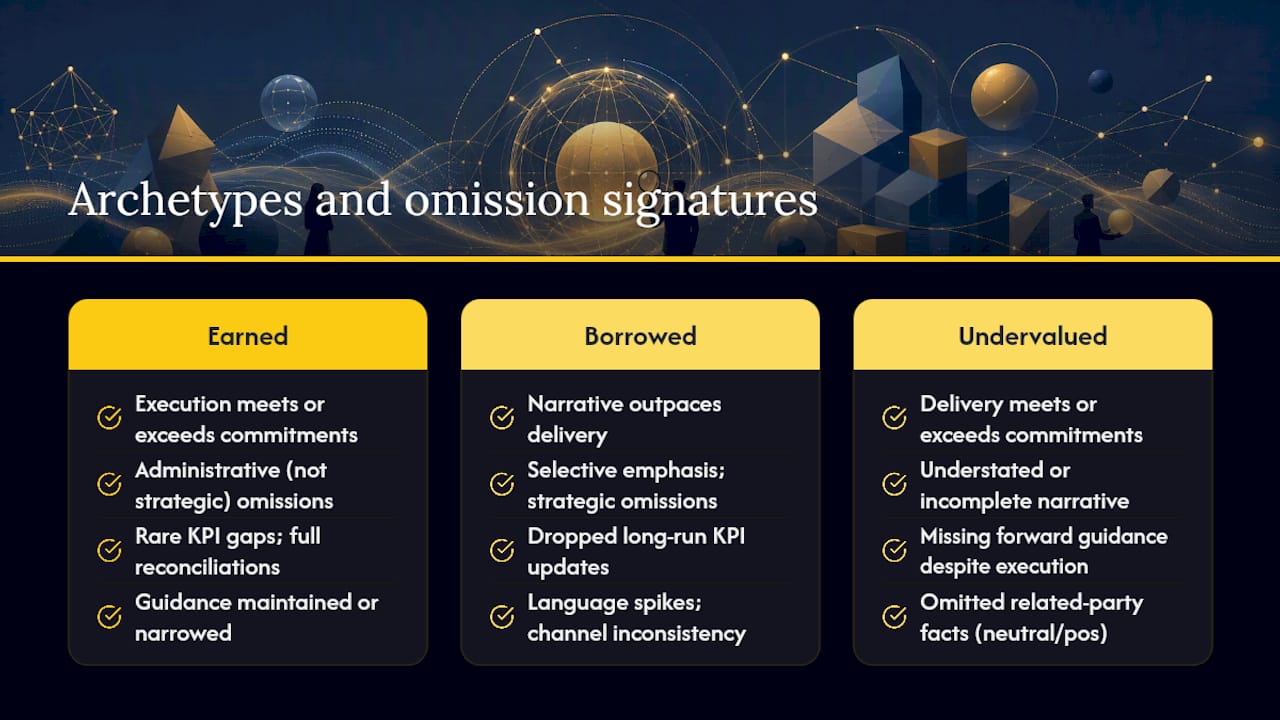
Lacunaindex classifies companies into three archetypes based on the relationship between narrative claims and measurable delivery. Each archetype carries a characteristic omission signature.
Earned: Execution consistently meets or exceeds stated commitments. Omissions, when present, tend to be administrative rather than strategic. Hallmark pattern: rare KPI gaps, full reconciliation tables, guidance maintained or narrowed with explanation.
Borrowed: Narrative claims outpace delivery. The company sustains a positive market valuation through selective emphasis and strategic omission rather than demonstrated results. Hallmark patterns include dropped long-run KPI updates, obfuscatory language spikes coinciding with margin compression, and channel inconsistency between investor-day slides and concurrent 10-Q disclosures.
Undervalued: Delivery meets or exceeds commitments, but the narrative is understated or incomplete, often due to conservative disclosure practices. Hallmark pattern: missing forward-looking guidance despite consistent execution, or omitted related-party facts that, if disclosed, would be neutral or positive.
Short anonymized examples illustrate the pattern. A mid-cap industrial company dropped its backlog-conversion ratio from its 10-K after two consecutive quarters of deterioration, while continuing to reference "strong backlog" in earnings call prepared remarks — a textbook borrowed-archetype omission pairing channel inconsistency with an omitted KPI. A technology company withdrew annual revenue guidance without explanation in Q3 while its investor-day slides from six weeks earlier still projected double-digit growth, producing a timing/scope omission with a measurable MRP on the corrective analyst-day event. For public disclosure gap analysis, the archetype classification anchors the investigator hypothesis before evidence collection begins.
4. Regulatory context analysts need to know
This section provides practical compliance background for forensic analysts. It is not legal advice; analysts should engage qualified securities counsel for legal determinations.
SEC MD&A guidance frames materiality around the "total mix" of information available to a reasonable investor. Companies must evaluate whether material information disclosed in earnings releases, analyst calls, or website postings creates an obligation to include that information in the filed MD&A, because omission could render the filed document misleading. This "total mix" standard is the analytical foundation for cross-channel inconsistency checks.
Rule 12b-20 extends this logic: any filing must include information necessary to make the statements made, in light of the circumstances, not misleading. Cross-channel inconsistency between a press release and a concurrent 10-Q is therefore a compliance signal, not merely a stylistic discrepancy.
Regulation FD (Reg FD) requires simultaneous public disclosure when an issuer intentionally reveals material nonpublic information to select market participants, and prompt public disclosure (generally within 24 hours) for inadvertent selective disclosures. Posting to a company website or filing a Form 8-K can satisfy the public-disclosure requirement. Analysts who observe a material item discussed in a private analyst meeting but absent from a concurrent 8-K have a Reg FD signal worth documenting. See the Cleary Gottlieb practice guide for the full selective-disclosure framework.
The Supreme Court's distinction between pure omissions and omissions that render affirmative statements misleading is directly relevant to forensic prioritization: analysts should concentrate investigative resources on omissions that make existing affirmative statements misleading, since those carry the stronger legal and governance signal. SEC staff and practice notes confirm that consistency between earnings releases, calls, and filings is an active enforcement focus.
5. A prioritized analyst workflow for detecting and escalating omissions
The following workflow moves from initial signal detection through evidence collection to governance escalation. Narrative accountability guidance for proxy advisors maps directly onto steps 6 and 7.
Detection to escalation checklist:
- Screen for novelty spikes and disclosure-activity declines across the target's last eight 10-K/10-Q filings using EDGAR full-text search or an open-source signal tool such as EdgarRisk.
- Map KPIs and non-GAAP metrics across all periods; flag any item that disappears, changes definition, or loses its XBRL tag.
- Cross-check earnings call transcripts against concurrent 8-Ks and the subsequent 10-Q for any material item present in the call but absent from filings.
- Compute F, D, M, and MRP for each flagged omission using the sector peer distribution as the normalization baseline.
- Calculate the composite disclosure-gap score and rank all flagged items.
- Apply triage thresholds:
- Disclosure-gap score above 0.65 (on the 0–1 normalized scale): escalate to senior analyst review.
- Magnitude above the 75th sector percentile: flag for governance team notification.
- Duration exceeding four consecutive quarters: treat as a chronic omission pattern requiring formal documentation.
- Compile the evidence packet with the following fields for each flagged omission: filing CIK, filing date, XBRL tag or transcript timestamp, original slide filename, computed metrics, and a 2–3 sentence summary for the governance team (e.g., "The company omitted its customer-churn rate from the 10-K for three consecutive quarters beginning Q1 2024, while continuing to reference 'strong retention' in earnings call prepared remarks. The disclosure-gap score is 0.71, driven by a magnitude of 34% relative to the last disclosed figure and a market-reaction proxy of +2.1% abnormal volume on the corrective analyst-day event. Recommend governance team review and counsel consultation before proxy voting decision.").
- Escalate to counsel for any omission that appears to render an affirmative statement misleading, or where Reg FD timing signals are present.
Triage thresholds should be recalibrated quarterly against the sector peer distribution, since absolute score values shift as disclosure norms evolve across industries.
6. Analytic limits and ethical cautions
Public-record forensic analysis has structural blind spots that every analyst must account for before drawing conclusions or escalating findings.
Structural limitations: Private-company data, non-SEC regulated-entity filings (bank call reports, insurance statutory filings), and foreign-private-issuer filings on Form 20-F or 6-K follow different disclosure regimes. Peer-baseline comparisons break down when the peer set is small or when an industry undergoes rapid structural change. Events occurring between filing dates, including intra-quarter operational deterioration, are invisible to filing-based metrics until the next periodic report.
False-positive risk: A KPI dropped by an entire sector in response to a regulatory change or accounting standard update is not a company-specific omission signal. Obfuscatory language scores can spike during periods of genuine uncertainty without indicating intentional concealment. Magnitude estimates derived from inferred values carry model risk proportional to the quality of the inference assumptions.
Legal and ethical boundaries: Identifying a disclosure gap is not equivalent to establishing legal fraud or a securities violation. That determination requires legal analysis, insider-access evidence, and counsel review. Forensic analysts should document findings objectively, avoid characterizing omissions as intentional without corroborating evidence, and follow their organization's escalation and reporting protocols. Regulatory oversight gaps in public reporting further constrain what public-record methods can resolve.
Pro Tip: *Run every omission signal through a peer-normalization filter before scoring it.
7. The Lacunaindex perspective on omission forensics
Lacunaindex applies the taxonomy and metrics described above as the operational core of its forensic reports. Every evaluation is built exclusively from public records, including SEC filings, earnings call transcripts, press releases, proxy statements, and investor presentations, with no reliance on insider access or proprietary data feeds. Each company receives an execution score and a narrative score derived from audit-traceable evidence, and is classified into the earned, borrowed, or undervalued archetype based on the measured aspiration-to-execution gap. Sector benchmarks provide the normalization baseline that makes individual company scores interpretable in context. The methodology's value lies in its reproducibility: any analyst with access to EDGAR and the company's public communications can retrace every scoring step from the evidence packet.
Lacunaindex forensic reports map directly to your investigation workflow
Lacunaindex delivers the disclosure-gap scoring, archetype classification, and sector benchmarks that the workflow above requires, built entirely from public records and structured for institutional use. Each forensic report includes an execution score, a narrative score, audit-traceable evidence fields, and a sector-normalized disclosure-gap score, so analysts can move directly from signal detection to a defensible triage decision without rebuilding the methodology from scratch.
Free sector benchmarks are available immediately for contextualization against peer distributions. For enterprise access to per-company forensic reports and custom sector analysis, contact the Lacunaindex sales team to discuss subscription options aligned with your governance or investment mandate.
Sources
- Sec
- Supreme Court decides pure omissions are not actionable under Rule 10b-5(b) in Macquarie Infrastructure Corp. v. Moab Partners LP | Paul Weiss
- Detecting Disclosure Discrepancies in SEC Filings: A Deep Learning Approach for Regulatory Compliance Verification | Journal of Sustainability, Policy, and Practice
This article is general information, not a substitute for advice from a qualified financial advisor. Consult a qualified financial professional about your own circumstances before acting on anything here.