
Tone shift analysis is the systematic comparison of language sentiment and specificity across a company's disclosure channels, press releases, earnings calls, and SEC filings to detect deviations from expected baselines that signal delivery risk. The headline evidence: tone surprise (abnormal negativity relative to a benchmark) and inconsistency between contemporaneous press releases and earnings calls both predict weaker future earnings and produce a measurable, multi‑week negative post‑earnings price drift as markets initially under‑react to disappointing tone.
If you monitor corporate communications for a living, the immediate action is threefold:
- Flag tone surprise: the residual gap between actual and model‑predicted sentiment, not raw positivity.
- Compare topical emphasis between the press release and the call transcript for the same quarter.
- Count qualifying language ("approximately," "probably," "could") in Q&A responses, where vagueness dampens the informativeness of earnings news most sharply.
Key Takeaways
Tone surprise and cross-channel tonal inconsistency predict future earnings weakness and drive a measurable post-earnings price drift that most investors miss.
| Point | Details |
|---|---|
| Measure surprise, not raw tone | Score sentiment as a residual against fundamentals, analyst expectations, and CEO style, not as an absolute value. |
| Compare channels, not just quarters | Check the press release against the same quarter's earnings call for topical divergence and inconsistency. |
| Vagueness is quantifiable | Count qualifiers like "approximately" and "probably" in Q&A answers as a distinct, measurable red flag. |
| Drift plays out over weeks | Tone disappointment triggers an attenuated initial reaction followed by roughly two months of negative drift. |
| Lacuna Index operationalizes the workflow | Its forensic reports apply audit-traceable scoring and sector benchmarks built entirely from public disclosures. |
Table of Contents
- What Counts as a Tone Shift in Corporate Disclosures?
- How Do You Measure a Tone Shift Step by Step?
- Which Tone Shift Signals Actually Warrant Action?
- How Do Different Roles Apply Tone Shift Analysis?
- How Does Lacuna Index Operationalize Tone Shift Detection?
- What Should Investors Get Right About Tone Shift Analysis?
- How Can Lacuna Index Scale Your Tone Shift Monitoring?
- Frequently Asked Questions
- Sources
What Counts as a Tone Shift in Corporate Disclosures?
A tone shift is any measurable change in sentiment, certainty, or thematic emphasis between two points in a company's disclosure record, most commonly quarter over quarter, or channel to channel within the same reporting cycle. Treating every fluctuation as meaningful is a rookie error. The discipline requires three distinctions:
- Channel taxonomy. MD&A prose, the earnings press release, the earnings call presentation, and the earnings call Q&A each carry different incentive structures and different audiences, so each needs its own baseline before comparison.
- Tone shift versus tone surprise. A tone shift is the raw change. Tone surprise is the residual after controlling for what fundamentals and analyst expectations would predict, and it is the more predictive of the two for future earnings.
- Tonal inconsistency versus vagueness. Inconsistency means two channels disagree in the same period. Vagueness means one channel hedges its claims regardless of what the other says.
Benchmark controls matter as much as the language model you choose. Without adjusting for earnings surprise, prior stock performance, and CEO‑specific speaking style, an analyst will mistake a naturally terse executive for a evasive one, or a genuinely strong quarter for manufactured optimism.
How Do You Measure a Tone Shift Step by Step?
Reproducible tone shift analysis starts with clean data and ends with a residual, not a raw sentiment score. Pull filings directly from EDGAR for MD&A and 8-K press releases, and use a formal transcript provider with verified timestamps rather than scraped news aggregations, since minutes matter when you are aligning a press release's release time against the call's opening remarks.
The core workflow runs in four stages:
- Preprocess separately. Split every transcript into presentation and Q&A segments before scoring anything. Analyst questions carry their own tone that will contaminate management's signal if left blended in.
- Score with an established dictionary. The Loughran–McDonald financial sentiment lexicon remains the field standard for 10-K and call language, and it should run alongside an uncertainty lexicon to capture qualifiers like "approximately" and "may."
- Regress and extract residuals. Model expected tone as a function of earnings surprise, prior-quarter performance, and CEO fixed effects, then treat the regression residual as your tone surprise metric rather than reacting to the raw score.
- Run an LLM placebo test. Generate a synthetic press release from the same underlying financial facts and compare its tone to the real one. Academic work has used this exact approach to confirm that observed inconsistency exceeds what random language variation would produce, and it is a cheap way to rule out false positives before you escalate a finding.
A short operational checklist keeps the process honest: lock your sampling window to a single fiscal quarter, confirm press release and call timestamps against each other to the minute, tag every sentence by segment (MD&A, presentation, Q&A), and log analyst question tone separately so it never gets folded into the management score.
Pro Tip: Run the LLM placebo test before you brief a portfolio manager on a finding. A tonal gap that survives comparison against a synthetic counterpart is far more defensible than one that doesn't, and it will save you from chasing a stylistic quirk instead of a real signal.
Which Tone Shift Signals Actually Warrant Action?
Not every tonal wobble deserves a follow-up call to the investor relations desk. Evidence strength varies by signal type, and treating them as equally reliable is how false positives creep into a research file.
- Strong signals: tone disappointment and cross-channel inconsistency. Abnormal negativity in a call, what the research literature calls tone disappointment, predicts future earnings problems more reliably than tone delight predicts good ones. Paired with a press release that emphasizes growth while the call quietly pivots to risk factors, this combination is associated with a documented market pattern: an attenuated initial price reaction followed by a negative drift lasting roughly two months, as the market slowly absorbs what it missed following the earnings date.
- Moderate to weak signals: isolated hedging and small deviations. A single vague answer to one analyst question, or a tone shift within normal quarter-to-quarter noise, rarely justifies escalation on its own. It goes on a watch list, not an alert.
Several confounds routinely mislead analysts new to this work: naturally blunt or naturally flowery CEOs will register as tonal outliers against a generic baseline, industry norms vary widely (biotech calls read differently than industrial calls by default), and dense analyst coverage can itself shape how carefully management chooses words. A useful decision rubric: open an investigative packet when tone disappointment coincides with topical divergence across channels; simply monitor when the shift is small and isolated.
A related but distinct finding worth flagging with caution: large upward shifts in MD&A tone preceded higher restatement rates in a China-focused sample, particularly under weaker governance. That evidence is market-specific and should inform a hypothesis for U.S. filers, not stand in as direct proof.
How Do Different Roles Apply Tone Shift Analysis?
The same underlying signal, tone surprise, gets used differently depending on your seat.
- Portfolio managers run tone surprise as a screening layer across a coverage universe, flagging names where the residual crosses a set threshold for closer review rather than automatic action.
- Event-driven analysts work an earnings-day checklist: score the press release tone, score the call tone, check for topical divergence, and note any Q&A answers loaded with qualifiers before the market closes.
- Governance teams treat a pattern of sustained tone surprises across multiple quarters as a proxy-season or audit-committee trigger, especially when it lines up with executive compensation cycles.
- Financial journalists verify a tonal lead against the filing record itself: pull the related disclosure inconsistencies directly from EDGAR, cross-check management's public statements against contracts or prior guidance, and confirm a source's claim before treating a hunch as a story.
Each workflow converts the same residual into a different kind of action, screening for one audience, escalation for another, verification for a third.
How Does Lacuna Index Operationalize Tone Shift Detection?
Lacunaindex builds its forensic reports on exactly the evidence-only discipline this kind of analysis demands: no insider access, no management guidance calls, just public filings, transcripts, and press releases mined systematically and scored against reproducible benchmarks.
The platform's methodology maps closely onto the academic toolkit described above:
- Every score traces back to a specific public disclosure, creating an audit trail an analyst can independently verify.
- Companies are sorted into performance archetypes, earned, borrowed, or undervalued, based on how execution scores compare against narrative claims and sector benchmarks.
- Sector benchmarks give a baseline for what "normal" tone and delivery look like within an industry, the same control step that separates a real signal from a stylistic quirk.
Reproducibility is the differentiator. A tone shift finding that cannot be traced back to a specific filing, timestamp, and benchmark comparison is an opinion, not evidence.
Analysts adopting these checks in their own research process can review Lacunaindex's disclosure integrity primer for a condensed version of the same workflow.
What Should Investors Get Right About Tone Shift Analysis?
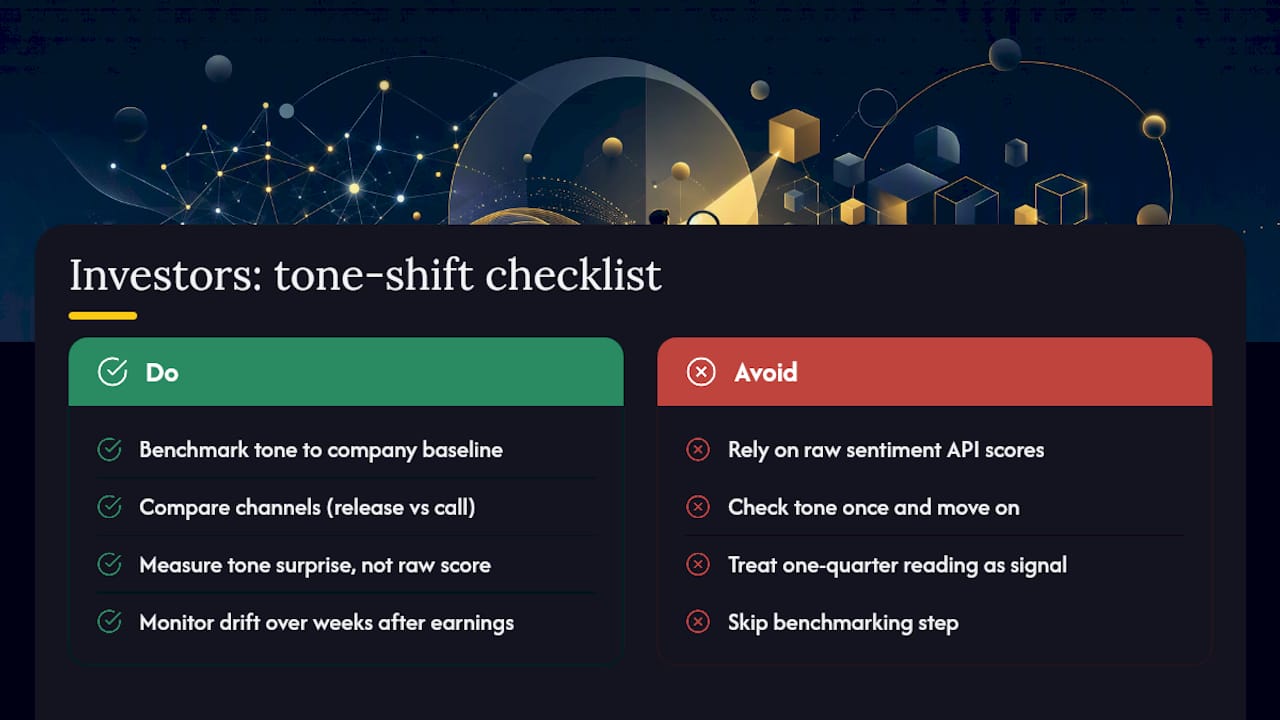
The evidence here supports a narrower claim than most commentary on corporate language suggests. Tone surprise, the residual after controlling for fundamentals, and cross-channel inconsistency both carry real predictive weight. Raw sentiment scores, the kind most retail-facing tools produce, mostly do not. The conventional shortcut, running a press release through a sentiment API and calling the output a signal, skips the benchmarking step that makes the number meaningful in the first place.
The bigger blind spot is timing. Markets under-react to tone disappointment on the earnings date itself, which means the drift plays out over weeks, not hours. An analyst who checks tone once and moves on will miss exactly the window where the signal resolves.
Prioritize the comparison, not the score. A single quarter's sentiment reading tells you almost nothing on its own. A press release that diverges from its own earnings call, measured against a company-specific baseline, tells you where to look next.
How Can Lacuna Index Scale Your Tone Shift Monitoring?
Running this methodology in-house means building sentiment baselines, transcript pipelines, and CEO fixed-effects regressions for every name in a coverage universe, before you get to a single usable score. Lacunaindex has already built that infrastructure, and it publishes the output as forensic reports rather than raw data dumps.
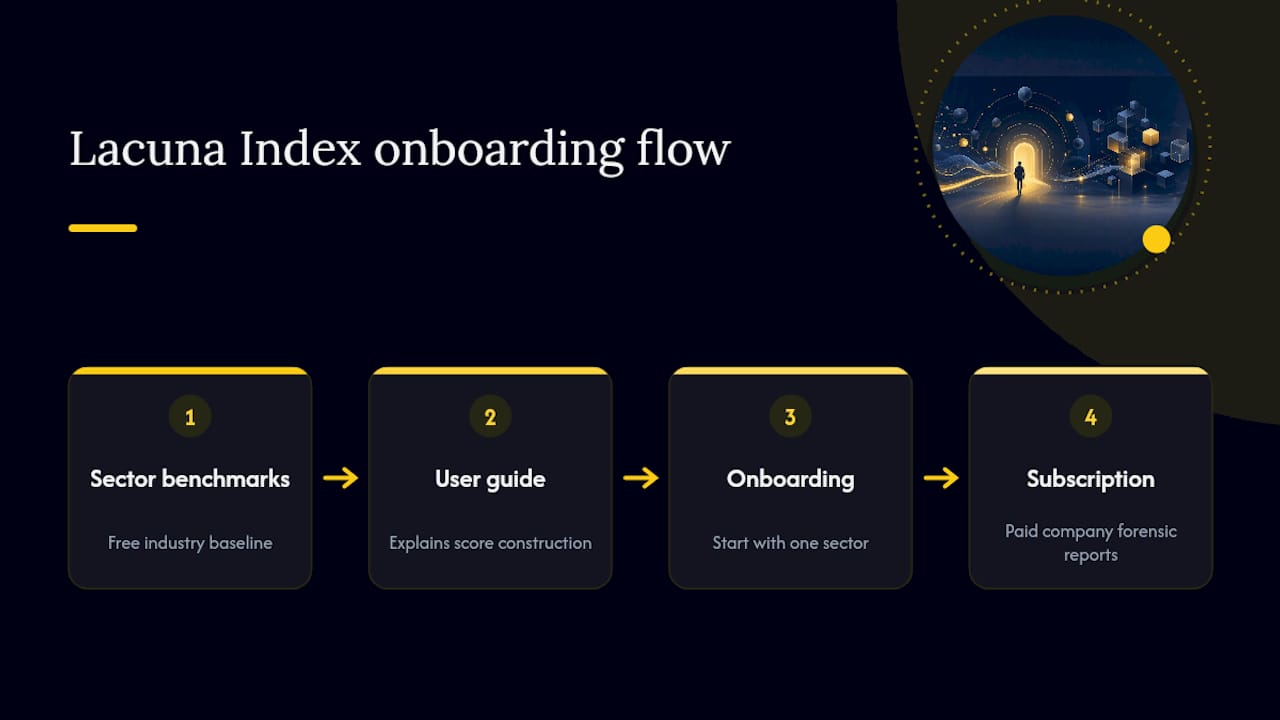
Sector benchmarks are free and give governance teams, journalists, and analysts a baseline for what normal narrative-to-delivery ratios look like within an industry, useful even before you commit to a subscription. Full company-level forensic reports, with execution scores, narrative scores, and archetype classification (earned, borrowed, or undervalued), sit behind a paid subscription built for institutional research desks and newsroom investigative teams. Onboarding typically starts with a single sector or watchlist rather than a full portfolio, so teams can validate the scoring against names they already know well.
Start by reviewing the sector benchmarks for your coverage area, then work through the user guide to see how execution scores are built from public filings alone.
Frequently Asked Questions
What is the difference between tone shift and tone surprise? A tone shift is any raw change in sentiment between two disclosures. Tone surprise is the residual after removing what fundamentals, analyst expectations, and a manager's own speaking style would already predict, and it carries more predictive weight for future earnings.
Which channels should a tone shift analysis compare? At minimum, the earnings press release against the earnings call, with the call itself split into presentation remarks and Q&A. MD&A language in the 10-Q or 10-K adds a fourth comparison point for firms where restatement risk is a concern.
Does linguistic vagueness always signal a problem? Not on its own. A single hedged answer to one analyst question is normal. A pattern of qualifying language across multiple answers, especially from the CEO, is associated with reduced informativeness of the earnings news and merits closer review.
How long does it take for a tone shift signal to show up in price? Research on tonal inconsistency between press releases and calls finds an attenuated reaction on the earnings date itself, followed by a negative drift over roughly two months as the market catches up to what the language actually signaled.
Can tone shift analysis be automated reliably? Large parts of it can, dictionary scoring, regression-based residuals, and LLM placebo testing are all reproducible steps, but interpretation still requires human judgment on confounds like CEO style and industry language norms before escalating a finding.
Sources
- Conference call tone predicts future earnings and uncertainty (Harvard MRCBG working paper)
- Mixed Messages: Strategic Tonal Inconsistency and Recovery of the PEAD Anomaly (AEA 2026 conference paper)
- Narratives contextualizing numeric disclosures: Insights from earnings calls (Journal of Business Finance & Accounting, 2026)
- Vagueness and the information content of earnings conference calls (NBER working paper)