
Systematic transparency measurement is defined as a structured, replicable process for quantifying corporate accountability by evaluating key operational dimensions rather than relying on ad-hoc disclosure. Industry-standard frameworks, including the Infrastructure Transparency Initiative (CoST) and Stanford's Foundation Model Transparency Index (FMTI), organize this process around four core dimensions: enabling environment, institutional capacities, information publication, and citizen participation. These dimensions shift the evaluation from whether a company discloses anything to whether its disclosure machinery actually functions. For institutional investors and corporate governance advocates, understanding this methodology is the first step toward distinguishing genuine accountability from engineered narrative.
What are the core frameworks for systematic transparency measurement?
Systematic transparency measurement, known in governance practice as structured disclosure assessment, relies on frameworks that evaluate transparency as an operational system rather than a checklist. Three frameworks define current practice: the Infrastructure Transparency Initiative (CoST), the Government Transparency Institute's comparative indices, and Stanford's FMTI. Each applies a distinct lens but shares a common architecture built on the four core dimensions.
| Framework | Primary Focus | Assessment Method | Key Strength |
|---|---|---|---|
| Infrastructure Transparency Initiative (CoST) | Public infrastructure projects | Multi-stakeholder disclosure review | Operational and civic participation depth |
| Government Transparency Institute | Cross-country governance indices | Quantitative indicator scoring | Comparative benchmarking across jurisdictions |
| Stanford FMTI | AI foundation model disclosure | 100 structured indicators, dual pathway | Independent researcher verification |

The enabling environment dimension examines the legal and regulatory frameworks that require disclosure. Without enforceable rules, voluntary transparency remains performative. Institutional capacities assesses whether an organization has the internal systems, personnel, and processes to actually produce reliable disclosures. Information publication measures data availability, quality, and accessibility. Citizen participation evaluates whether disclosed information reaches and engages affected stakeholders in a meaningful way.
These frameworks deliberately avoid tick-box assessments. A company can publish hundreds of pages of disclosures and still score poorly on institutional capacities if those disclosures cannot be traced to verifiable data sources. The FMTI uses 100 structured indicators scored through dual pathways: company-submitted reports and independent researcher assessments. That dual-pathway design is what separates a credible index from a self-reported survey.
Pro Tip: When reviewing a transparency framework, check whether it includes independent verification alongside company submissions. Frameworks that rely solely on self-reporting cannot detect selective disclosure.
How is transparency measured practically?
Practical transparency measurement combines quantitative indicator scoring, multi-source data collection, and independent verification to produce accountability metrics that go beyond surface ratings. The methodology requires attention to data lineage, ownership naming, and audit trails. Data transparency requires public definitions, lineage visibility, ownership naming, quality status, and documented access rules. Each of these elements reduces costly analytics inefficiencies and builds the evidentiary foundation that auditors and regulators need.
The measurement process faces three persistent challenges:
- Selective disclosure. Companies publish favorable data while omitting unfavorable operational details. A high volume of disclosures does not indicate high transparency quality.
- Greenwashing and narrative inflation. Corporate communications frequently overstate governance commitments. Transparency measurement exposes gaps between narrative disclosures and actual delivery, revealing governance risks before financial impacts materialize.
- Subjective scoring. Even structured frameworks carry evaluator bias. The FMTI addresses this through a multi-stage consensus process that mitigates subjectivity but cannot eliminate it entirely.
Independent assessments are the most reliable counterweight to these challenges. When a third party scores a company's disclosures against standardized indicators without relying on company-provided materials, the resulting score carries substantially more evidentiary weight. Continuous monitoring adds another layer. Quantitative metrics such as interpretability scores and coverage of explanations can trigger alerts for transparency degradation in real time. The same logic applies to corporate governance: a transparency score that is only measured annually misses the operational drift that occurs between reporting cycles.
Pro Tip: Focus on lineage over labels. A company that can trace every disclosed figure to a named data owner and an auditable source is more transparent than one that publishes polished sustainability reports without source documentation.
Why should institutional investors prioritize transparency measurement?
Transparency is a continuous operational capability that reflects organizational health, not a static score to be filed and forgotten. Companies refusing structured index-based transparency reporting often indicate deeper operational opacity. That refusal is itself a measurable signal, and institutional investors who treat non-participation as neutral are misreading the data.
The investment risk implications are direct. A company with a high public transparency score but poor data-driven accountability reveals governance risks that precede financial outcomes. Investors who rely on narrative disclosures alone, such as earnings call language or press release framing, miss the aspiration-to-execution gap that forensic assessment captures. The importance of transparency measurement for equity valuation is well documented: markets systematically misprice companies whose disclosed narrative diverges from operational reality.
The practical benefits for governance advocates include:
- Behavioral change, not just scoring. Effective transparency measurement generates findings that drive governance reforms rather than serve as performative exercises. Without reform recommendations tied to specific accountability metrics, measurement produces no change.
- Pre-financial risk detection. Transparency score discrepancies surface governance failures before they appear in earnings or regulatory filings.
- Engagement leverage. Measurement findings give investors and advocates a specific, evidence-based basis for constructive engagement with company management.
"Transparency must be treated as a systemic pulse reflecting organizational health rather than a static metric." — Infrastructure Transparency Initiative (CoST)
Costa Rica's experience with the Infrastructure Transparency Initiative illustrates the practical upside. The country increased its CoST score by 41% over four years through structured transparency efforts. That improvement translated into tangible accountability gains and measurable increases in public participation. The mechanism is replicable in corporate governance contexts when measurement frameworks are applied with the same rigor.
How to apply transparency measurement in governance and investment analysis
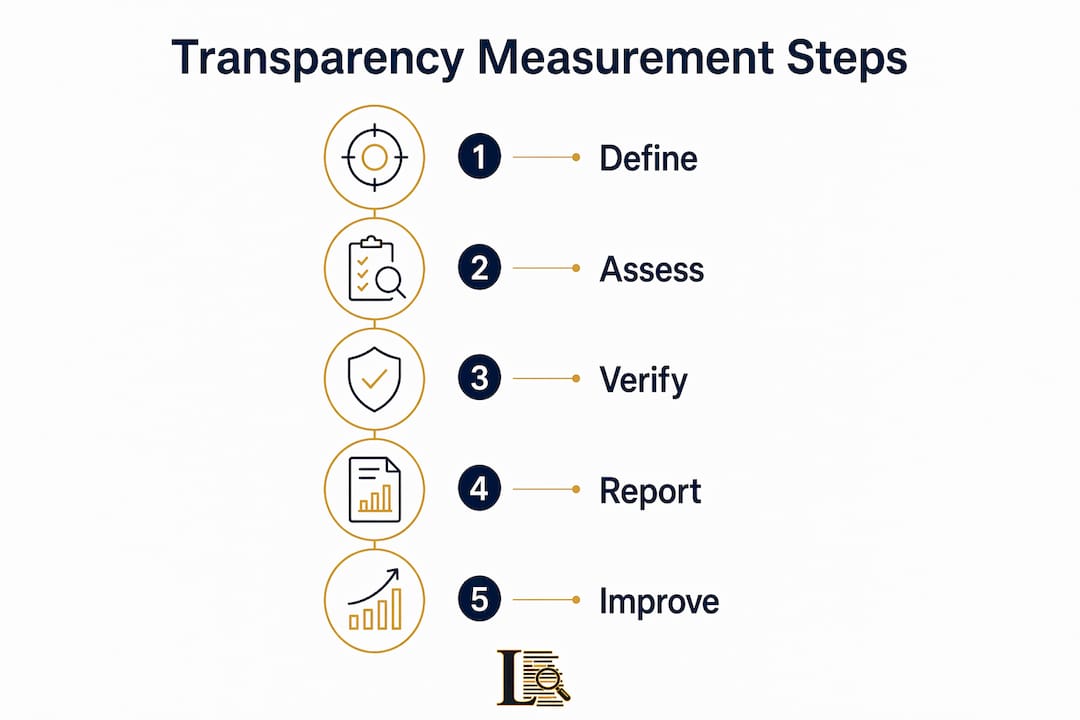
Integrating transparency metrics into governance evaluation requires a disciplined, sequential approach. The following steps reflect how institutional investors and governance advocates can move from raw measurement outputs to investment-grade conclusions.
-
Interpret scores through lineage, not labels. A transparency rating means little without understanding how it was produced. Verify whether the underlying indicators were independently assessed and whether the company's disclosures can be traced to named data owners and auditable sources.
-
Identify governance red flags from score discrepancies. A company that scores high on information publication but low on institutional capacities is publishing data its own systems cannot reliably produce. That gap signals structural governance risk. The governance red flags guide provides a structured reference for interpreting these patterns in public disclosures.
-
Integrate transparency findings with financial analysis. Transparency scores are leading indicators, not standalone verdicts. Cross-reference measurement outputs with SEC filings, proxy statements, and earnings call language to identify the aspiration-to-execution gap. Sector benchmarks provide the comparative context needed to calibrate findings.
-
Engage companies constructively using measurement evidence. Transparency findings give investors a specific, documented basis for shareholder engagement. Framing questions around data lineage, audit trail availability, and institutional capacity gaps is more productive than general inquiries about disclosure volume.
-
Monitor continuously, not annually. Transparency requires continuous monitoring of adherence to intended governance commitments and evidence generation observable in real time. Annual assessments miss the operational drift that accumulates between reporting cycles.
Lacunaindex applies this methodology by mining public records, including earnings calls, SEC filings, press releases, and proxy statements, to quantify the gap between corporate narrative and actual delivery. The platform's execution scores and sector benchmarks give investors a structured reference point that does not depend on company cooperation or insider access.
Pro Tip: When a company declines to participate in structured transparency assessments, treat that refusal as a data point. Non-participation is a transparency indicator in its own right, and it warrants deeper scrutiny of available public disclosures.
Key Takeaways
Systematic transparency measurement is the most reliable method for detecting the aspiration-to-execution gap in corporate governance before it becomes a financial event.
| Point | Details |
|---|---|
| Four core dimensions | Enabling environment, institutional capacities, information publication, and citizen participation define credible transparency frameworks. |
| Lineage over labels | Audit trail availability and named data ownership matter more than aggregate transparency scores or disclosure volume. |
| Non-participation signals risk | Companies that refuse structured transparency reporting reveal deeper operational opacity, making refusal itself a measurable governance indicator. |
| Measurement drives reform | Transparency findings produce behavioral change only when tied to specific accountability metrics and reform recommendations. |
| Continuous monitoring required | Annual assessments miss operational drift; real-time transparency metrics provide earlier signals of governance degradation. |
What I've learned watching transparency measurement evolve
I've watched transparency assessment shift from static annual indices to dynamic, multi-dimensional operational audits over the past decade. The change is significant, and most institutional investors have not caught up with it.
The most common misconception I encounter is that a high transparency score means a company is well governed. It does not. A score reflects what was measured, by whom, and against what standard. A company can publish voluminous disclosures and still have no auditable data lineage connecting those disclosures to actual operations. That is not transparency. That is documentation.
The second misconception is that transparency measurement is primarily a reputational exercise. Governance advocates who treat it that way miss its most valuable function: pre-financial risk detection. The public company accountability benchmarks that matter most are the ones that surface execution gaps before they show up in earnings revisions or regulatory actions.
My practical advice is this: anchor every transparency evaluation in data lineage and audit trail availability. Ask not whether a company disclosed something, but whether that disclosure can be traced to a named source, a verifiable date, and an accountable owner. That question separates operational transparency from disclosure theater.
— Glen
Lacunaindex and the tools that make measurement practical
Lacunaindex is built for investors and governance advocates who need more than a transparency rating.

The platform mines public records, including SEC filings, earnings calls, proxy statements, and press releases, to produce execution scores that quantify the gap between corporate narrative and actual delivery. Its sector benchmarks give investors a comparative reference across industries without relying on company cooperation. For those new to reading forensic transparency reports, the Lacunaindex user guide provides a structured walkthrough of how to interpret scores, identify red flags, and integrate findings into governance evaluations. The methodology is evidence-based, replicable, and grounded entirely in publicly available information.
FAQ
What is systematic transparency measurement?
Systematic transparency measurement is a structured, replicable process for quantifying corporate accountability using standardized frameworks and indicators. It evaluates four core dimensions: enabling environment, institutional capacities, information publication, and citizen participation.
How does transparency measurement differ from standard disclosure review?
Standard disclosure review checks whether information was published. Transparency measurement assesses whether the disclosure machinery functions, whether data is traceable to auditable sources, and whether disclosures reflect actual operational reality rather than curated narrative.
Why does data lineage matter in transparency assessment?
Data lineage establishes the chain of custody from a disclosed figure back to its source, owner, and verification date. Without lineage, a disclosure cannot be independently verified, making it impossible to distinguish accurate reporting from selective or misleading disclosure.
What does non-participation in transparency frameworks signal?
Refusal to submit to structured transparency frameworks often signals deeper governance risks. Non-participation is itself a transparency indicator and warrants heightened scrutiny of available public disclosures.
How can institutional investors use transparency scores in practice?
Investors should interpret transparency scores alongside data lineage verification, sector benchmarks, and financial filings to identify the aspiration-to-execution gap. Scores are leading indicators of governance risk, not standalone verdicts on company quality.