
Systematic accountability data journalism maps corporate narrative claims to measurable delivery using only public records, producing audit-traceable outputs that institutional investors and governance teams can act on directly. Three immediate takeaways for any investor evaluating this capability:
- Outputs are verifiable: every derived metric traces back to a sourced disclosure, versioned dataset, or reproducible code notebook.
- Signals are decision-ready: execution scores, archetype classifications, and sector benchmarks translate directly into engagement triggers, valuation adjustments, and proxy vote inputs.
- Minimum trust checks before procurement: confirm a published methodology, reproducible scripts, and raw data exports exist before relying on any report.
The recommended next step for an investor evaluating this capability is to request a methodology document and attempt to reproduce a single claim against the underlying SEC filing before committing to a subscription or engagement.
Table of Contents
- What is the systematic accountability data journalism role for investors?
- What data sources and methods make accountability analysis credible?
- What outputs do investors and governance teams actually use?
- How do you evaluate the credibility of an accountability report?
- How do you integrate forensic accountability signals into investment workflows?
- What are the limitations and legal boundaries investors must know?
- How Lacunaindex applies systematic accountability analysis
- Key Takeaways
- Why evidence-first analytics is the only defensible foundation
- Lacunaindex forensic analytics for institutional teams
- Authoritative sources for verification and further study
What is the systematic accountability data journalism role for investors?
Systematic accountability data journalism is a discipline distinct from traditional investigative reporting in three structural ways: scale, reproducibility, and dataset complexity. Where a conventional investigation might rely on a whistleblower tip or a single leaked document, data-driven accountability work processes large, structured datasets to identify performance gaps across entire sectors and time horizons. Respondents in City Research Online's multi-country study unanimously agreed that digital data reporting constitutes a new form of accountability journalism that was previously impossible without the availability of datasets and the digital tools to analyze them.
For market actors, the value is concrete. The American Press Institute frames this approach as "recoded journalism": issue-based, data-driven analysis that measures actual delivery against communicated promises rather than targeting individual statements for fact-checking. When a company's 10-K guidance diverges from subsequent quarterly filings over multiple periods, a systematic analysis surfaces that pattern as a measurable aspiration-to-execution gap. An institutional investor can use that evidence as an engagement trigger, initiating a governance dialogue with management before the gap becomes a valuation event. The SEC's EDGAR database provides the primary disclosure infrastructure for this work in the United States, making the evidentiary chain fully public and independently verifiable.
What data sources and methods make accountability analysis credible?
Primary public sources for systematic accountability analysis in the U.S. market include:
- SEC filings: 10-Ks, 10-Qs, 8-Ks, DEF 14A proxy statements, and S-1 registration documents available through EDGAR.
- Earnings call transcripts: verbatim records of management narrative claims, sourced from SEC filings or licensed transcript providers.
- Press releases and investor presentations: forward-looking statements and guidance disclosures.
- Regulatory documents: consent orders, comment letters, and enforcement actions from the SEC, FTC, and sector-specific regulators.
- Public statements: earnings guidance, ESG commitments, and strategic roadmaps published in annual reports or investor day materials.
Core methods that convert these sources into credible findings include PDF and API-based data ingestion, record linkage and entity resolution across filing periods, time-series reconstruction of guidance versus reported outcomes, and explicit claim mapping that anchors each narrative assertion to a measurable metric. Reproducible code and provenance logs are not optional extras; they are the mechanism by which a governance team can independently audit a conclusion.
A procurement mini-checklist for institutional users evaluating any accountability report:
- Published methodology document (not just a methods footnote).
- Versioned, downloadable raw data exports.
- Reproducible scripts or code notebooks.
- Explicit provenance chain for each derived metric.
- Documented data cleaning decisions and exclusion criteria.
Pro Tip: Before accepting any execution score at face value, ask the provider to show you the data cleaning log for a single company. Practitioners report that 80–90% of project time goes to data hygiene before analysis begins. A provider who cannot show that work has likely skipped it.
What outputs do investors and governance teams actually use?
Systematic accountability analysis produces a defined set of deliverables, each mapping to a specific decision context.
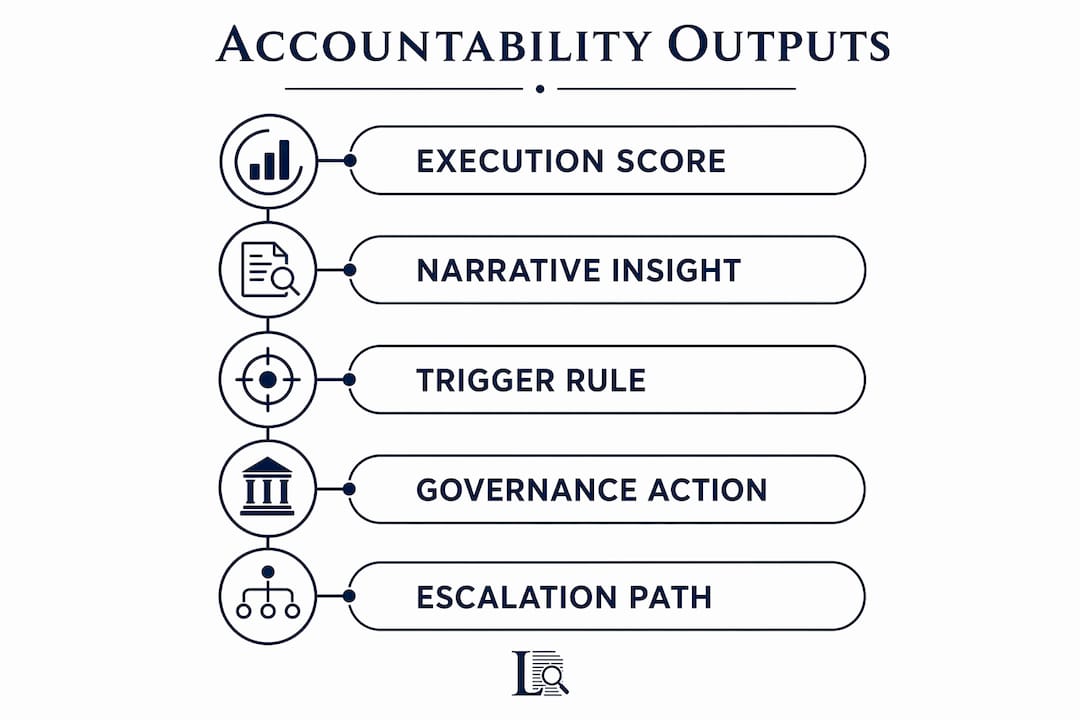
| Output | Investor Use Case |
|---|---|
| Execution score | Quantifies delivery against stated guidance; triggers engagement review when score declines across two or more consecutive periods. |
| Narrative score | Measures disclosure opacity and claim specificity; flags companies with high narrative ambition and low measurable commitment. |
| Archetype classification | Categorizes companies as earned, borrowed, or undervalued based on the relationship between delivery record and current valuation. |
| Forensic report with evidence stack | Provides sourced, claim-by-claim documentation for proxy vote preparation or legal-grade engagement letters. |
| Sector benchmark | Establishes peer comparators so a single company's score is interpreted relative to industry norms, not in isolation. |
A concrete trigger rule: when a company's execution score declines for three consecutive quarters while its narrative score holds steady or rises, that divergence constitutes a disclosure opacity signal. The governance response sequence is: (1) pull the underlying forensic report and verify the claim mapping, (2) cross-reference with the most recent proxy statement for any changes in executive compensation structure, (3) initiate a written engagement request citing the specific delivery gaps identified. Accountability journalism's most durable findings come from systemic patterns across time, not isolated incidents, which is why the trigger rule requires a multi-period trend rather than a single data point.
How do you evaluate the credibility of an accountability report?
A 15-point procurement and credibility checklist for institutional users:
- Published methodology document with version history.
- Reproducible code or scripts available for download.
- Raw data exports in machine-readable format (CSV, JSON, or equivalent).
- Explicit provenance log tracing each metric to its source filing.
- Defined data cleaning rules and documented exclusion decisions.
- Peer review or editorial audit by a named independent party.
- Disclosed conflicts of interest for all analysts and funders.
- Named analyst credentials verifiable against public professional records.
- Sector benchmark comparators drawn from a defined, reproducible peer group.
- Uncertainty and error disclosure (e.g., OCR extraction error rates, coverage gaps).
- Redaction and anonymization policies stated explicitly.
- Update frequency and version control for recurring reports.
- Distinction between inference and proof stated in the report itself.
- Coverage scope defined (which filings, which periods, which geographies).
- Contact or escalation path for factual corrections.
Suggested questions to ask a provider: "Can you walk me through the provenance chain for this execution score?" and "What is your process when a source document is unavailable or redacted?" For independent spot-checks, select one claim from the report, locate the cited filing on EDGAR, and verify the underlying figure manually. Publishing methods and exports increases institutional uptake precisely because it enables this kind of verification. You can also review how to validate corporate claims in public disclosures as a structured verification framework.
How do you integrate forensic accountability signals into investment workflows?
Converting accountability outputs into governance action requires defined signal rules, escalation paths, and realistic resource estimates.

| Workflow Step | Responsible Role | Approximate Timeline |
|---|---|---|
| Signal detection (score threshold breach) | Quantitative analyst | Same day as report publication |
| Analyst review and claim verification | Research analyst + legal review | 2–5 business days |
| Governance engagement letter preparation | Engagement lead + legal counsel | 5–10 business days |
| Management dialogue or proxy action | Portfolio manager + stewardship team | 90 days depending on AGM calendar |
Signal rules should specify both a threshold (e.g., execution score below sector median for two consecutive periods) and a corroboration requirement (e.g., the score decline must be supported by at least two independently sourced filing discrepancies). Corroboration prevents single-source errors from triggering unnecessary engagement. Accountability journalism's economic value to markets depends on sustainable, well-resourced workflows; smaller teams can produce high-impact work, but the procurement cost must be budgeted against the governance benefit. For teams building internal capacity, systematic accountability scoring benefits are well-documented as a complement to traditional fundamental analysis.
What are the limitations and legal boundaries investors must know?
Core methodological limitations include:
- Incomplete disclosures: companies are not required to disclose all material information in all formats; gaps in EDGAR filings do not always indicate concealment.
- OCR and PDF extraction errors: machine-readable conversion of legacy filings introduces error rates that must be documented and disclosed.
- Timing mismatches: guidance issued in one fiscal period may be measured against outcomes reported under different accounting standards or segment definitions.
- Survivorship and selection bias: analyses covering only currently listed companies exclude delistings, mergers, and bankruptcies that may be the most instructive cases.
- Inference vs. proof: a low execution score is evidence of a delivery gap, not proof of fraud or intentional misrepresentation.
Legal and reputational risks are material. Publicly citing a named company as having a high disclosure opacity score without a defensible, sourced evidentiary basis creates defamation exposure, particularly when the finding is used in investor communications or proxy campaigns. Legal counsel should review any engagement letter that cites accountability findings before it is transmitted. Confidentiality boundaries apply when findings are derived from material non-public information, even inadvertently; the public-records-only discipline of systematic accountability journalism is partly a legal safeguard, not only a methodological preference.
Pro Tip: When sharing accountability findings externally, always state the inference boundary explicitly: "This analysis identifies a pattern in public disclosures; it does not constitute a legal finding or a determination of intent." That single sentence substantially reduces reputational and legal exposure.
How Lacunaindex applies systematic accountability analysis
Lacunaindex operationalizes the systematic accountability data journalism role as a subscription forensic analytics platform built entirely on public records. Deliverables include:
- Forensic reports with sourced, claim-by-claim evidence stacks drawn from SEC filings, earnings call transcripts, press releases, and proxy statements.
- Execution and narrative scores quantifying the aspiration-to-execution gap for each covered company.
- Archetype classifications: Earned (delivery consistently matches or exceeds narrative), Borrowed (valuation exceeds delivery record, creating reversion risk), and Undervalued (delivery record exceeds market recognition, signaling potential upside).
- Sector benchmarks providing peer-relative context, available at no cost as the platform's entry-level offering.
- Reproducible data exports and a published methodology guide supporting independent verification.
Audit-traceability is built into the platform architecture: methodology pages document scoring logic, data exports carry provenance metadata, and change logs record updates when source filings are amended. An investor receiving a Borrowed classification for a portfolio holding has a documented evidentiary basis for an engagement letter without requiring any insider access or proprietary data.
Key Takeaways
Systematic accountability data journalism produces audit-traceable, reproducible forensic outputs that convert public disclosure records into decision-ready signals for institutional investors and governance teams.
| Point | Details |
|---|---|
| Reproducibility is non-negotiable | Demand versioned data exports, published methodology, and reproducible code before relying on any accountability report. |
| Data cleaning dominates project time | Practitioners report 80–90% of effort goes to data hygiene; a provider who cannot show cleaning logs has likely skipped this step. |
| Trigger rules require multi-period trends | A single-period score decline is insufficient; require two or more consecutive periods plus corroborating filing evidence before escalating. |
| Inference boundaries must be stated | Execution scores evidence delivery gaps; they do not constitute legal findings or proof of intent. |
| Lacunaindex as a procurement option | Lacunaindex provides execution scores, archetype classifications, sector benchmarks, and reproducible exports built entirely on public records. |
Why evidence-first analytics is the only defensible foundation
The conventional assumption in governance circles is that qualitative engagement, relationship-based dialogue with management, is sufficient to assess corporate accountability. The evidence does not support that assumption. Management teams are sophisticated communicators; earnings calls and investor presentations are engineered disclosure environments, not neutral information channels. A governance professional who relies solely on those interactions is, in effect, measuring narrative quality rather than delivery quality.
The shift that systematic accountability analysis represents is not merely methodological. It is a change in the evidentiary standard that governance work is held to. When an engagement letter cites a three-period execution score decline mapped to specific filing discrepancies, it is structurally different from a letter citing "concerns raised in our recent dialogue." The former is auditable, reproducible, and defensible. The latter is not. The evolution of accountability journalism toward a market transparency instrument reflects exactly this demand from sophisticated investors for an evidentiary foundation that qualitative engagement alone cannot provide.
Lacunaindex forensic analytics for institutional teams
Institutional investors and governance professionals who need forensic accountability analysis without building an internal data team have a direct path through Lacunaindex. Free sector benchmarks provide peer-relative execution context at no cost, making them a low-friction starting point for evaluating the platform's methodology. A paid subscription unlocks full company forensic reports, execution and narrative scores, archetype classifications, and reproducible data exports with complete provenance documentation.
Methodology transparency is not a marketing claim at Lacunaindex; it is a structural feature. Every report links to the scoring logic, every export carries provenance metadata, and the user guide walks subscribers through interpreting scores, archetypes, and benchmarks in the context of their own portfolio or governance mandate. To request a demo or discuss a pilot subscription for your team, visit lacunaindex.com.
Authoritative sources for verification and further study
- SEC EDGAR: The primary U.S. disclosure database. Best for accessing raw 10-K, 10-Q, 8-K, and proxy filings to reproduce any claim in an accountability report.
- City Research Online — Digital data reporting and the fourth estate: Academic foundation for understanding how data journalism functions as a fourth-estate accountability mechanism; methodological context.
- ISOJ — The Economics of Accountability Journalism: Covers funding models, market value, and the public-good economics of high-cost investigative accountability work.
- American Press Institute — Improving Accountability Reporting: Practitioner guide on recoded journalism and data-driven accountability formats; useful for understanding output design.
- DataJournalism.com — Working openly in data journalism: Canonical reference for methodology transparency, open code practices, and reproducibility standards.
- Matt Waite — Data Journalism With R and the Tidyverse: Practitioner handbook covering data cleaning workflows, reproducible analysis, and provenance documentation; best for understanding time and resource requirements.
- Al Jazeera Data Journalism Guide (2023): Structured curriculum covering data acquisition, cleaning, analysis, and verification; useful for teams building internal accountability analytics capacity.
- Knight Science Journalism @MIT — Data Journalism Toolkit: Curated tool inventory including DocumentCloud, Tableau Public, and QGIS; best for teams selecting technical infrastructure for disclosure analysis.