
Sell-side coverage accountability gaps are systemic failings in how analyst research fails to deliver transparent, timely, and independent financial information to market participants. These gaps range from severe small-cap information deserts to structural conflicts of interest that compromise objective analysis. Regulatory enforcement actions, including multimillion-dollar fines for trade monitoring failures and hundreds of unfiled suspicious activity reports, confirm that these deficiencies carry real market consequences. For investment professionals and corporate governance analysts, understanding the precise nature of these gaps is the first step toward building a more defensible research process.

1. What are the common sell-side coverage accountability gaps?
Sell-side accountability gaps fall into four primary categories: coverage deserts, data lag, structural proximity to management, and regulatory reporting failures. Each category represents a distinct failure mode in the research production process.
- Coverage deserts. Between 62% and 80% of small-cap companies receive zero analyst coverage. That concentration of research on large-cap names leaves entire market segments without independent valuation, creating information asymmetry that distorts pricing.
- Data integration lag. Analysts typically integrate only 60–70% of new data before publication. The result is a 30–40% dampened coverage lag, meaning published views routinely underrepresent rapid or cumulative changes in a company's fundamentals.
- Structural proximity to management. Corporate access functions as a compliance-governed, prioritized service rather than open networking. Priority access flows to senior analysts at major firms, while junior or smaller-firm analysts receive lower-conviction information. This hierarchy embeds accountability tension directly into the research process.
- Regulatory reporting failures. RBC Dominion Securities paid $3.4M for futures trader oversight failures, and Canaccord Genuity failed to file over 300 suspicious activity reports. These are not isolated incidents. They reflect systemic gaps in sell-side compliance infrastructure.
Pro Tip: When evaluating a sell-side report, check the publication date against the most recent earnings release or material filing. A gap of more than three weeks after a significant disclosure event is a signal of data integration lag.
2. How structural incentives institutionalize coverage gaps
The economics of sell-side research directly determine which companies receive coverage and which do not. Research departments are funded primarily through transaction-based models, meaning coverage decisions follow revenue potential rather than market need.
- Transaction-based funding. Firms allocate analyst resources to companies that generate trading commissions or investment banking fees. Small-cap firms generate less of both, so they attract less coverage regardless of their investment merit.
- MiFID II resource reallocation. Payment unbundling rules introduced under MiFID II forced firms to price research explicitly. The result was a contraction in coverage breadth, as firms concentrated resources on names where research could be monetized most efficiently.
- The corporate access hierarchy. Corporate access is an institutionalized hierarchy of information access, not an informal loophole. Senior analysts at bulge-bracket firms receive management time and context that smaller or independent analysts do not. This creates a tiered research quality that is invisible to most end users of sell-side reports.
- Repetitive large-cap coverage. Despite mandates to expand small-cap research, total reports increased 39.1% year over year while small-cap coverage rose only 22.2%. The gap between those two numbers represents redundant coverage of already well-covered large firms, not genuine expansion of research breadth.
3. What consequences do these gaps create for investors and governance?
Coverage gaps in sell-side research produce measurable harm across three dimensions: market pricing, investment decision quality, and corporate governance oversight.
Mispricing and information asymmetry
Undercovered companies trade on thinner information sets. Prices reflect narrative more than fundamentals when independent verification is absent. This is the core mechanism behind the aspiration-to-execution gap that Lacunaindex quantifies: without rigorous coverage, a company's communicated promises face no systematic challenge from the analyst community.
Governance failures in undercovered firms
Corporate governance depends partly on external scrutiny. When sell-side coverage is absent or captured by sponsored research, boards face less external pressure to maintain disclosure discipline. Sponsored or initiation research inflates apparent coverage metrics without providing genuine independent valuation. Governance analysts who rely on coverage counts as a proxy for oversight quality will systematically overestimate the scrutiny applied to undercovered companies.
Regulatory and cultural risk
Hard-charging cultures within investment banks increase risk-taking and reduce critical assessment. Jefferies faces scrutiny for risky lending practices linked to its internal culture. That cultural dynamic extends to research departments, where pressure to maintain banking relationships can suppress negative ratings. Citadel Securities failed to report tens of billions of transactions over multiple years, generating fines and demonstrating that enforcement gaps compound the underlying accountability failures.
| Consequence | Mechanism | Impact on analysts |
|---|---|---|
| Mispricing | Thin information set | Variant perception becomes unreliable |
| Governance failure | Sponsored research inflates coverage counts | Oversight quality is overstated |
| Regulatory risk | Reporting failures and cultural pressure | Compliance exposure for firms and clients |
| Data lag | Incomplete model integration | Published views lag material events |
Pro Tip: Treat a company's analyst count as a starting point, not a conclusion. Filter out sponsored initiation notes and check whether remaining coverage comes from analysts with no banking relationship to the issuer.
4. How to address accountability gaps in your research process
Investment professionals can reduce exposure to sell-side accountability issues through a structured set of practices. These are not theoretical recommendations. Each addresses a specific failure mode identified above.
- Diversify data sources. Relying exclusively on sell-side output concentrates your information risk. Independent institutional research, primary data sources, SEC filings, and earnings call transcripts each provide verification layers that sell-side reports may omit or underweight. Lacunaindex mines exactly these public disclosure sources to produce accountability scores independent of analyst relationships.
- Apply accountability scoring frameworks. Systematic scoring of sell-side reliability, based on historical forecast accuracy, rating change frequency, and proximity to banking mandates, produces a defensible filter for research quality. Lacunaindex's execution scores apply this logic at the company level, measuring delivery against stated commitments across public records.
- Scrutinize sponsored research. Sponsored or initiation notes require manual filtering before they contribute to a coverage assessment. Check whether the research provider has a fee arrangement with the issuer. If so, treat the note as a disclosure document rather than an independent valuation.
- Monitor publication timing relative to material events. A report published more than three weeks after a material filing or earnings release carries elevated lag risk. Build a simple timestamp check into your research intake process to flag stale views before they influence a position.
- Advocate for transparency standards. Governance analysts in particular should push for disclosure of analyst-banking relationships in research headers, standardized coverage quality metrics, and mandatory reporting of coverage gaps in investor relations materials. The regulatory oversight framework for sell-side compliance is evolving, and institutional pressure accelerates that evolution.
- Use periodic deep-dive reviews. Quarterly or semi-annual reviews of your sell-side coverage universe, assessing which names have seen rating changes, which have gone dark, and which are covered only by sponsored notes, provide a structured early warning system for accountability deterioration.
Key takeaways
Sell-side coverage accountability gaps are structural, measurable, and directly addressable through disciplined research practices and independent verification frameworks.
| Point | Details |
|---|---|
| Coverage deserts are quantifiable | Between 62% and 80% of small-cap firms receive zero analyst coverage, creating systematic pricing blind spots. |
| Data lag is built into the process | Analysts integrate only 60–70% of new data before publication, producing views that routinely trail material events. |
| Sponsored research inflates metrics | Initiation notes with fee arrangements overstate true independent coverage and require manual filtering. |
| Structural incentives drive gaps | Transaction-based funding and MiFID II unbundling concentrate resources on large-cap names at the expense of breadth. |
| Accountability scoring closes the gap | Systematic frameworks that measure delivery against stated commitments provide a defensible alternative to raw coverage counts. |
What I've learned from watching sell-side gaps compound over time
The most persistent mistake I see governance analysts make is treating analyst count as a measure of scrutiny. It is not. A company covered by eight sponsored initiation notes and zero independent analysts is, for practical purposes, uncovered. The notes exist to satisfy a disclosure requirement, not to challenge management's narrative.
The corporate access hierarchy compounds this problem in ways that are rarely discussed openly. When senior analysts at major firms receive preferential management access, their published views carry an implicit endorsement of the relationship. Junior analysts and independent researchers, who often ask harder questions, receive lower-quality information and publish with lower conviction. The market reads conviction signals, not the underlying information quality. That inversion is where mispricing originates.
Quantitative accountability frameworks change this dynamic. When you measure a company's execution score against its stated commitments across SEC filings, earnings calls, and press releases, you bypass the access hierarchy entirely. The benefits of systematic scoring are not theoretical. They show up in variant perception, in earlier identification of deteriorating governance, and in more defensible position sizing. The sell-side will not fix its own accountability gaps. That responsibility falls to the professionals who use its output.
— Glen
Lacunaindex: forensic accountability for undercovered markets
Sell-side coverage gaps leave investment professionals and governance analysts working with incomplete, often biased information. Lacunaindex addresses that directly by measuring the gap between what companies claim and what public records confirm, without relying on analyst relationships or corporate access.
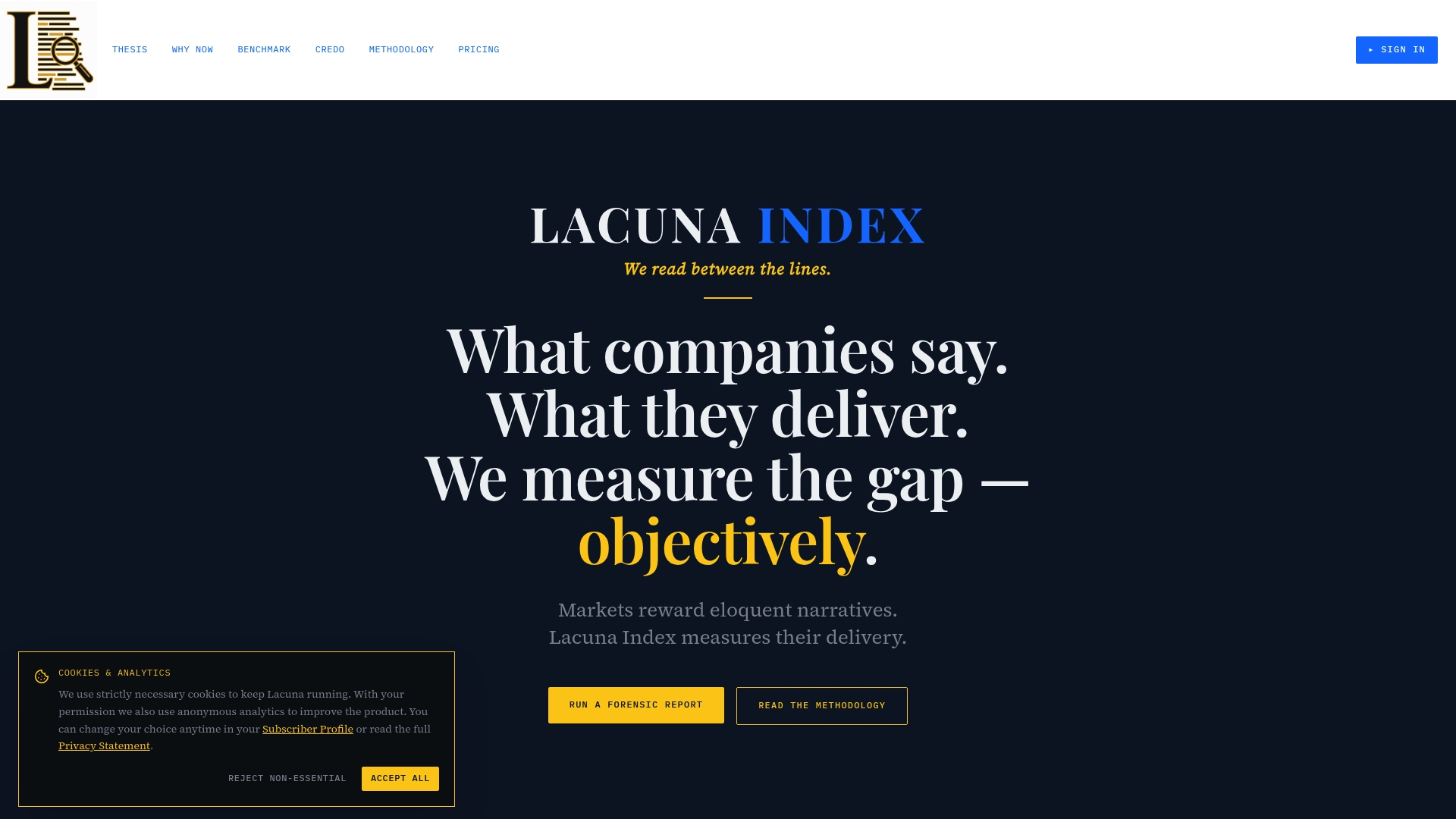
Lacunaindex's sector benchmarks provide objective valuation reference points for companies across coverage tiers, including those with zero independent analyst coverage. The platform's execution scores and forensic reports give governance analysts a structured alternative to sponsored research. For professionals who want to understand how Lacunaindex reads between the lines of corporate disclosure, the user guide explains the full methodology. Start with the benchmarks to see where your current coverage universe stands against independently verified accountability data.
FAQ
What are sell-side coverage accountability gaps?
Sell-side coverage accountability gaps are systemic failures in analyst research that result in incomplete, biased, or delayed financial information. They include coverage deserts for small-cap firms, data integration lag, structural conflicts from corporate access hierarchies, and regulatory reporting failures.
Why do small-cap companies receive so little analyst coverage?
Transaction-based funding models direct research resources toward companies that generate commissions and banking fees. Small-cap firms generate less of both, so between 62% and 80% receive zero analyst coverage despite representing a significant portion of listed equities.
How does sponsored research distort coverage quality?
Sponsored initiation notes inflate apparent coverage counts without providing independent valuation. Because the research provider has a fee arrangement with the issuer, the analysis functions as a disclosure document rather than an objective assessment, requiring manual filtering before it contributes to a coverage evaluation.
What regulatory actions have exposed sell-side accountability failures?
RBC Dominion Securities paid $3.4M for futures trader oversight failures, and Canaccord Genuity failed to file over 300 suspicious activity reports. These enforcement actions reflect systemic gaps in sell-side compliance infrastructure, not isolated incidents.
How can governance analysts reduce exposure to sell-side accountability gaps?
Governance analysts should diversify data sources beyond sell-side output, apply accountability scoring frameworks to assess research reliability, filter sponsored research from coverage counts, and monitor publication timing relative to material disclosure events.