
Public-records equity analysis is a forensic verification layer that validates and augments traditional valuation inputs; it does not replace DCF models, P/E multiples, or audited financial filings. Its primary function is to surface disclosure gaps, generate targeted diligence questions, and produce ongoing monitoring signals, each traceable to an original government URL. The role of public records in equity analysis is to anchor what management claims against what the documentary record shows, using sources such as SEC filings, county recorder records, and agency enforcement databases as the evidentiary foundation.
Table of Contents
- Which public records matter for equity and governance analysis?
- A repeatable forensic methodology for public-records equity analysis
- How do public-records signals fit into investment and governance workflows?
- What are the main limitations of public-records analysis?
- How should analysts interpret scores, archetypes, and benchmarks?
- What timeline and cost should institutions expect?
- Anonymized vignettes: when public records changed the decision
- How do you operationalize this analysis across a fund or program?
- Key Takeaways
- Why forensic public-records work matters more now than it did five years ago
- Lacunaindex: institutional-grade forensic analysis from public records
- Useful sources and methodology references
Which public records matter for equity and governance analysis?
Public records analysis produces actionable signals only when analysts map each record category to a specific investment question rather than treating the corpus as a general data lake.
- SEC filings and XBRL data establish stated financials, subsidiary lists (Exhibit 21), and executive compensation disclosures. The practical question: does the subsidiary list in Exhibit 21 align with county ownership records for the same properties?
- County recorder and assessor records anchor parcel identity, ownership history, and financing events. A deed establishes the recorded owner; a mismatch with the SEC-disclosed entity structure is a diligence flag.
- Court and enforcement records surface legal risk, regulatory sanctions, and consent orders that may not appear prominently in 10-K risk-factor language.
- Permits and zoning records create capex and use-change questions. An active demolition permit on a property listed as a core operating asset warrants explanation.
- Entity registries (state secretary-of-state filings) map ownership structures, registered agents, and formation dates, supporting related-party transaction analysis.
- Tax and licensing records provide expense and operational context, including delinquency signals that can precede liquidity stress.
- Proxy statements and earnings-call transcripts are public artifacts that record narrative claims and executive commitments, forming the narrative side of a narrative-vs-delivery comparison.
Lower-value sources require caution. Press mentions and third-party aggregated scores without source-URL attribution introduce noise and create reproducibility problems. Aggregated scores without audit trails risk incorrect due-process conclusions and decision errors when the underlying government records cannot be independently verified.
Pro Tip: Record the primary government URL, ingestion timestamp, and a confidence label (high/medium/low) for every record at the moment of retrieval. This practice is the foundation of an audit-traceable evidence store.
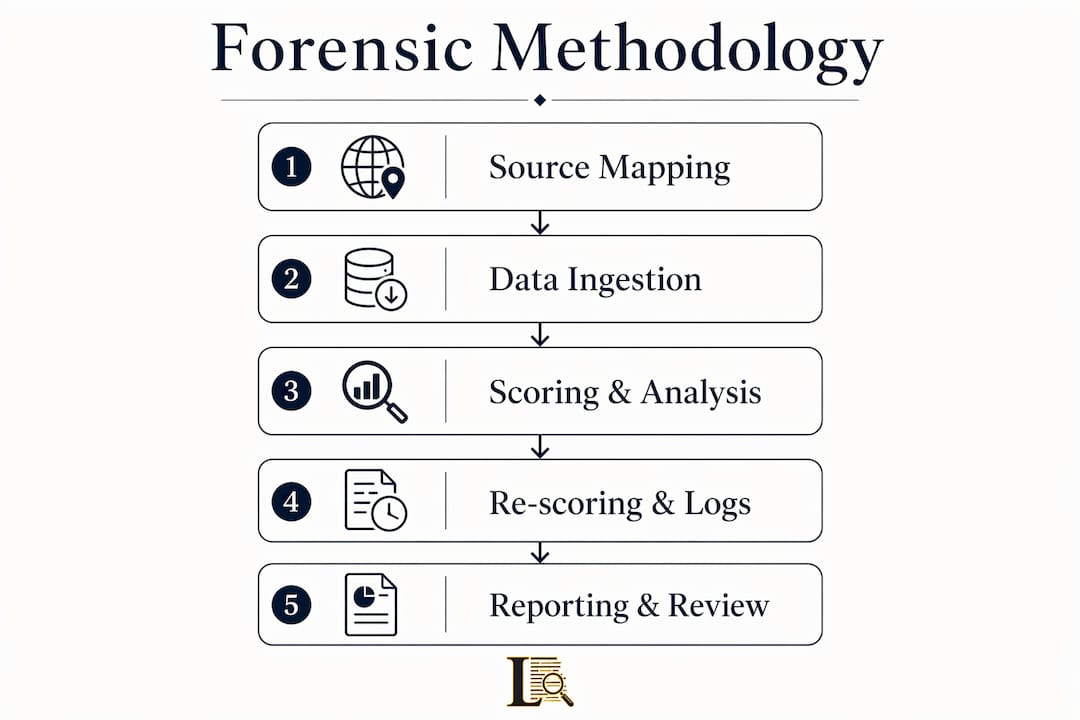
A repeatable forensic methodology for public-records equity analysis
A reproducible forensic workflow moves from primary-source discovery through normalization, clustering, signal scoring, and traceable reporting, with methodology versioning at every stage.
- Discover primary-source URLs. Identify the authoritative government or regulatory source for each record type. Never substitute a third-party aggregator for the primary record without logging both.
- Normalize and canonicalize entities. Standardize legal entity names, addresses, and identifiers across jurisdictions. Jurisdictional field-definition mismatches are the leading cause of false linkages and missed connections.
- Cluster linked records. Group ownership, address, and filing records into entity clusters. Computational clustering at scale reveals ownership concentration patterns that manual lookups cannot surface.
- Score and triage signals. Assign a versioned risk or execution score to each signal, attaching the source URL, ingestion timestamp, and the methodology version that produced the score. This preserves historical defensibility.
- Escalate open questions. Convert high-severity signals into documented diligence questions routed to management, broker conversations, or specialist reviewers. Signals are inputs to questions, not final verdicts.
- Report with full traceability. Every derived signal in the final report must link back to its originating government record. Methodology versioning keeps older scores attached to the version that produced them, preventing silent re-scoring.
Pro Tip: Maintain a versioned scoring methodology document and make any re-scoring explicit, with a change log entry, rather than silently updating historical scores. Without this discipline, comparing current and past signals becomes unreliable.
How do public-records signals fit into investment and governance workflows?
Public-records outputs should drive specific, documented questions and prioritization decisions, not final investment verdicts. The forensic corporate analysis workflow maps naturally onto four investment lifecycle stages.
- Deal sourcing. Ownership cluster analysis and enforcement-record screening prioritize leads by risk profile before committing diligence resources.
- Pre-deal diligence. Recorder, assessor, permit, and entity-registry records validate ownership chains, lien positions, and capex assumptions. Mismatches between Exhibit 21 subsidiaries and county ownership records are a standard escalation trigger.
- Post-investment monitoring. Automated checks on enforcement events, new court filings, and permit activity provide early-warning signals between reporting cycles.
- Proxy-season governance analysis. Stakeholder network mapping and related-party transaction tracing, drawn from proxy statements and entity registries, support engagement preparation and vote recommendations.
For prioritization, apply a simple impact-vs-ease-to-verify matrix: signals with high potential impact on valuation or governance posture and low verification cost (a single government URL confirms or refutes the flag) should be addressed first. Signals that are high-impact but require multi-jurisdiction verification warrant dedicated analyst time. Low-impact, hard-to-verify signals are candidates for deferral or monitoring rather than immediate escalation.
What are the main limitations of public-records analysis?
Public records are inputs and flags, not definitive proof of valuation or management intent. Treating them otherwise is the most common misuse pattern.
- Inconsistent update cadences. County recorder and assessor records update on varying schedules; a record that appears current may reflect a transaction from months prior.
- Field-definition mismatches. Jurisdictional variation in how fields are defined, particularly across county assessor databases, means that cross-jurisdiction comparisons require explicit normalization before analysis.
- Stale and misattributed records. Entity name changes, address reuse, and data-entry errors in government systems can produce false linkages. Sample-checking a random subset of records before relying on cluster outputs is a minimum verification standard.
- Aggregation without source traceability. Proprietary scores that do not expose the originating government URL cannot be independently verified and should not be treated as primary evidence.
- Assessor value vs. market value. Assessed values are tax-administration figures; they do not represent market value and should never be substituted for appraisal or transaction-based valuation.
- Beneficial ownership databases. Not all beneficial ownership data is publicly accessible in the United States; assuming completeness without confirming the access model for a given registry is a procedural error.
The disclosure gap between public records and reported financials is itself a signal, but one that requires downstream verification before it can support an investment decision.
How should analysts interpret scores, archetypes, and benchmarks?

Common outputs from forensic public-records analysis are triage signals and archetype labels, not standalone valuations. Each output type has a defined scope and intended use.
| Output Type | Description | Intended Use |
|---|---|---|
| Audit-traceable risk score | Versioned 0–100 signal tied to source URLs and ingestion timestamps | Triage and prioritization |
| Execution score | Measures delivery against stated narrative commitments | Narrative-vs-delivery gap analysis |
| Ownership cluster metric | Count and concentration of linked entities | Related-party and structure review |
| Archetype label | Earned, borrowed, or structural gap classification | Portfolio posture and engagement framing |
| Sector benchmark | Cross-company reference distribution within a GICS sector | Relative positioning and peer context |
Archetype labels carry specific implications. An earned classification indicates that delivery metrics align with or exceed narrative claims. A borrowed classification signals that market valuation reflects narrative commitments not yet supported by execution evidence. A structural gap label identifies companies where the aspiration-to-execution gap is persistent across multiple reporting periods, warranting closer governance engagement.
High scores on a triage scale warrant immediate diligence escalation. Medium signals are candidates for monitoring with a defined re-review trigger. Low signals are logged and held unless a corroborating record emerges.
What timeline and cost should institutions expect?
Small-scope checks on a single company can be completed in days. Portfolio-scale normalization, entity resolution, and clustering across multiple jurisdictions typically requires a substantial amount of time, depending on automation coverage.
| Phase | Typical Duration | Key Activities |
|---|---|---|
| Pilot / discovery | a short period | Source mapping, sample record retrieval, field normalization scoping |
| Normalization and mapping | several weeks | Entity canonicalization, cross-jurisdiction field alignment, cluster construction |
| Scoring and validation | a few weeks | Signal scoring, methodology versioning, sample-check verification |
| Integration and monitoring | Ongoing | Automated refresh, alert routing, audit-trail maintenance |
Cost drivers include coverage breadth (number of jurisdictions and record types), the ratio of automated to manual review, refresh frequency, entity-resolution complexity, and verification intensity. A focused pilot covering one sector and three to five companies is a practical entry point for institutions evaluating program-level investment. Program-scale implementations that span a full portfolio and multiple jurisdictions require dedicated data-engineering capacity alongside forensic analyst resources.
Anonymized vignettes: when public records changed the decision
A record mismatch between SEC-disclosed subsidiaries and county ownership records led to a targeted diligence question that materially changed the terms of a transaction.
- Vignette 1 — Ownership structure discrepancy. An analyst querying a state entity registry found a subsidiary not listed in the company's most recent Exhibit 21. The primary source was a secretary-of-state filing (government URL logged with ingestion timestamp). The question posed to management: why does this entity appear in the state registry but not in the SEC disclosure? The outcome was a revised Exhibit 21 and a renegotiated representation in the purchase agreement.
- Vignette 2 — Undisclosed enforcement event. A court-records search surfaced a consent order from a federal agency that predated the current reporting period but had not been referenced in the 10-K risk factors. Source: federal court PACER docket (URL and timestamp logged). The governance team used the finding to prepare targeted questions for the annual meeting and adjusted the engagement posture from passive to active.
- Vignette 3 — Permit activity inconsistency. A permit record from a county building department showed an active demolition permit on a property the company described as a long-term operating asset in its most recent earnings call. The signal was escalated to the real estate diligence workstream, which confirmed a planned disposition not yet disclosed in public filings.
Evidence-link template: Source type | Government URL | Ingestion date | Confidence label | Open question | Resolution status. Every signal in a forensic report should carry this structure.
How do you operationalize this analysis across a fund or program?
Scale requires normalization infrastructure, entity-resolution logic, versioned methodology, and a clear handoff model between roles.
- Data engineer: responsible for ingestion pipelines, field normalization, and maintaining the canonical entity graph with source-traceable links.
- Forensic analyst: interprets clustered signals, assigns archetype labels, and drafts the open-question log for management or diligence routing.
- Governance lead: translates forensic findings into engagement strategy, proxy-season preparation, and escalation decisions.
- Audit reviewer: periodically samples the evidence store to confirm that derived signals trace to valid primary-source URLs and that methodology versioning is current.
Architecture requirements include a canonical entity graph, a source-traceable evidence store with ingestion timestamps, a versioned methodology repository, and API or report integration points into portfolio management systems. Large public-records corpora can span tens of billions of records across thousands of sources; the operational challenge is not access but normalization and linking logic. Routine checks should be automated; high-severity signals should route to human triage with a documented escalation path. Governance analysis best practices consistently emphasize that the audit trail for every derived signal is as important as the signal itself.
Key Takeaways
Public-records equity analysis functions as a forensic verification layer that generates audit-traceable questions, not as a replacement for valuation models or audited filings.
| Point | Details |
|---|---|
| Verification layer, not valuation | Public records validate inputs and surface flags; DCF, P/E, and audited filings remain the valuation foundation. |
| Audit-traceability is non-negotiable | Every signal must link to a primary government URL, ingestion timestamp, and methodology version. |
| Questions, not verdicts | Convert signals into documented diligence questions routed to management or specialist reviewers. |
| Jurisdictional variation is the main operational risk | Field definitions and update cadences differ by county and agency; normalize before cross-jurisdiction analysis. |
| Lacunaindex provides institutional-grade outputs | Forensic reports, execution scores, and sector benchmarks from Lacunaindex are versioned and audit-traceable. |
Why forensic public-records work matters more now than it did five years ago
Disclosure engineering has become more sophisticated. Companies have learned to satisfy the letter of SEC reporting requirements while leaving material operational and governance information in the gap between what is stated and what is delivered. Sector benchmarks now show that the aspiration-to-execution gap is not randomly distributed; it clusters by industry, by company size, and by reporting period, which means it is measurable and comparable. Audit-traceable methods are the only defensible response to that environment. An analyst who cannot trace a risk signal back to its originating government record cannot defend the signal in a governance engagement, a proxy contest, or a portfolio review. The forensic methodology described here is not a theoretical construct; it is the operational standard that the current disclosure environment demands.
Lacunaindex: institutional-grade forensic analysis from public records
Institutions that need reproducible, audit-traceable public-records analysis without building the infrastructure from scratch have a direct option in Lacunaindex. The platform delivers forensic reports with execution and narrative scores, archetype classifications, and sector benchmarks derived entirely from public company disclosures, with every signal traceable to its originating source.
Sector benchmarks are available at no cost and provide immediate reference distributions for peer comparison. Full company-level forensic reports, including execution scores, ownership cluster analysis, and the complete evidence trail, are available to subscribers. The user guide explains how to read a Lacunaindex report, interpret execution and narrative scores, and integrate findings into an existing investment or governance workflow. Institutions evaluating program-level adoption can start with the free benchmarks to assess coverage and methodology before committing to a subscription.
Useful sources and methodology references
- CFA Institute — Equity Valuation: Concepts and Basic Tools: The authoritative reference for intrinsic value estimation frameworks (present value, multiplier, and asset-based models). Use to confirm the boundary between valuation methodology and forensic verification inputs.
- Acren — CRE Public Records Source Atlas: Maps recorder, assessor, tax, entity, permit, zoning, court, and environmental records to specific diligence questions. A practical atlas for building a record-category-to-question mapping in any sector.
- Nexus — Property Ownership Transparency and Public Records: Documents the computational approach to ownership-network analysis at scale, including the methodology for surfacing ownership concentration clusters from large assessor datasets.
- PublicTrace — Methodology: Explains source-URL attachment, methodology versioning, and the practice of keeping older scores attached to the version that produced them. The reference standard for audit-traceable scoring design.
- Lupa Intelligence — Methodology: Addresses the risks of aggregated scores without primary-source traceability and the jurisdictional variation challenges that require explicit normalization before cross-jurisdiction analysis.
- Lacunaindex — Forensic Financial Analysis Methodology Steps: Step-by-step guidance for building a reproducible forensic workflow, including entity normalization, signal scoring, and audit-trail construction.