
Public disclosures are the primary evidentiary foundation for investigative reporting on corporate misconduct. When institutional investors and governance advocates understand the role of public disclosures in investigative reporting, they gain a clearer picture of how accountability actually functions: not through insider access, but through the systematic analysis of what companies are legally required to reveal. The detection mechanism works because disclosures create a paper trail that forensic analysts and journalists can interrogate against actual outcomes.
Key functions of public disclosures in this accountability architecture:
- They provide a legally mandated, auditable record that investigators can cite without reliance on confidential sources.
- They reveal discrepancies between management's stated intentions and measurable delivery, the core of the aspiration-to-execution gap.
- They serve as both investigative tools and evidentiary resources for enforcement agents and journalists.
- They reduce information asymmetry between corporate insiders and external stakeholders, including institutional investors.
- Lacunaindex applies forensic analytics to these disclosures, quantifying delivery gaps and classifying companies by execution archetype.
Table of Contents
- What public disclosures actually contain and why they matter
- How investigative reporting uses public disclosures to expose misconduct
- Challenges in transparency: strategic management and analytical limitations
- How Lacunaindex applies forensic analytics to public disclosures
- Tools and methodologies for enhancing accountability
- Case studies: when public disclosures drove accountability
- Best practices for institutional investors in disclosure-based due diligence
- How real-time digital disclosures have changed investigative depth
- How journalists, investors, and governance advocates collaborate on disclosure data
- Key Takeaways
What public disclosures actually contain and why they matter
Public disclosures encompass the formal, periodic filings and voluntary statements that U.S. public companies submit under SEC oversight. Core documents include Form 10-K annual reports, Form 10-Q quarterly filings, proxy statements (DEF 14A), earnings call transcripts, press releases, and specialized forms such as Form SD for mandated social disclosures. Each document type carries distinct informational content: the 10-K provides audited financials and risk factor narratives; proxy statements reveal executive compensation structures and board composition; earnings calls expose management's forward-looking claims in real time.
The regulatory purpose is to reduce information asymmetry between corporate insiders and external capital markets participants. Mandatory disclosure under the Securities Exchange Act of 1934 and subsequent SEC rulemaking establishes minimum standards; voluntary disclosures, such as supplemental ESG reports or investor day presentations, extend beyond compliance. Research demonstrates that voluntary disclosure improves liquidity by reducing information asymmetries between retail and institutional investors, with managers actively shaping their information environments to lower cost of capital.
Digital EDGAR access has transformed the processing of these documents. What once required physical requests now arrives in machine-readable formats, enabling systematic cross-document analysis at scale.
- Mandatory filings: 10-K, 10-Q, 8-K, DEF 14A, Form SD
- Voluntary disclosures: ESG reports, investor presentations, earnings guidance
- Regulatory framework: SEC rules under the Securities Exchange Act, Dodd-Frank provisions
- Access mechanism: EDGAR database, real-time SEC filing notifications
How investigative reporting uses public disclosures to expose misconduct
Investigative journalists function as secondary gatekeepers in the accountability system, translating complex disclosure data into narratives that drive enforcement and market discipline. The evidentiary architecture they rely on is largely legal and regulatory: court documents and regulatory reports are among the most instrumental sources for accountability journalism, providing credible, libel-resistant evidence on the behavior of powerful corporate actors.
Media disclosures of white-collar crimes correlate strongly with formal prosecutions and convictions, functioning as a detection mechanism that operates independently of private fraud examiner reports. The OECD has documented that media reporting is an essential, if underutilized, source of detection in corruption cases, with investigative journalism triggering both law enforcement investigations and corporate self-reporting.

The mechanism is layered. A journalist cross-references an earnings call transcript against a 10-K risk factor disclosure, identifies a material inconsistency, then corroborates it through litigation records or regulatory correspondence. The resulting story reaches a global readership within days, compressing what would otherwise be a years-long enforcement timeline. Whistleblowers accelerate this process by directing journalists toward specific disclosure documents that contain the most probative information.
Challenges in transparency: strategic management and analytical limitations
Disclosure does not automatically produce transparency. True transparency requires that information be understandable and contextually relevant; raw data released without structure or explanation increases uncertainty rather than reducing it. This distinction is analytically critical for institutional investors who must distinguish between disclosure opacity engineered by management and genuine complexity inherent to the business.
Corporate managers strategically release voluntary information to influence market liquidity and reduce cost of capital, a practice that can obscure material risks behind a volume of favorable narrative. Separately, transparency operationalized for market efficiency differs fundamentally from transparency designed to detect corruption; conflating the two produces unreliable accountability assessments.
Analytical limitations compound these challenges:
- Reputational crowding: Mandatory disclosure can prompt credit analysts to shift toward conservative, less accurate ratings by relying on public information over private insight, reducing rating accuracy.
- Information overload: High disclosure volume without analytical structure favors management narratives over material facts.
- Mandated social disclosures: Under Dodd-Frank Section 1502, conflict mineral disclosures increased bid-ask spreads and price volatility, demonstrating that mandated disclosures can raise information asymmetry rather than reduce it.
- Timing manipulation: Earnings releases and material event filings timed to low-attention periods reduce the probability of investigative scrutiny.
Pro Tip: Accessing public financial disclosures through EDGAR's anonymous online interface, rather than formal FOIA requests, allows enforcement agents and investigators to conduct covert early-stage reviews without alerting investigation targets. Online disclosure access reduces acquisition costs and supports lead development before any formal inquiry is initiated.
How Lacunaindex applies forensic analytics to public disclosures
Forensic analytics converts the raw material of public disclosures into measurable accountability metrics. Lacunaindex mines earnings call transcripts, SEC filings, proxy statements, and press releases to detect engineered narratives, identify unasked questions, and quantify the gap between management's stated aspirations and verifiable delivery. The methodology operates exclusively on publicly available information, eliminating the need for insider access while maintaining evidentiary integrity.
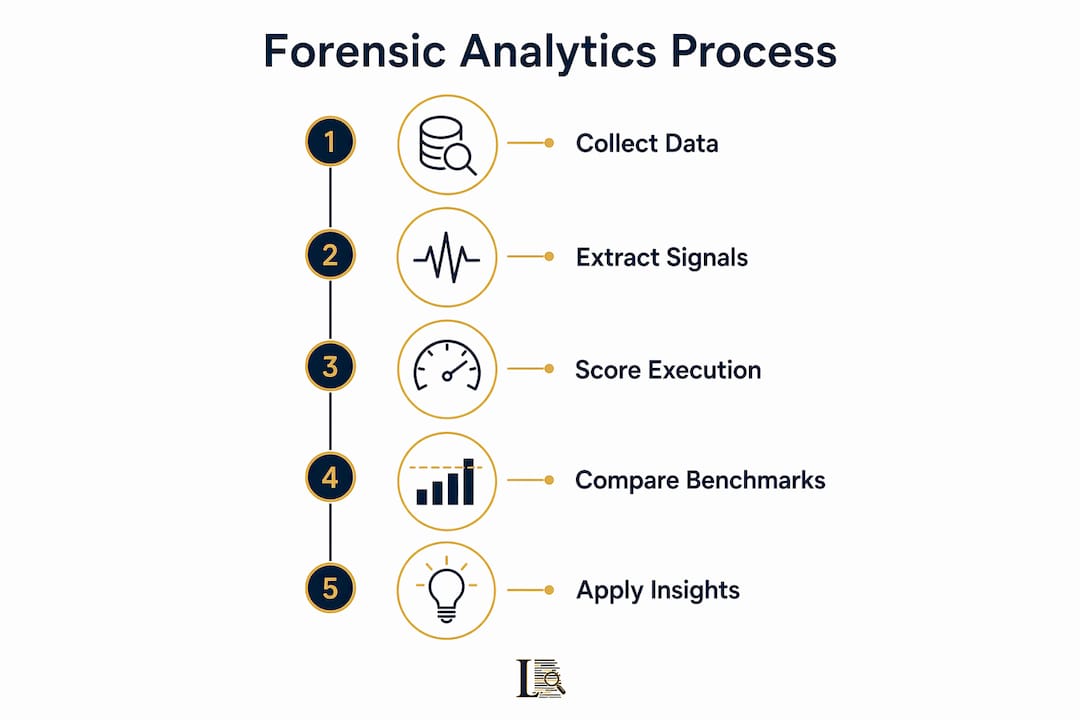
The platform's execution score assigns a quantitative measure to each company's delivery record relative to its disclosed commitments. Companies are then classified into archetypes: earned (delivery consistently matches or exceeds narrative), borrowed (valuation rests on narrative not yet supported by execution), and undervalued (delivery exceeds market recognition). These classifications inform both investment decisions and governance advocacy by identifying where mispricing originates.
| Disclosure Source | Forensic Signal Extracted | Accountability Application |
|---|---|---|
| Earnings call transcripts | Language pattern shifts, hedging frequency | Narrative consistency scoring |
| SEC 10-K / 10-Q filings | Guidance vs. reported outcome delta | Execution gap measurement |
| Proxy statements | Compensation alignment with performance | Governance archetype classification |
| Press releases | Claim specificity and verifiability | Disclosure opacity assessment |
Sector benchmarks provide comparative context, allowing institutional investors to assess whether a company's disclosure pattern is an outlier within its peer group or consistent with industry norms. The transparency premium in equity valuation is measurable precisely because forensic analytics can isolate the narrative component of a company's market price from its execution-backed component.
Tools and methodologies for enhancing accountability
Beyond forensic analytics platforms, institutional investors and governance advocates draw on a layered set of methodologies. EDGAR full-text search enables keyword tracking across filings over time, surfacing changes in risk factor language or the disappearance of previously disclosed metrics. Natural language processing applied to earnings call transcripts can flag statistically anomalous shifts in management tone or specificity. Cross-document reconciliation, comparing guidance issued in one quarter against reported outcomes in the next, forms the backbone of execution gap analysis.
Regulatory databases including SEC EDGAR, the Financial Industry Regulatory Authority's BrokerCheck, and court PACER records extend the evidentiary base beyond voluntary and mandatory corporate filings. Governance red flags in disclosures often appear as omissions rather than commissions: metrics that were disclosed in prior periods and then quietly dropped, or risk factors that narrow in scope as underlying exposures widen.
Case studies: when public disclosures drove accountability
The Panama Papers investigation, awarded the Pulitzer Prize for Explanatory Reporting in April 2017, grew from five years of work by the International Consortium of Investigative Journalists mining financial secrecy disclosures across multiple jurisdictions. The investigation demonstrated that cross-border disclosure data, when systematically aggregated, exposes structures that no single national regulator could detect in isolation.
Dodd-Frank Section 1502 conflict mineral disclosures provided a domestic parallel: mandatory Form SD filings created a structured, auditable record of supply chain sourcing that governance advocates and journalists used to assess corporate compliance with human rights standards. The disclosures did not resolve the underlying policy problem, but they created an evidentiary baseline against which corporate claims could be tested.
In U.S. corporate fraud enforcement, the pattern is consistent: media exposure of disclosure inconsistencies precedes formal SEC investigation in a material fraction of cases. The OECD Anti-Bribery Convention's working group maintains a matrix of foreign bribery allegations drawn primarily from public media reporting, which member countries use as a detection source.
Best practices for institutional investors in disclosure-based due diligence
Effective due diligence treats public disclosures as a longitudinal dataset, not a point-in-time snapshot. Comparing risk factor language across three to five annual filings reveals whether management is expanding or contracting its disclosed risk universe relative to observable business conditions. Proxy statement analysis should track the relationship between executive compensation metrics and the specific operational targets disclosed in earnings guidance.
How public disclosures reveal management gaps is most visible when investors cross-reference the specificity of forward-looking statements against the granularity of subsequent reporting. Vague aspirational language in earnings calls, followed by aggregated rather than segmented financial reporting, is a consistent pattern in companies with elevated aspiration-to-execution gaps. Institutional investors who systematically track this pattern gain an early signal of governance deterioration before it appears in price action.
How real-time digital disclosures have changed investigative depth
The shift from paper-based to digital, real-time disclosure has compressed the detection timeline for corporate misconduct. SEC 8-K filings, which must be submitted within four business days of a material event, now reach EDGAR within hours and are immediately accessible to journalists, analysts, and enforcement agents simultaneously. This simultaneity eliminates the information lag that once allowed management to shape the narrative before external scrutiny could begin.
Machine-readable XBRL tagging of financial statements enables automated comparison across thousands of companies and periods, a capability that was operationally impossible before digital standardization. Investigative journalists working with data editors can now identify sector-wide disclosure anomalies in days rather than months. The covert accessibility of online public financial disclosures further supports early-stage investigations by allowing enforcement agents to build evidentiary context without triggering premature disclosure of the inquiry itself.
How journalists, investors, and governance advocates collaborate on disclosure data
The most consequential accountability outcomes emerge when investigative journalists, institutional investors, and governance advocates operate from a shared evidentiary base. Journalists surface narrative inconsistencies that trigger investor scrutiny; investor engagement through shareholder proposals generates additional disclosure that journalists can then analyze; governance advocates use both to build regulatory pressure. This iterative cycle is most effective when each actor has access to the same underlying disclosure record.
Transnational journalist networks such as the International Consortium of Investigative Journalists have demonstrated that coordinated disclosure analysis across jurisdictions produces enforcement outcomes that no single actor could achieve independently. For institutional investors, formal engagement with governance research organizations that systematically analyze corporate accountability through public records extends the analytical reach beyond what internal teams can sustain.
Lacunaindex's sector benchmarks provide the comparative disclosure analytics that institutional investors and governance advocates need to contextualize individual company assessments within peer-group execution norms.
Key Takeaways
Public disclosures are the foundational evidentiary layer for both investigative reporting and forensic corporate accountability analysis, with their effectiveness determined by analytical methodology, not disclosure volume alone.
| Point | Details |
|---|---|
| Disclosures as evidence | SEC filings, earnings calls, and proxy statements form a legally mandated, auditable record for accountability analysis. |
| Media as detection mechanism | Media disclosures of white-collar crimes correlate with formal prosecutions, functioning beyond private fraud examiner reports. |
| Strategic disclosure risk | Managers voluntarily release information to shape liquidity and reduce cost of capital, which can obscure material risks. |
| Forensic analytics advantage | Lacunaindex quantifies the aspiration-to-execution gap using only public records, classifying companies as earned, borrowed, or undervalued. |
| Digital access accelerates scrutiny | Online EDGAR access enables covert, low-cost early-stage investigations and compresses the detection timeline for misconduct. |