
The five red flags that matter most are revenue growing faster than operating cash flow, receivables and days sales outstanding rising ahead of sales, unexplained changes to revenue recognition policy, sales concentrated suspiciously at quarter-end, and vague or shifting footnote language around performance obligations. The immediate next step is a five-minute triage: compare rolling revenue to cash collected, check accounts receivable aging, plot revenue by week within the quarter, and track deferred revenue against recognized revenue. What follows lays out the tests, the escalation path, and how public-record forensic analysis narrows the search for real misstatement risk.
TL;DR:
- A divergence between revenue growth and operating cash flow exceeding 15-20 percentage points warrants a detailed review of recognition practices.
- Sustained growth in accounts receivable and increasing days sales outstanding over ten days suggest loosening credit and potential premature revenue recognition.
- Significant revenue concentration at quarter-end coupled with policy language shifts indicate channel stuffing or policy-driven recognition acceleration.
- Evidence such as restatements, auditor changes, or material weakness disclosures signal deep control issues or possible misstatement tendencies.
- Sector-specific risks include judgment-heavy allocations in software, long-term construction, high channel-stuffing potential in retail, and variable consideration in healthcare.
Table of Contents
- Prioritized Checklist: Quick Triage for Revenue Recognition Red Flags
- What Each Red Flag Actually Means in the Filings
- Analytic Tests That Confirm or Dismiss a Suspected Red Flag
- Turning Findings Into Action: Triage, Evidence, and Escalation
- How Lacuna Index Reads Between the Lines on Revenue Claims
- When One-Time Items and Unusual Credits Start Doing Too Much Work
- Restatements, Auditor Turnover, and Weak Controls Rarely Travel Alone
- Why Revenue Risk Looks Different by Industry
- How These Flags Distort Ratios and Investor Perception
- Regulators Have a Long, Specific History With Revenue Fraud
- What Management Behavior Often Reveals Before the Numbers Do
- The Footnote Tell Most Analysts Skim Past
- Standards and Regulators Worth Bookmarking
- Sources
Prioritized Checklist: Quick Triage for Revenue Recognition Red Flags
Run these checks in order. Each one takes minutes with a 10-K, 10-Q, and a spreadsheet, and each failure raises the priority of a deeper look.
- Cash flow vs. revenue divergence. Compare trailing twelve-month revenue growth to operating cash flow growth. A widening gap, especially above 15 to 20 percentage points, deserves scrutiny.
- Accounts receivable growth vs. revenue growth. If AR grows materially faster than sales for two or more consecutive quarters, recognition is running ahead of collection.
- DSO trend. Calculate days sales outstanding each quarter. A steady climb of 10 or more days over a year signals loosening credit terms or premature booking.
- Quarter-end sales concentration. Pull weekly or monthly shipment data where disclosed; a disproportionate share of revenue in the final two weeks of the period suggests channel stuffing.
- Policy language changes. Read the revenue recognition footnote year over year, word for word, for any shift in performance obligation timing.
- Deferred revenue vs. recognized revenue trend. A shrinking deferred revenue balance alongside rising recognized revenue can mean the company is pulling forward future obligations.
- Bill-and-hold arrangements. Search footnotes and MD&A for "bill and hold," which lets a company recognize revenue before shipment.
- Related-party transaction disclosures. Check proxy statements for customers or distributors tied to insiders.
- One-time or "other revenue" line growth. A growing miscellaneous revenue category padding the top line warrants a closer read.
- Returns and credit memo volume. Rising returns after strong quarters often confirm channel stuffing after the fact.
- Auditor tenure and opinion changes. A new auditor or a qualified opinion within 12 months of other flags raises the stakes considerably.
- Internal control disclosures. Any reported material weakness tied to revenue processes moves a company straight to the top of the review queue.
Pull the cash flow statement, AR aging schedule (if available through investor relations or supplemental disclosures), segment revenue tables, and the full revenue recognition footnote before moving to deeper analysis.
What Each Red Flag Actually Means in the Filings
Every item on that checklist maps to a specific accounting mechanism, and understanding the mechanism is what separates a real forensic read from a checklist exercise.
Cash flow divergence happens when a company recognizes revenue under ASC 606 performance obligations before cash actually changes hands. This shows up as rising net income alongside flat or declining operating cash flow. A persistent gap between rolling 12-month revenue and rolling cash collected from customers is one of the cleanest signals available, because it strips out seasonality and isolates the structural mismatch between booked sales and realized cash.
AR growth and DSO expansion often trace back to extended payment terms offered to hit a quarter, or to recognizing revenue on shipments that customers have not actually accepted. AICPA guidance explicitly flags unusually long payment terms as a condition that should trigger expanded audit procedures, alongside policy changes, end-of-period sales spikes, and related-party transactions.
Policy changes under ASC 606 are the subtlest and most dangerous category. When a company shifts from point-in-time to over-time recognition, or reallocates transaction price across bundled deliverables, it can accelerate revenue without any change in the underlying business. Comparing the company's stated policy against three industry peers often reveals when a shift has pushed recognition materially ahead of what peers report for similar contracts.
Bundled contracts and allocation manipulation exploit the judgment built into ASC 606's five-step model. A company selling hardware, software, and a service plan together has latitude in how it allocates the transaction price across those performance obligations. Front-loading value onto the component recognized earliest inflates near-term revenue while pushing the shortfall into future periods.
Deferred revenue patterns deserve close attention because deferred revenue, or contract liabilities, should move in a predictable relationship with billings and recognized revenue. A company drawing down deferred revenue faster than new bookings replace it is quietly borrowing from future quarters.
Bill-and-hold and channel stuffing both accelerate recognition ahead of genuine customer demand. Detection relies on AR turnover deterioration, a spike in revenue concentrated at period-end, subsequent spikes in returns, and evidence of distributor inventory buildup, confirmed where possible through sell-in versus sell-through analysis.
Related-party transactions matter because a sale to an entity controlled by an executive, a major shareholder, or an affiliated distributor may not reflect an arm's length transaction at all.
Reserves and allowance manipulation show up when a company under-reserves for returns or doubtful accounts to protect reported revenue, then takes a larger charge later when the true collection rate becomes undeniable.
- Footnote wording around "performance obligations" and allocation methods is one of the most common places judgment gets stretched. Small phrasing shifts often mask materially different timing under PwC's ASC 606 disclosure guidance.
Pro Tip: Read the revenue footnote from the current filing next to the same footnote from two years earlier, sentence by sentence. Genuine businesses rarely need to rewrite how they describe their own performance obligations. When the wording changes but the disclosed rationale does not, treat that as a standalone signal worth investigating.
Analytic Tests That Confirm or Dismiss a Suspected Red Flag
A suspicion is not a finding. These stepwise tests convert a checklist hit into evidence an audit committee or investment committee can act on.
- Rolling 12-month revenue vs. cash collected. Plot both series monthly. A persistent gap that widens when sales jump indicates recognition running ahead of cash realization.
- AR turnover and DSO trend line. Formula: DSO = (Accounts Receivable ÷ Total Credit Sales) × Number of Days. Chart it quarterly across at least eight quarters to separate a genuine trend from noise.
- Within-quarter sales distribution. Where shipment or invoicing data is available, break revenue into weekly buckets. A normal business shows a relatively even distribution; a business under pressure shows a hockey-stick pattern in the last one to two weeks.
- Deferred revenue reconciliation. Beginning deferred revenue plus new billings minus recognized revenue should equal ending deferred revenue. A reconciliation that does not hold, or that management adjusts through unexplained "other" line items, needs a direct explanation.
- Sell-in vs. sell-through comparison. Where distributor or retail sell-through data exists (from point-of-sale reports, industry trackers, or public disclosures), compare it against the company's sell-in figures. A sustained gap confirms channel-level inventory buildup rather than end-customer demand.
- Customer and distributor confirmations. For flagged accounts, direct confirmation of amounts owed, delivery terms, and any side agreements remains one of the few tests that catches undisclosed terms altogether.
Analysts and forensic accountants working from public filings alone can run tests one through four without any special access. Tests five and six require either proprietary access during an audit engagement or a willingness to cross-reference third-party industry data.
PCAOB inspection reports and the FASB codification remain the reference points for how far substantive procedures should extend once a metric crosses a concerning threshold, such as DSO expansion beyond 10 days in a year or a cash flow to revenue gap exceeding 15 percentage points sustained over two quarters.
Escalate from triage to full investigation when two or more independent tests confirm the same direction of distortion, or when a single test reveals a magnitude large enough to move reported earnings past a reasonable estimate of what collections actually support.
Turning Findings Into Action: Triage, Evidence, and Escalation
Classify every flagged company into one of three tiers before deciding how much further to dig.
- Low priority: one soft signal (mild DSO drift, one unusual quarter) with a plausible operational explanation disclosed in MD&A. Monitor next quarter; no immediate escalation.
- Medium priority: two or more confirmed tests point the same direction, such as AR growth outpacing revenue alongside a policy footnote change. Request additional disclosure detail, model the impact on reported margins, and flag the position for closer review at the next reporting cycle.
- High priority: cash flow divergence, quarter-end concentration, and a control weakness or auditor change appear together. Move immediately to formal evidence collection.
At the high-priority tier, request customer and distributor confirmations, shipping manifests, and any side letters referenced in contract files. Present findings to the audit committee directly rather than routing them through management first. Where evidence suggests intentional misstatement rather than aggressive-but-disclosed judgment, SEC enforcement precedent supports notifying regulators alongside adjusting any internal valuation model for the company.
How Lacuna Index Reads Between the Lines on Revenue Claims
Some forensic reports are built entirely from public records: earnings call transcripts, SEC filings, proxy statements, and press releases, with no insider access and no reliance on management's framing of its own results. Such methodologies score each company on the gap between what it claims and what its own disclosures actually support, then classify companies into archetypes like earned, borrowed, or undervalued based on how consistently execution matches narrative.
For revenue recognition specifically, this narrative-versus-delivery lens can work as a prioritization filter. A company whose earnings-call language about "strong momentum" and "record demand" diverges sharply from its own AR aging and deferred revenue trends earns a wider execution gap in forensic scoring, which helps prioritize triage. Sector benchmarks can let an analyst see, at a glance, whether one company's DSO trajectory or cash conversion pattern sits meaningfully outside its peer group before spending hours on a full filing review.
When One-Time Items and Unusual Credits Start Doing Too Much Work
Watch the "other revenue" or "miscellaneous income" line closely once it starts growing faster than core operating revenue. Legitimate one-time items exist: asset sales, licensing settlements, insurance recoveries. The red flag is frequency, not the existence of a single unusual item.
A pattern worth flagging: a company reports a one-time gain or unusual revenue item in three or more of the last eight quarters, each time large enough to close a gap between actual results and analyst estimates. That regularity undercuts the "one-time" label itself. Genuine one-time events are, by definition, irregular.
Returns and credit memos deserve the same scrutiny in reverse. A spike in returns processed one or two quarters after a period of unusually strong sales is a classic signature of channel stuffing catching up with itself; the initial sale inflated the top line, and the return corrects it only after the reporting period has already closed and been reported to the market. Look specifically at the allowance for sales returns relative to gross revenue. If that allowance stays flat or shrinks while gross revenue climbs, the company may be under-reserving for returns it already expects.
Credit memos issued to distributors or resellers close to quarter-end, then reversed or reissued the following quarter, are another pattern worth tracing through footnote disclosures and, where available, through distributor-level channel data.
Restatements, Auditor Turnover, and Weak Controls Rarely Travel Alone
A restatement tied to revenue recognition is one of the strongest confirmed signals available, because it represents management or the auditor admitting the prior numbers were wrong. The pattern to watch is frequency and clustering: a single restatement for an isolated technical error is far less concerning than two or more restatements within three years, especially when both touch revenue timing or allocation.
Auditor changes deserve equal weight. A company switching audit firms shortly after a disagreement over accounting treatment, or right before a quarter with unusual revenue patterns, should move up the priority list automatically. Proxy statements and 8-K filings disclosing auditor changes typically include a brief explanation; read it skeptically, since companies rarely volunteer the full story in a regulatory filing.
Internal control weaknesses reported under Sarbanes-Oxley Section 404 assessments carry direct relevance when they specifically cite revenue processes, order-to-cash cycles, or contract review procedures. A material weakness in these areas is effectively management confirming that the controls meant to prevent premature or manipulated recognition were not functioning.
None of these three signals, alone, proves misstatement. Together, layered on top of a cash flow divergence or a policy change, they shift a company from watch-list status to a genuine investigation candidate. The clustering matters more than any single data point, because fraud and aggressive accounting rarely announce themselves through one clean signal.

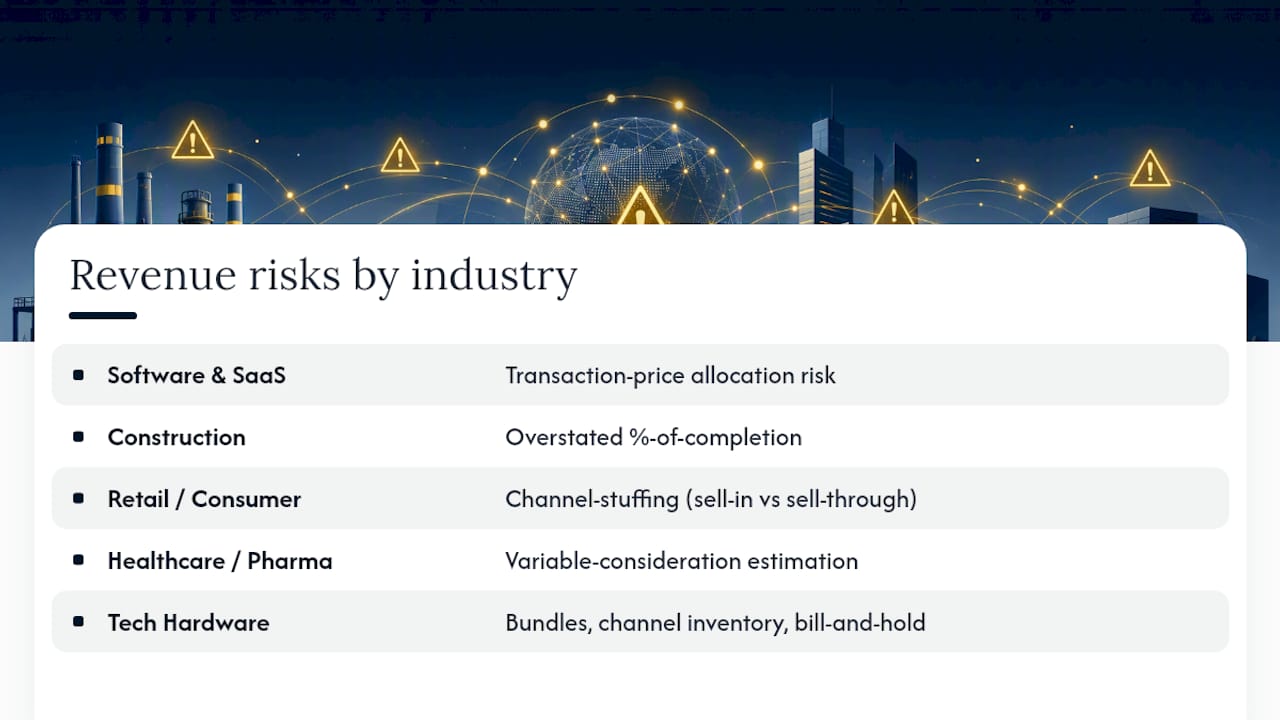
Why Revenue Risk Looks Different by Industry
Software and subscription businesses live and die by how they allocate transaction price across performance obligations under ASC 606. A software company bundling a perpetual license, implementation services, and multi-year support faces real judgment calls in splitting that price, and small allocation shifts toward the license component can front-load revenue that should be recognized ratably.
Homebuilders and long-term contractors face similar judgment in percentage-of-completion estimates. Overstating completion percentage accelerates revenue against a project that has not actually progressed that far, a pattern historically common enough that auditors treat construction and engineering as elevated-risk sectors by default.
Retail and consumer products companies carry the highest channel-stuffing exposure, because they rely on distributor and reseller networks where sell-in and sell-through can diverge for months before the mismatch becomes visible in financial statements.
Health care and pharmaceutical companies wrestle with variable consideration: rebates, chargebacks, and copay assistance programs all require estimation, and companies with a pattern of favorable "true-up" adjustments to prior estimates deserve a second look at how conservatively they set those estimates in the first place.
Technology hardware companies combine several risks at once: bundled contracts, channel inventory, and bill-and-hold arrangements tied to custom manufacturing schedules. Each sector's specific mechanics change, but the underlying forensic question stays constant: does the timing of recognized revenue match the timing of genuine economic delivery?
How These Flags Distort Ratios and Investor Perception
Aggressive revenue recognition does not just inflate the top line; it distorts nearly every ratio built on top of it. Gross margin looks stronger than the underlying unit economics support when revenue is pulled forward without matching cost recognition. Return on assets and return on equity both overstate management's actual capital efficiency once the gap between reported and cash-adjusted revenue widens.
Valuation multiples suffer the same distortion in reverse once the market catches on. A stock trading at a premium multiple on reported revenue growth can reprice sharply when a restatement or an SEC inquiry reveals that growth rate to have been partly manufactured rather than earned. Investors who anchor on revenue growth alone, without checking it against cash flow and receivables trends, are the ones most exposed to that repricing risk.
Perception compounds the mechanical distortion. Analysts building consensus estimates off a company's own guidance tend to extrapolate recent quarters forward, so an artificially inflated quarter does not just misstate the present, it biases the entire forward model. That is part of why the gap between narrative and delivery matters as much as any single quarter's numbers: a company that consistently beats its own guidance through recognition timing rather than genuine demand growth will eventually face a quarter where the trick runs out of runway, and the correction tends to be sharper than the original inflation.
Regulators Have a Long, Specific History With Revenue Fraud
Revenue recognition fraud remains one of the most consistently pursued categories in SEC enforcement history, and that consistency reflects how central revenue is to nearly every other reported metric a company presents to the market. When the top line is fabricated or accelerated improperly, the distortion cascades into margins, earnings per share, and every valuation multiple built on those numbers.
The SEC's enforcement approach typically targets a combination of factors rather than a single accounting choice: fictitious sales, premature recognition of legitimate sales, improper bill-and-hold arrangements, and channel stuffing disguised through side agreements with distributors. Cases frequently involve internal emails or side letters that contradict the terms disclosed in the actual sales contract, which is why documentary evidence, not just financial ratios, tends to determine whether an SEC matter proceeds to a formal action.
For analysts and auditors, the practical takeaway is that regulatory risk rises sharply once a red flag moves from an accounting judgment call into a documented pattern of concealment. A company that discloses an aggressive but defensible policy choice faces a very different regulatory posture than one where internal records show executives knew shipments would be returned and booked the revenue anyway. That distinction, judgment versus concealment, is exactly what confirmatory tests like distributor confirmations and side-letter review are designed to surface.
What Management Behavior Often Reveals Before the Numbers Do
Numbers lag behavior. Management teams under pressure to hit a number tend to signal it before the financial statements confirm anything, and experienced analysts learn to listen for the pattern.
Watch for language on earnings calls that shifts from specific operational detail toward vague reassurance, particularly phrases emphasizing "confidence in the pipeline" or "strong momentum" without corresponding detail on bookings, backlog, or customer counts. A management team that answered detailed analyst questions about customer concentration two years ago and now deflects the same question with generalities is often signaling discomfort with what a direct answer would reveal.
Executive departures, especially a CFO or chief accounting officer leaving with limited notice or no clearly stated reason, deserve immediate attention when they follow closely after a strong quarter. Insider selling concentrated right after a quarter that beat expectations, particularly when it involves executives who rarely sell, is a pattern worth cross-referencing against Form 4 filings.
Guidance behavior matters too: a company that repeatedly issues conservative initial guidance and then beats it by a suspiciously consistent margin every quarter may be managing earnings through recognition timing rather than genuinely outperforming, since real operating businesses rarely beat their own forecasts by an identical amount quarter after quarter.
The Footnote Tell Most Analysts Skim Past
Here is the heuristic worth memorizing: when the footnote gets longer but the numbers get simpler, read it twice. A revenue recognition footnote that expands from three paragraphs to seven, while the reported revenue figure itself becomes smoother and more consistent quarter to quarter, usually means management added disclosure to justify a judgment call rather than to clarify an operational change.
Real operational shifts, a new product line, a changed sales channel, produce footnote language that describes something concrete: a new performance obligation, a new customer type, a new delivery method. Language that instead reworks how an existing obligation is described, without a matching operational story, is the signature of a policy shift built to move the numbers rather than reflect the business.
Think of it as the "quiet footnote" test. Genuine change is loud; it shows up in the MD&A, the earnings call, and the footnote all telling the same operational story. Engineered change is quiet: only the footnote moves.
— Glen
Standards and Regulators Worth Bookmarking
Consult ASC 606 as the governing standard for how performance obligations and transaction price allocation should work. The SEC's Division of Enforcement publishes precedent on how aggressive recognition becomes an enforcement matter. AICPA practice alerts set the audit-response baseline auditors are expected to follow. PCAOB inspection reports show where audit firms have historically fallen short on revenue-related procedures, which is useful context for weighing how much to trust a clean audit opinion on its own.
Before committing analyst hours or audit budget to a full investigation, cross-check flagged companies against Lacuna Index's sector benchmarks, which compare execution-versus-narrative scores across peer companies using only public disclosures. For contract-heavy sectors where unusual terms and financing structures complicate the read, reviewing how prop trading firms structure their own contract terms offers a useful parallel in how fine print can obscure the real economics of an arrangement.
Sources
- AICPA Practice Alert — Revenue recognition fraud risk and audit response
- A roadmap to applying the new revenue recognition standard — Deloitte
- Sec