
Proxy season, for research purposes, is the recurring cycle of annual-meeting disclosures anchored to each issuer's DEF 14A filing, not a fixed calendar window. In 2026, that cycle carries unusual regulatory risk: a Securities and Exchange Commission (SEC) pause on Rule 14a-8 no-action responses and a proposed rescission of the rule itself mean omission decisions are harder to verify against settled precedent. The single action that protects a research file against this uncertainty is straightforward. Pull the DEF 14A from EDGAR and start a version-controlled evidence log the moment the filing posts.
TL;DR:
- The SEC's proposed rescission of Rule 14a-8 and the no-action request pause in 2026 create legal uncertainty, making prior staff responses unreliable for exclusion decisions.
- Accurate proxy research requires detailed timestamped tracking of all DEF 14A filings, amendments, and deadlines, especially for issuers with mini-seasons or late revisions.
- Building a standardized, version-controlled work process ensures reproducibility, with key dates and amendment logs critical to avoiding citing outdated or incorrect filings.
- Analyzing shareholder proposals' exclusion bases and vote tallies demands detailed documentation of procedural, correspondence, and settlement records since final outcomes can be complex.
- Cross-referencing narrative claims with disclosed figures in proxy and compensation filings is essential, as discrepancies between the story and the data can signal red flags or misreporting.
Table of Contents
- What Is Proxy Season and How Does Timing Work for U.S. Issuers?
- What Key Dates Should You Log During Proxy Research?
- What Are the 2026 SEC Rule Changes to Rule 14a-8?
- How Do You Build a Reproducible Workflow for Reviewing Proxy Statements?
- How Should You Analyze Shareholder Proposals and Voting Outcomes?
- How Do You Test Executive Compensation Claims Against Reported Pay?
- Where Do You Find Reliable Proxy Research Data?
- What Does a 90/60/30/7-Day Proxy Research Plan Look Like?
- How Does Lacuna Index's Forensic Method Fit Into Proxy Research?
- A Research Analyst's Take on Proxy Season in 2026
- How Lacuna Index Supports Audit-Ready Proxy Research
- Sources
- FAQ
What Is Proxy Season and How Does Timing Work for U.S. Issuers?
Proxy season describes the period when most U.S. public companies distribute proxy materials and hold annual shareholder meetings, typically concentrated in spring but never confined to it. The DEF 14A is the operative document: it lays out the meeting agenda, director nominees, executive compensation, auditor ratification, and any shareholder proposals up for a vote. The SEC's own guidance on proxy materials frames this as a recurring annual cycle rather than a one-time event, which matters for how a researcher builds a repeatable process instead of a one-off review.
Timing mechanics trip up even experienced analysts. A company sets a record date, the cutoff for determining who holds shares eligible to vote, which usually falls weeks before the meeting date itself. Ownership status changes what a shareholder receives: registered holders get a proxy card directly from the company, while beneficial owners, those holding shares through a broker or bank, receive a voting instruction form instead. This distinction, confirmed in the SEC's own materials, determines who can actually cast a vote and through which channel.
Most companies schedule their annual meeting shortly after fiscal year close, which is why the traditional proxy season clusters between April and June for calendar-year filers. But fiscal-year exceptions and so-called mini seasons, running from July through December for issuers on non-calendar fiscal years, mean a research calendar built only around spring will miss a meaningful slice of filings.
Practical orientation points for any new proxy file:
- The DEF 14A number and filing date establish the authoritative version to cite.
- The record date, not the meeting date, determines voting eligibility.
- Registered versus beneficial ownership changes the delivery mechanism and, sometimes, the voting deadline.
- Mini-season issuers require a separate tracking cadence outside the April to June cluster.
What Key Dates Should You Log During Proxy Research?
A proxy research file is only as reliable as its date discipline. Every filing version, every deadline, and every amendment needs a timestamp, because companies do amend DEF 14A filings, and an analyst working from a superseded version will draw conclusions that do not hold up to scrutiny.
Build a key-date table with these fields for every issuer under review:
- Initial DEF 14A filing date and accession number from EDGAR, so the exact version is retrievable later.
- Record date for voting eligibility, logged separately from the meeting date.
- Meeting date, cross-checked against any subsequent DEFA14A supplemental filings that might reschedule it.
- Beneficial-holder voting deadlines, which brokers set independently and often earlier than the meeting date itself.
- Broker-search window, the period during which the company or its agent identifies beneficial owners for distribution purposes.
- Any amended or supplemental filings, each logged with its own accession number and a note on what changed.
Around this table, a working schedule keeps a research team from scrambling in the final week. At 90 days out, identify which issuers in coverage typically file in the upcoming window based on prior-year timing, and flag any with pending shareholder proposals from earlier correspondence. At 60 days, begin extracting agenda items as filings post and reconcile against the prior year's DEF 14A for structural changes. At 30 days, finalize vote-scenario modeling and confirm record dates against meeting dates. At 7 days, lock the evidence file, verify no late amendments have posted, and confirm broker voting deadlines for any positions requiring action.
Version control matters more than most research teams initially budget for. A single issuer might file three or four amendments to a DEF 14A across a season, and citing the wrong one undermines an otherwise sound analysis.
What Are the 2026 SEC Rule Changes to Rule 14a-8?
On September 16, 2026, the SEC proposed rescinding Rule 14a-8 entirely, alongside reforms to the proxy solicitation process, and it is critical to treat this as a proposal, not an effective rule. The SEC's own announcement confirms the rescission remains under public comment, alongside proposed changes to broker-search windows and the elimination of Notices of Exempt Solicitation. None of this is settled law as of this writing.
Layered on top of the rescission proposal, SEC staff announced a pause in responding to most Rule 14a-8 no-action requests. In practice, this means companies deciding whether to exclude a shareholder proposal from their proxy statement often cannot rely on a staff response to validate that decision before the filing deadline arrives. The SEC's updated statement on the Division of Corporation Finance's role confirms that current operative rules, proposed changes, and litigation outcomes need to be tracked as three separate categories, not blended into a single "the rules changed" narrative.
Regulatory snapshot: The proposed rescission and the no-action pause were both announced within the same 2026 regulatory cycle, per the SEC's proposal release, meaning any company excluding a proposal this season is operating with less staff-level cover than in prior years.
What does this mean for a researcher tracking omissions? A company can still choose to exclude a shareholder proposal on procedural or substantive grounds under Rule 14a-8, but without a staff no-action letter confirming the basis, that decision carries more exposure to a proponent's litigation or a subsequent settlement. Analysts should log:
- The specific basis the company asserts for exclusion (ownership threshold, resubmission limits, ordinary business, or another enumerated ground).
- Whether the company sought a no-action letter and, if so, whether the SEC staff responded or simply acknowledged receipt.
- Any correspondence between the proponent and the company disputing the omission.
- Litigation filings, settlement terms, or withdrawal notices tied to the dispute.
A version-control approach that separates "current operative rule," "proposed rule (with docket status)," and "litigation and settlement flags" into distinct fields prevents an analyst from citing a proposal as though it were binding, which is an easy mistake to make when press coverage compresses proposal and rule into the same sentence.
How Do You Build a Reproducible Workflow for Reviewing Proxy Statements?
A forensic review of any DEF 14A should follow the same sequence every time, regardless of issuer size or sector, because consistency is what makes a finding defensible to a second reviewer. The SEC's guidance on proxy rules and Schedule 14A lays out the disclosure architecture that this workflow is built to interrogate.
- Retrieve the filing from EDGAR and record the accession number, filing date, and any prior-year DEF 14A for comparison.
- Extract the meeting agenda in full: director elections, auditor ratification, say-on-pay, and every shareholder or management proposal listed.
- Capture director and committee disclosures, including independence determinations, committee assignments, and any recent board turnover.
- Log beneficial ownership tables, noting five percent holders, insider ownership changes, and any pledged-shares disclosures.
- Pull auditor disclosures, including fee tables and any auditor changes disclosed in the current or prior year's filing.
- Extract the full compensation disclosure, starting with the Compensation Discussion and Analysis (CD&A) narrative.
- Reconcile the CD&A narrative against the Summary Compensation Table, checking whether the story the company tells about pay-for-performance alignment matches the actual reported figures.
- Cross-check pay-versus-performance disclosure against both the CD&A and the Summary Compensation Table, since these three sections sometimes use different performance periods or metric definitions.
- Review shareholder proposals and the board's statement on each, noting the company's stated rationale for recommending against or in favor.
Throughout this sequence, preserve the filing link, the specific page or paragraph reference, the version date, and any calculation logic used to reach a conclusion. This is the discipline the SEC's own staff guidance implicitly assumes when it separates rule interpretation from filing content: a reviewer six months later should be able to retrace every step without re-deriving the analysis from scratch.
Three disclosure traps deserve particular attention. First, compensation award changes disclosed only in a footnote to the grants table, not in the CD&A narrative itself, often reveal a discretionary adjustment the company would rather not headline. Second, related-party transaction notes, frequently buried near the end of the proxy statement, sometimes describe arrangements that contradict independence claims made earlier in the director bios. Third, committee independence assertions should be checked against the actual director bios rather than accepted at face value, since a director's outside business relationships are not always cross-referenced against their committee assignment.

Pro Tip: Screenshot or archive the exact HTML or PDF version of the DEF 14A you cite, not just the EDGAR link, since companies occasionally file corrected versions that supersede the original without a prominent notice.
Reviewing filings side by side with a checklist of common red flags, like this one covering forensic proxy disclosure issues, tends to surface inconsistencies faster than reading the document start to finish.
How Should You Analyze Shareholder Proposals and Voting Outcomes?
A shareholder proposal that disappears from the final proxy statement is not automatically a defeated proposal, and treating it as such is one of the more common analytical errors in proxy research. It might have been omitted under Rule 14a-8, withdrawn by the proponent, settled privately with the company, resolved in litigation, or it might simply have failed to meet a procedural requirement like the continuous ownership threshold. The SEC's database of Rule 14a-8 responses is the audit trail for distinguishing between these outcomes, and given the current no-action pause, that trail is thinner than in prior seasons.
For every proposal, log the following:
- The procedural or substantive basis the company asserts for any exclusion.
- Whether a Rule 14a-8(j) notice was filed and on what date relative to the proxy mailing.
- Any reply from the proponent disputing the company's position.
- Litigation, settlement, or withdrawal status, with dates and source documents.
Once a proposal reaches an actual vote, the raw pass or fail outcome tells you less than the underlying data model. A useful vote-tracking structure captures far more than the final tally:
| Field | Why it matters |
|---|---|
| Meeting date and proposal category | Distinguishes management proposals from shareholder proposals and allows year-over-year comparison |
| Proponent name | Identifies repeat filers and coordinated campaigns |
| Management recommendation | Establishes the board's stated position before the vote |
| Proxy-advisor recommendations (ISS, Glass Lewis) | Separates advisor influence from independent investor judgment |
| Votes for, against, abstain, withheld | The raw tally before adjustment |
| Broker non-votes | Affects the denominator and can swing apparent support levels |
| Voting standard and denominator | Determines whether percentages are calculated on votes cast or shares outstanding |
Vote percentages are easy to misread without the denominator. A proposal reported as receiving 52% support calculated on votes cast can look very different when broker non-votes are folded into a shares-outstanding denominator, a distinction the Cooley 2026 proxy season review flags as a recurring source of misreported results.
Proxy advisory firms like ISS and Glass Lewis shape outcomes meaningfully. Proposals with ISS support in 2026 averaged materially higher shareholder backing than proposals ISS opposed, according to the same Cooley review, but correlation is not causation. Institutional investors increasingly build in-house voting analytics rather than defaulting to advisor recommendations, which means a research file that only tracks ISS and Glass Lewis positions is modeling half the market. Overall proposal volume declined in the 2026 season even as governance-focused proposals drew stronger support, a pattern worth weighting over raw counts. Checking vote data against known manipulation indicators, such as those cataloged here, adds another layer of verification before drawing conclusions from a close vote.
How Do You Test Executive Compensation Claims Against Reported Pay?
The CD&A narrative tells a story about pay-for-performance alignment, but the story and the numbers do not always match, and testing that gap is the core forensic task in compensation research. Start by mapping every claim in the CD&A to its corresponding line in the Summary Compensation Table, the grants of plan-based awards table, and the outstanding equity awards table.
A workable checklist for this reconciliation:
- Confirm the performance period the CD&A describes matches the period covered by the Summary Compensation Table figures.
- Check whether performance metrics are GAAP-based or adjusted, and whether the adjustment methodology changed from the prior year.
- Compare the current year's peer group against last year's; a peer-group change can quietly shift what counts as competitive pay.
- Look for discretionary bonus adjustments layered on top of formula-driven incentive payouts.
- Note the timing of equity grants relative to material announcements or earnings releases.
- Cross-reference realized pay, what executives actually received when awards vested, against the grant-date fair values reported in the summary tables.
Peer-group changes are a particularly easy place for a company to improve its relative pay narrative without changing actual compensation practices. Swapping out three lower-paying peers for three higher-paying ones shifts the median a board can point to as justification, and that shift is rarely explained in plain language in the CD&A itself.
Pro Tip: When a company reports a non-GAAP adjusted metric as the basis for incentive payouts, pull the reconciliation table from the 10-K or earnings release and check whether the adjustment inflates the payout relative to the GAAP figure investors actually see reported elsewhere.
Say-on-pay advisory votes provide a useful signal here, though they are non-binding. A weak say-on-pay result, tested against actual delivery rather than compensation committee rhetoric, often precedes a peer-group change or metric redefinition in the following year's proxy statement. Present findings with the specific table and page citation rather than a general characterization.
Where Do You Find Reliable Proxy Research Data?
EDGAR remains the foundational source for DEF 14A filings, 10-Ks, and any amended proxy materials, and it should be the first stop for any research file. Beyond the filings themselves, the SEC's correspondence database tracks Rule 14a-8 no-action requests and staff responses, which is essential for verifying whether an omission had staff backing or simply proceeded during the current pause.
Beyond EDGAR, a working dataset typically draws from:
- Exchange filings and investor-relations pages for supplemental materials not always mirrored on EDGAR promptly.
- Vote-result exports, often filed as 8-K attachments shortly after the annual meeting, containing the final tally by proposal.
- Internal calculation notebooks that preserve the denominator and voting-standard assumptions used for any percentage cited in a report.
Storing this material as flat CSV exports alongside PDF filings, with a shared identifier linking each vote record to its source filing, makes it possible to rebuild a prior year's analysis without starting over. Boards are also increasingly disclosing AI governance practices in their materials, and examples of how boards structure that reporting offer a useful comparison point when proxy disclosures reference algorithmic risk oversight.
What Does a 90/60/30/7-Day Proxy Research Plan Look Like?
A prioritized timeline keeps a research or governance team from treating proxy season as a single deadline instead of a sequence of decisions.
- 90 days out: Identify likely agenda items based on prior-year filings and known shareholder proposal campaigns; flag issuers with pending litigation over prior omissions.
- 60 days out: Model vote scenarios for contested proposals, incorporating likely ISS and Glass Lewis positions where advisor influence is material to the outcome.
- 30 days out: Engage with holders or proponents where research findings warrant outreach; finalize denominator and voting-standard assumptions for each tracked proposal.
- 7 days out: Lock the evidence file, confirm no late amendments have posted, and verify broker voting deadlines against the record date.
Escalation triggers worth building into any team's workflow include an unexplained change in an omission basis between filing years, disclosure language that shifts without a corresponding footnote explanation, and any late DEFA14A that materially alters the agenda close to the meeting date.
| Artifact | Purpose |
|---|---|
| DEF 14A and all amendments with accession numbers | Establishes the authoritative filing record |
| Vote-result 8-K or exports | Documents final tallies and denominators |
| No-action correspondence, where available | Confirms or disputes an omission basis |
| Calculation notebook | Makes percentage claims reproducible |
Engaging directly with holders ahead of a contested vote often changes outcomes more than post-meeting analysis, and a structured engagement checklist helps standardize that outreach across a coverage list.
How Does Lacuna Index's Forensic Method Fit Into Proxy Research?
Lacuna Index approaches corporate disclosure the same way this guide approaches proxy statements: by measuring the gap between what a company claims and what its public records actually show, using only publicly available filings. That evidence-first discipline, tracing every score back to a specific disclosure rather than a summary characterization, is the same standard this checklist asks analysts to apply to CD&A claims and shareholder proposal outcomes.
For readers building out a proxy research practice, several related guides extend the workflow covered here:
Each guide is built on the same reproducibility standard: cite the specific disclosure, preserve the version, and let the evidence carry the conclusion.
A Research Analyst's Take on Proxy Season in 2026
Treat this checklist as a handoff document, not a personal notebook. The version-control habits described here, dated filings, logged omission bases, denominators recorded alongside every vote percentage, only pay off if the next analyst on your team can pick up a file mid-season and trust what they find. Build that expectation into onboarding, not just into your own workflow.
On the regulatory front, resist the temptation to assume either the rescission proposal or the no-action pause becomes permanent. Scenario-plan for three outcomes, current rules holding, partial rulemaking, and full rescission, rather than betting research infrastructure on any single prediction. Litigation over 2026 omissions will likely take months to resolve, and that lag is itself a data point worth tracking.
— Glen
How Lacuna Index Supports Audit-Ready Proxy Research
Building the evidence file this guide describes by hand works for a handful of issuers. It stops scaling once coverage expands past a small watchlist, which is where a systematic narrative-versus-delivery approach earns its keep. Lacuna Index applies that same forensic discipline, mining SEC filings, earnings calls, and proxy statements to score the gap between what a company claims and what its record actually shows, without relying on insider access or proprietary data feeds.
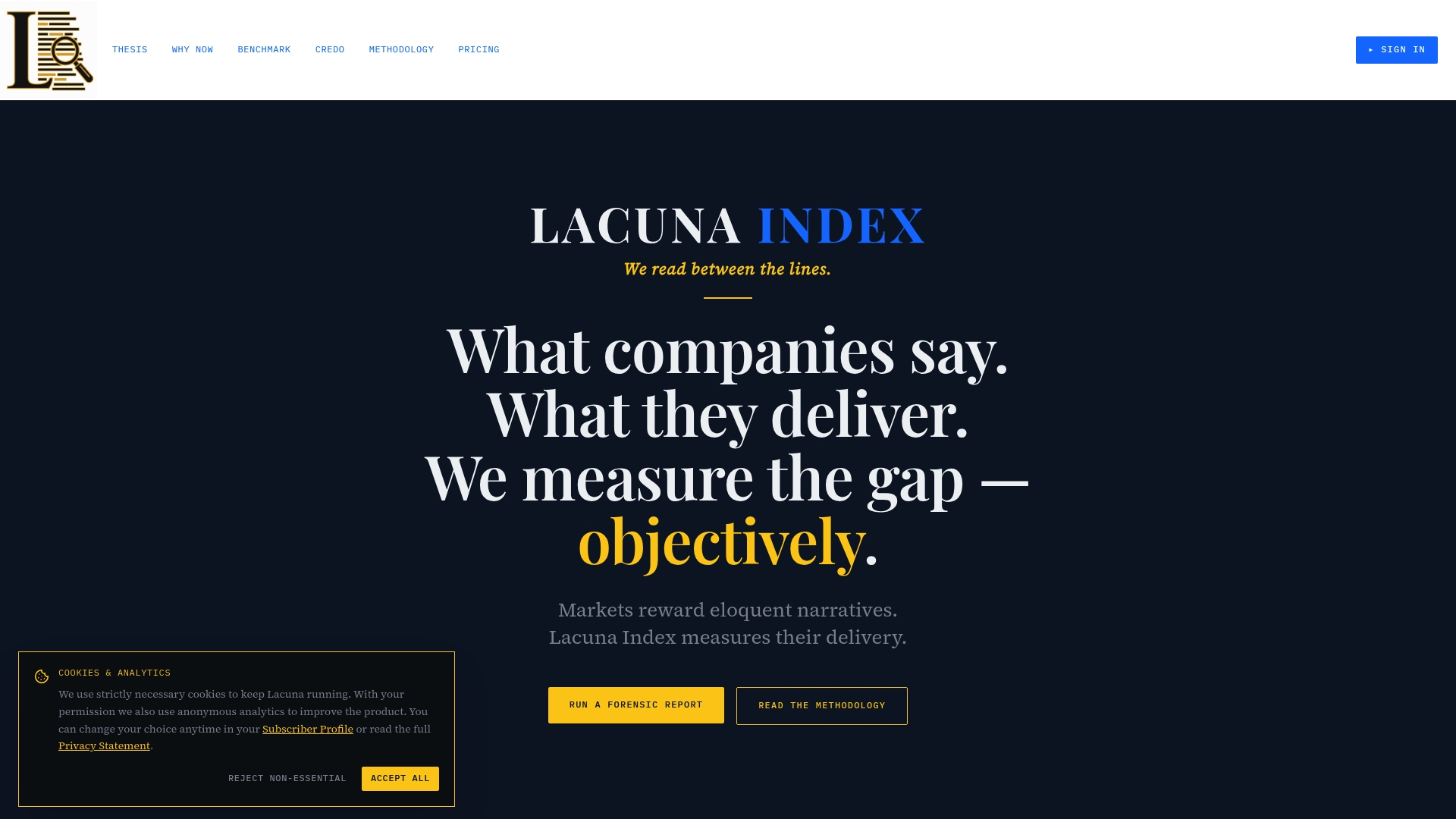
For proxy season specifically, this means detailed forensic reports that reconcile narrative claims against disclosed performance, and sector benchmarks that help users compare an issuer's compensation or governance story against its peers. Reports carry scoring with links back to specific disclosures allowing traceability of conclusions similar to recommended logging practices. If your research file needs a sector-wide starting point before you drill into individual proxy statements, the sector benchmark library is a practical place to begin, and the Cohort Pulse and Sector Sweep plans outline how full per-company access works for teams tracking multiple issuers through a season.
Sources
- Spotlight on Proxy Matters — Receiving Proxy Materials
- 2026 proxy season highlights: final shareholder-proposal results and management proposals
- Prepping for Proxy Season: A Primer on Proxy Statements and Shareholders’ Meetings
This article is general information, not a substitute for advice from a qualified financial advisor. Consult a qualified financial professional about your own circumstances before acting on anything here.
FAQ
What Is the Difference Between Record Date and Meeting Date?
The record date determines which shareholders are eligible to vote, while the meeting date is when the annual meeting actually occurs. The SEC clarifies that these dates rarely align, and beneficial owners must confirm their eligibility as of the record date regardless of when they vote.
Are the 2026 SEC Rule 14a-8 Changes Already in Effect?
No. The rescission proposed on September 16, 2026 remains a proposal under public comment, though the SEC has separately paused responding to most no-action requests as a staff policy. Analysts should track these as two distinct developments, not one settled change.
Why Did a Shareholder Proposal Disappear From the Final Proxy Statement?
A proposal can vanish for several reasons: SEC-permitted omission, proponent withdrawal, a private settlement, failure to meet procedural requirements, or litigation. The SEC's response database is the only reliable way to distinguish which outcome applies to a specific case.
How Do I Verify a Reported Vote Percentage?
Check the denominator and voting standard behind any reported percentage, since totals calculated on votes cast versus shares outstanding produce materially different results. The Cooley 2026 proxy season review documents this as a common source of misreported outcomes.
Does Lacuna Index Offer Proxy-Specific Forensic Reports?
Lacuna Index provides per-company forensic analysis and sector benchmarks built from public filings, including proxy statements, which support the kind of reconciliation work this guide describes. Pricing details for full company-level access are available on the Lacuna Index pricing page.